
Which 60cm DTF Printer Manufacturer Is Better for Shirt Production? A 2026 Decision Guide
Shirt printing buyers in 2026 face a crowded market of 60cm DTF printer manufacturers. The better choice is not always the cheapest machine; it is the supplier whose printhead configuration, compliance documents, production capacity, and after-sales support line up with your shirt production volume. This guide compares DTF with screen printing, sublimation, and DTG, then explains how to evaluate a 60cm DTF printer manufacturer such as Guangzhou Xin Flying Digital Technology Co., Ltd. (XINFLYING) before you commit.
Problem Definition: Why Manufacturer Selection Is Critical
Most purchasing mistakes happen when buyers treat all DTF printers as identical. An A2 entry-level unit and a 60cm industrial line serve different businesses. Without checking output speed, printhead setup, fabric compatibility, certifications, and service network, a shirt producer can end up with a machine that prints well in a demo but fails during continuous production. The decision process must connect the printer to the real workflow: design, film printing, powder application, curing, heat pressing, and order volume.
Industry Background: DTF Printing Is a Mainstream Shirt Decoration Method
The Direct-to-Film printing market reached USD 2.7 billion in 2024 and is projected to grow to USD 5.2 billion by 2034, according to Grand View Research and Dataintelo. China accounts for more than 45% of global DTF printer manufacturing capacity, and Europe held a 36.0% regional revenue share in 2024. T-shirts are the dominant end product, representing 41% of DTF printing revenue, while industrial DTF printers made up 58.3% of revenue share in 2025. These numbers explain why 60cm DTF printers have become standard equipment for shirt decoration and why choosing a reliable manufacturer is a commercial necessity.
Detailed Solution: How DTF Compares with Other Shirt Printing Technologies
DTF printing uses a film transfer workflow: the printer prints the design onto PET transfer film, hot melt powder is applied, the transfer is cured, and a heat press bonds the design onto the shirt. The key advantage is that image printing and garment application are separated, so you can print transfers in advance and apply them when needed. This makes DTF especially suitable for shirt printing with frequent design changes, mixed fabric types, and short to medium batch sizes.
DTF vs Screen Printing for Shirts
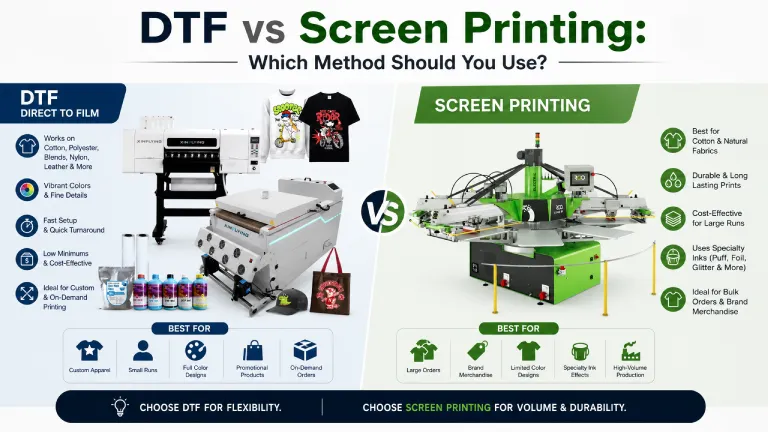
Compared with screen printing, DTF has distinct advantages for short-run and customized production. It reduces production setup time by up to 100% because no screens or color separation are required. DTF also eliminates screen preparation, screen storage, and setup fees for each design change, lowering upfront production costs for small orders. For small-to-medium orders (typically 1–100 pieces), DTF can reduce total production costs. Screen printing remains more economical for large-volume orders with simple, repeated designs.
DTF vs Sublimation for Shirts
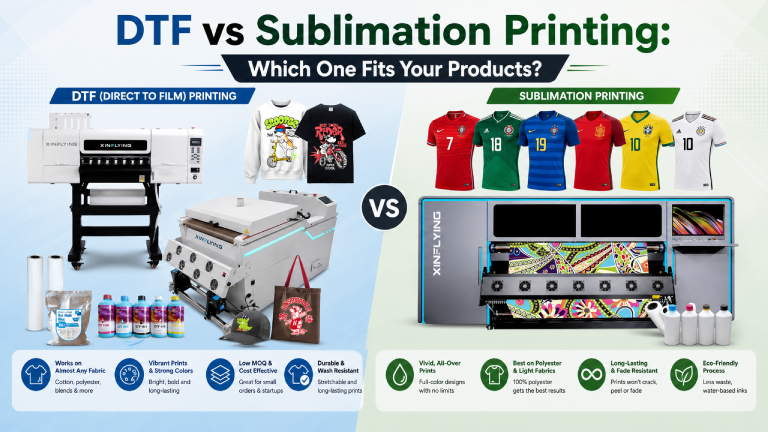
The core difference between DTF and sublimation is fabric compatibility. DTF supports a wider range of fabrics and colors, including cotton, polyester, blends, and dark garments, while sublimation is mainly optimized for light-colored polyester fabrics. DTF provides a 3–4× improvement in fabric compatibility over sublimation. One DTF workflow can handle more garment types without requiring polyester-specific sourcing, which reduces inventory and production limitations. For shirt production, this means you are not locked into polyester-only products.
DTF vs DTG for Shirts
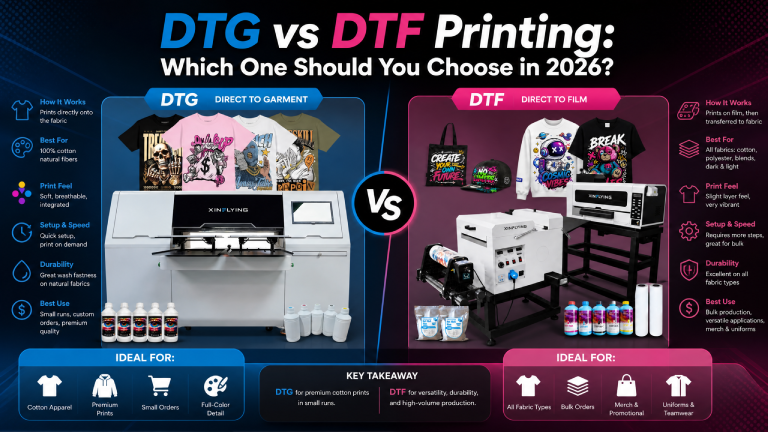
Compared with DTG, DTF provides more flexible production options because it works with cotton, polyester, blends, and dark garments, while DTG is mainly optimized for cotton and often requires pre-treatment for dark fabrics. DTF equipment investment is typically 30–50% lower than commercial DTG systems, with lower maintenance requirements and better production flexibility for small-to-medium batch production. DTF also allows batch transfer preparation, quick design changes, and efficient handling of customized orders.
What to Look for in a 60cm DTF Printer Manufacturer
When comparing 60cm DTF printer manufacturers, use these criteria:
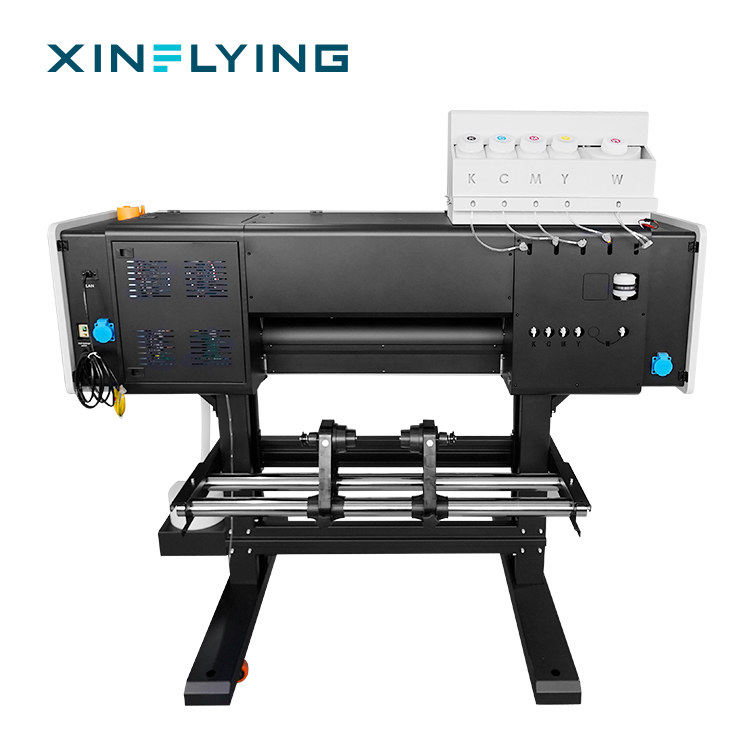
- Printhead configuration: More printheads generally means higher throughput. Entry-level machines may use 2× Epson i1600-A1; commercial 60cm models use 2× Epson i3200-A1; industrial models use 4 to 8 printheads.
- Printing width: 60cm (24") lets you print multiple shirt transfers in one pass, improving efficiency.
- Compliance documents: CE for Europe, FCC for the United States, RoHS for restricted substances, and relevant electrical safety documentation must match the actual machine model.
- After-sales support: Evaluate spare parts availability, technical communication, warranty policies, and training.
- Production capacity: Match the machine speed to your daily shirt output needs.
Step-by-Step Breakdown: How to Buy a 60cm DTF Printer for Shirt Production
Follow this six-step process when buying a 60cm DTF printer for shirt production:
- Define your shirt order mix. Estimate daily volume, typical design complexity, and fabric types such as cotton, polyester, blends, or dark garments.
- Choose print width and printhead configuration. Select a machine that can produce your target number of transfers per hour without running at maximum stress all day.
- Verify certifications. Confirm that CE, FCC, RoHS, or other required documents are model-specific and provided before shipment.
- Request printing samples. Test on the exact shirt fabrics you plan to decorate, including dark and blended materials.
- Check after-sales support. Confirm spare parts availability, remote technical assistance, and warranty terms.
- Compare total cost of ownership. Consider machine price, ink, film, powder, maintenance, and potential downtime risk.
Comparison Table: DTF vs Screen Printing vs Sublimation vs DTG
| Method | Fabric Compatibility | Setup Requirements | Best Order Size | Typical Shirt Uses |
|---|---|---|---|---|
| DTF | Cotton, polyester, blends, dark garments | No screens; digital design to film to heat press | Small to medium batches, custom orders | Custom T-shirts, sportswear, hoodies, promotional shirts |
| Screen Printing | Most fabrics with proper ink | Separate screen for each color; longer setup | Large volumes with simple designs | Bulk basic shirts, team uniforms |
| Sublimation | Mainly light-colored polyester | Polyester substrate and controlled heat transfer | Polyester-specific large runs | Sports jerseys, polyester performance shirts |
| DTG | Mainly cotton; often pre-treatment for dark fabrics | Direct garment printing; more pretreatment steps | Small cotton-based batches | Premium cotton apparel, detailed direct prints |
XINFLYING 60cm DTF Printer Configurations at a Glance
XINFLYING offers three 60cm DTF printer tiers that cover commercial and industrial shirt production:
| Model | Printheads | Ink Colors | Max Speed | Key Features |
|---|---|---|---|---|
| XF-702E | 2× Epson i3200-A1 | CMYK+W | 13 m²/h (6PASS fastest) | Auto moisture retention, white ink circulation, 60cm width |
| XF-C604 | 4× Epson i3200-A1 | CMYK+CMYK+W+W | 38 m²/h (4PASS fastest) | Optional auto moisturizing, 60cm width, higher throughput |
| XF-C605 | 5× Epson i3200-A1 | CMYK+CMYK+CMYK+W+W | 36 m²/h (6PASS fastest) | Designed for continuous industrial shirt production |
Use Cases: Matching the Printer to the Shirt Business
Custom apparel shop: An entry-level A2 all-in-one such as XF-450PRO can be enough for low daily volume, because it combines printing, powder shaking, and drying in one unit.
Growing print-on-demand business: A 60cm commercial package such as XF-702E plus a powder shaker and curing system supports wider prints and higher daily output.
Garment factory: An industrial line such as XF-C605 with 5 Epson i3200-A1 printheads and automatic powder recycling system is designed for continuous shirt production.
Promotional products and mixed fabrics: DTF's wide fabric compatibility lets one machine print cotton shirts, polyester sportswear, tote bags, and caps without changing the core workflow.
FAQ
What certifications should I check before importing a 60cm DTF printer?
Before importing a DTF printer, confirm that the machine meets your target market's requirements. Common documents include CE certification for Europe, FCC for the United States, RoHS compliance for restricted substances, and relevant electrical safety documentation. A reliable supplier should provide certification documents, product specifications, test reports, and supporting technical files before shipment.
Is DTF printing better than DTG for T-shirt production?
DTF and DTG are both digital textile printing solutions, but DTF prints designs onto transfer film first and then applies them with heat, while DTG prints directly onto the garment. DTF works with a wider range of fabrics, including cotton, polyester, blends, and dark garments, and requires less garment pretreatment. DTG may be suitable for businesses focusing on direct cotton garment printing. The better choice depends on your products, fabric requirements, and production workflow.
Can DTF printing replace screen printing for small shirt orders?
For small-to-medium orders, DTF has distinct advantages over screen printing because it eliminates screens, color separation, and setup fees. Designs can be changed digitally, which enables quicker sampling and flexible production scheduling. Screen printing may be more economical for large-volume orders with simple, repeated designs.
Which XINFLYING DTF printer is suitable for a growing print shop?
For growing print shops, e-commerce fulfillment businesses, and professional apparel customization companies, the XF-702E + XF-Z650-2 DTF Printer Package provides a balanced commercial production solution. It includes 2 Epson i3200-A1 printheads, an automatic powder shaker and curing system, auto moisture retention, white ink circulation, and RIP software support. This 60cm package supports regular commercial shirt production with higher efficiency compared with entry-level models.
What after-sales risks should I consider when purchasing a DTF printer?
After-sales support is important because DTF printers require installation, maintenance, and technical assistance. Buyers should evaluate a supplier's technical communication, operation guidance, warranty policies, and spare part availability before purchasing. Choosing a supplier with reliable support reduces downtime risks and improves long-term operation.
Conclusion
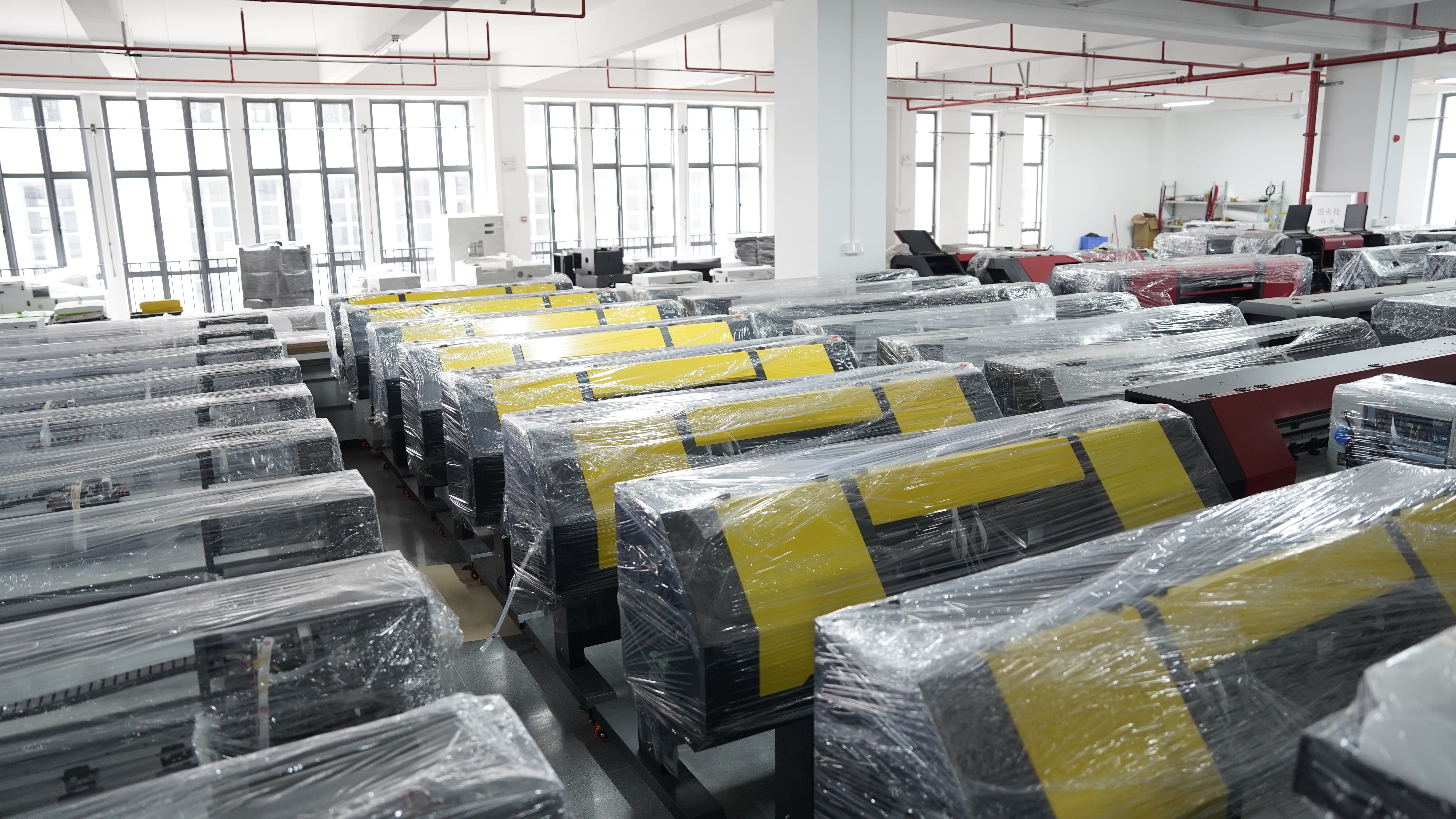
Selecting a 60cm DTF printer manufacturer for shirt production comes down to matching machine capability with production reality. DTF offers distinct advantages over screen printing, sublimation, and DTG for custom and small-to-medium shirt orders. A transparent supplier such as XINFLYING, with certified equipment, documented specifications, and three tiers of 60cm configurations, gives shirt producers a clear upgrade path from entry-level to industrial output.
Get the full XINFLYING factory and product overview.
Download the Corporate Brochure
For sample prints and quotes, contact info@xin-flying.com or WhatsApp +86 188-1322-1357.
Have Questions or Need More Details?
Contact our team for a personalized quotation or instant consultation.
Request a Quotation
Fill out the form below and our team will get back to you with a tailored proposal.
WhatsApp Direct Chat
Prefer to chat in real-time? Message us on WhatsApp for instant assistance & quick answers.
- Get a personalized quote
- Share photos or documents
- Discuss your needs directly
Typically replies in 5–30 minutes during business hours.