
Wide Format Magic: Comparing 1.9 m and 1.8 m Sublimation Printers
Short answer: A 1900 mm class printer buys an extra 100 mm of printable width on every panel and typically supports higher-throughput head configurations, such as the 190 cm, 8-head XF-19E8-PRO. An 1800 mm class machine is built around a leaner package, such as the 180 cm, 2-head XF-H1802X-2I32A1. The decision usually turns on nesting yield, floor power and space, and whether the compliance file you are handed actually names the model you are buying.
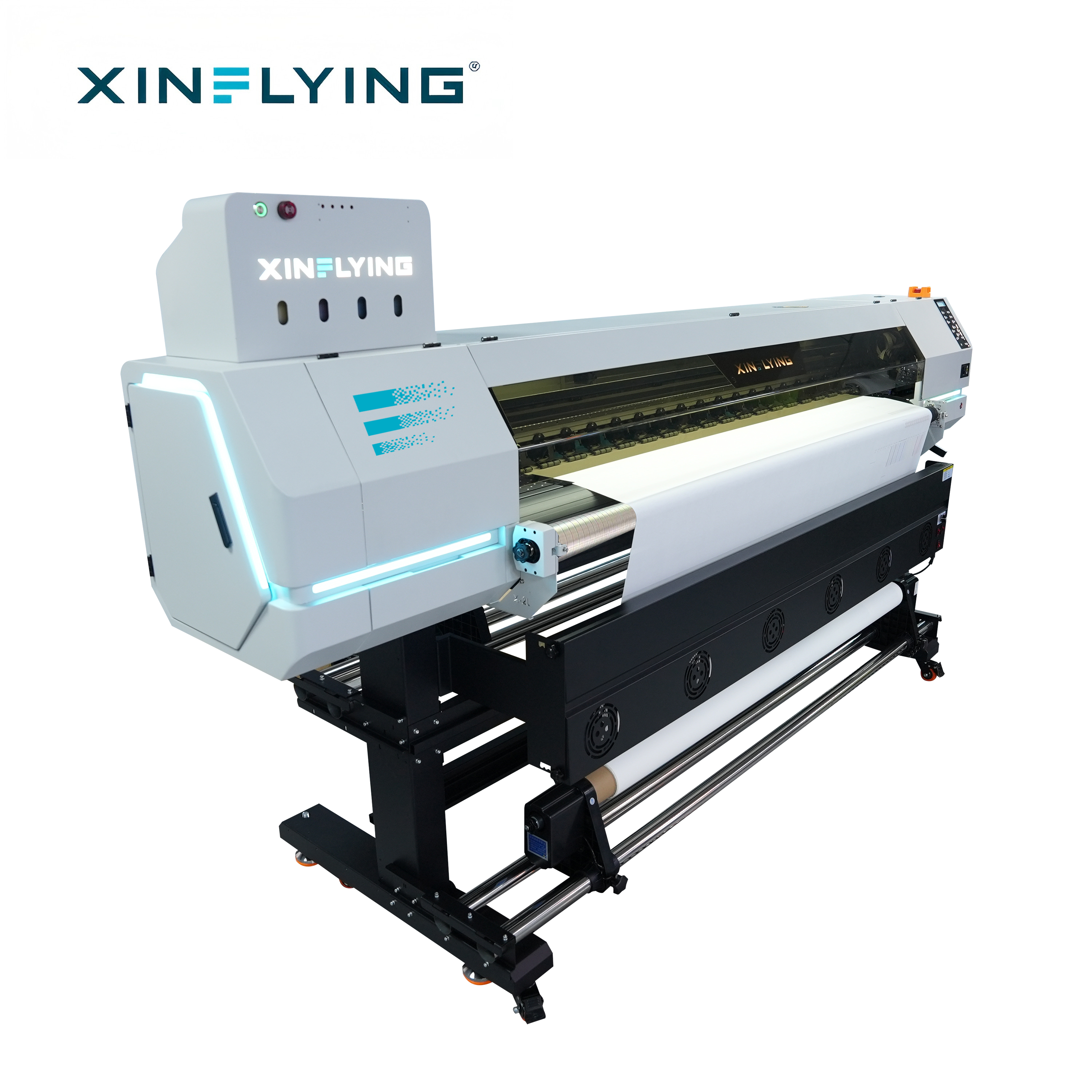
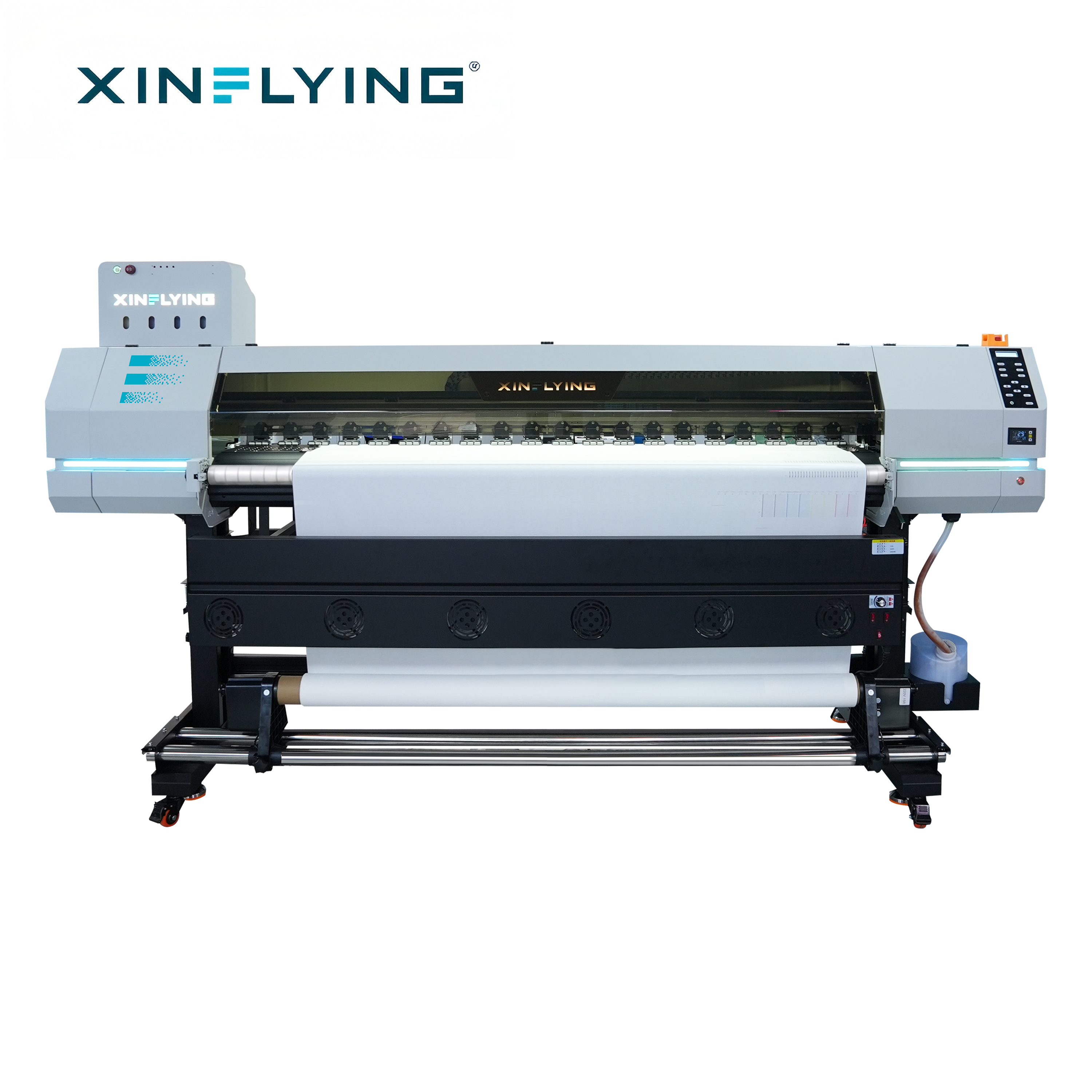
Xinflying XF-H1802X-2I32A1, the 180 cm entry point of the comparison.
Problem Definition: What a Factory Is Really Deciding
The width choice between 1.8 m and 1.9 m is rarely about print quality. Both classes print sublimation ink onto transfer paper at production resolution; both feed roll-to-roll into a heat press calender. What separates them is a chain of practical constraints that a factory only discovers after installation if it does not plan for them first.
Four questions define the real decision:
- Nesting yield. Can a 180 cm printable area carry your most repeated panel layout without wasting paper or splitting a design?
- Throughput versus headcount. Is your bottleneck the printer or the finishing line, and does a 2-head machine keep the calender fed?
- Site readiness. Does your electrical supply, floor loading and access route accept the machine you are considering?
- Documentation. Can your supplier show a compliance file that matches the exact model and voltage configuration you are importing?
XINFLYING (Guangzhou Xin Flying Digital Technology Co., Ltd.), founded in 2010, is a digital printing equipment manufacturer producing DTF, UV DTF, UV flatbed, DTG and dye sublimation printing equipment, exporting to North America, South America, Europe, Asia, the Middle East and Africa. Its sublimation range spans 130 cm to 195 cm widths, which is why buyers often end up comparing an 1800 mm model against a 1900 mm model rather than comparing brands.
Industry Background: Why 1.9 m Became the Reference Width
Grand View Research valued the global dye sublimation printing market at USD 16.4 billion in 2025 and projects USD 39.0 billion by 2033, with Asia Pacific holding a 36.5% revenue share in 2025 led by China. Mordor Intelligence puts the dye sublimation printer segment specifically at USD 1.88 billion in 2025, rising to USD 2.53 billion by 2030.
Demand composition explains the width preference. Grand View Research attributes a 13.1% CAGR through 2030 in the digital textile sublimation market largely to personalised apparel and home decor demand, and FESPA Insights describes roll-to-roll sublimation printers with 1.9 m (1900 mm) widths as the standard for high-volume textile and soft signage applications.
In other words, the 1900 mm class did not become common because of marketing. It became common because a 190 cm print width matches the way textile panels, soft signage segments and sportswear markers are nested. The 1800 mm class then sits one step below it as a lower-investment, lower-site-impact entry into the same production model.
Detailed Solution: What Actually Differs Between the Two Classes
1. The 100 mm Is a Nesting Budget, Not a Number on a Spec Sheet
The XF-H1802X-2I32A1 carries an 180 cm (1.8 m) print width. The XF-19E8-PRO carries a 190 cm (75 inch) print width. The gap is 10 cm.
That 10 cm belongs to your nesting budget. It absorbs the edge trim a heat press calender needs, the gap between repeated panels, and the difference between a marker that fits whole and a marker that has to be split and seamed. A factory running long repeat runs of identical panels will notice the difference less than a factory producing mixed orders where every layout is rebuilt. If your products are cut and sewn after transfer, the question to answer before ordering is whether your most common panel set fits inside 180 cm without a seam.
2. Head Count Drives Speed Far More Than Width Does
The width difference between the two classes is 5%. The head difference is 300%.
- XF-H1802X-2I32A1: 2 x Epson i3200-A1 printheads, CMYK+CMYK, 4PASS 52 m²/h at fastest setting and 4PASS 42 m²/h at standard setting.
- XF-19E8-PRO: 8 x Epson i3200-A1 printheads, CMYK, 1PASS 306 m²/h and 2PASS 153 m²/h at fastest setting, 1PASS 210 m²/h and 2PASS 109 m²/h at standard setting, at 3200 dpi.
For a factory whose orders are sampled and small-batch, the 2-head configuration of the XF-H1802X-2I32A1 is a deliberate match: it keeps capital and running cost low and is positioned for businesses starting sublimation printing, custom textile production, apparel sampling and small-batch orders. For continuous commercial printing, the 8-head XF-19E8-PRO is positioned for textile factories, large garment manufacturers and professional sublimation production centres.
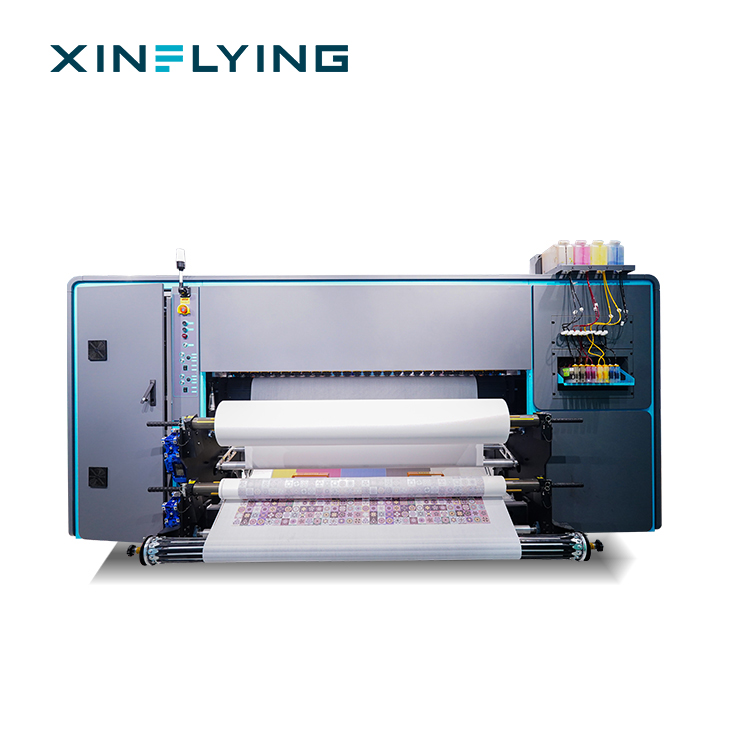
Xinflying XF-19E8-PRO, the 190 cm side of the comparison, configured with 8 Epson i3200-A1 printheads.
3. The Electrical Package Is Where the Two Machines Diverged Most
This is the part of the comparison that factory managers most often discover late.
| Electrical parameter | XF-H1802X-2I32A1 (1800 mm) | XF-19E8-PRO (1900 mm) |
|---|---|---|
| Power | 3.5 kW | 10.2 kW |
| Power supply | 110/220V, 27.2A / 13.6A, 50–60Hz | 210–230V, 45A |
| Operating temperature | 20–35°C | 18–30°C |
| Operating humidity | 45–65%RH | 45–65%RH |
The XF-H1802X-2I32A1 is a dual-voltage machine that can run on 110 V or 220 V supply. The XF-19E8-PRO is specified for a 210–230 V, 45 A supply. Those are not administrative details. They determine whether your building needs a dedicated circuit before delivery, and they determine which compliance documentation is relevant to the unit you actually receive.
4. Footprint, Weight and Access
Machine size tells you what has to pass through the door. The XF-H1802X-2I32A1 measures 3000×880×1630 mm with a net weight of 265 kg and a gross weight of 325 kg. The XF-19E8-PRO measures 3840×1300×1800 mm with a net weight of 1400 kg and a gross weight of 1500 kg, packed at 4010×1180×2160 mm.
A 265 kg machine and a 1400 kg machine are two different logistics projects. The first can often be positioned with a pallet truck on a standard industrial floor. The second needs a planned route, appropriate lifting equipment, and a floor area that also respects the working clearances around the heat press calender the printer feeds.
5. Drying, Moisture and Head Care
Both models use front, middle and rear break-controlled heating. The XF-19E8-PRO adds an external intelligent air-heat integrated dryer, fully sealed automatic moisturising and cleaning, an intelligent printhead cleaning and moisturising device, Japan THK silent linear guides, anti-collision devices at both ends, US-imported fluorine rubber pressure paper wheels, and liquid level and waste ink alarms. The XF-H1802X-2I32A1 uses a Honson board, aluminium ink rack and a retraction system.
In operational terms: the 1900 mm machine is engineered for unattended continuity, which is what 24/7 textile production demands. The 1800 mm machine is engineered for controllability and low site impact.
6. Certificate Distinctions Between the Two Model Designations
This is the section buyers most often skip, and it is the one that creates the most expensive problems after arrival.
XF-H1802X-2I32A1 and XF-19E8-PRO are two separate model designations. A compliance file is issued against a model and a configuration, not against a product family. Three practical consequences follow.
First, documents do not transfer between the two models. A CE file for one designation does not cover the other. When a supplier presents a single certificate as covering an entire range, ask for the annex that lists the covered models and confirm both designations appear.
Second, the voltage configuration changes the file. Because the XF-H1802X-2I32A1 can be supplied for a 110 V or a 220 V environment, the relevant electrical safety and electromagnetic compatibility documentation depends on which configuration is being shipped to you. A factory importing a 220 V unit should not accept documentation written around a 110 V build, and vice versa.
Third, the market determines which documents you need at all. For the European market, buyers should verify CE compliance including applicable electrical safety, electromagnetic compatibility and product safety requirements, with valid certification documents, test reports and technical files that match the actual printer model. For the US market, FCC compliance is commonly required for electronic equipment to control electromagnetic interference, and additional safety certifications may be required depending on product specifications and sales channels. Environmental documentation such as RoHS helps confirm that electrical and electronic components meet restrictions on hazardous substances.
Before releasing an order, match three things line by line: the model designation on the certificate, the voltage and current rating on the certificate, and the voltage and current rating on the quotation. For the XF-H1802X-2I32A1 that means 110/220 V at 27.2 A / 13.6 A; for the XF-19E8-PRO that means 210–230 V at 45 A.
Step-by-Step Breakdown: Choosing Between 1.8 m and 1.9 m
The sequence below is written for a factory moving from research into evaluation, where the machine is already shortlisted and the question is fit.
- Collect five real production layouts. Not catalogue artwork. Take the five orders you repeat most and lay them out at 180 cm and at 190 cm. Count the panels per metre and the wasted edge trim in each case.
- Define the finishing ceiling. Measure how many square metres your heat press calender transfers per hour. If the calender is the bottleneck, an 8-head printer will sit idle; if the printer is the bottleneck, a 2-head machine will delay every shipment.
- Audit the electrical supply. Confirm whether you can allocate a 210–230 V, 45 A supply for a 10.2 kW machine, or whether a 3.5 kW machine on 110/220 V is the realistic option for your building.
- Measure the route and the floor. Check door widths, turning space and floor loading against 3000×880×1630 mm at 265 kg versus 3840×1300×1800 mm at 1400 kg.
- Match the environment to the specification. The XF-19E8-PRO is specified for 18–30°C and 35–65%RH; the XF-H1802X-2I32A1 for 20–35°C and 45–65%RH. A workshop that exceeds 30°C in summer needs that fact on the table before the order, not after.
- Request the compliance pack against the exact model. Ask for the certificate annex, test reports and technical file, and check model designation, voltage and current against the quotation.
- Run a transfer test, not just a print test. Sublimation output is only proven after heat transfer onto your actual polyester fabric through your calender, at your temperature and dwell time.
- Confirm the consumable and service chain. Lock in sublimation paper supply, ink supply, RIP configuration and the spare parts route before the machine ships.
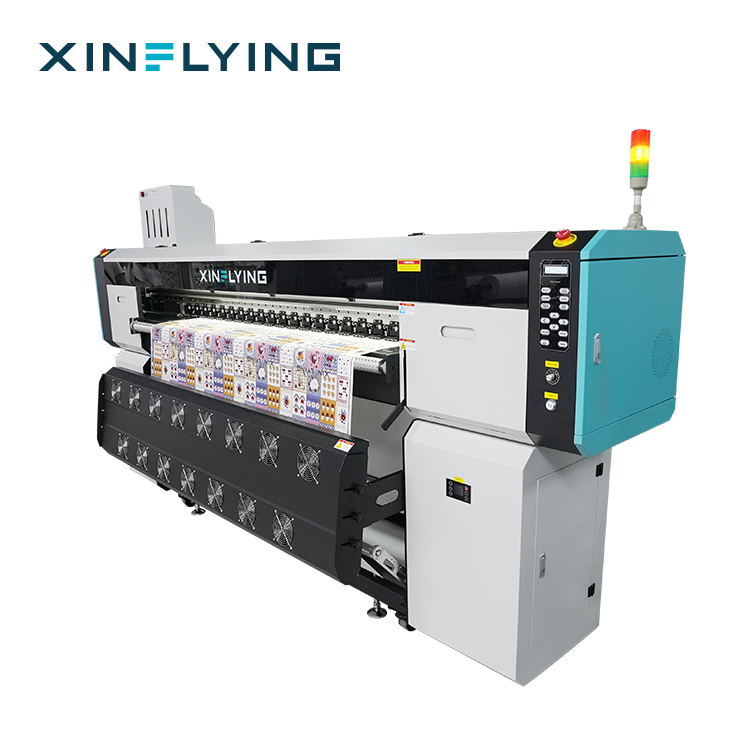
Where the width ladder continues: the XF-O2000-4I32A1 offers 195 cm with 4 printheads, between the two classes discussed here and higher-volume machines above them.
Use Cases: Which Width Belongs to Which Production Profile
Apparel sampling and small-batch custom orders. A 2-head 1800 mm machine fits this profile directly. Small and medium-sized printing businesses, custom textile producers and apparel sampling operations are the stated fit for the XF-H1802X-2I32A1, which prints at up to 52 m²/h at its fastest 4PASS setting.
Customised sportswear at commercial volume. Team kits, training uniforms and personalised jerseys require full-colour graphics printed onto polyester before cutting and sewing. A sportswear manufacturer in Brazil running 15 units over four years reported improved production flexibility for customised orders, reduced dependence on outsourced printing and more consistent colour across batches. A separate sports uniform supplier in Brazil running 8 units over five years reported shorter production cycles for customised sportswear while holding vibrant colour and fine detail.
Print service providers serving multiple apparel clients. A digital textile printing service provider operating 5 units over three years, serving sportswear brands, apparel factories and customised textile businesses, reported expanded capacity, support for more customer projects and faster response on customised textile orders.
Home textiles and decorative fabric. A home textile manufacturer running 10 units over four years uses sublimation for curtains, cushions, decorative fabrics and customised polyester products, developing collections with rich patterns, accurate colour and flexible production. In this segment, the 1900 mm class is the natural fit for wider decorative panels, while narrower machines serve sampling and shorter runs.
Soft signage, flags and banners. FESPA Insights identifies 1.9 m roll-to-roll sublimation as standard for high-volume textile and soft signage work. Where banner and flag widths are fixed by the market, the extra 100 mm of the 1900 mm class reduces the number of split seams per finished piece.
Comparison Table: 1800 mm Class vs 1900 mm Class
| Specification | XF-H1802X-2I32A1 | XF-19E8-PRO |
|---|---|---|
| Print width | 180 cm (1.8 m) | 190 cm (75 inch) |
| Printheads | 2 x Epson i3200-A1 | 8 x Epson i3200-A1 |
| Ink colours | CMYK+CMYK | CMYK |
| Speed, fastest | 4PASS 52 m²/h | 1PASS 306 m²/h; 2PASS 153 m²/h |
| Speed, standard | 4PASS 42 m²/h | 1PASS 210 m²/h; 2PASS 109 m²/h |
| Resolution | Not stated in this model's published specification | 3200 dpi |
| Media | Heat transfer paper | Sublimation paper |
| RIP | Maintop (standard) | Maintop standard; RIIN (Hoson only), PhotoPrint, Printfactory optional |
| Heating | Front/middle/rear break-controlled | Front/middle/rear break-controlled |
| Drying | Not stated as external dryer in this model's published specification | External intelligent air-heat integrated dryer |
| Power | 3.5 kW | 10.2 kW |
| Power supply | 110/220V, 27.2A / 13.6A, 50–60Hz | 210–230V, 45A |
| Machine size | 3000×880×1630 mm | 3840×1300×1800 mm |
| Net / gross weight | 265 kg / 325 kg | 1400 kg / 1500 kg |
| Operating environment | 20–35°C, 45–65%RH | 18–30°C, 35–65%RH |
| Stated fit | Startups, custom textile production, apparel sampling, small-batch orders | Textile factories, large garment manufacturers, professional sublimation production centres |
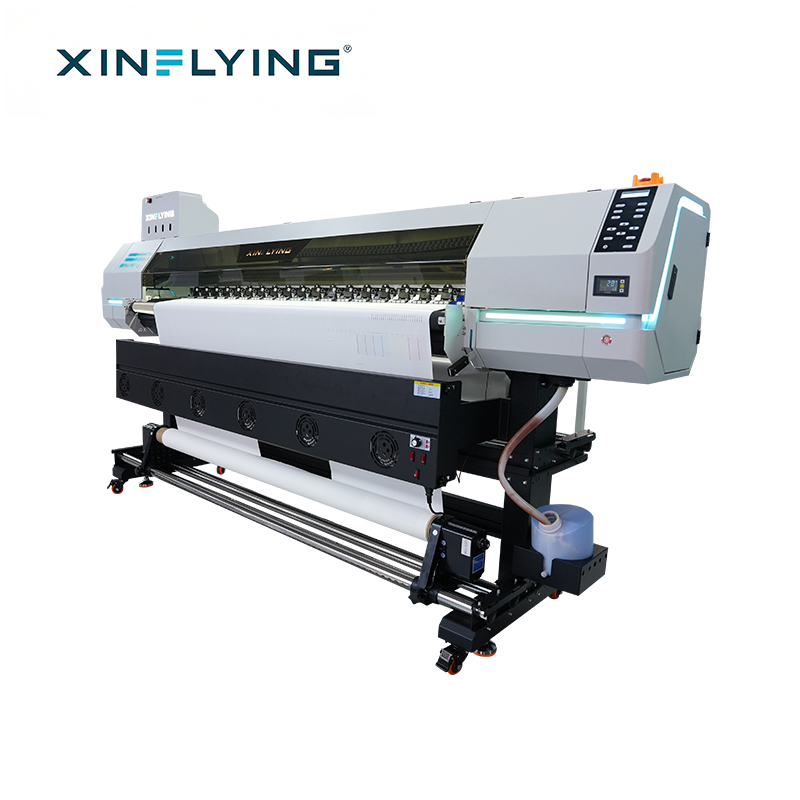
The 1800 mm class in detail: 2 heads, 3.5 kW and a 265 kg footprint keep site preparation modest.
FAQ
Can the CE documentation for XF-19E8-PRO cover an XF-H1802X-2I32A1 order?
No. Compliance documentation is tied to a model designation and configuration, not to a product family. XF-19E8-PRO and XF-H1802X-2I32A1 are separate designations with different electrical packages — 210–230 V at 45 A and 10.2 kW for the former, 110/220 V at 27.2 A / 13.6 A and 3.5 kW for the latter. For European imports, request valid CE documents, test reports and technical files that match the actual printer model, and confirm the certificate annex names the machine on your order. Incorrect or incomplete compliance documents can result in customs delays, sales restrictions or additional compliance costs.
Is an 1800 mm, 2-head printer capable of commercial apparel output?
It depends on which side of the line is the bottleneck. The XF-H1802X-2I32A1 prints at 4PASS 52 m²/h at its fastest setting and 4PASS 42 m²/h at standard setting, using 2 Epson i3200-A1 printheads with CMYK+CMYK. That is a genuine production capability and matches custom textile production, apparel sampling and small-batch orders. It will not match an 8-head machine running 1PASS 306 m²/h. The practical test is whether your heat press calender can absorb more than 42–52 m²/h; if it cannot, the larger printer adds no shipped output.
Where does the running-cost difference between the two classes sit?
The clearest published difference is electrical. The XF-H1802X-2I32A1 is rated at 3.5 kW on a 110/220 V supply; the XF-19E8-PRO is rated at 10.2 kW on a 210–230 V, 45 A supply. Secondary differences come from scale rather than from width: a 1400 kg machine occupies more floor and needs more substantial handling than a 265 kg machine, and its environmental window of 18–30°C may require more active workshop climate control than the 20–35°C window of the smaller unit. Configure the comparison around your actual operating hours rather than around the width figure alone.
What sample testing should happen before the purchase order?
Test the transfer, not only the print. The XF-19E15-PRO application, for example, requires pairing with a heat press calender and dye sublimation paper, and the same principle applies across the range: the printed paper is only half the process. Ask for a sample run using your own polyester fabric, your own calender settings and your own ICC profile, then judge colour accuracy, edge definition on fine detail, and shrink behaviour after transfer. Confirm at the same time which RIP is configured — Maintop is standard on the XF-H1802X-2I32A1 and XF-19E8-PRO, with RIIN, PhotoPrint and Printfactory available as options on the XF-19E8-PRO — because the RIP determines how much of the colour workflow you control in-house.
What lead time and support should be planned for?
XINFLYING quotes a lead time of 5–40 days with a minimum order quantity of 1 unit and monthly capacity of 1600+ units, with pre-shipment testing applied to each machine. After-sales support is delivered by over 50 engineers providing 24/7 online technical support. OEM/ODM customisation is available across product branding, machine appearance, colour, logo, packaging and solutions built around specific customer requirements. To move from evaluation to a decision, send your five production layouts and your electrical and floor constraints to info@xin-flying.com or reach the team on WhatsApp at +86 188-1322-1357 and request a width recommendation with a sample and quotation for the model that fits.
Conclusion
The 1800 mm and 1900 mm classes are not two answers to the same question. They are two different production models that happen to look similar on a specification sheet.
Choose the 1900 mm class — XF-19E8-PRO at 190 cm with 8 Epson i3200-A1 heads, 3200 dpi and up to 306 m²/h at 1PASS — when the finishing line can absorb the throughput, when 100 mm of extra nesting width removes seams from your standard layouts, and when your site can supply 210–230 V at 45 A and 10.2 kW. Choose the 1800 mm class — XF-H1802X-2I32A1 at 180 cm with 2 heads, 52 m²/h at fastest 4PASS and 3.5 kW on 110/220 V — when the objective is controlled entry into sublimation production with modest site preparation and a fast route from order to first shipped job.
In both cases, the last box to tick is the one most often left unticked: a compliance file whose model designation and voltage rating match the machine on the invoice. A 100 mm width decision can be corrected with better nesting. A documentation mismatch cannot be corrected after the container arrives.
Download the full XINFLYING company and product brochure here: XINFLYING corporate brochure (PDF). For a model-specific sample and quotation, contact WhatsApp +86 188-1322-1357 or email info@xin-flying.com.
Request a transfer sample and quotation configured to your width, voltage and market requirements.
Have Questions or Need More Details?
Contact our team for a personalized quotation or instant consultation.
Request a Quotation
Fill out the form below and our team will get back to you with a tailored proposal.
WhatsApp Direct Chat
Prefer to chat in real-time? Message us on WhatsApp for instant assistance & quick answers.
- Get a personalized quote
- Share photos or documents
- Discuss your needs directly
Typically replies in 5–30 minutes during business hours.