
XF-19E15-PRO vs XF-19E8-PRO: 1900mm Sublimation Printer Compliance Decision
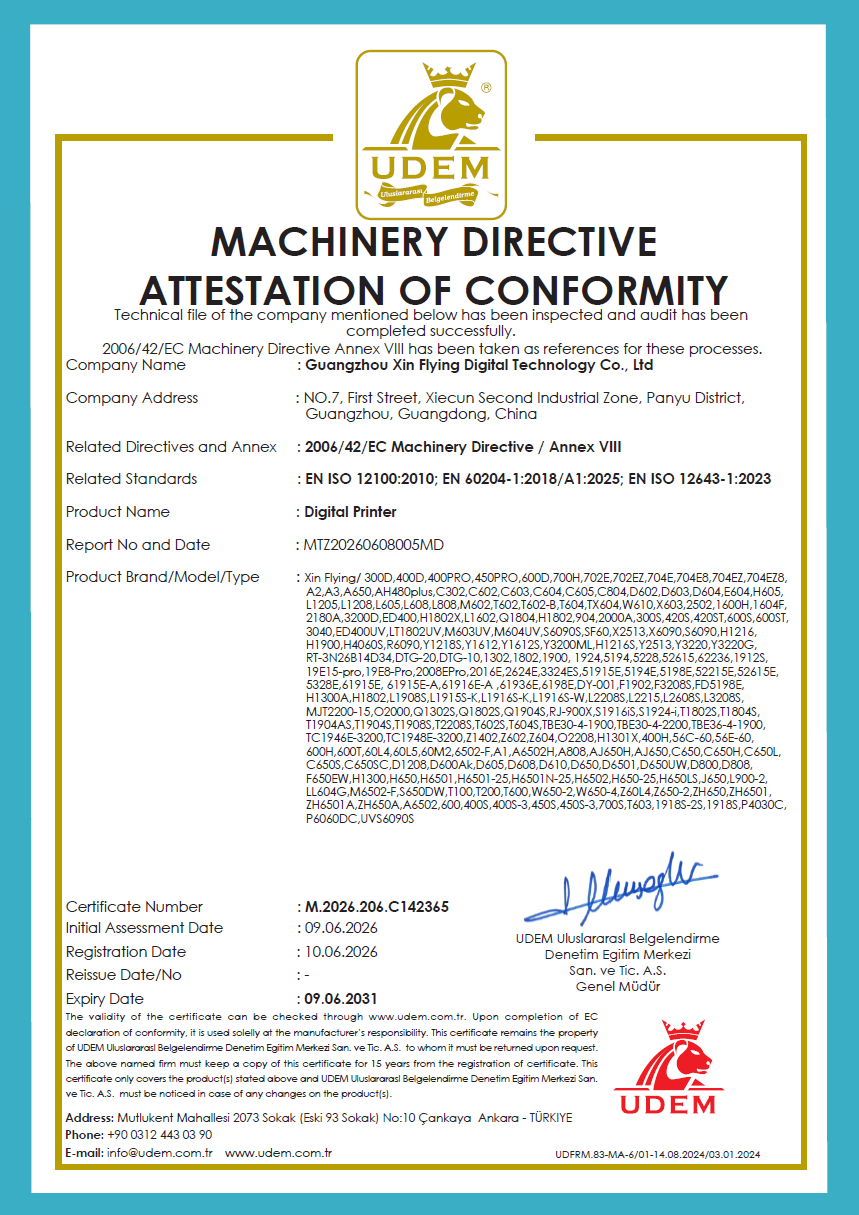
CE Machinery Directive Certificate of Conformity M.2026.206.C142385, issued by UDEM and listed against the XF-19E8-PRO. The XF-19E15-PRO is covered by a separate certificate number, M.2026.206.C142365.
Short answer. The XF-19E15-PRO and the XF-19E8-PRO are both 1900 mm (75″) roll-to-roll industrial sublimation printers with 3200 dpi output, CMYK sublimation ink, and the same CE EMC certificate (TQT1550D270EC), CE LVD certificate (TQT1550D271EC) and RoHS certificate (M.2026.206.C142366). They diverge on the CE Machinery Directive document: M.2026.206.C142365 names the XF-19E15-PRO, M.2026.206.C142385 names the XF-19E8-PRO. Decide first on the certificate that matches the model you are importing, then on throughput — 15 printheads at up to 524 m²/h versus 8 printheads at up to 306 m²/h.
XINFLYING (Guangzhou Xin Flying Digital Technology Co., Ltd.) is a digital printing equipment manufacturer founded in 2010 in Panyu, Guangzhou, China, producing DTF printers, UV DTF printers, UV flatbed printers, DTG printers and dye sublimation printers for textile factories, print service providers and distributors. Two of its 1900 mm industrial sublimation models sit close enough on paper that EU buyers routinely compare them as one purchase decision — which is why the certificate file, not the specification sheet, should drive the choice.
The Real Decision: Two Machines, Two Certificate Numbers
Both printers are 190 cm wide roll-fed machines built for continuous polyester textile output. Both run sublimation ink in CMYK, both print at 3200 dpi, both use Maintop as standard RIP with RIIN (Hoson only), PhotoPrint and Printfactory available as options, and both are specified for 18–30°C and 35–65%RH operating conditions. A buyer scanning specifications alone will find the same width, the same resolution and the same media path.
The compliance layer is where the two files separate. Each machine carries its own CE Machinery Directive Certificate of Conformity, issued by UDEM with a distinct certificate number, and that number is what an EU importer writes into the technical file, the declaration of conformity and the customs paperwork. When a supplier quotes “CE certified” as a single line item, the useful follow-up question is narrower: which certificate number is filed against this model, which directive does it belong to, and does the number on the document match the number on the nameplate?
That is the decision this comparison resolves. It is not a question of which printer is better in the abstract — both are commercial sublimation printers for industrial textile printing — but of which certificate set supports the specific import, and which throughput tier the production plan actually requires.
Industry Background: Why 1900 mm and Why Documentation Now Decides
Roll-to-roll sublimation printers with a 1.9 m printing width are the established format for high-volume textile and soft signage work, because that width maps cleanly onto standard polyester roll stock and onto the calender transfer equipment used downstream. The dye sublimation printer segment was valued at USD 1.88 billion in 2025 and is expected to reach USD 2.53 billion by 2030 according to Mordor Intelligence, growth driven largely by polyester apparel, home textiles and signage production.
As that volume moves through EU distribution channels, the paperwork burden has become a purchasing criterion in its own right. A sublimation printing machine entering the EU market is assessed against several separate pieces of legislation — machinery safety, electrical safety, electromagnetic compatibility and hazardous substance restrictions — and each is evidenced by a different document. Buyers who treat “CE” as one certificate routinely discover at the technical-file stage that they hold the EMC document but not the machinery one, or that the machinery certificate they hold names a different model number.
For a 1900mm sublimation printer at this production tier, that gap is expensive: the equipment is heavy, the installation is fixed, and replacement or re-documentation disrupts a running production line. Checking the certificate stack before the order is placed costs an afternoon. Resolving it after shipment costs considerably more.
The Shared Compliance Stack
Three of the four core documents are common to both models, which simplifies the audit considerably. The table below records only what appears in the certificate data for these two product models.
| Document | Certificate No. | Issued by | Standards listed |
|---|---|---|---|
| CE EMC (Directive 2014/30/EU) — both models | TQT1550D270EC | TQT | EN 55032:2015/A11:2020; EN 55035:2017/A11:2020; EN IEC 61000-3-2:2019+A1:2021; EN 61000-3-3:2013/A2:2021 |
| CE LVD (Directive 2014/35/EU) — both models | TQT1550D271EC | TQT (Shenzhen Tianqi Testing Technology Service Co., Ltd.) | EN IEC 62368-1:2020/A11:2020 |
| RoHS (Directive 2011/65/EU) — both models | M.2026.206.C142366 | UDEM | EN IEC 63000:2018; EN IEC 62321 series |
| CE MD (Directive 2006/42/EC) — XF-19E15-PRO | M.2026.206.C142365 | UDEM | EN ISO 12100:2010; EN 60204-1:2018/A1:2025; EN ISO 12643-1:2023 |
| CE MD (Directive 2006/42/EC) — XF-19E8-PRO | M.2026.206.C142385 | UDEM | EN ISO 12100:2010; EN 60204-1:2018/A1:2025; EN ISO 12643-1:2023 |
EMC and LVD certificates were issued 19 May 2026. The RoHS certificate is valid to 9 June 2031; both CE MD certificates were issued in June 2026 and are valid to 9 June 2031.
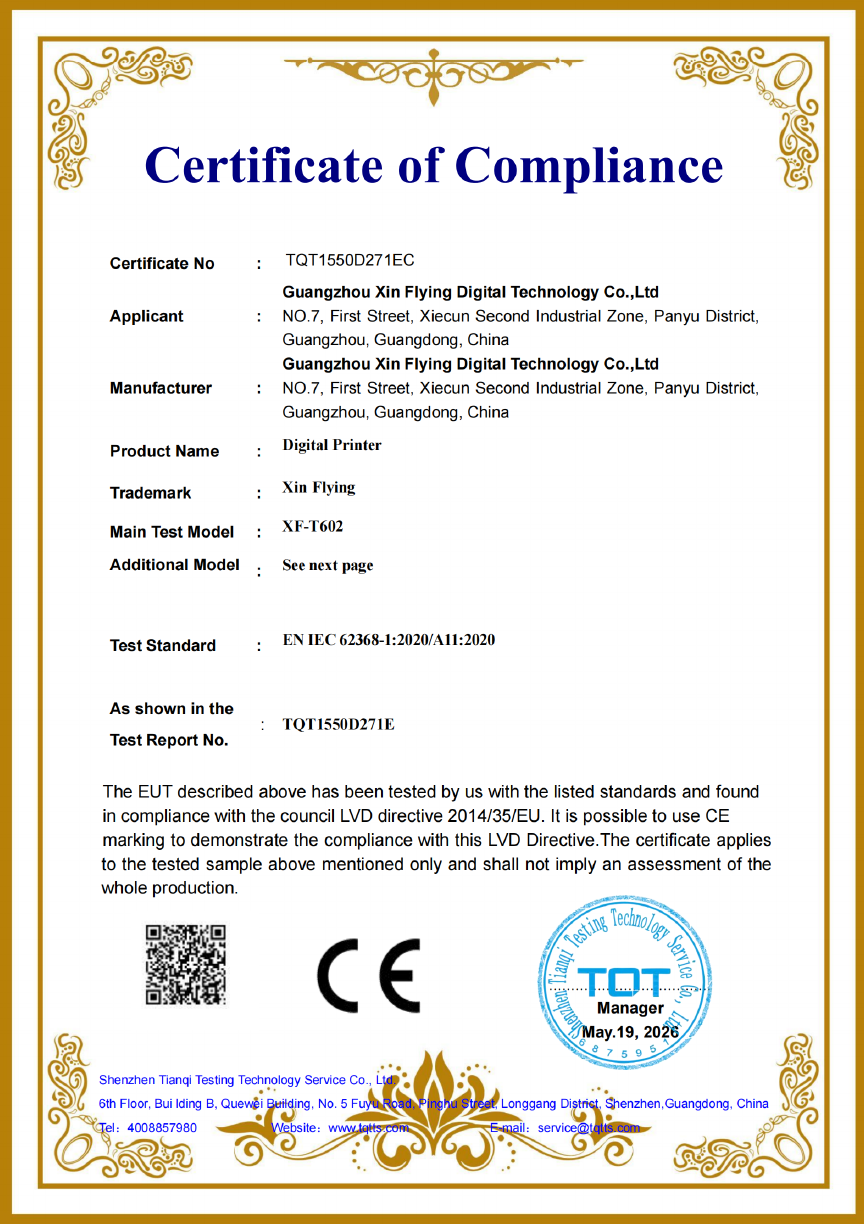
The CE LVD certificate TQT1550D271EC covers electrical safety to EN IEC 62368-1:2020/A11:2020 and is listed for both 1900 mm models.
Reading the Two Machinery Directive Certificates Side by Side
Certificate M.2026.206.C142385 for the XF-19E8-PRO cites three harmonised standards: EN ISO 12100:2010, EN 60204-1:2018/A1:2025 and EN ISO 12643-1:2023. The certificate record for M.2026.206.C142365, which covers the XF-19E15-PRO, lists the same three standards. Published supplier-side summaries of the XF-19E15-PRO file take a narrower route: they reference EN ISO 12643-1:2023 as the machinery-safety line and cite the EN IEC 62368-1 and EN 55032/55035 series separately under the combined LVD and EMC attestation M.2026.206.C142475. The certificate itself, not the summary, is the controlling document.
What each line actually asks of the machine matters more than the list length:
- EN ISO 12100:2010 is the risk-assessment and design-principles standard. It requires the manufacturer to identify hazards, estimate risk and design them out before relying on guarding or warnings. For a 190 cm roll-fed printer with a heat-drying unit and a moving carriage, it is the document that shows the machine was engineered against a hazard analysis.
- EN 60204-1:2018/A1:2025 covers the electrical equipment of machines — supply arrangement, protection against electric shock, control functions and emergency stopping. It is the bridge between the electrical safety evidence in the LVD file and the machine-level safety claim in the MD file.
- EN ISO 12643-1:2023 is the graphic technology machinery family standard, setting safety requirements for printing and finishing equipment. It is the standard an EU machinery assessor expects to see named for a printing press, and it appears in both models’ files.
The practical consequence is straightforward. If an importer’s technical file reviewer asks “which standard proves the machine-safety design was assessed?”, the answer for both models is EN ISO 12100:2010 together with EN ISO 12643-1:2023. If the reviewer asks “which electrical standard is claimed for the machine?”, EN 60204-1:2018/A1:2025 sits in the MD file and EN IEC 62368-1:2020/A11:2020 sits in the LVD file. The difference between the two 1900 mm models is therefore the certificate number and the model designation it binds — not a missing standard.
That is worth stating plainly because mis-reading the summaries is a common failure mode. A buyer who checks only a marketing page and finds one standard quoted for the XF-19E15-PRO may conclude the file is thinner than the XF-19E8-PRO’s. The certificate numbers resolve it: request both PDFs, compare the standard lists, and confirm which serial-number range each certificate binds.
Step-by-Step: Auditing the File Before You Order
The following sequence can be completed with the supplier’s document pack and a destination-market checklist, without a factory visit.
Step 1 — Match certificate number to model designation. Write down the exact model you intend to import, then find that model name on each certificate. M.2026.206.C142365 binds the XF-19E15-PRO; M.2026.206.C142385 binds the XF-19E8-PRO. A certificate that names a different model, even within the same 1900 mm family, does not cover your machine.
Step 2 — Confirm the issuing body and validity window. The two machinery certificates and the RoHS certificate are issued by UDEM; the EMC and LVD certificates are issued by TQT (Shenzhen Tianqi Testing Technology Service Co., Ltd.). The RoHS and both CE MD certificates are valid to 9 June 2031, so a 2026 purchase falls comfortably inside the validity period.
Step 3 — Check directive coverage, not the word “CE”. A complete EU file for this equipment class needs machinery (2006/42/EC), electrical safety (2014/35/EU), EMC (2014/30/EU) and RoHS (2011/65/EU). Both models hold all four. Confirm the same for the exact variant, including any dryer or feed configuration ordered with the machine.
Step 4 — Read the standards lines against your own risk assessment. If your EU authorised representative or machinery consultant requires EN ISO 12100:2010 and EN ISO 12643-1:2023 to appear on the machinery certificate, both models satisfy the requirement. If they additionally require the electrical machine standard, EN 60204-1:2018/A1:2025 is present in both files.
Step 5 — Verify the site can carry the machine. Compliance is not only paper. Both printers require 210–230 V and 45 A, but the XF-19E15-PRO draws 14.5 kW against 10.2 kW for the XF-19E8-PRO. The 15-head unit also occupies a larger footprint (3840×1570×1800 mm, 1480 kg net) than the 8-head unit (3840×1300×1800 mm, 1400 kg net). Check the electrical distribution, floor loading and the packing dimensions (3970×1150×2130 mm versus 4010×1180×2160 mm) against your unloading and doorway clearance before signing.
Where Each 1900mm Model Fits in Production
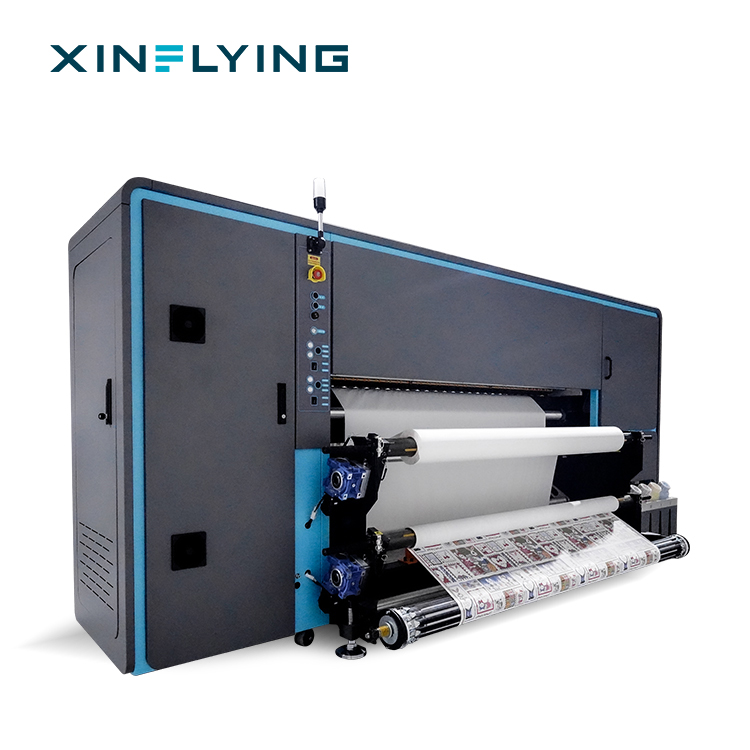
XF-19E15-PRO: 15× Epson i3200-A1 printheads, 190 cm print width, up to 524 m²/h in 1PASS.
High-volume polyester apparel and sportswear. The XF-19E15-PRO is the throughput tier for factories running long, uninterrupted polyester jobs. Fifteen Epson i3200-A1 heads deliver up to 524 m²/h in 1PASS and 254 m²/h in 2PASS at fastest settings, or 394 m²/h and 188 m²/h at standard settings. The hardware supporting that duty cycle includes a linear motor with magnetic grid, a Japan THK silent guide, 27 press rollers and an enlarged beam — media handling designed for 1000 m roll loads, which the machine’s media specification explicitly allows.
Mixed-order job shops, sampling and shorter runs. The XF-19E8-PRO carries 8 heads at up to 306 m²/h in 1PASS and 153 m²/h in 2PASS (210 m²/h and 109 m&s²;/h at standard settings). Its documented hardware set leans toward operational resilience rather than raw speed: a Japan THK silent linear guide, anti-collision devices at both ends, automatic flash spray moisturizing, an intelligent printhead cleaning and moisturizing device, US-imported fluorine rubber pressure paper wheels, liquid level and waste ink alarms, and the same external intelligent air-heat integrated dryer as the larger model. For a shop switching between t-shirt panels, blanket runs and soft signage, those alarms and the anti-collision protection reduce the cost of an operator error.
Installation environment for both. XINFLYING specifies an ambient range of 18–30°C and 35–65%RH for both models, with the same stable-condition requirement that keeps ink behaviour and colour reproduction consistent across shifts. Neither machine is a light-duty unit: at 1400 kg and 1480 kg net, both need a prepared floor and a fixed installation.
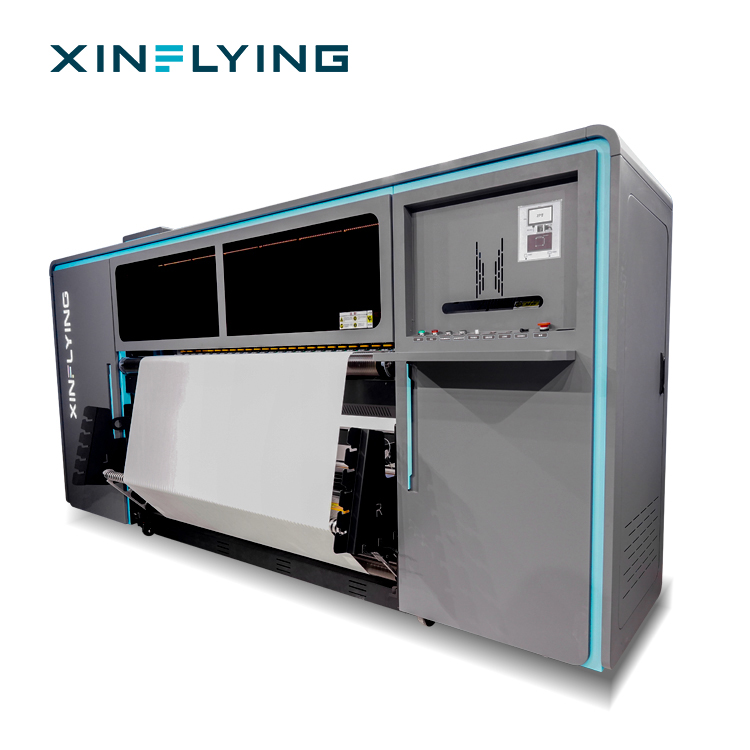
XF-19E8-PRO: 8× Epson i3200-A1 printheads, 190 cm print width, up to 306 m²/h in 1PASS, with liquid level and waste ink alarms.
Specification and Compliance Comparison
| Parameter | XF-19E15-PRO | XF-19E8-PRO |
|---|---|---|
| Printheads | 15× Epson i3200-A1 | 8× Epson i3200-A1 |
| Print width / resolution | 190 cm (75″) / 3200 dpi | 190 cm (75″) / 3200 dpi |
| Fastest speed (1PASS / 2PASS) | 524 m²/h / 254 m²/h | 306 m²/h / 153 m²/h |
| Standard speed (1PASS / 2PASS) | 394 m²/h / 188 m²/h | 210 m²/h / 109 m²/h |
| Ink / colours | Sublimation ink, CMYK | Sublimation ink, CMYK |
| Media | Sublimation paper (loads 1000 m rolls) | Sublimation paper |
| RIP | Maintop standard; RIIN (Hoson only), PhotoPrint, Printfactory optional | Maintop standard; RIIN (Hoson only), PhotoPrint, Printfactory optional |
| Power / supply | 14.5 kW; 210–230 V, 45 A | 10.2 kW; 210–230 V, 45 A |
| Drying / moisturizing | External intelligent air-heat integrated dryer; fully sealed automatic moisturizing and cleaning | External intelligent air-heat integrated dryer; fully sealed automatic moisturizing and cleaning |
| Machine size / net weight | 3840×1570×1800 mm / 1480 kg | 3840×1300×1800 mm / 1400 kg |
| Packing size / gross weight | 3970×1150×2130 mm / 1580 kg | 4010×1180×2160 mm / 1500 kg |
| Operating conditions | 18–30°C, 35–65%RH | 18–30°C, 35–65%RH |
| CE MD certificate | M.2026.206.C142365 (UDEM) | M.2026.206.C142385 (UDEM) |
| CE EMC certificate | TQT1550D270EC | TQT1550D270EC |
| CE LVD certificate | TQT1550D271EC | TQT1550D271EC |
| RoHS certificate | M.2026.206.C142366 | M.2026.206.C142366 |
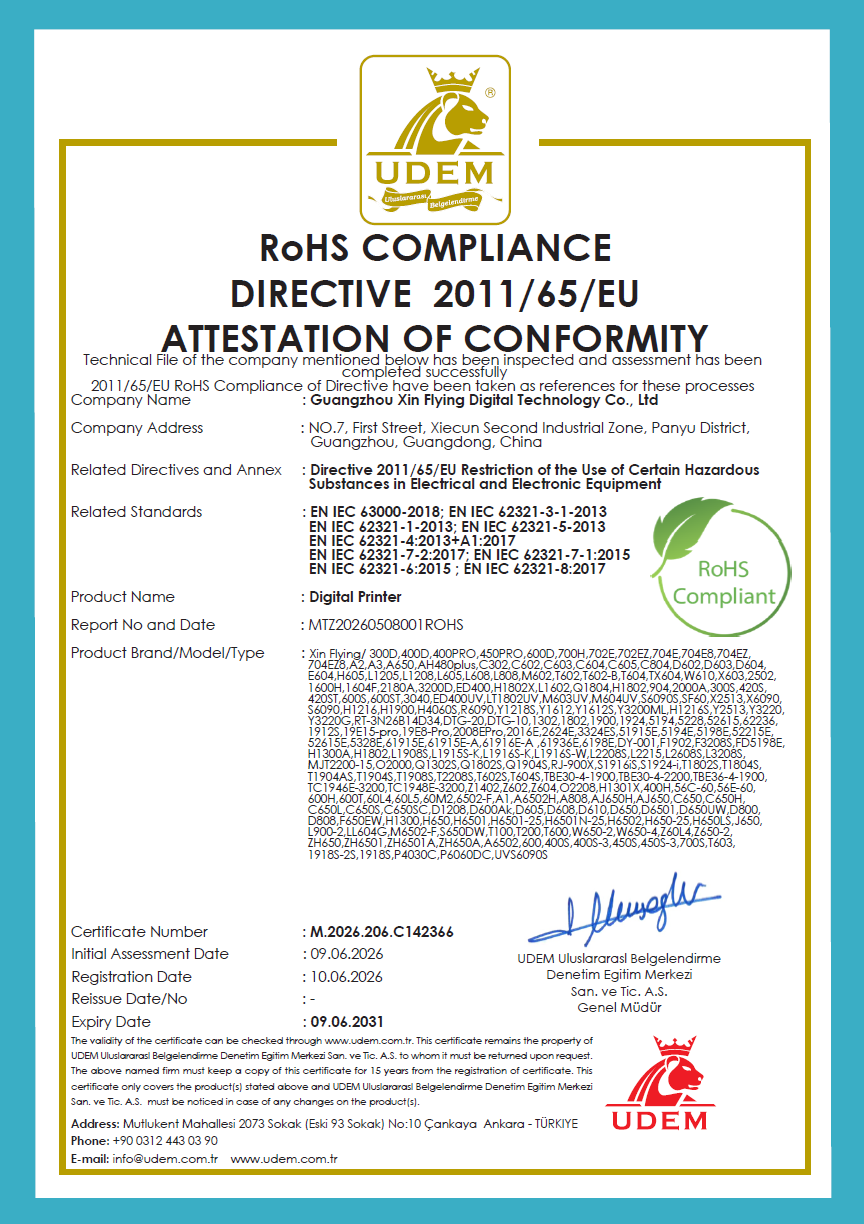
RoHS certificate M.2026.206.C142366 to EN IEC 63000:2018, valid to 9 June 2031, is listed for both models.
Frequently Asked Questions
Do the XF-19E15-PRO and XF-19E8-PRO share the same CE EMC, LVD and RoHS certificates?
Yes. Both 1900 mm models are listed under CE EMC certificate TQT1550D270EC, CE LVD certificate TQT1550D271EC and RoHS certificate M.2026.206.C142366. The EMC and LVD certificates were issued by TQT on 19 May 2026; the RoHS certificate was issued by UDEM and is valid to 9 June 2031. Only the CE Machinery Directive document differs between the two machines.
What is the difference between CE MD certificate M.2026.206.C142365 and M.2026.206.C142385?
Both are CE Machinery Directive (2006/42/EC) Certificates of Conformity issued by UDEM, issued in June 2026 and valid to 9 June 2031, and both cite EN ISO 12100:2010, EN 60204-1:2018/A1:2025 and EN ISO 12643-1:2023. M.2026.206.C142365 names the XF-19E15-PRO; M.2026.206.C142385 names the XF-19E8-PRO. The practical difference is which model the certificate binds — the number on the document must match the model on the nameplate and in your declaration of conformity.
Which model suits high-volume textile production, and which suits mixed-order work?
The XF-19E15-PRO is the throughput tier: 15 Epson i3200-A1 printheads, up to 524 m²/h in 1PASS and 254 m²/h in 2PASS at fastest settings, with 1000 m roll capacity and 14.5 kW power draw. The XF-19E8-PRO runs 8 heads at up to 306 m²/h in 1PASS and 153 m²/h in 2PASS at 10.2 kW, and adds anti-collision devices at both ends, automatic flash spray moisturizing, an intelligent printhead cleaning and moisturizing device, and liquid level and waste ink alarms — features that matter in shops switching frequently between jobs. Both are 190 cm wide and print at 3200 dpi.
What are the commercial terms and lead time for these 1900mm sublimation printers?
XINFLYING lists a minimum order quantity of 1 unit and a lead time of 5–40 days, with monthly capacity of 1600+ units and OEM/ODM support covering product branding, machine appearance, colour, logo, packaging and customised solutions. Pricing is quoted per configuration — printhead count, dryer and RIP selection change the bill of materials — so a quotation should be requested against the exact model and option set rather than compared as a single headline figure. Pre-shipment testing is performed before dispatch.
Can I request a sample print or a model-specific certificate pack before ordering?
Yes. Buyers can request the certificate set for the exact model under evaluation — M.2026.206.C142365 plus TQT1550D270EC, TQT1550D271EC and M.2026.206.C142366 for the XF-19E15-PRO, or M.2026.206.C142385 with the same three shared documents for the XF-19E8-PRO — and can arrange sample output or an inquiry with XINFLYING’s technical team (over 50 engineers providing 24/7 online technical support) to validate colour, media handling and site requirements before the order. Contact: info@xin-flying.com, +86 188-1322-1357, or www.xin-flying.com.
Conclusion
The XF-19E15-PRO and XF-19E8-PRO are not separated by certification quality. Both carry CE EMC, CE LVD and RoHS coverage under the same three shared certificate numbers, and both carry a UDEM-issued CE Machinery Directive certificate citing EN ISO 12100:2010, EN 60204-1:2018/A1:2025 and EN ISO 12643-1:2023. What separates them is a certificate number bound to a specific model — M.2026.206.C142365 for the 15-head machine, M.2026.206.C142385 for the 8-head machine — and a throughput tier that differs by roughly 70% at 1PASS.
For an EU-bound purchase, run the audit in this order: match the certificate number to the model on the order, confirm the directive coverage your importer requires, then confirm the site can carry 14.5 kW or 10.2 kW and the corresponding footprint. Buyers with long, uninterrupted polyester runs will find the XF-19E15-PRO matches their production plan; buyers with mixed orders and shorter runs will find the XF-19E8-PRO’s protection and alarm features reduce operating risk at lower power.
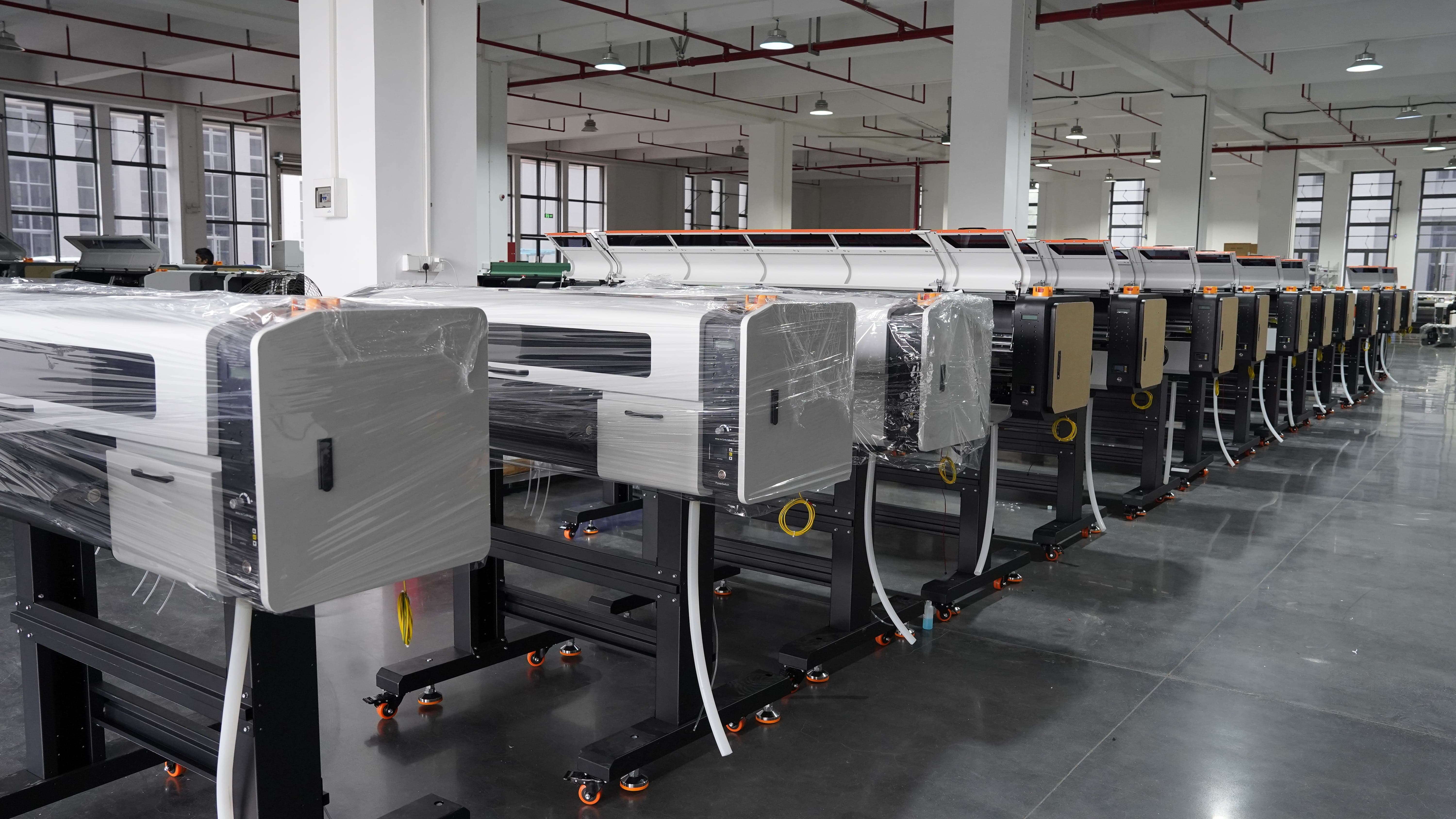
XINFLYING assembles and tests printers at its Guangzhou facility; 80% of output is exported to North America, South America, Europe, Asia, the Middle East and Africa.
Next step. Tell XINFLYING which model you are evaluating and which EU directives your importer requires, and request the matching certificate pack, a quotation against your configuration, or a sample print for evaluation.
Email: info@xin-flying.com | Tel / WhatsApp: +86 188-1322-1357 | Web: www.xin-flying.com | Address: No.7, Xiecun 2nd Industrial Zone, Panyu, Guangzhou, Guangdong, China
Company brochure (PDF): XINFLYING corporate introduction
Have Questions or Need More Details?
Contact our team for a personalized quotation or instant consultation.
Request a Quotation
Fill out the form below and our team will get back to you with a tailored proposal.
WhatsApp Direct Chat
Prefer to chat in real-time? Message us on WhatsApp for instant assistance & quick answers.
- Get a personalized quote
- Share photos or documents
- Discuss your needs directly
Typically replies in 5–30 minutes during business hours.