
XF-19E15-PRO vs XF-19E8-PRO: Industrial vs Commercial Sublimation Printer Decision
The XF-19E15-PRO and the XF-19E8-PRO are both 1900 mm (75 in) roll-to-roll dye sublimation printers built by XinFlying, and both sit on the same three EU compliance documents: CE EMC certificate TQT1550D270EC, CE LVD certificate TQT1550D271EC and RoHS certificate M.2026.206.C142366. The choice between them comes down to two things a quotation rarely shows. First, how many Epson i3200-A1 printheads your production plan can justify — 15 on the XF-19E15-PRO against 8 on the XF-19E8-PRO. Second, which CE Machinery Directive certificate is printed on the delivery documents: M.2026.206.C142365 for the XF-19E15-PRO or M.2026.206.C142385 for the XF-19E8-PRO.
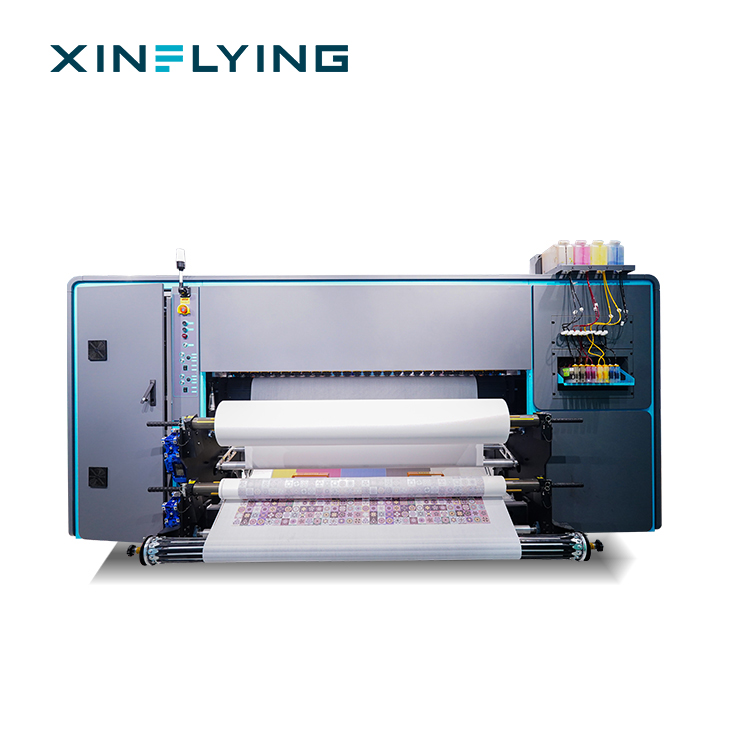
The XF-19E8-PRO: 8 × Epson i3200-A1, 190 cm print width, 10.2 kW — the commercial-duty side of this comparison.
Problem Definition: Two Machines That Read the Same on a Quotation
On a one-page offer sheet the XF-19E15-PRO and the XF-19E8-PRO look interchangeable. Both are listed as Digital Textile Printer with a 190 cm (75 in) print width. Both print CMYK sublimation ink at 3200 dpi on sublimation paper. Both run Maintop as standard RIP with RIIN (Hoson only), PhotoPrint and Printfactory available as options. Both are certified to the same EMC, LVD and RoHS files. Three of the four EU compliance documents are literally shared between the two models.
The difference is buried where buyers do not normally look: the printhead count, the installed power, the machine mass and footprint, and the certificate number on the Machinery Directive attestation. A purchasing team that checks only “CE: yes” will approve either machine and then find at installation that the electrical supply, the freight plan or the serial-to-certificate mapping does not match the file that was reviewed.
That mismatch is the practical risk in this comparison. A CE Machinery Directive attestation is issued per machine, not per product family. When the certificate number, the invoice line and the actual serial on the crate disagree, the buyer — not the factory — is the party who has to resolve it with a customs broker and, in some cases, a market surveillance authority.
Before comparing speeds, settle these four points:
- Which of the two CE MD certificate numbers appears on your contract, proforma and packing list.
- Whether your site can carry 14.5 kW or 10.2 kW on a 210–230 V, 45 A supply.
- Whether your order mix rewards 15 printheads or is better served by 8 printheads plus operator-protection features.
- Whether the floor, the doorway and the freight quote can accept the machine and packing dimensions of the model you select.
Industry Background: Why 1900 mm and Why Documentation
Two market references frame this decision. Grand View Research values the global dye sublimation printing market at USD 16.4 billion in 2025, projected to reach USD 39.0 billion by 2033, with a CAGR of 11.5% from 2026 to 2033. Mordor Intelligence estimates the dye sublimation printer segment specifically at USD 1.88 billion in 2025, rising to USD 2.53 billion by 2030. Published figures differ by scope — one source puts the wider dye sublimation printing market at USD 15.22 billion for 2025, another uses a broader definition reaching USD 42.95 billion — so treat market size as directional context for capacity planning rather than as a precise forecast input.
Geography is more decisive than the total. Asia Pacific held a 36.5% revenue share in 2025, led by China as the largest country market, which is why Chinese-built 1900 mm roll-to-roll machines form the default comparison set for textile printers worldwide. FESPA positions 1.9 m roll-to-roll printing as the standard width for high-volume textile and soft signage work — precisely the width both of these models share.
The second shift is documentation. A CE-marked textile printer now requires four separate files — Machinery Directive, EMC, Low Voltage Directive and RoHS — plus, where output touches skin, ink-level evidence such as OEKO-TEX ECO PASSPORT. Colour validation is also increasingly discussed against ISO 12647-8:2021, the standard for validating print processes working directly from digital data. In procurement terms, compliance is no longer a checkbox appended to a technical comparison; it is one of the comparison dimensions.
The Shared Platform: What You Get on Both Machines
Everything in this section is identical on the XF-19E15-PRO and the XF-19E8-PRO, so it should not drive the decision. It is listed because buyers frequently re-open the comparison on these points and need to see that the difference lies elsewhere.
- Print width: 190 cm (75 in) on both.
- Resolution: 3200 dpi on both.
- Ink: CMYK sublimation ink on both.
- Media: sublimation paper on both; the XF-19E15-PRO is specified for rolls up to 1000 m.
- RIP: Maintop standard; RIIN (Hoson only), PhotoPrint and Printfactory optional.
- File formats: JPG, TIFF, PDF.
- Drying: external intelligent air-heat integrated dryer on both.
- Moisturizing: fully sealed automatic moisturizing and cleaning on both.
- Power supply: 210–230 V, 45 A on both.
- Operating environment: 18–30 °C, 35–65% RH.
- Workstation: Windows 11/10 (32/64-bit), Intel i7, 4 GB RAM, 500 GB HD, ATI discrete graphics, DVD ROM, gigabit LAN.
- Structure: aluminum alloy, stainless steel and ABS plastic.
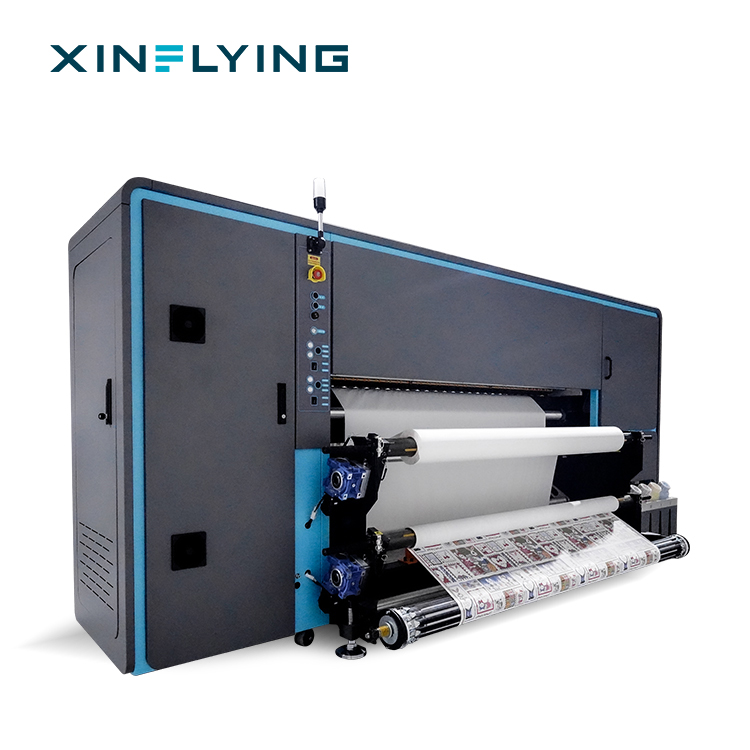
The XF-19E15-PRO: 15 × Epson i3200-A1, 190 cm print width, 14.5 kW — the industrial-duty side of the same platform.
Detailed Comparison: Where the Two Models Actually Diverge
Printhead count sets the duty cycle, not the resolution
Both machines print at 3200 dpi, so adding printheads does not increase resolution. It increases the number of nozzles firing in parallel, which is why the published speed bands separate. The XF-19E15-PRO carries 15 Epson i3200-A1 heads and publishes 1PASS 524 m²/h and 2PASS 254 m²/h at its fastest settings, and 1PASS 394 m²/h and 2PASS 188 m²/h at standard settings. The XF-19E8-PRO carries 8 Epson i3200-A1 heads and publishes 1PASS 306 m²/h and 2PASS 153 m²/h at its fastest settings, and 1PASS 210 m²/h and 2PASS 109 m²/h at standard settings. The i3200-A1 head on the XF-19E15-PRO is described in the specification as a 3200-nozzle unit with variable ink drop.
The supporting hardware follows the same logic. The XF-19E15-PRO lists a linear motor with magnetic grid, a Japan THK silent guide, 27 press rollers and an enlarged beam. Those are media-transport and registration components, and they matter most when the carriage is working at the higher pass rates. The XF-19E8-PRO lists a Japan THK silent linear guide, an anti-collision device at both ends, a US-imported fluorine rubber pressure paper wheel, automatic flash spray moisturizing, an intelligent printhead cleaning and moisturizing device, and liquid level and waste ink alarms.
Read the two feature lists as two operating philosophies. The industrial configuration concentrates on throughput and media control at speed. The commercial configuration concentrates on collision protection, fluid monitoring and operator support — features that shorten recovery time in a shop running mixed orders with fewer operators per machine.
Utilities, floor space and freight
Installed power separates cleanly: 14.5 kW for the XF-19E15-PRO against 10.2 kW for the XF-19E8-PRO. Both are specified for 210–230 V, 45 A, so the supply type is the same, but the connected load and any transformer sizing differ. Net weight is 1480 kg versus 1400 kg; gross weight is 1580 kg versus 1500 kg. Machine dimensions are 3840×1570×1800 mm versus 3840×1300×1800 mm — the same 3840 mm length, with a 270 mm difference in width.
Packing is closer than the machine sizes suggest: 3970×1150×2130 mm for the XF-19E15-PRO and 4010×1180×2160 mm for the XF-19E8-PRO. In practice the larger machine does not demand a larger shipping envelope, so a freight quote built around the XF-19E8-PRO does not automatically have to be re-quoted if the specification moves up.
Roll handling is the quiet operational difference. The XF-19E15-PRO is specified to load sublimation paper rolls of up to 1000 m, which reduces roll-change frequency on long runs. If your order book is dominated by continuous metres of the same design, that specification is worth more than a marginal difference in head count.
The compliance architecture: three shared files, one split file
Both models appear on CE EMC certificate TQT1550D270EC and CE LVD certificate TQT1550D271EC, issued by TQT (Shenzhen Tianqi Testing Technology Service Co., Ltd.). The EMC file cites EN 55032:2015/A11:2020, EN 55035:2017/A11:2020, EN IEC 61000-3-2:2019+A1:2021 and EN 61000-3-3:2013/A2:2021. The LVD file cites EN IEC 62368-1:2020/A11:2020. The records show validity to 2099-01-01.
RoHS certificate M.2026.206.C142366, issued by UDEM, cites EN IEC 63000:2018 and the EN IEC 62321 series, with validity to 2031-06-09. This file is shared by both printers and covers the restriction of hazardous substances in the electrical and electronic assemblies.
Machinery safety is where the models separate. The XF-19E15-PRO is listed under CE MD certificate of conformity M.2026.206.C142365; the XF-19E8-PRO is listed under M.2026.206.C142385. Both are issued by UDEM, both reference Directive 2006/42/EC, both cite EN ISO 12100:2010, EN 60204-1:2018/A1:2025 and EN ISO 12643-1:2023, and both run to 2031-06-09. Same standard set, different certificate number, because the Machinery Directive file is built against a specific machine configuration — head count, electrical architecture and guarding differ, so the attestation differs.
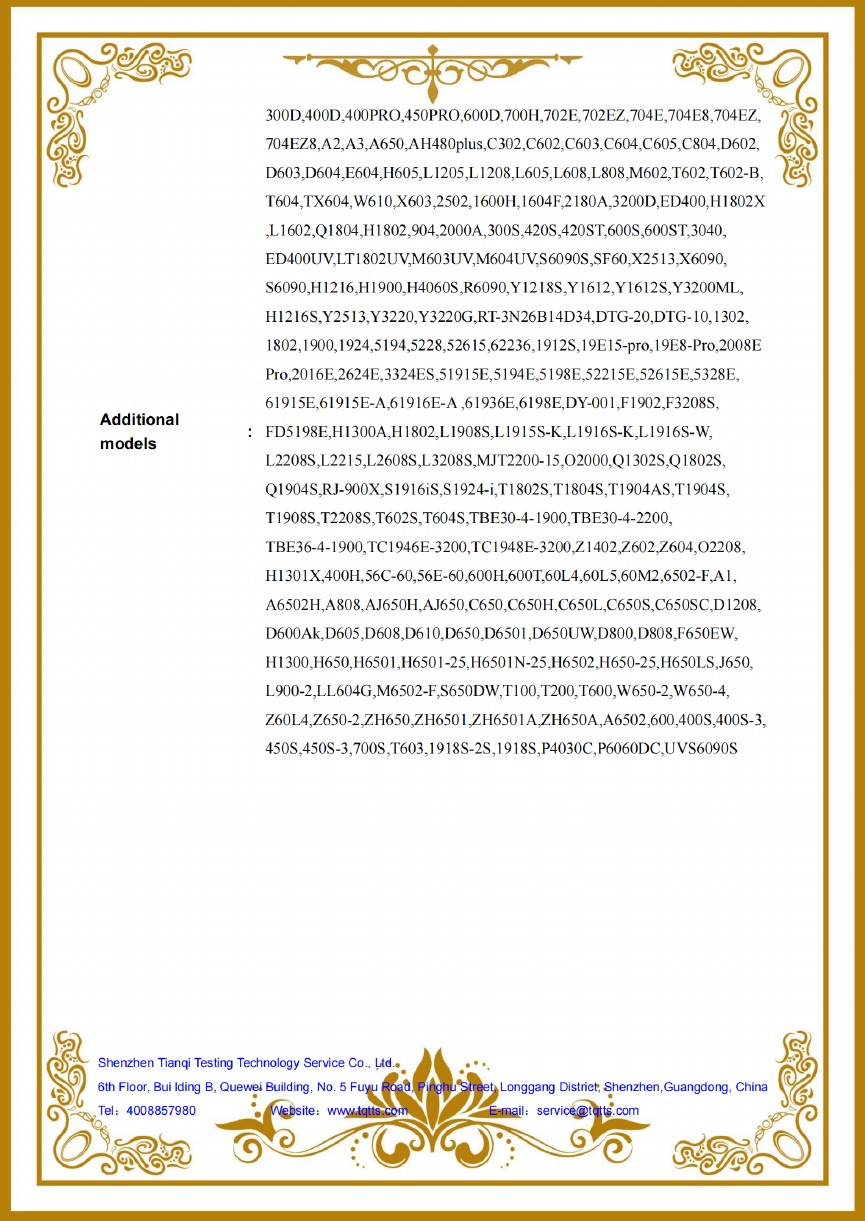
CE EMC certificate TQT1550D270EC, issued by TQT, covers both models in this comparison.
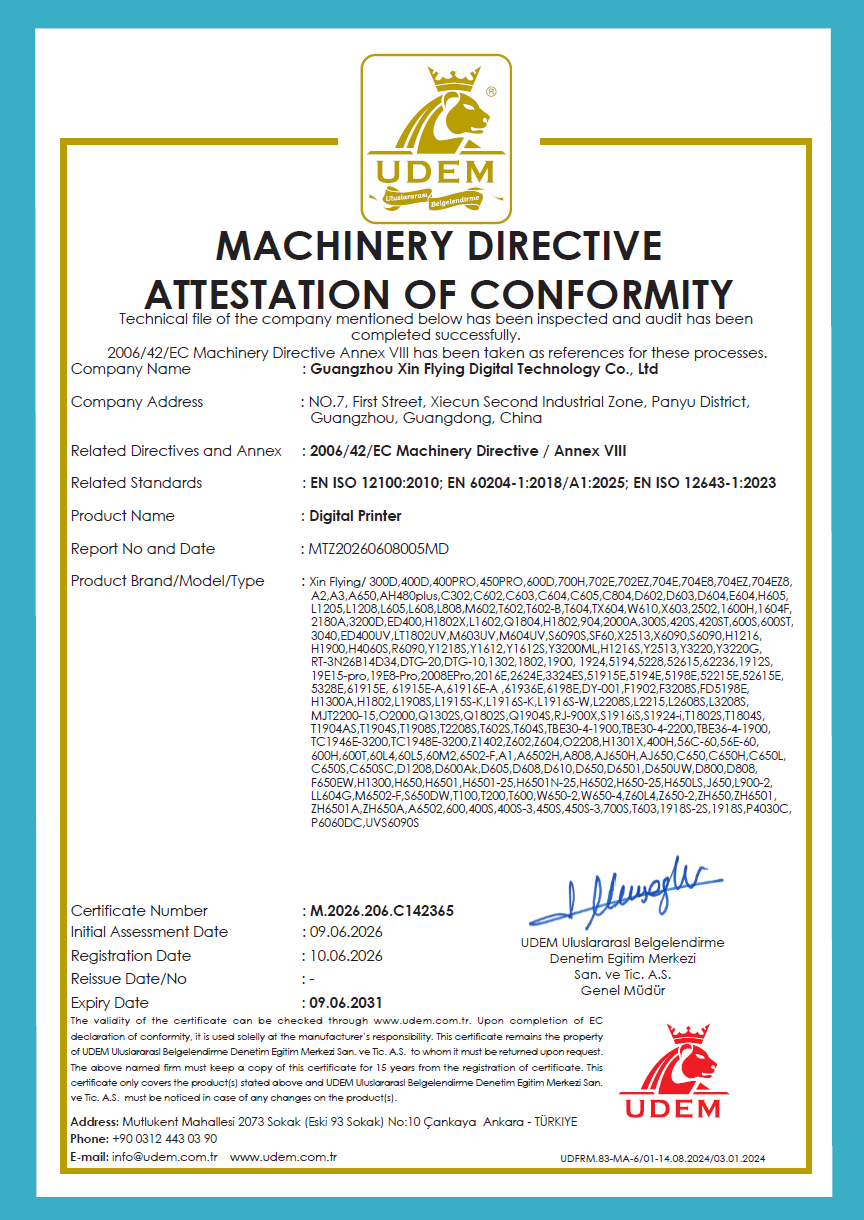
The Machinery Directive file is the one document that is not shared: M.2026.206.C142365 for the XF-19E15-PRO and M.2026.206.C142385 for the XF-19E8-PRO.
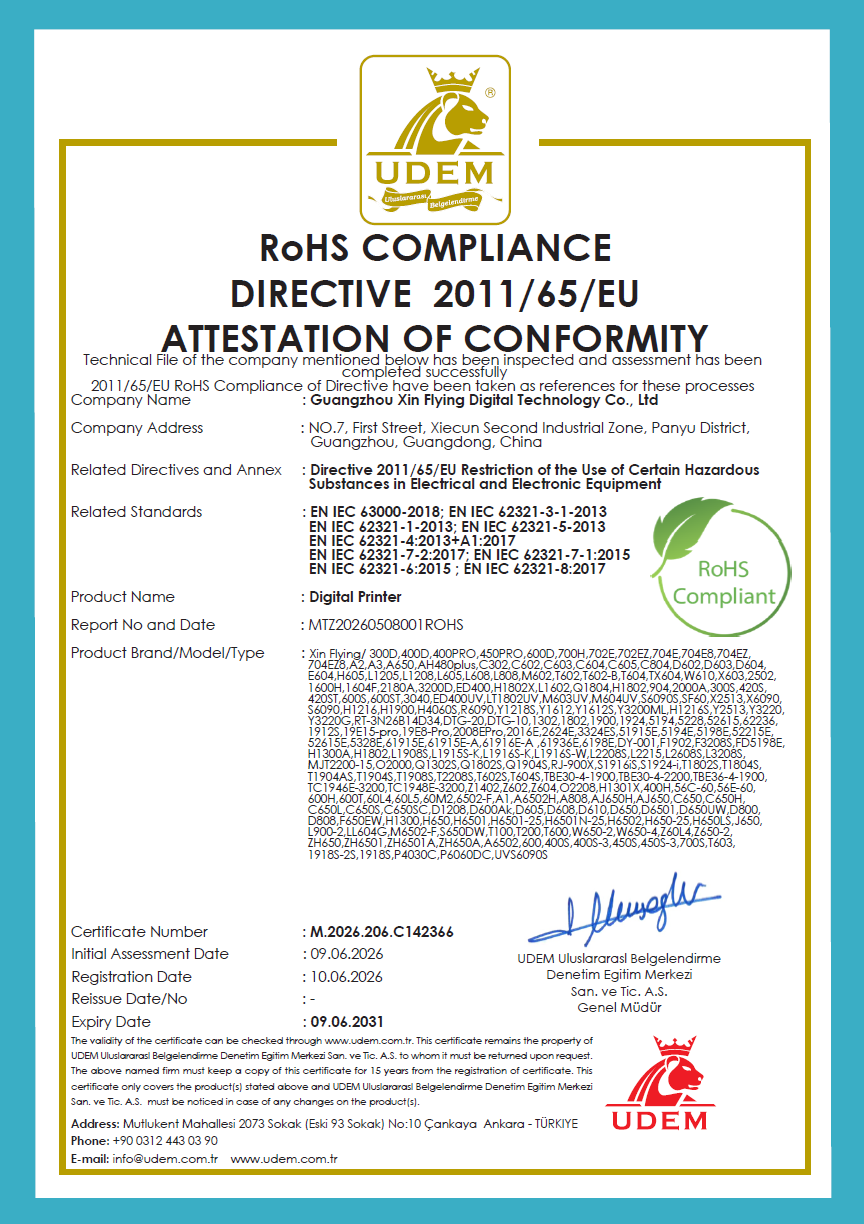
RoHS certificate M.2026.206.C142366, issued by UDEM, is shared across the two models.
What a certificate number does and does not prove
A certificate number proves that a named document exists, was issued by a named body on a stated date, references stated standards, and covers a stated product model. It does not prove that the unit in your crate is that model, that later accessories added locally fall inside the scope, or that the importing entity has completed its own obligations as the party placing the machinery on the market.
Two boundaries are worth stating plainly. First, the OEKO-TEX ECO PASSPORT certificate SH150194016, issued by TESTEX AG against EN ISO 17050-1, covers textile printing inks and printing pastes — it is an ink-level document, not a machine certificate, and it is relevant when printed output comes into contact with skin. Second, the CE files referenced here are machine files; they do not replace an EU authorised representative arrangement or the importer's own declaration details.
The practical verification step is simple: the model string on the certificate must equal the model string on the invoice and on the machine plate. If a supplier sends a certificate for M.2026.206.C142385 while quoting an XF-19E15-PRO, the document set is wrong regardless of how similar the two machines look.
Step-by-Step Breakdown: A Six-Step Decision Sequence
- Write the compliance requirement before the specification. Name the destination market, the directives that apply, and the exact documents you must hold on file. For EU delivery that means CE MD, CE EMC, CE LVD and RoHS. This step decides which model can be quoted at all; it is not a post-selection formality.
- Match the Machinery Directive number to the model. XF-19E15-PRO maps to M.2026.206.C142365; XF-19E8-PRO maps to M.2026.206.C142385. Record both the certificate number and the standards cited — EN ISO 12100:2010, EN 60204-1:2018/A1:2025 and EN ISO 12643-1:2023 — in the purchase file.
- Size the electrical installation. Both machines are specified for 210–230 V, 45 A. The connected load is 14.5 kW on the XF-19E15-PRO and 10.2 kW on the XF-19E8-PRO. Confirm breaker rating, cable cross-section and, where relevant, transformer capacity against the model you actually order.
- Match printhead count to shift pattern. If the plant runs the machine as a production asset across multiple shifts with few design changeovers, the 15-head XF-19E15-PRO configuration aligns with that duty. If the machine shares floor space, changes designs frequently and depends on a small operating team, the 8-head XF-19E8-PRO configuration with collision protection and fluid alarms aligns better.
- Confirm floor, freight and roll logistics. Check 3840×1570×1800 mm against 3840×1300×1800 mm on the floor plan, 1480 kg against 1400 kg for slab loading and lifting equipment, and the packing envelopes 3970×1150×2130 mm against 4010×1180×2160 mm with the freight forwarder.
- Fix acceptance, spares and support terms. Orders start at one unit, lead time runs 5–40 days, and pre-shipment testing is part of the process. Plan spares for 15 heads or 8 heads accordingly, and confirm after-sales cover: XinFlying supports customers with over 50 engineers providing 24/7 online technical support.
Use Cases: Which Profile Fits Which Machine
Industrial, high-volume polyester production. Multi-shift sportswear, football and basketball kit production, and long continuous runs of the same design are the profile where the XF-19E15-PRO configuration makes sense. The 190 cm width matches standard fabric webs, runs of up to 1000 m reduce roll changes, and the transport hardware — linear motor with magnetic grid, 27 press rollers, enlarged beam — is aimed at holding registration at the top of the speed range.
Commercial, mixed-order production. Team kit runs with individual names and numbers, apparel sampling, home textiles, flags and soft signage are the profile where the XF-19E8-PRO configuration fits. Anti-collision devices at both ends, automatic flash spray moisturizing, intelligent printhead cleaning and moisturizing, and liquid level and waste ink alarms reduce the cost of a mistake or a neglected maintenance interval — which is what mixed, short-run production tends to generate.
Installed behaviour from existing users supports the split in duty rather than in print quality. A digital textile printing service provider running five units for three years reports expanded production capacity and faster response on customised textile orders. A sportswear manufacturer in Brazil running 15 units over four years reports reduced dependence on outsourced printing and more consistent colour across batches. A sports uniform supplier in Brazil running eight units for five years reports shorter production cycles on personalised kits with names, numbers and graphics. A home textile manufacturer running ten units over four years produces curtains, cushions and decorative fabrics. In each case the relevant question is not which machine is faster, but which machine's duty rating matches the shop's order rhythm.
Comparison Table
| Decision factor | XF-19E15-PRO | XF-19E8-PRO |
|---|---|---|
| Specified application | Industrial textile sublimation printing (high-volume) | Industrial textile sublimation printing |
| Printheads | 15 × Epson i3200-A1 | 8 × Epson i3200-A1 |
| Print width / resolution | 190 cm (75 in) / 3200 dpi | 190 cm (75 in) / 3200 dpi |
| Ink / media | CMYK sublimation ink / sublimation paper, loads 1000 m rolls | CMYK sublimation ink / sublimation paper |
| Fastest speed | 1PASS 524 m²/h; 2PASS 254 m²/h | 1PASS 306 m²/h; 2PASS 153 m²/h |
| Standard speed | 1PASS 394 m²/h; 2PASS 188 m²/h | 1PASS 210 m²/h; 2PASS 109 m²/h |
| Power / supply | 14.5 kW / 210–230 V, 45 A | 10.2 kW / 210–230 V, 45 A |
| Machine size | 3840×1570×1800 mm | 3840×1300×1800 mm |
| Net / gross weight | 1480 kg / 1580 kg | 1400 kg / 1500 kg |
| Packing size | 3970×1150×2130 mm | 4010×1180×2160 mm |
| Transport features | Linear motor plus magnetic grid; Japan THK silent guide; 27 press rollers; enlarged beam | Japan THK silent linear guide; anti-collision device at both ends; US-imported fluorine rubber pressure paper wheel |
| Monitoring / upkeep | Fully sealed automatic moisturizing and cleaning | Automatic flash spray moisturizing; intelligent printhead cleaning and moisturizing; liquid level and waste ink alarm |
| CE MD (2006/42/EC) | M.2026.206.C142365 (UDEM) | M.2026.206.C142385 (UDEM) |
| CE EMC | TQT1550D270EC (TQT) | TQT1550D270EC (TQT) |
| CE LVD | TQT1550D271EC (TQT) | TQT1550D271EC (TQT) |
| RoHS | M.2026.206.C142366 (UDEM) | M.2026.206.C142366 (UDEM) |
Specifications as published by XinFlying for each model; certificate numbers as issued by TQT and UDEM.
Frequently Asked Questions
Do the XF-19E15-PRO and XF-19E8-PRO share the same CE certificates?
Three files are shared and one is not. Both models are covered by CE EMC certificate TQT1550D270EC and CE LVD certificate TQT1550D271EC, both issued by TQT (Shenzhen Tianqi Testing Technology Service Co., Ltd.), and both are covered by RoHS certificate M.2026.206.C142366 issued by UDEM. The EMC file cites EN 55032:2015/A11:2020, EN 55035:2017/A11:2020, EN IEC 61000-3-2:2019+A1:2021 and EN 61000-3-3:2013/A2:2021; the LVD file cites EN IEC 62368-1:2020/A11:2020. Machinery safety is separate: the XF-19E15-PRO is listed under CE MD M.2026.206.C142365 and the XF-19E8-PRO under M.2026.206.C142385, both issued by UDEM against Directive 2006/42/EC, EN ISO 12100:2010, EN 60204-1:2018/A1:2025 and EN ISO 12643-1:2023. Match the MD number on the certificate to the model on the invoice.
How do I decide between 15 printheads and 8 printheads for my production?
Head count changes throughput and redundancy, not resolution — both machines print at 3200 dpi. The XF-19E15-PRO publishes 1PASS 524 m²/h and 2PASS 254 m²/h at its fastest settings, and 1PASS 394 m²/h and 2PASS 188 m²/h at standard settings, with 15 Epson i3200-A1 heads, a linear motor with magnetic grid, 27 press rollers and an enlarged beam. The XF-19E8-PRO publishes 1PASS 306 m²/h and 2PASS 153 m²/h fastest, and 1PASS 210 m²/h and 2PASS 109 m²/h standard, with 8 heads plus anti-collision devices at both ends, automatic flash spray moisturizing, intelligent printhead cleaning and moisturizing, and liquid level and waste ink alarms. Choose the 15-head configuration when the machine is a dedicated production asset across multiple shifts with long runs; choose the 8-head configuration when orders change frequently and a small team operates the equipment.
What drives the budget difference between the two models?
Equipment pricing is quoted per configuration rather than published, so compare the documented cost drivers instead of a headline figure. The measurable differences are connected load (14.5 kW versus 10.2 kW, both on 210–230 V, 45 A), printhead count (15 versus 8, which sets the spares holding), machine mass (1480 kg versus 1400 kg net; 1580 kg versus 1500 kg gross, which affects lifting and freight handling), and footprint (3840×1570×1800 mm versus 3840×1300×1800 mm for floor planning). Packing sizes of 3970×1150×2130 mm and 4010×1180×2160 mm are close enough that shipping envelopes may not need a full re-quote. Odds-and-ends such as transformer sizing and roller inventories should be priced locally. Orders start at one unit.
Can I validate the machine before committing to a full order?
Yes, and validation should cover both the print result and the paperwork. XinFlying accepts orders from one unit (MOQ 1 unit) and runs pre-shipment testing as part of the process, and the company offers OEM/ODM customisation covering product branding, machine appearance, colour, logo, packaging and solutions tailored to customer requirements. For the compliance side, request the certificate copies that carry the exact model string of the configuration you intend to buy — M.2026.206.C142365 or M.2026.206.C142385 for the Machinery Directive, plus the shared EMC, LVD and RoHS files — and confirm that the machine plate, the invoice and the certificate agree before releasing the balance payment.
What is the lead time, and what support comes with delivery?
Lead time runs 5–40 days depending on configuration and order volume, against a stated monthly capacity of 1600+ units. XinFlying was founded in 2010, operates a 37,440 m² facility with 200+ employees, a 20-engineer R&D team and annual output of 20,000+ units, and exports to North America, South America, Europe, Asia, the Middle East and Africa. After-sales support is delivered by over 50 engineers providing 24/7 online technical support. When planning the installation, reserve power and floor space for the specific model — and confirm spares for 15 or 8 Epson i3200-A1 heads, since head inventory is the main consumable-planning difference between the two builds.
Conclusion
The XF-19E15-PRO and the XF-19E8-PRO are not competitors in a speed race; they are two duty ratings built on one 190 cm platform. Both give you 3200 dpi, CMYK sublimation printing, the same RIP options, the same operating environment and the same three shared EU files: CE EMC TQT1550D270EC, CE LVD TQT1550D271EC and RoHS M.2026.206.C142366. What changes is the production philosophy. Fifteen Epson i3200-A1 heads and 14.5 kW support continuous, high-volume polyester work with runs of up to 1000 m, under CE MD certificate M.2026.206.C142365. Eight heads and 10.2 kW support mixed-order commercial work with collision protection, moisturizing automation and fluid alarms, under CE MD certificate M.2026.206.C142385.
The decision rule is therefore short. Choose the model whose certificate number you can match to your invoice, whose connected load your site can carry, and whose duty rating matches the rhythm of your order book. Everything else — width, resolution, ink, RIP, environment — is the same.
Next step: check the documents before the specification
Request the certificate pack for the exact model you intend to order (CE MD, CE EMC, CE LVD, RoHS), a printed sample of your own artwork on your own sublimation paper, and a quote for the configuration — 15-head or 8-head — that matches your shift pattern.
Email: info@xin-flying.com | Tel / WhatsApp: +86 188-1322-1357 | Web: www.xin-flying.com
Company brochure (PDF, open access): XinFlying company profile
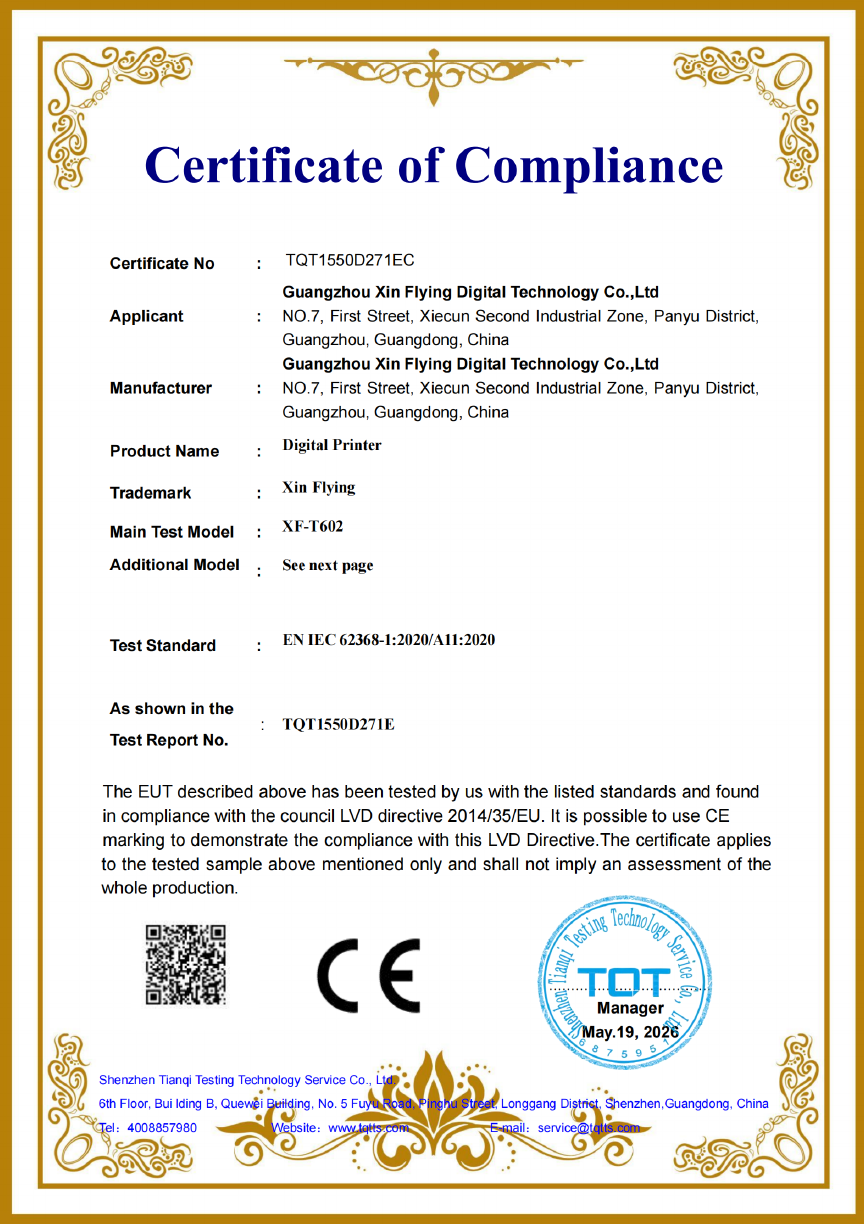
CE LVD certificate TQT1550D271EC (EN IEC 62368-1:2020/A11:2020) is issued by TQT and shared by both models — request it together with the Machinery Directive file for your chosen configuration. XinFlying is the trading name of Guangzhou Xin Flying Digital Technology Co., Ltd., No.7, Xiecun 2nd Industrial Zone, Panyu, Guangzhou, Guangdong.
Have Questions or Need More Details?
Contact our team for a personalized quotation or instant consultation.
Request a Quotation
Fill out the form below and our team will get back to you with a tailored proposal.
WhatsApp Direct Chat
Prefer to chat in real-time? Message us on WhatsApp for instant assistance & quick answers.
- Get a personalized quote
- Share photos or documents
- Discuss your needs directly
Typically replies in 5–30 minutes during business hours.