
The 2026 Must-Have: Certified Textile Printers for High Efficiency
Two years ago a textile printer sold itself on throughput. In the 2026 buying cycle, throughput is the second document a purchasing team reads. The first is the certificate file. European buyers now ask for a certificate number before they ask for a price, because a machine that cannot show a CE Machinery Directive attestation covering the exact model on the invoice cannot be lawfully placed on the EU market, no matter how many square metres per hour it prints.
Xinflying (Guangzhou Xin Flying Digital Technology Co., Ltd.) is a digital printing equipment manufacturer founded in 2010 in Panyu, Guangzhou, producing DTF printers, dye sublimation printers, DTG printers and UV printers for apparel, home textile and soft signage producers. Roughly 80% of its output is exported to North America, South America, Europe, Asia, the Middle East and Africa. This ranking examines the certified portion of that range, and why certificate numbers — not headline speed — now decide which models enter a 2026 production floor.
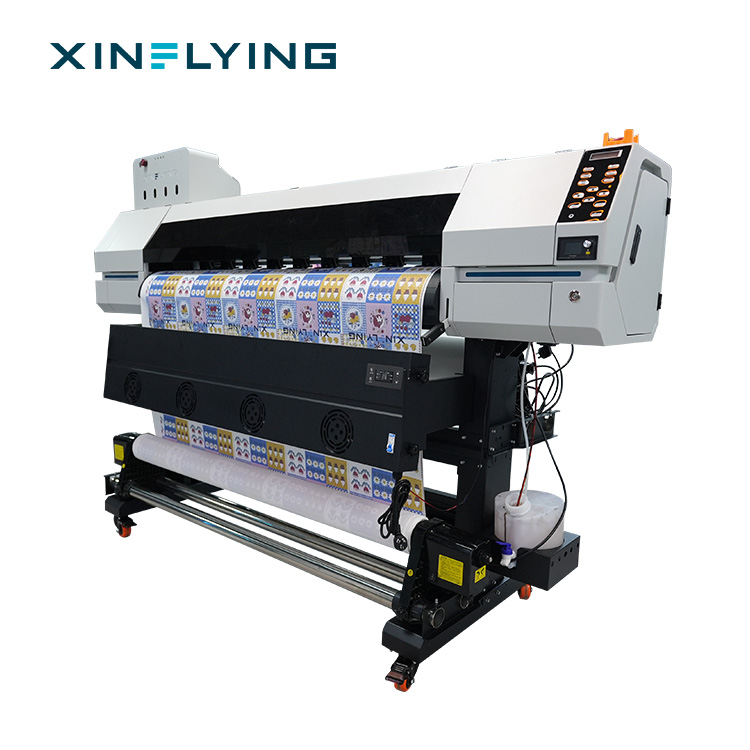
XinFlying XF-H1301X-1I32A1, a 130 cm roll-fed sublimation printer covered by CE and RoHS documentation.
Problem Definition: When a Fast Printer Cannot Be Sold
The constraint that stops textile printer projects in 2026 is rarely speed. It is documentation mismatch. Three failure patterns recur in EU and UK import reviews.
Pattern one — the single-certificate assumption. A supplier forwards one EMC test report and describes the machine as "CE certified." CE is not one certificate. For a textile printer it is a stack: Machinery Directive 2006/42/EC, Low Voltage Directive 2014/35/EU, EMC Directive 2014/30/EU, and RoHS Directive 2011/65/EU. A missing LVD declaration is a missing declaration, regardless of how complete the EMC file looks.
Pattern two — the model-name gap. The certificate references a model family; the commercial invoice references a configured variant with a different printhead count or width. Customs and notified bodies compare strings, not intentions. If the certificate does not name the delivered model, the document is decorative.
Pattern three — the expired file. Certificates carry issue and expiry dates. A file that was valid when the purchasing decision started can be out of date by the time the container ships. High-efficiency hardware with a lapsed certificate becomes high-efficiency inventory.
A fourth pattern applies specifically to textile work: ink and print chemistry sit outside machinery compliance. A printer can hold every CE document and still fail a brand's restricted-substance audit if the ink itself has no OEKO-TEX ECO PASSPORT. Buyers who treat machine certification and ink certification as one item discover the gap late, usually after the first bulk order is rejected.
Industry Background: A Larger Market With Tighter Documentation
The documentation pressure is arriving alongside real volume growth. Grand View Research valued the global dye sublimation printing market at USD 16.4 billion in 2025 and projects USD 39.0 billion by 2033, a CAGR of 11.5% from 2026 to 2033. Within that total, Mordor Intelligence sized the dye sublimation printer segment at USD 1.88 billion in 2025, rising to USD 2.53 billion by 2030. Asia Pacific held a 36.5% revenue share in 2025, with China the largest single country market — a position supported by China's textile and garment exports of USD 293.6 billion in 2023.
Supply is concentrated. Epson holds 26.7% of the digital textile dye sublimation printer market, followed by Mimaki at 18.6% and Roland DG at 15.5%. Those figures describe brand-level presence, not the compliance status of any individual machine — a distinction buyers should keep in mind when a reseller cites market share as a quality argument.
Format has also standardised. Roll-to-roll sublimation printers with 1.9 m (1900 mm) widths are the accepted format for high-volume textile and soft signage work, which is why the 1900 mm and 1.95 m platforms dominate the upper half of the ranking below. On the colour side, ISO 12647-8:2021 provides the validation standard for print processes working directly from digital data — the reference point for buyers who need colour agreement documented rather than asserted.
The 2026 Certification Baseline: Five Document Sets
Before any model comparison, a buyer should be able to assemble five document sets. If any one is missing, the comparison is premature.
- CE Machinery Directive attestation under 2006/42/EC, referencing EN ISO 12100:2010, EN 60204-1:2018/A1:2025 and EN ISO 12643-1:2023.
- CE Low Voltage Directive compliance under 2014/35/EU, referencing EN IEC 62368-1:2020/A11:2020.
- CE EMC compliance under 2014/30/EU, referencing the EN 55032, EN 55035 and EN 61000-3 series.
- RoHS attestation under 2011/65/EU, referencing EN IEC 63000:2018 and the EN IEC 62321 series.
- Ink-level textile safety, normally OEKO-TEX ECO PASSPORT under EN ISO 17050-1.
Xinflying's current file set maps onto those five categories with identifiable numbers. The CE Machinery Directive attestation M.2026.206.C142365 was issued by UDEM on 10 June 2026 and runs to 9 June 2031; a parallel Machinery Directive attestation, M.2026.206.C142385, also issued by UDEM, covers a second model group. CE Low Voltage Directive certificate TQT1550D271EC was issued by TQT on 19 May 2026 against EN IEC 62368-1:2020/A11:2020. CE EMC certificate TQT1550D270EC, issued the same day, references EN 55032:2015/A11:2020, EN 55035:2017/A11:2020, EN IEC 61000-3-2:2019+A1:2021 and EN 61000-3-3:2013/A2:2021. The combined CE LVD and EMC attestation M.2026.206.C142475 was issued by UDEM on 11 June 2026 and expires 10 June 2031. RoHS certificate M.2026.206.C142366 runs from 10 June 2026 to 9 June 2031. Older but still-live files — BSTXD211021006201EC from BST Testing and CTICAIQ415250900815313DC from CTIC — extend coverage to the compact and DTF platforms. On the ink side, OEKO-TEX ECO PASSPORT SH150194016, issued by TESTEX AG on 11 December 2025, is valid to 31 December 2026.
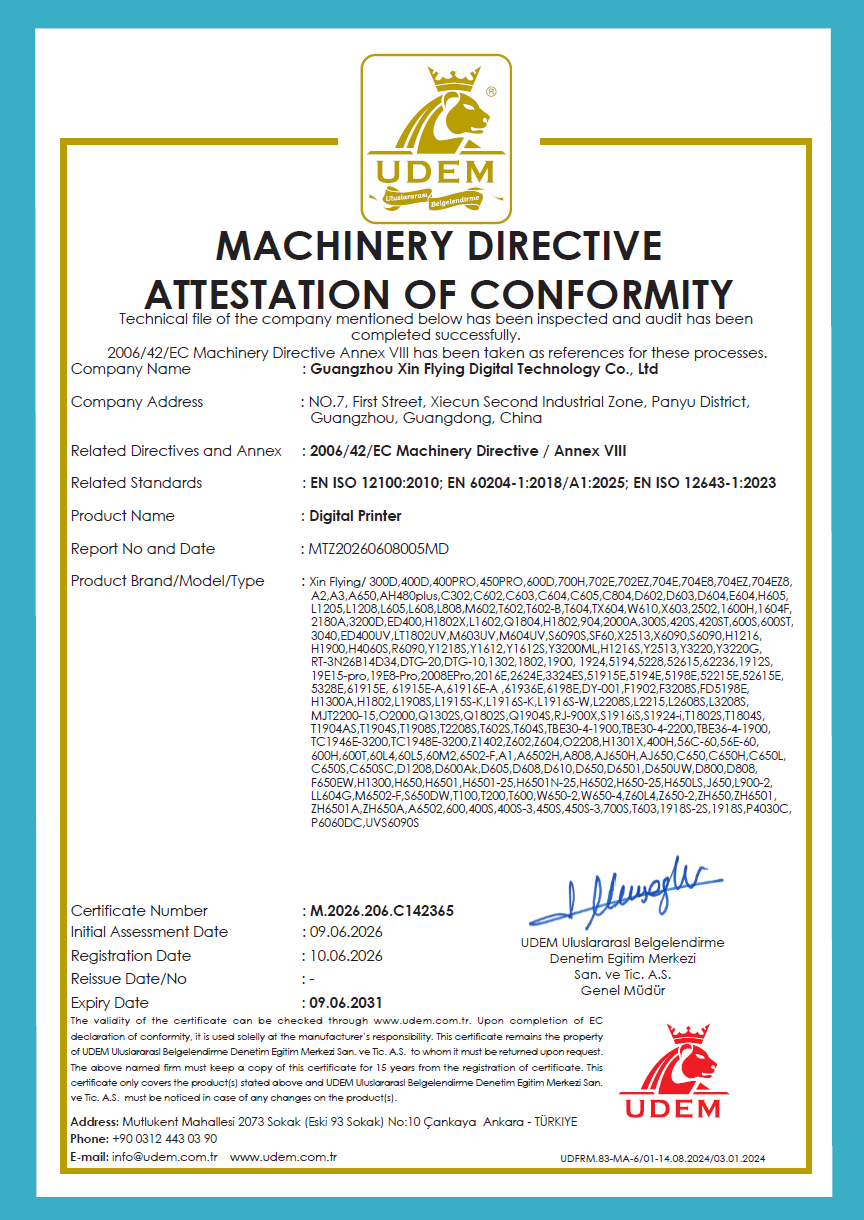
CE Machinery Directive Certificate of Conformity M.2026.206.C142365, issued by UDEM and valid to 9 June 2031.
The 2026 Certified Textile Printer Ranking
Ranking method: models are ordered by stated maximum throughput, then by certificate breadth (number of the five document sets held), then by platform width. Only models with identifiable certificate numbers are included. Speed figures are the manufacturer's stated 1PASS or fastest-mode values and will not be achieved on every fabric or file.
1. XF-19E15-PRO — the throughput ceiling
The XF-19E15-PRO is a 190 cm (75 inch) dye sublimation printer built on 15 Epson i3200-A1 printheads. Stated fastest output is 524 m²/h at 1PASS and 254 m²/h at 2PASS, with standard-mode figures of 394 m²/h and 188 m²/h. Resolution is 3200 dpi, power draw is 14.5 kW on a 210–230V, 45A supply, and the machine weighs 1480 kg net. The media system loads 1000 m sublimation paper rolls. Certification coverage is the widest in the range: CE MD M.2026.206.C142365, CE LVD TQT1550D271EC, CE EMC TQT1550D270EC and RoHS M.2026.206.C142366. This is the model for a facility already running multi-shift textile production and able to support the electrical service it requires.
2. XF-19E8-PRO — the high-volume workhorse
The XF-19E8-PRO uses 8 Epson i3200-A1 printheads on the same 190 cm platform, at 306 m²/h (1PASS) and 153 m²/h (2PASS) maximum, or 210 m²/h and 109 m²/h in standard mode. Power draw drops to 10.2 kW, which materially changes site requirements versus the 15-head machine. Hardware includes a Japan THK silent linear guide, anti-collision devices at both ends, a fully sealed automatic moisturizing and cleaning system, and an external intelligent air-heat integrated dryer. Its certificate set is CE MD M.2026.206.C142385, CE LVD TQT1550D271EC, CE EMC TQT1550D270EC and RoHS M.2026.206.C142366.
3. XF-O2000-4I32A1 — the 1.95 m mid-range platform
The XF-O2000-4I32A1 carries 4 Epson i3200-A1 printheads in a CMYK+CMYK+CMYK+CMYK configuration across a 195 cm width, delivering 180 m²/h at 2PASS and 92 m²/h at 4PASS. It runs on 220V, 50/60Hz at 8.5 kW, accepts heat transfer paper rolls of 1000–1500 m, and weighs approximately 490 kg. Certification includes CE MD, CE LVD and EMC under M.2026.206.C142475, CE LVD TQT1550D271EC, CE EMC TQT1550D270EC, RoHS M.2026.206.C142366 and CE Certificate of Compliance BSTXD211021006201EC. The 1.95 m width makes it the practical choice where cut-and-sew panels exceed the 1.9 m standard.
4. XF-H1802X-2I32A1 — the 1.8 m entry platform
The XF-H1802X-2I32A1 pairs 2 Epson i3200-A1 printheads with a 180 cm width, at 52 m²/h (4PASS fastest) and 42 m²/h standard. It draws 3.5 kW on 110/220V, 27.2A/13.6A, weighs 265 kg net, and ships in a 3070×880×850 mm crate. It holds CE MD certification, CE LVD and EMC under M.2026.206.C142475 with compliance to EN IEC 62368-1:2020, plus CE BSTXD211021006201EC and RoHS M.2026.206.C142366. For a shop moving from outsourced printing to in-house production, this is the lowest-risk certified entry point on the platform.
5. XF-H1301X-1I32A1 — the compact certified unit
The XF-H1301X-1I32A1 runs a single Epson i3200-A1 head across 130 cm at 28 m²/h (4PASS), on 2 kW and a 110/220V, 18A/9A supply. It includes an external constant-temperature automatic drying system and ships with Maintop as standard RIP. Coverage: CE MD under MD 2006/42/EC with EN ISO 12100:2010, EN 60204-1:2018/A1:2025 and EN ISO 12643-1:2023; CE LVD and EMC under M.2026.206.C142475; RoHS under EN IEC 63000:2018. It suits sampling rooms and short-run work where a full 1.9 m platform is unjustified.
6. XF-C604 — the certified DTF crossover
The XF-C604 is a 60 cm DTF printer rather than a sublimation unit, and belongs in a textile shortlist because it handles the cotton and blend orders that sublimation cannot. It uses 4 Epson i3200-A1 heads in CMYK+CMYK+W+W, reaching 38 m²/h at 4PASS, 26 m²/h at 6PASS and 20 m²/h at 8PASS, with standard-mode figures of 27, 18 and 13 m²/h. Power is 1.6 kW, net weight 180 kg. Certification is unusually broad for a compact machine: CE under M.2026.206.C142475 for digital printing equipment safety and EMC compliance, CE under BSTXD211021006201EC including EN IEC 61000-3-2:2019, and CE Machinery Directive coverage.
7. XF-450PRO — the small-format certified entry
The XF-450PRO is a 42 cm DTF printer with 2 Epson i1600-A1 heads in CMYK+W, at 11 m²/h (6PASS), 9 m²/h (8PASS) and 7 m²/h (12PASS) maximum; standard mode gives 9, 7 and 5 m²/h. It draws 3.5 kW on 110–220V, 16A/32A, weighs 250 kg and occupies 1950×1065×1350 mm. It is covered by CE Certificate of Compliance BSTXD211021006201EC and by CE EMC and Low Voltage Directive certification M.2026.206.C142475. Critically for garment work, OEKO-TEX ECO PASSPORT SH150194016 covers the textile printing inks and pastes used in this model, under EN ISO 17050-1, issued by TESTEX AG and valid to 31 December 2026.
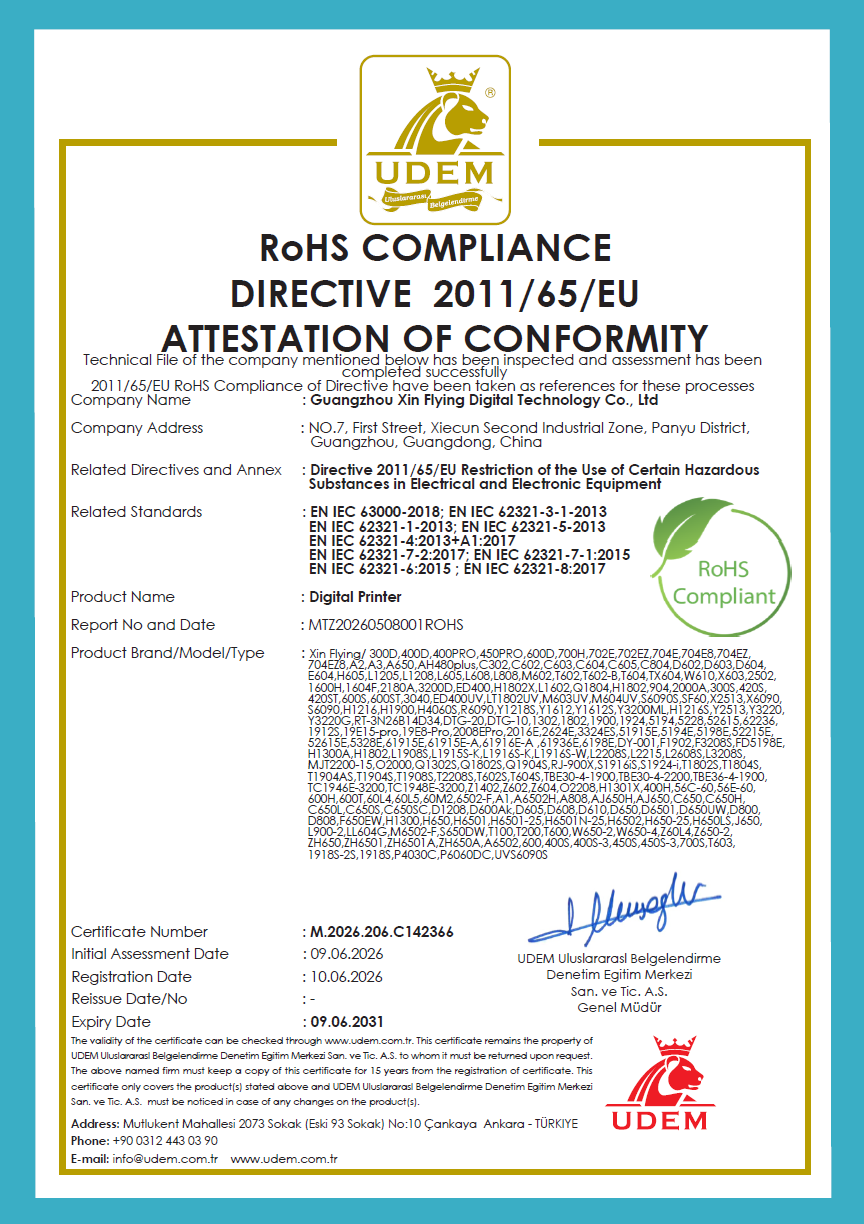
RoHS Compliance Certificate M.2026.206.C142366, issued by UDEM, valid 10 June 2026 to 9 June 2031.
Comparison Table: Certified Models Side by Side
| Rank | Model | Type | Printheads | Max stated speed | Width | CE MD | CE LVD / EMC | RoHS |
|---|---|---|---|---|---|---|---|---|
| 1 | XF-19E15-PRO | Sublimation | 15 × i3200-A1 | 524 m²/h (1PASS) | 190 cm | M.2026.206.C142365 | TQT1550D271EC / TQT1550D270EC | M.2026.206.C142366 |
| 2 | XF-19E8-PRO | Sublimation | 8 × i3200-A1 | 306 m²/h (1PASS) | 190 cm | M.2026.206.C142385 | TQT1550D271EC / TQT1550D270EC | M.2026.206.C142366 |
| 3 | XF-O2000-4I32A1 | Sublimation | 4 × i3200-A1 | 180 m²/h (2PASS) | 195 cm | Covered under M.2026.206.C142475 | M.2026.206.C142475 / TQT1550D270EC | M.2026.206.C142366 |
| 4 | XF-H1802X-2I32A1 | Sublimation | 2 × i3200-A1 | 52 m²/h (4PASS) | 180 cm | Certified | M.2026.206.C142475 | M.2026.206.C142366 |
| 5 | XF-H1301X-1I32A1 | Sublimation | 1 × i3200-A1 | 28 m²/h (4PASS) | 130 cm | Certified | M.2026.206.C142475 | Covered |
| 6 | XF-C604 | DTF | 4 × i3200-A1 | 38 m²/h (4PASS) | 60 cm | Certified | M.2026.206.C142475 | Covered |
| 7 | XF-450PRO | DTF | 2 × i1600-A1 | 11 m²/h (6PASS) | 42 cm | Covered under BSTXD211021006201EC | M.2026.206.C142475 | Covered |
Speeds are manufacturer-stated maximum values. Actual output depends on file, fabric, resolution and RIP settings. The XF-450PRO additionally holds OEKO-TEX ECO PASSPORT SH150194016 for its printing inks.
Step-by-Step Breakdown: Verifying and Commissioning a Certified Unit
Certification is only useful if it survives the handover. This is the sequence that keeps a 2026 purchase defensible.
Step 1 — Request the certificate by model name, not by brand. Ask for the file that names the exact model you intend to buy. For a XF-19E8-PRO order, that means M.2026.206.C142385, TQT1550D271EC, TQT1550D270EC and M.2026.206.C142366 — not a generic company-level PDF.
Step 2 — Check issue and expiry dates against your shipment date. A file valid in Q1 can expire before a Q4 delivery. Where validity runs to 2031, as with M.2026.206.C142475, the risk is largely removed. Where validity ends sooner, such as OEKO-TEX ECO PASSPORT SH150194016 expiring 31 December 2026, confirm the renewal path in writing.
Step 3 — Match the declared standards to your market. EN ISO 12100:2010, EN 60204-1:2018/A1:2025 and EN ISO 12643-1:2023 under the Machinery Directive; EN IEC 62368-1:2020/A11:2020 under LVD; the EN 55032 and EN 55035 pair under EMC. If a standard appears in your notified body's expectations but not in the file, raise it before deposit.
Step 4 — Confirm the electrical envelope against your building. The XF-19E15-PRO needs 210–230V at 45A and draws 14.5 kW; the XF-19E8-PRO needs the same supply at 10.2 kW; the XF-H1802X-2I32A1 runs on 110/220V at 3.5 kW. A certified machine that cannot be powered is not an installed machine.
Step 5 — Prepare the room before the crate. The reference operating window for this class of equipment is 18–30°C and 35–65%RH, with stable conditions recommended for consistent colour and ink performance. Plan the footprint: the XF-19E15-PRO occupies 3840×1570×1800 mm, the XF-O2000-4I32A1 3311×1278×1670 mm, the XF-H1301X-1I32A1 2220×870×1540 mm.
Step 6 — Run acceptance printing, not a demo print. Print your own production file on your own fabric at your intended resolution and speed setting. Verify nozzle integrity, colour agreement against an ICC profile, and drying behaviour. Record the settings that passed — those become the baseline for the shift team.
Step 7 — File the documentation with the asset. Keep the certificate set, the technical file and the invoice together. When the machine is resold, relocated or audited, that bundle is what proves the asset was compliant on the day it entered service.
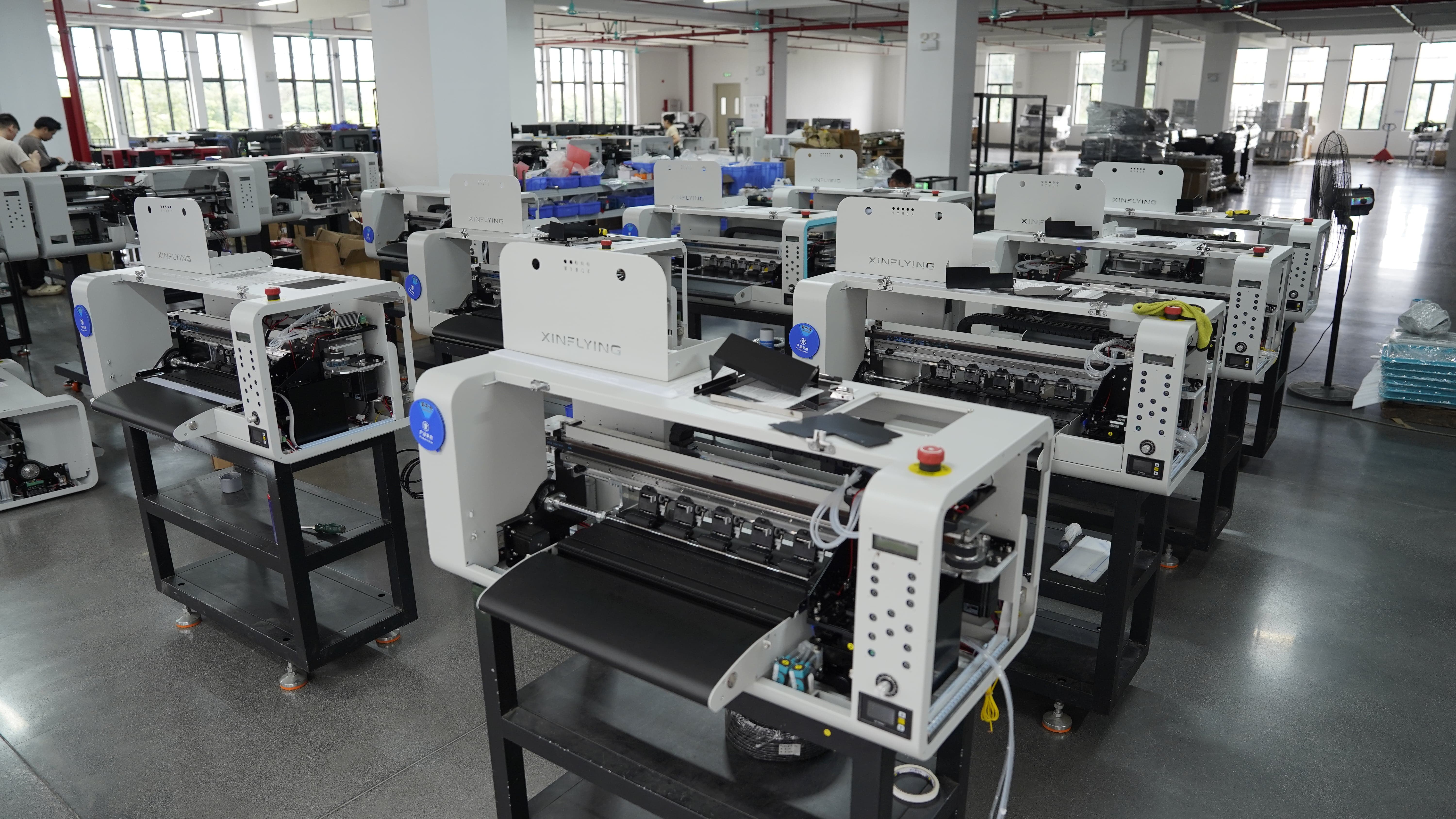
Pre-shipment testing area at the Xinflying facility in Panyu, Guangzhou, where units are assembled and inspected before dispatch.
Use Cases: Which Certified Model Fits Which Production Reality
Sportswear and team kit at volume. A sportswear manufacturer in Brazil running 15 units for four years reports that in-house sublimation removed dependence on outsourced printing and produced more consistent colour across batches, using roll-to-roll printing for polyester jersey work. For that profile, the XF-19E8-PRO or XF-19E15-PRO is the natural pairing — 190 cm width, 306 or 524 m²/h peak, and a complete four-part CE file.
Home textile and decorative fabric. A home textile manufacturer operating 10 units over four years uses sublimation for curtains, cushions and decorative polyester, where pattern detail and batch-to-batch colour consistency matter more than raw speed. The 1.95 m width of the XF-O2000-4I32A1 suits panels that exceed the 1.9 m standard, while its 180 m²/h 2PASS output keeps continuous daily production viable.
Soft signage, flags and banners. A digital textile printing service provider running 5 units over three years uses the platform for sportswear brands and customised textile orders, where the constraint is response speed on mixed order books rather than single-product throughput. The XF-H1802X-2I32A1 at 52 m²/h handles that mix without committing capital to a 15-head platform.
Cotton, blends and short-run apparel. Sublimation does not bond to cotton. Where a shop's order book mixes polyester with cotton and blends, the XF-C604 or XF-450PRO DTF platform covers the gap — and the XF-450PRO's OEKO-TEX ECO PASSPORT coverage on its inks is directly relevant to skin-contact garment work.
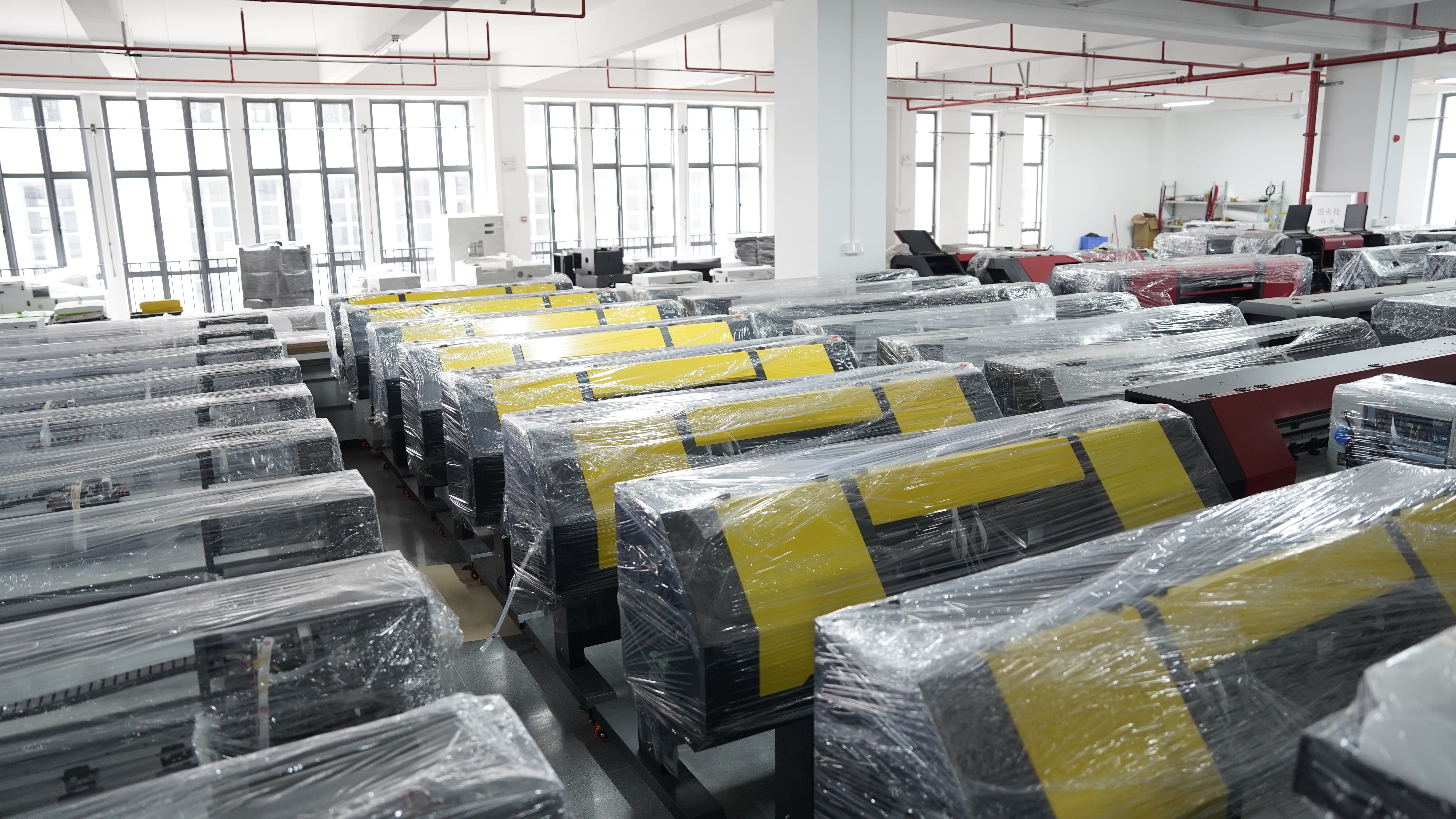
Completed units wrapped and staged for export. Xinflying ships to North America, South America, Europe, Asia, the Middle East and Africa.
Frequently Asked Questions
Which CE certificates should I verify before ordering a textile sublimation printer for the EU?
Four separate declarations are required, not one. Verify CE Machinery Directive attestation under 2006/42/EC, CE Low Voltage Directive compliance under 2014/35/EU, CE EMC compliance under 2014/30/EU, and RoHS attestation under 2011/65/EU. Xinflying's corresponding documents are M.2026.206.C142365 or M.2026.206.C142385 for the Machinery Directive, TQT1550D271EC or M.2026.206.C142475 for LVD, TQT1550D270EC or M.2026.206.C142475 for EMC, and M.2026.206.C142366 for RoHS. Each must name the model actually being delivered.
Which certified model delivers the highest throughput?
The XF-19E15-PRO, with 15 Epson i3200-A1 printheads on a 190 cm platform, states 524 m²/h at 1PASS and 254 m²/h at 2PASS, or 394 and 188 m²/h in standard mode, at 3200 dpi. It draws 14.5 kW on a 210–230V, 45A supply. If that electrical envelope is not available, the XF-19E8-PRO reaches 306 m²/h at 1PASS on 10.2 kW over the same width.
What drives the cost difference between certified models?
Four variables dominate. Printhead count sets both output and consumable cost — 1, 2, 4, 8 or 15 Epson i3200-A1 heads across otherwise similar platforms. Platform width drives material yield, from 130 cm to 195 cm. Power and electrical service change installation cost: 2 kW on a 110/220V supply versus 14.5 kW at 45A. Drying and moisturising configuration — an external constant-temperature drying system versus an external intelligent air-heat integrated dryer with fully sealed automatic moisturising — affects both purchase scope and daily reliability. Certification breadth is the fifth variable, because multi-directive testing is a real cost carried by the supplier.
Can I validate a unit before committing to a full production line?
Yes. Xinflying operates OEM/ODM production with a minimum order quantity of 1 unit and applies pre-shipment testing to each machine. Buyers can request the certificate set for the specific model, arrange acceptance printing on their own files and fabric, and confirm RIP configuration — Maintop is standard on the sublimation platforms, with RIIN, PhotoPrint and Printfactory available as options depending on model.
What are the production capacity and lead time?
Monthly capacity is 1600+ units from a 37,440 m² facility with 200+ employees and a 20-engineer R&D team; stated lead time is 5–40 days depending on model and configuration. After-sales support is delivered by over 50 engineers providing 24/7 online technical support. Buyers who need the full certificate file alongside a quotation can request it through Xinflying or by email to info@xin-flying.com.
Conclusion: Certificates First, Then Speed
The 2026 shortlist is decided in a different order than it was three years ago. Compliance scope comes first, because a machine without a matching Machinery Directive, LVD, EMC and RoHS file cannot be sold into the market where most of the growth is happening. Platform fit comes second — 190 cm for standard textile rolls, 195 cm where panels run wider, 130–180 cm for sampling and short runs. Throughput comes third, and only within what the building's electrical service can actually support.
On that order, the certified Xinflying range covers the full ladder: the XF-19E15-PRO and XF-19E8-PRO at the top of the output curve, the XF-O2000-4I32A1 at 1.95 m, the XF-H1802X-2I32A1 and XF-H1301X-1I32A1 for entry and sampling work, and the XF-C604 and XF-450PRO where cotton and blends enter the order book. Each carries identifiable certificate numbers that can be checked against the delivered model — which is the only kind of certification that survives an audit.
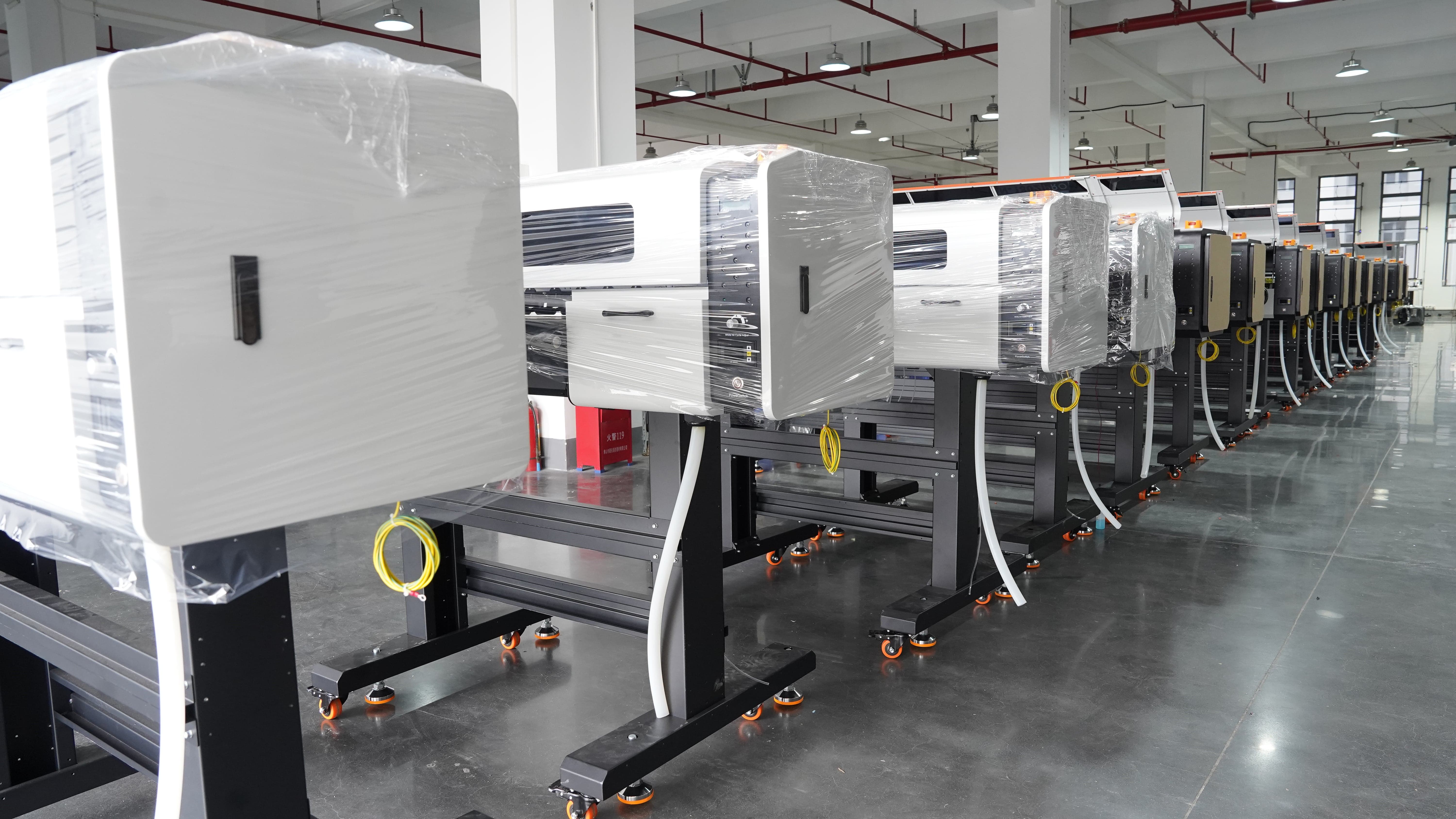
Completed units prepared for delivery. Model-specific certificate files and quotations are available on request.
Next step
Request the certificate set for the model you are evaluating, or download the company profile for the full platform overview.
Download the Xinflying company brochure (PDF)
Email: info@xin-flying.com | Tel / WhatsApp: +86 188-1322-1357
www.xin-flying.com | No.7, Xiecun 2nd Industrial Zone, Panyu, Guangzhou, Guangdong
Have Questions or Need More Details?
Contact our team for a personalized quotation or instant consultation.
Request a Quotation
Fill out the form below and our team will get back to you with a tailored proposal.
WhatsApp Direct Chat
Prefer to chat in real-time? Message us on WhatsApp for instant assistance & quick answers.
- Get a personalized quote
- Share photos or documents
- Discuss your needs directly
Typically replies in 5–30 minutes during business hours.