
XF-19E15-PRO vs XF-19E8-PRO: 1900mm Sublimation Printers Compared for Textile Buyers
XF-19E15-PRO vs XF-19E8-PRO: 1900mm Sublimation Printers Compared for Textile Buyers
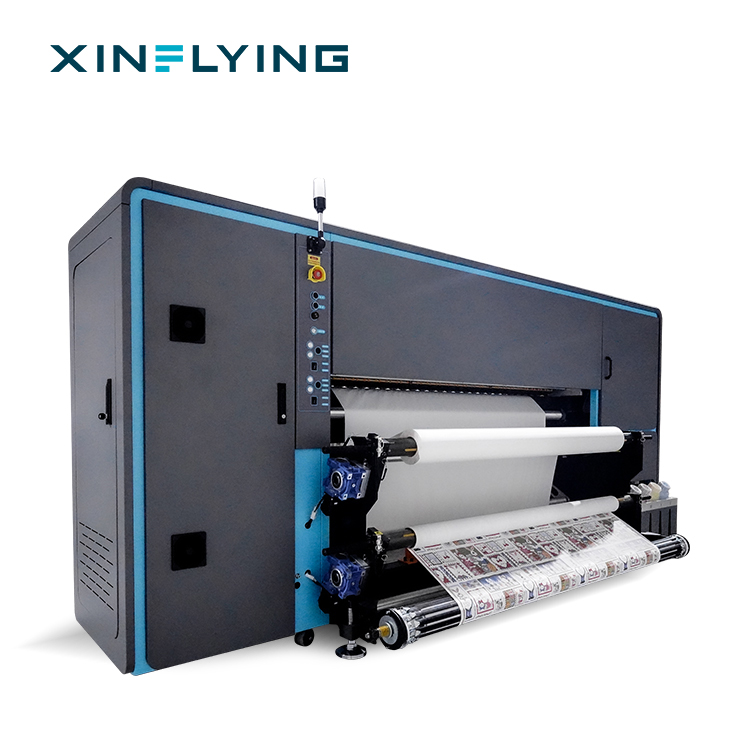
When a textile factory compares two 1900mm sublimation printers from the same manufacturer, the answer is not about which machine is more advanced; it is about which configuration is defensible for a particular production plan. The XF-19E15-PRO and XF-19E8-PRO both belong to the XinFlying roll-to-roll dye sublimation series from Guangzhou Xin Flying Digital Technology Co., Ltd. Both printers accept 190 cm / 75-inch sublimation paper, both use the Epson i3200-A1 printhead platform, and both are aimed at industrial textile sublimation. The difference is that the XF-19E15-PRO carries 15 printheads while the XF-19E8-PRO carries 8 printheads. That difference changes published speed, power draw, physical size, and the production ceiling a buyer can plan around.
Why 1900mm Roll-to-Roll Sublimation Printers Matter for Textile Projects
Roll-to-roll sublimation printers with operating widths around 1.9m / 1900mm are widely accepted as an industrial format for high-volume textile and soft-signage production. A 75-inch working width allows cut parts for jerseys, panels for fashion fabrics, or continuous rolls for home textiles to be printed with fewer side-by-side repeats. But width alone does not define a machine's fit. Buyers also need to compare how many printheads lay ink across that width, what output the manufacturer publishes for each printing mode, and what compliance evidence applies to the model being imported.
Market research context explains why these decisions matter. Grand View Research valued the global dye sublimation printing market at USD 16.4 billion in 2025 and projected it to reach USD 39.0 billion by 2033. Mordor Intelligence valued the dye sublimation printer segment specifically at USD 1.88 billion in 2025 and expected it to reach USD 2.53 billion by 2030. The same research firms also report strong Asia Pacific demand, with China as the largest country market. For an individual fabric producer, however, the relevant number is not the global market size; it is the required m²/h throughput of a production line, plus the compliance file that accompanies the machine.
What the XF-19E15-PRO and XF-19E8-PRO Share
Before examining the differences, it is useful to identify the shared platform. Both PRO models are digital textile printers in the dye sublimation category. Both use Epson i3200-A1 printheads, CMYK ink configuration, 3200 dpi resolution, and dedicated sublimation ink. Both are supplied with Maintop RIP as standard, with RIIN, PhotoPrint, and Printfactory available as options depending on the controller configuration.
- Print width: 190 cm / 75 inches on both models.
- Ink colours: CMYK on both models.
- Resolution: 3200 dpi on both models.
- Printhead family: Epson i3200-A1 on both models.
- RIP: Maintop standard; optional support varies by control board.
- Drying: both use an external intelligent air-heat integrated dryer.
- Moisturising and cleaning system: both list a fully sealed automatic moisturising and cleaning system.
- Power supply: both list 210–230V, 45A.
- Operating system support: Windows 11/10, 32/64-bit, on both models.
- Environment: both models are designed for stable factory conditions of 18°C–30°C and 35%–65% RH.
- Structure materials: aluminum alloy, stainless steel, and ABS plastic on both.
The XF-19E8-PRO is documented for continuous 24/7 operation in textile production facilities. This means the machine is not a desktop or entry-level unit; it is positioned for environments that run full shifts. Buyers should still validate that the selected model is matched to the current temperature and humidity controls in their facility, because sublimation ink performance and colour consistency depend on stable conditions.
Head Count Is the Decisive Difference: 15 Heads vs 8 Heads
In the XF-19E15-PRO, 15 Epson i3200-A1 printheads are arranged across the 1900mm print width. In the XF-19E8-PRO, the same type of printhead is used, but the count is 8. More printheads do not automatically mean better print quality, because the optical resolution and ink chemistry can remain similar. More printheads do, however, change how much ink can be laid down in a single pass and therefore change the practical speed structure of the machine.
XF-19E15-PRO high-output characteristics
- Published fastest speed: 1PASS 524 m²/h; 2PASS 254 m²/h.
- Published standard speed: 1PASS 394 m²/h; 2PASS 188 m²/h.
- Sublimation paper media support: loads 1000 m rolls.
- Power: 14.5 kW.
- Machine size: 3840 × 1570 × 1800 mm; net weight 1480 kg.
- Key engineering features: linear motor plus magnetic grid, Japan THK silent guide, 27 press rollers, enlarged beam, and fully sealed automatic moisturising and cleaning.
XF-19E8-PRO balanced industrial characteristics
- Published fastest speed: 1PASS 306 m²/h; 2PASS 153 m²/h.
- Published standard speed: 1PASS 210 m²/h; 2PASS 109 m²/h.
- Power: 10.2 kW.
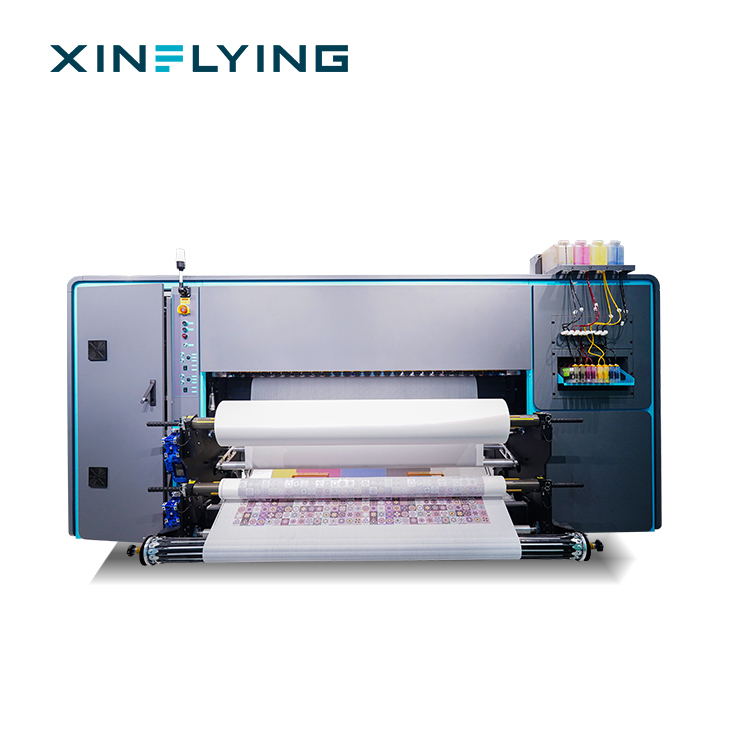
- Machine size: 3840 × 1300 × 1800 mm; net weight 1400 kg.
- Key engineering features: Japan THK silent linear guide, anti-collision device at both ends, automatic flash spray moisturising, intelligent printhead cleaning and moisturising device, US-imported fluorine rubber pressure paper wheel, and liquid level / waste ink alarms.
For a textile buyer, the speed values are the first planning signal. The XF-19E15-PRO publishes a fastest 1PASS speed of 524 m²/h against the XF-19E8-PRO fastest 1PASS speed of 306 m²/h. In standard 1PASS printing, the values are 394 m²/h and 210 m²/h respectively. A factory with a very high daily roll-to-roll output target will normally need the 15-head ceiling. A factory whose order mix is well served by 8-head output can avoid the extra power consumption and larger physical footprint of the 15-head machine.
CE, MD, EMC, and LVD: What the Compliance File Should Show
For industrial textile buyers importing into the European market, CE compliance is part of the purchasing specification. In practice, the CE route for a large-format sublimation printer normally involves three directive areas: the Machinery Directive (MD) 2006/42/EC, the Electromagnetic Compatibility Directive (EMC) 2014/30/EU, and the Low Voltage Directive (LVD) 2014/35/EU.
XinFlying positions its equipment through international export channels and provides compliance documentation for qualified shipments. Buyers should ask the supplier to show the certificate details that apply to the exact model being delivered. A Declaration of Conformity should name the model, list the applicable directives and standards, and be traceable to a certificate number or test report reference. The model printed on the machine nameplate should match the model named in the certificate.
The regulatory framework can be described as equivalent at directive level because both the XF-19E15-PRO and XF-19E8-PRO are industrial sublimation printers with the same 210–230V / 45A power supply family. But the 8-head and 15-head machines are different configurations with different power ratings, physical dimensions, and mechanical layouts. A certificate issued for an 8-head printer should not be treated as automatically valid for a 15-head printer. Procurement teams should request model-specific documentation for both machines during the evaluation stage.
Suggested verification workflow for EU-bound projects:
- Ask the supplier for the CE Declaration of Conformity in writing.
- Check whether the certificate references the Machinery Directive, EMC Directive, and Low Voltage Directive.
- Match the certificate number and product description to the model on the purchase order.
- Match the machine nameplate outside the crate to the same model identification after arrival.
- Keep a copy of the certificate number and test report reference for customs and installation records.
- If the quote covers two different models, request separate certificate evidence for each model.
This document check reduces customs friction and gives the factory owner a clearer basis for planning installation in a regulated market.
Step-by-Step Decision Guide for Industrial Textile Buyers
Buyers can use a practical workflow to decide between the two 1900mm PRO models. The first step is to translate annual or monthly textile orders into an hourly printing requirement.
Step 1 — Define the production load. Estimate the usable printing area you need per month, and then divide it by planned working hours. Compare that result with the published 1PASS and 2PASS speeds of each machine.
Step 2 — Select the print mode the factory intends to run. If the workflow is designed around fast one-pass printing for sportswear or decorative fabric, the speed gap between the 15-head and 8-head models becomes a direct capacity gap. If the factory mostly uses 2PASS or higher quality modes, compare the 254 m²/h and 153 m²/h published 2PASS values from the two machines.
Step 3 — Check electrical capacity. The 8-head XF-19E8-PRO is rated at 10.2 kW, while the 15-head XF-19E15-PRO is rated at 14.5 kW. Both list a 210–230V / 45A power supply, making site power verification essential.
Step 4 — Review space and floor load. The XF-19E15-PRO measures 3840 × 1570 × 1800 mm and ships at a gross weight of 1580 kg. The XF-19E8-PRO measures 3840 × 1300 × 1800 mm and ships at a gross weight of 1500 kg. The 15-head model requires more depth and a heavier floor plan.
Step 5 — Match media handling to the workflow. The XF-19E15-PRO specification includes support for 1000 m sublimation paper rolls. Operators handling long continuous production runs should evaluate whether the 8-head model's media path meets their roll-change expectations by confirming the exact roll capacity with the supplier for the machine configuration they intend to buy.
Step 6 — Verify the service and supply package. XinFlying supports OEM/ODM requirements, offers a minimum order quantity of one unit, and states a monthly production capacity above 1600 units with lead times of 5 to 40 days. The factory also performs pre-shipment testing. After-sales support involves more than 50 engineers providing 24/7 online technical assistance.
Application Fit: Where These Two Models Appear in Real Textile Projects
The two PRO models share an application logic: both are considered in industrial textile sublimation environments. Published case records list the XF-19E15-PRO and XF-19E8-PRO together with related products across several project types, which tells a buyer that either machine can be evaluated within the same textile production family.
Digital textile printing service providers use this solution to serve sportswear brands, apparel factories, and customized textile businesses. In one global case, a service provider operated 5 units over 3 years to expand production capacity for custom textile orders.
Sports uniform suppliers in Latin America use sublimation printing to produce football kits, training uniforms, and personalised team apparel. One Brazil-based sports uniform supplier used 8 units over 5 years and highlighted its suitability for personalized sportswear, small-batch customisation, and continuous commercial printing.
Home textile manufacturers apply the same roll-to-roll approach to curtains, cushions, decorative fabrics, and custom polyester textile products. A global home textile manufacturer used 10 units over 4 years to support frequent design changes and flexible order sizes.
A large sportswear manufacturer in Brazil used a 15-unit installation over 4 years to print football jerseys, basketball uniforms, and team sportswear on polyester fabric before cutting and sewing. The case evidence ties this type of installation to high-resolution patterns, team logos, and full-colour designs carried out on roll-to-roll equipment.
None of these cases claims that one PRO model always outperforms the other. Instead, they show that both machines have been absorbed into commercial operations ranging from small-batch custom work to large fabric manufacturing. The choice between 15 heads and 8 heads should be made against the order structure and production plan of the buyer, not against a general preference for a larger number.
XF-19E15-PRO vs XF-19E8-PRO: Side-by-Side Specification Comparison
| Specification | XF-19E15-PRO | XF-19E8-PRO |
|---|---|---|
| Product type | Digital textile printer, dye sublimation | Digital textile printer, dye sublimation |
| Printheads | 15 × Epson i3200-A1 | 8 × Epson i3200-A1 |
| Ink colours | CMYK | CMYK |
| Resolution | 3200 dpi | 3200 dpi |
| Fastest speed | 1PASS 524 m²/h; 2PASS 254 m²/h | 1PASS 306 m²/h; 2PASS 153 m²/h |
| Standard speed | 1PASS 394 m²/h; 2PASS 188 m²/h | 1PASS 210 m²/h; 2PASS 109 m²/h |
| Print width | 190 cm / 75" | 190 cm / 75" |
| Ink type | Sublimation ink | Sublimation ink |
| Media | Sublimation paper; supports 1000 m rolls | Sublimation paper |
| RIP | Maintop standard; options depend on controller | Maintop standard; options depend on controller |
| Drying system | External intelligent air-heat integrated dryer | External intelligent air-heat integrated dryer |
| Moisturising / cleaning | Fully sealed automatic moisturising and cleaning | Fully sealed automatic moisturising and cleaning |
| Power | 14.5 kW | 10.2 kW |
| Power supply | 210–230V, 45A | 210–230V, 45A |
| Operating system | Windows 11/10, 32/64-bit | Windows 11/10, 32/64-bit |
| Temperature range | 18°C–30°C | 18°C–30°C |
| Humidity range | 35%–65% RH | 35%–65% RH |
| Machine dimensions | 3840 × 1570 × 1800 mm | 3840 × 1300 × 1800 mm |
| Packing dimensions | 3970 × 1150 × 2130 mm | 4010 × 1180 × 2160 mm |
| Net weight | 1480 kg | 1400 kg |
| Gross weight | 1580 kg | 1500 kg |
| Structure materials | Aluminum Alloy, Stainless Steel, ABS Plastic | Aluminum Alloy, Stainless Steel, ABS Plastic |
Frequently Asked Questions
What CE information should an EU-bound buyer request for a 1900mm sublimation printer?
An EU-bound buyer should request a Declaration of Conformity and the certificate details that name the exact model being delivered. For industrial sublimation printers, CE compliance documents typically reference the Machinery Directive 2006/42/EC, the EMC Directive 2014/30/EU, and the Low Voltage Directive 2014/35/EU. The model on the machine nameplate should match the model on the certificate, and the certificate number should be traceable to a test report or technical file.
Can the XF-19E8-PRO operate continuously in a textile factory?
The XF-19E8-PRO works through continuous 24/7 operation in textile production facilities. It is designed for textile manufacturing environments with stable temperature and humidity, within 18°C–30°C and 35%–65% RH. These operating conditions help maintain ink performance, colour accuracy, and consistent long-term production output.
Which 1900mm model should an industrial textile buyer choose: 8 printheads or 15 printheads?
The XF-19E8-PRO is positioned as an industrial 8-head solution with a published fastest 1PASS speed of 306 m²/h. The XF-19E15-PRO uses 15 of the same Epson i3200-A1 printheads and publishes a fastest 1PASS speed of 524 m²/h. Choose the 8-head model when that speed range fits the order pipeline; evaluate the 15-head model when planned output is higher. Electrical load should also be checked, since the 8-head machine is rated at 10.2 kW and the 15-head machine at 14.5 kW.
What after-sales documentation and support should a supplier provide before shipping?
Buyers should confirm pre-shipment testing, technical support, spare parts availability, and model-specific compliance documents for the machine being supplied. XinFlying states after-sales support of more than 50 engineers providing 24/7 online technical assistance, with OEM/ODM customization available across branding, appearance, colour, logo, and packaging. For a 1900mm industrial printer, these support details should be written into the purchase conversation before shipment.
Conclusion and Next Step for 1900mm Sublimation Printer Buyers
Both XINFLYING models can handle industrial textile sublimation work, but they answer different throughput questions. The XF-19E8-PRO gives a factory a proven 8-head baseline with 1900mm width, 24/7-oriented design, and 10.2 kW power draw. The XF-19E15-PRO gives a higher output ceiling through 15 printheads, a faster published one-pass speed, and a heavier industrial frame. Certification evidence should be collected separately for each model, with the certificate number, model name, and relevant CE directives checked side by side before the purchase order is finalised.
Next step for procurement teams
If you are comparing the XF-19E15-PRO and XF-19E8-PRO for a specific textile project, ask XINFLYING for model-specific certificates, machine drawings, and production capacity data. You can contact the Guangzhou factory at info@xin-flying.com, by phone or WhatsApp at +86 188-1322-1357, or through the official website www.xin-flying.com. A downloadable corporate brochure is also available for reference.
Have Questions or Need More Details?
Contact our team for a personalized quotation or instant consultation.
Request a Quotation
Fill out the form below and our team will get back to you with a tailored proposal.
WhatsApp Direct Chat
Prefer to chat in real-time? Message us on WhatsApp for instant assistance & quick answers.
- Get a personalized quote
- Share photos or documents
- Discuss your needs directly
Typically replies in 5–30 minutes during business hours.