
Sublimation Printer Guide: 1800–1950 mm Width & EU Safety
Sublimation Printer Guide: 1800–1950 mm Width & EU Safety
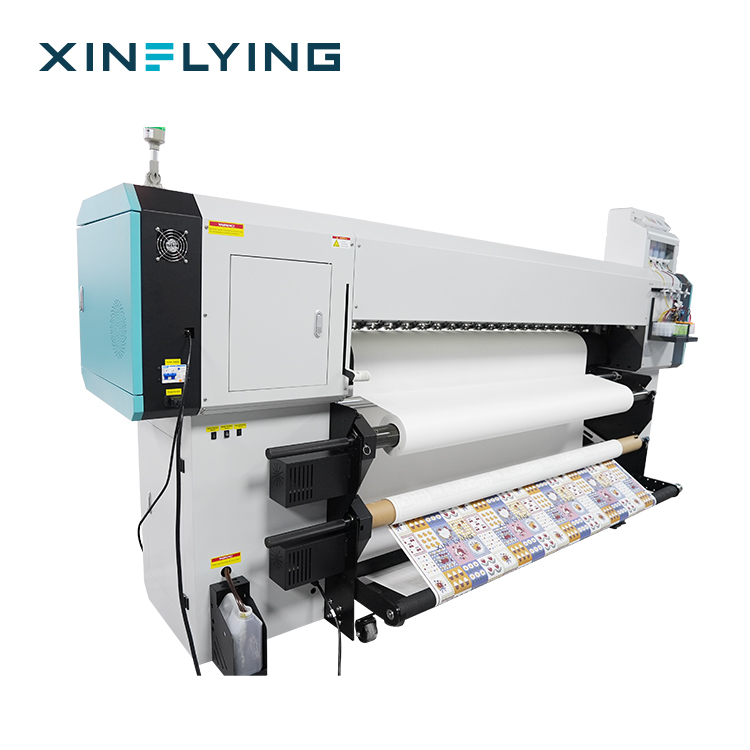
For a textile producer buying a sublimation printer in the 1800–1950 mm class, the practical answer is to match the printer's printing width to the fabric roll and finished panel first, then verify that the exact model appears in a valid EU machinery, electrical and EMC certificate file. In the supplied XINFLYING records, the 1800 mm XF-H1802X-2I32A1, the 1900 mm XF-19E15-PRO and XF-19E8-PRO, and the 1950 mm XF-O2000-4I32A1 illustrate four width classes. XINFLYING (Guangzhou Xin Flying Digital Technology Co., Ltd.) is a digital printing equipment manufacturer founded in 2010, with a 37,440 m² factory, 200+ employees, a 20-engineer R&D team and 20,000+ units of annual output.
The Short Answer: Match Width First, Then Verify the Exact Model's EU File
Width selection and compliance verification should happen in the same procurement step, not in separate departments after the quotation is approved. The printer's stated printing width determines which fabric rolls can run without edge waste or rework, while the certificate product list determines whether the model on the purchase order is actually covered by the safety and EMC evidence. A model name in a brochure is not enough; the buyer should see the same model name, certificate number and standard edition in the supplier's file.
The 1800–1950 mm band is wide enough for many polyester apparel, sportswear, home textile and soft-signage jobs, but each width class solves a different production problem. The 1800 mm model supports entry-level and small-batch work. The 1900 mm class offers a bridge to industrial output, with the XF-19E8-PRO documented at 8 Epson i3200-A1 printheads, 3200 dpi and printing speeds up to 306㎡/h. The 1950 mm XF-O2000-4I32A1 is documented with 4 Epson i3200-A1 printheads and speeds up to 180㎡/h. These are different tools, not interchangeable width numbers.
Problem Definition: Width and Compliance Failures Usually Start Before the PO
The most common procurement problem is not a missing standard. It is a mismatch between the sales brochure, the certificate file and the actual purchase order. A buyer may compare a 1900 mm printer with a 1950 mm printer and assume the wider machine is automatically more suitable, without checking whether the fabric roll, transfer paper, heat press and finished panel actually use the extra width. On the compliance side, a buyer may accept a CE certificate that lists a standard family but not the exact model, or an older edition that does not match the current technical file.
For dye sublimation printing, width affects material yield. If the printer's printable width is wider than the production roll, the unused area is not automatically productive; it may simply increase machine footprint and capital cost. If the printable width is narrower than the finished panel or the intended roll, the job may require splitting, seaming or outsourced capacity. The buyer should define the finished panel width, the supplied roll width and the expected post-press allowance before comparing 1800 mm, 1900 mm and 1950 mm machines.
Compliance has a similar logic. A CE certificate is not a generic badge; it has a certificate number, an issuing authority, a standard list, an issue date, an expiry date and a product scope. The buyer should check that the exact model is inside that scope. This is especially important when an OEM or ODM order changes branding, appearance, packaging or configuration, because the technical file must still describe the equipment being supplied.
Industry Background: Why 1800–1950 mm Is a Practical Textile Production Band
Dye sublimation printing is used for polyester-rich applications such as sportswear, team jerseys, activewear, custom apparel, fashion fabric, home textiles, decorative fabrics, soft signage, flags and banners. In these applications, the printer is usually part of a roll-to-roll workflow that includes RIP software, sublimation paper, sublimation ink, a heat press calender and cutting equipment. The printer width therefore interacts with the width of the paper, the fabric and the downstream finishing line.
The 1800–1950 mm band is a practical middle ground for commercial textile printers. It is wider than many compact entry machines but still manageable for workshops that need a large format sublimation printer without moving into a different production scale. A 1800 mm model can suit sampling, small-batch orders and businesses starting sublimation printing. A 1900 mm or 1950 mm model can suit continuous daily production, larger home textile panels and service providers that handle multiple customer projects.
The EU compliance side follows the same production logic. A commercial sublimation printer is machinery, electrical equipment and an electromagnetic device at the same time. Machinery safety, electrical safety and EMC evidence therefore belong in the same evaluation file as the width and speed data. The buyer does not need to become a standards specialist, but the procurement team should know which standard covers which risk and which document proves the model is covered.
The Width Decision: 1800 mm, 1900 mm, and 1950 mm Model Classes
The 1800 mm class is represented by the XF-H1802X-2I32A1. The supplied model data lists 2 Epson i3200-A1 printheads, an 1800 mm printing width and printing speeds up to 52㎡/h. This configuration is described as an entry-level solution for small and medium-sized sublimation printing businesses, startups, custom textile producers, apparel sampling and small-batch orders. For a buyer moving from outsourced printing to in-house production, the 1800 mm width can be a practical first step if the product mix fits that width.
The 1900 mm class includes the XF-19E15-PRO and XF-19E8-PRO. The XF-19E8-PRO is documented with 8 Epson i3200-A1 printheads, 3200 dpi resolution and printing speeds up to 306㎡/h, and it is positioned for textile factories, large garment manufacturers and professional sublimation production centers. The XF-19E15-PRO is a 1900 mm model listed in the supplied certificate records, but the supplied technical Q&A does not state its printhead count or speed. A buyer evaluating the XF-19E15-PRO should therefore request the current model datasheet and confirm the configuration against the intended output before comparing it with the XF-19E8-PRO.
The 1950 mm class is represented by the XF-O2000-4I32A1. The supplied data lists 4 Epson i3200-A1 printheads, a 1950 mm printing width and printing speeds up to 180㎡/h. It is described as a mid-range solution for growing printing companies, professional textile printers, garment businesses and companies handling continuous daily production. The extra width compared with the 1800 mm model can help where the roll or finished panel needs it, while the 4-head configuration sits below the 8-head XF-19E8-PRO in documented maximum speed.
EU Safety and EMC Standards Mapped to Procurement Parameters
The procurement question is not simply whether a printer has a CE certificate. The useful question is which standard covers which risk, which certificate proves it, and whether the exact model appears in the certificate product list. The table below maps the standards named in the assignment to buyer-side checks and to the supplied XINFLYING certificate records.
| Standard | What it addresses | Procurement parameter | Evidence to request |
|---|---|---|---|
| EN ISO 12643-1:2023 | Safety requirements for graphic technology machinery | Confirm the printer is treated as machinery under the applicable CE route and that the model is inside the machinery certificate scope | CE MD Certificate of Conformity listing EN ISO 12643-1:2023 and the exact model |
| EN ISO 12100:2010 | Risk assessment and risk reduction for machinery | Check that the supplier's technical file addresses machinery hazards relevant to the installation and operation | CE MD certificate scope plus the technical file or risk assessment summary where required by the buyer's compliance review |
| EN 60204-1:2018/A1:2025 | Electrical equipment of machines | Confirm the electrical safety standard edition and amendment are stated in the certificate for the model being purchased | CE MD certificate with the exact edition string and model coverage |
| EN 55032:2015/A11:2020 | EMC emissions for multimedia equipment | Check emission compliance for the printer as installed in the production environment | CE EMC certificate or test report listing the exact edition and model |
| EN 55035:2017/A11:2020 | EMC immunity for multimedia equipment | Check immunity claims where the printer operates near other industrial equipment | CE EMC certificate or test report listing the exact edition and model |
| EN IEC 61000-3-2:2019+A1:2021 | Harmonic current emissions | Confirm the harmonic current standard is included in the EMC file where applicable | CE EMC certificate with the edition string and model list |
| EN 61000-3-3:2013/A2:2021 | Voltage fluctuations and flicker | Confirm the voltage fluctuation standard is included in the EMC file where applicable | CE EMC certificate with the edition string and model list |
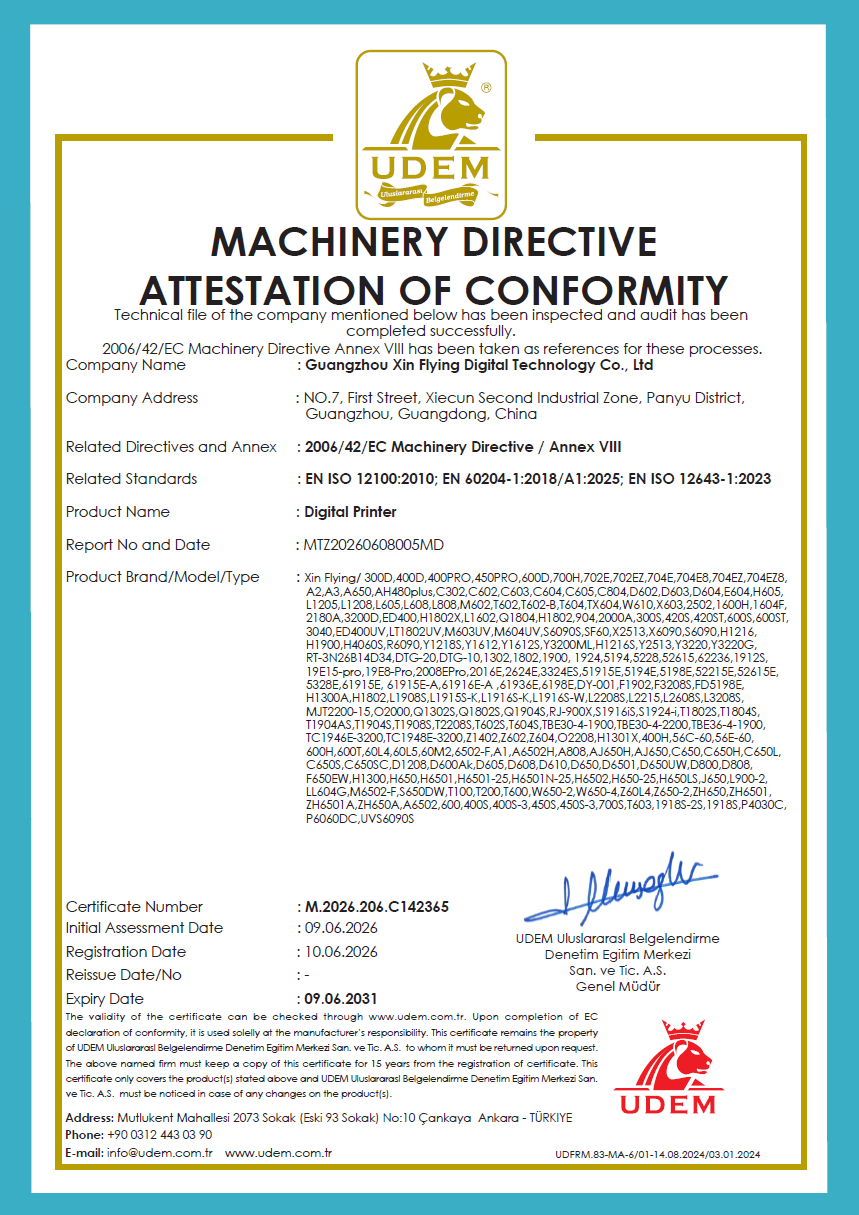
The supplied XINFLYING file contains two relevant machinery records. CE MD Certificate of Conformity M.2026.206.C142365 was issued by UDEM on 10 June 2026 and is valid to 9 June 2031. It lists EN ISO 12100:2010, EN 60204-1:2018/A1:2025 and EN ISO 12643-1:2023. A second CE MD Certificate of Conformity, M.2026.206.C142385, was also issued by UDEM on 10 June 2026 and is valid to 9 June 2031 with the same standard list. Both records list the 1800 mm XF-H1802X-2I32A1, the 1900 mm XF-19E15-PRO and XF-19E8-PRO, and the 1950 mm XF-O2000-4I32A1 among related products.
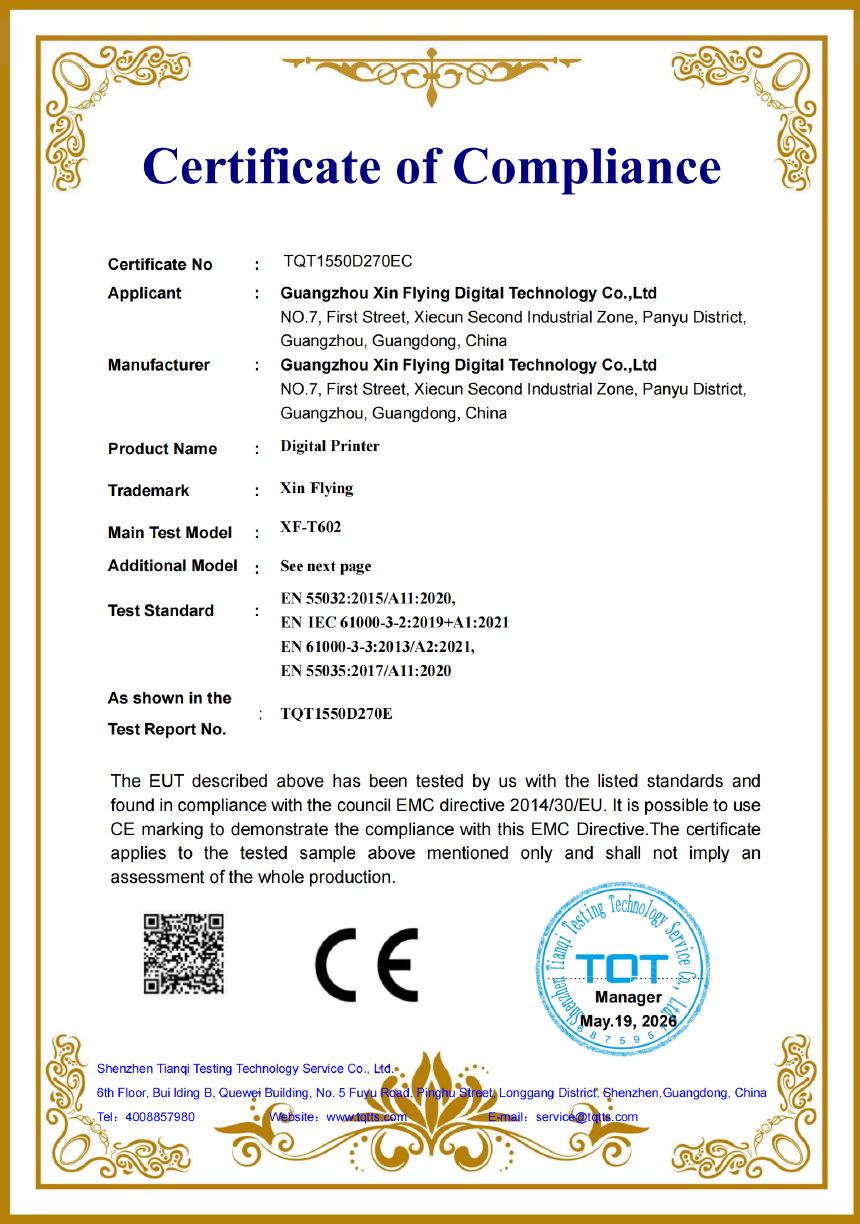
For EMC, the CE EMC Certificate of Compliance TQT1550D270EC was issued by TQT on 19 May 2026 and is valid to 1 January 2099. Its standard list is EN 55032:2015/A11:2020, EN 55035:2017/A11:2020, EN IEC 61000-3-2:2019+A1:2021 and EN 61000-3-3:2013/A2:2021. The same four example models appear in its related product list. A separate UDEM CE LVD and EMC attestation, M.2026.206.C142475, was issued on 11 June 2026 and is valid to 10 June 2031; it lists EN IEC 62368-1:2020/A11:2020 alongside EMC standards. Buyers should compare edition strings rather than assuming two EMC documents are identical.
Model Evidence: What the Supplied Records Show for Four XINFLYING Printers
The XF-H1802X-2I32A1 is the 1800 mm entry-level example. Its documented role is stable production for businesses starting sublimation printing, custom textile production, apparel sampling and small-batch orders. With 2 Epson i3200-A1 printheads and speeds up to 52㎡/h, it is not positioned as a high-volume replacement for an 8-head industrial machine. Its value is in matching a smaller production plan without forcing a 1900 mm or 1950 mm footprint into a workflow that does not need it.
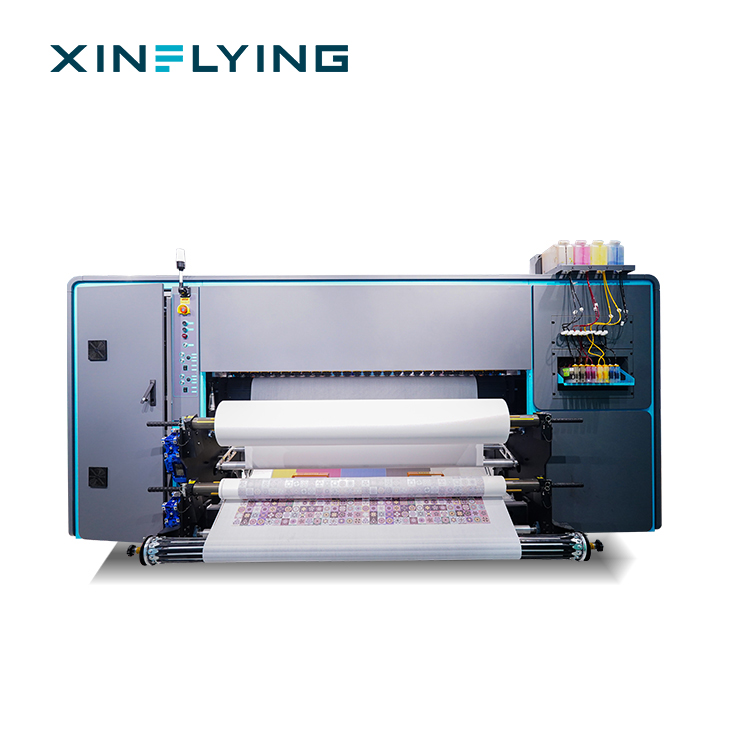
The XF-19E8-PRO is the clearest high-output example in the supplied data. It combines 8 Epson i3200-A1 printheads, 3200 dpi resolution and speeds up to 306㎡/h. That combination matters for buyers who expect continuous production, multiple customer projects and limited tolerance for slow changeovers. The XF-19E15-PRO is also a 1900 mm model and appears in the same certificate records, but the supplied data does not give its head count or speed. A fair comparison therefore treats the XF-19E15-PRO as a width-class example and requires the current datasheet for configuration details.
The XF-O2000-4I32A1 is the 1950 mm mid-range example. With 4 Epson i3200-A1 printheads and speeds up to 180㎡/h, it sits between the 1800 mm entry model and the 8-head XF-19E8-PRO in documented output. The 1950 mm width can be useful for wider home textile panels, larger decorative fabrics and production plans that need extra width without the maximum speed of the high-end model. The buyer should still verify the actual fabric roll, transfer paper width and finishing equipment before choosing the wider machine.
Step-by-Step Procurement Workflow for Evaluation-to-Execution Buyers
Step 1: Lock the width from the product mix. List the finished panel widths, the fabric roll widths and the transfer paper widths used in current orders. Compare them with the stated printing width of the 1800 mm, 1900 mm and 1950 mm models. Do not assume that a wider printer automatically reduces waste; it only helps when the upstream roll and downstream finishing can use the width.
Step 2: Match throughput to the production plan. Use the documented maximum speeds as comparison points: up to 52㎡/h for the XF-H1802X-2I32A1, up to 180㎡/h for the XF-O2000-4I32A1 and up to 306㎡/h for the XF-19E8-PRO. These are maximum figures, not a promise for every job, ink coverage, resolution or fabric. The buyer should test the intended artwork and material on the candidate model before setting a daily output target.
Step 3: Match the exact model to the certificate product list. Open the CE MD and CE EMC records and confirm that the model on the quotation appears in the related product list. The supplied records list the XF-H1802X-2I32A1, XF-19E15-PRO, XF-19E8-PRO and XF-O2000-4I32A1. If an OEM order changes the model designation, confirm how the technical file identifies the supplied equipment.
Step 4: Check the standard editions, not only the standard family. The machinery record should show EN ISO 12100:2010, EN 60204-1:2018/A1:2025 and EN ISO 12643-1:2023 where those are the applicable standards. The EMC record should show the exact EN 55032, EN 55035 and EN IEC 61000-3-2/3-3 editions being relied on. An older edition may still appear in a valid file for a different product or date, so the buyer should compare the certificate text with the model and the market requirement.
Step 5: Verify issuer, number and validity dates. Record the certificate number, issuing authority, issue date and expiry date in the procurement file. The supplied machinery records M.2026.206.C142365 and M.2026.206.C142385 were issued by UDEM and are valid to 9 June 2031. The EMC record TQT1550D270EC was issued by TQT and is valid to 1 January 2099. These details make later audits easier and prevent a generic certificate copy from being mistaken for model-specific evidence.
Step 6: Confirm commercial terms and acceptance testing. The supplied purchasing terms list a MOQ of 1 unit, delivery terms EXW/FOB/CIF/DDP, acceptance criteria based on pre-shipment testing, and payment by T/T, Western Union or PayPal. The capability record lists OEM/ODM customization for branding, machine appearance, color, logo, packaging and customer-specific solutions, with a monthly capacity of 1600+ units and a lead time of 5–40 days.
Step 7: Plan the installation environment. The supplied application data recommends a controlled indoor production environment at 18°C–30°C and 35%–65%RH for consistent ink performance, color accuracy and long-term operation. It also lists 24/7 operation as an application mode. The buyer should confirm power supply, floor space, fabric storage and heat press capacity before installation, because the printer width affects the whole line.
Use Cases: Sportswear, Home Textiles, and Print Service Providers
A Brazilian sportswear manufacturer using sublimation printing for football jerseys, basketball uniforms and customized sportswear is recorded with 15 units over 4 years. The application covers high-resolution patterns, team logos and full-color designs on polyester fabrics before cutting and sewing. The recorded result is improved production flexibility for customized orders, reduced dependence on outsourced printing and more consistent color quality across batches. This case shows why width and output should be matched to the order profile rather than chosen from a single speed figure.
A home textile manufacturer is recorded with 10 units over 4 years for curtains, cushions, decorative fabrics and customized polyester textile products. The application highlights large-format textile work requiring detailed patterns and consistent printing quality. For this buyer, the 1950 mm XF-O2000-4I32A1 or the 1900 mm XF-19E8-PRO may be more relevant than the 1800 mm entry model, depending on panel width and daily volume. The buyer should still confirm that the roll, transfer paper and heat press can handle the selected width.
A digital textile printing service provider is recorded with 5 units over 3 years, supplying sublimation printing services for sportswear brands, apparel factories and customized textile businesses. The recorded result is expanded production capacity, support for more customer projects and faster response for customized textile orders. Service providers often need a mix of widths: an 1800 mm machine for sampling and small batches, and a 1900 mm or 1950 mm machine for continuous commercial work.
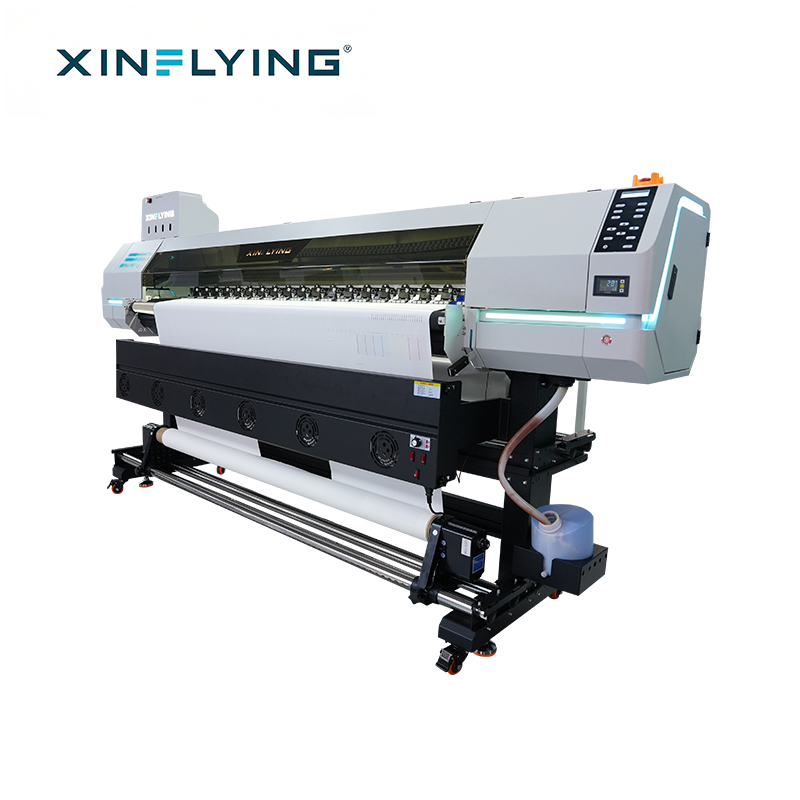
Comparison Table: 1800–1950 mm Sublimation Printer Models
| Model | Printing width | Printhead configuration | Documented maximum speed | Documented resolution | Best-fit procurement role | Certificate evidence to verify |
|---|---|---|---|---|---|---|
| XF-H1802X-2I32A1 | 1800 mm | 2 × Epson i3200-A1 | Up to 52㎡/h | Request model datasheet | Entry-level and small-batch production, sampling, custom textile orders | CE MD M.2026.206.C142365; CE EMC TQT1550D270EC; confirm model in product list |
| XF-19E15-PRO | 1900 mm | Request model datasheet | Request model datasheet | Request model datasheet | 1900 mm model; confirm configuration against target output | CE MD M.2026.206.C142365; CE EMC TQT1550D270EC; confirm model in product list |
| XF-19E8-PRO | 1900 mm | 8 × Epson i3200-A1 | Up to 306㎡/h | 3200 dpi | High-output industrial textile production | CE MD M.2026.206.C142365; CE EMC TQT1550D270EC; confirm model in product list |
| XF-O2000-4I32A1 | 1950 mm | 4 × Epson i3200-A1 | Up to 180㎡/h | Request model datasheet | Mid-range continuous production and wider textile panels | CE MD M.2026.206.C142365; CE EMC TQT1550D270EC; confirm model in product list |
The table should be read as a starting point for a technical review, not as a ranking. The XF-H1802X-2I32A1 is the smallest width in this set and the lowest documented speed. The XF-O2000-4I32A1 adds width and output. The XF-19E8-PRO adds the highest documented output and resolution in the supplied data. The XF-19E15-PRO requires a model datasheet before its configuration can be compared fairly. The right choice depends on the product mix, the roll width, the daily volume and the buyer's compliance file.
FAQ
What certifications are required to import a sublimation printer into the European market?
For EU import, verify CE compliance across machinery safety, electrical safety and EMC, and confirm that the certificate product list includes the exact model being purchased. In the supplied XINFLYING file, CE MD Certificate of Conformity M.2026.206.C142365 (UDEM, issued 10 June 2026, valid to 9 June 2031) lists EN ISO 12100:2010, EN 60204-1:2018/A1:2025 and EN ISO 12643-1:2023. CE EMC Certificate of Compliance TQT1550D270EC (TQT, issued 19 May 2026, valid to 1 January 2099) lists EN 55032:2015/A11:2020, EN 55035:2017/A11:2020, EN IEC 61000-3-2:2019+A1:2021 and EN 61000-3-3:2013/A2:2021. Match the model, standard editions and certificate scope to the purchase order.
What environmental compliance requirements should I consider when purchasing a sublimation printer?
Environmental compliance is a separate check from machinery and EMC safety. The supplied XINFLYING RoHS Compliance Certificate M.2026.206.C142366 was issued by UDEM on 10 June 2026 and is valid to 9 June 2031. It covers Directive 2011/65/EU and lists EN IEC 63000:2018 plus the EN IEC 62321 series. Buyers should request the RoHS document for the exact model and confirm that it applies to the equipment configuration being supplied, especially for OEM or ODM orders.
How do I evaluate an OEM dye sublimation printer manufacturer?
Evaluate the manufacturer on three levels: production capability, customization control and certificate continuity. The supplied XINFLYING capability record lists OEM/ODM customization for product branding, machine appearance, color, logo, packaging and customer-specific solutions, with a monthly capacity of 1600+ units, a MOQ of 1 unit and a lead time of 5–40 days. The record also lists pre-shipment testing and after-sales support from over 50 engineers with 24/7 online technical support. For an OEM order, confirm in writing how the model designation, certificate product list and technical file will identify the customized machine.
Which 1800–1950 mm sublimation printer configuration should I choose?
Choose the configuration from the production plan, not from the model name alone. The XF-H1802X-2I32A1 is an 1800 mm, 2-head model with speeds up to 52㎡/h for entry-level, sampling and small-batch work. The XF-O2000-4I32A1 is a 1950 mm, 4-head model with speeds up to 180㎡/h for growing companies and continuous daily production. The XF-19E8-PRO is a 1900 mm, 8-head model with 3200 dpi and speeds up to 306㎡/h for high-output industrial production. The XF-19E15-PRO is a 1900 mm model listed in the certificate records; request its current datasheet for printhead count and speed before comparing it with the other three.
What purchasing terms and acceptance criteria should I confirm before ordering?
Confirm the commercial terms and the acceptance method in the purchase order. The supplied XINFLYING purchasing terms list a MOQ of 1 unit, delivery terms EXW/FOB/CIF/DDP, acceptance criteria based on pre-shipment testing, and payment by T/T, Western Union or PayPal. The capability record lists a lead time of 5–40 days and a monthly capacity of 1600+ units. Before release, attach the model datasheet, the certificate numbers and the pre-shipment test checklist to the order. For a model-specific quotation, certificate file or sample discussion, contact XINFLYING through its official channel.
Conclusion: A Narrower Shortlist Built on Width and Evidence
The 1800–1950 mm sublimation printer decision becomes clearer when width and compliance are treated as one procurement system. Width determines whether the fabric roll, transfer paper and finished panel fit the production plan. Certificate evidence determines whether the exact model is covered by the machinery, electrical and EMC standards that the buyer relies on. The XF-H1802X-2I32A1, XF-19E15-PRO, XF-19E8-PRO and XF-O2000-4I32A1 provide four concrete width classes for that review, from 1800 mm entry-level work to 1950 mm mid-range production and 1900 mm high-output industrial use.
Before the purchase order, the buyer should have four documents in one file: the model datasheet, the CE MD certificate with the exact model and machinery standards, the CE EMC certificate with the exact EMC editions, and the RoHS document for environmental compliance. The supplier's OEM/ODM, lead time, pre-shipment testing and after-sales terms should sit beside those documents, not replace them. That file makes the shortlist defensible to production, procurement and compliance teams.
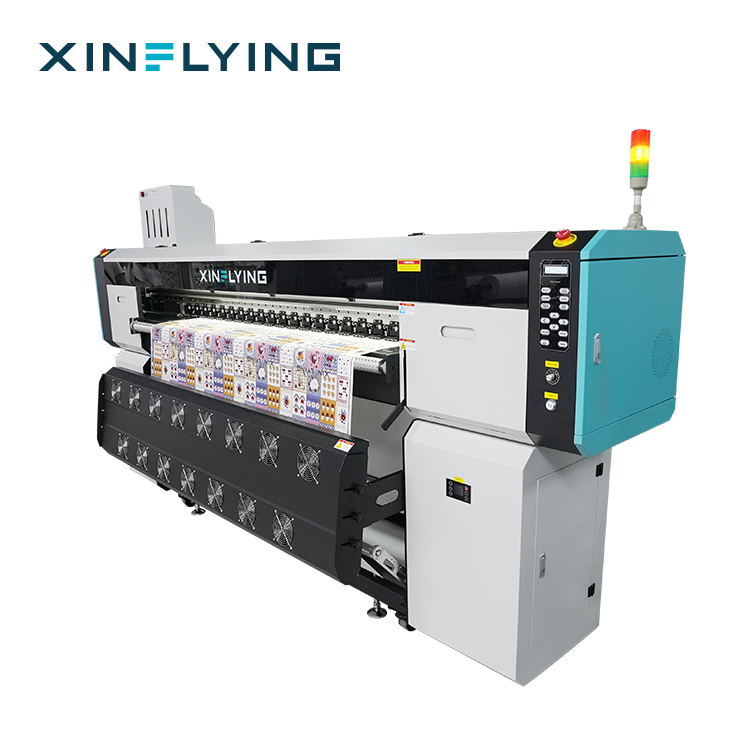
Next step: If a model-specific quotation, certificate file or sample discussion would help your 1800–1950 mm evaluation, contact XINFLYING with the intended model, fabric width and target market. The XINFLYING corporate brochure is available here: XINFLYING corporate brochure (PDF).
Have Questions or Need More Details?
Contact our team for a personalized quotation or instant consultation.
Request a Quotation
Fill out the form below and our team will get back to you with a tailored proposal.
WhatsApp Direct Chat
Prefer to chat in real-time? Message us on WhatsApp for instant assistance & quick answers.
- Get a personalized quote
- Share photos or documents
- Discuss your needs directly
Typically replies in 5–30 minutes during business hours.