
Sublimation Printer Ink Proof for Brand Audits: XF-450PRO
A brand customer will not release a sublimation production order until its compliance team has seen evidence that the inks going onto the fabric are safe. For a textile printer, that request usually arrives as one short line in an email — asking for “your ink certificate” — and the quality of the reply often decides whether the order is scheduled this month or pushed into a re-testing loop.
For the Digital Textile Printer XF-450PRO, the reply is a defined document: OEKO-TEX ECO PASSPORT certificate SH150194016, issued by TESTEX AG, covering the textile printing inks and pastes used in the XF-450PRO and valid for the global market. Obtaining the certificate is rarely the hard part. Presenting it so that an auditor who has never visited your plant can match the paper to the machine, the ink and the order — that is where files succeed or stall.
This guide follows the situation from the producer’s side: what a brand audit is actually checking, what SH150194016 covers and where its scope stops, how to test the certificate against the XF-450PRO before you send it, and what belongs in the small document pack that travels with it.
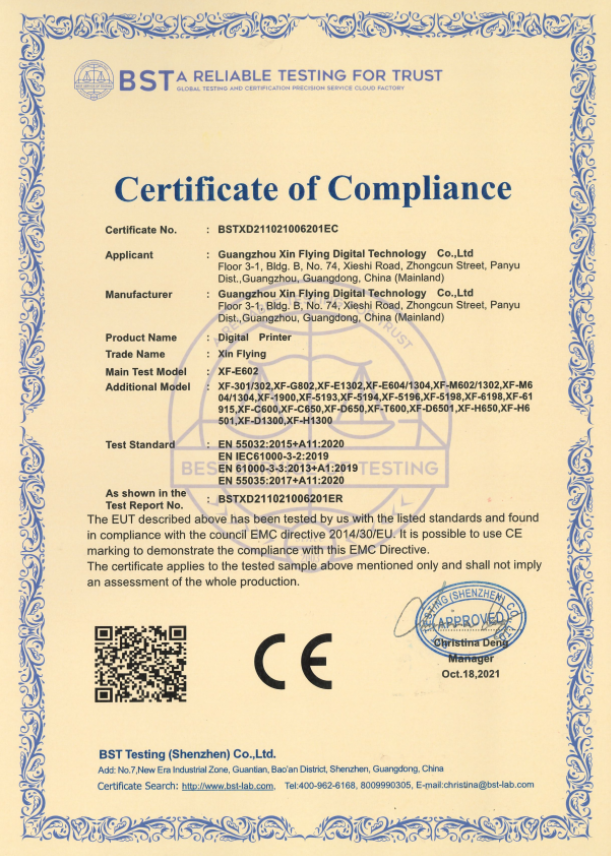
Why an ink certificate becomes a production gate
Brand compliance teams manage chemical risk across a supply chain they do not own. A sublimation print house sits inside that chain: the brand specifies the design and the fabric, but the ink chemistry that ends up bonded into the polyester is chosen further downstream. Because the brand cannot inspect every ink drum, it asks for third-party documentation instead, and it treats that documentation as a condition of approval rather than a courtesy.
The request typically appears at three moments: supplier onboarding, the launch of a new program or fabric, and the seasonal refresh of the brand’s own chemical requirements. In each case the auditor is doing essentially one thing — comparing what you claim against what a certification body has actually issued.
Two failures are common in the sublimation segment. The first is a document that proves something real but not what was asked: a general safety declaration instead of a certificate, or a certificate for a different ink set. The second is a genuine certificate that arrives unattached — a PDF with no model reference, no ink product names and no statement of which order it supports. Neither failure destroys credibility, but both send the approval back to you with questions attached.
What certificate SH150194016 states
ECO PASSPORT is an OEKO-TEX certification programme for chemicals, colourants and auxiliaries used in textile and leather production. Certificate SH150194016 belongs to that programme and was issued by TESTEX AG. Its scope is deliberately narrow: the textile printing inks and pastes used in the Digital Textile Printer XF-450PRO. It is not a certificate for the printer as a machine, for the polyester fabric, or for the finished garment.
| Certificate detail | What it establishes | What the auditor compares |
|---|---|---|
| Programme: OEKO-TEX ECO PASSPORT | The certificate belongs to a chemical-safety programme for textile production inputs. | That the file contains an ECO PASSPORT certificate, not a different OEKO-TEX label or an internal declaration drafted by the supplier. |
| Number: SH150194016 | A unique identifier that can be quoted in the audit file and in supplier correspondence. | That the number on the certificate, the cover note and the email are identical, with no typing drift. |
| Issuer: TESTEX AG | The certification body that issued the certificate. | The issuer name on the document itself; scope questions go to the issuer rather than being paraphrased internally. |
| Scope: textile printing inks and pastes | The product category the certificate assesses. | That the wording names inks and pastes, which is what a sublimation plant actually consumes. |
| Application: Digital Textile Printer XF-450PRO | The machine in which the covered inks and pastes are used. | That the model string matches the quotation, order documents and the nameplate on the machine. |
| Market: global | The certificate is not restricted to one country or region. | Whether the brand’s own acceptance rules add requirements on top of the certificate. |
Read the table as a matching exercise rather than a summary. Every row is a place where an audit file can break: a number typed from memory, an issuer described loosely as “the lab”, a scope sentence compressed into “our inks are certified”. Compression is where scope gets lost.
The phrase “inks and pastes” deserves attention. A plant that prints with both ink and print paste needs both to fall inside the documented category; if the certificate describes only one of them, that is a question for the supplier before the brand asks it.
Where the scope stops
A certificate read as broader than it is creates a different risk: the brand relies on it for something it never covered. Four boundaries are worth stating in the audit email itself.
- It covers the inks and pastes, not the machine. Electrical safety, electromagnetic compatibility and machinery requirements are documented through a separate certification route; a brand reviewing ink chemistry is not reviewing those files, and the reverse is also true.
- It covers inputs, not the finished fabric. A garment, sportswear or home-textile buyer may still test the printed article and may still apply its own restricted-substance requirements to the final product.
- It does not extend to other models or to unrelated inks. The scope is tied to the inks and pastes used in the XF-450PRO; changing the ink brand, or running the same ink on a different machine, creates a new matching question rather than inheriting the old answer.
- It does not guarantee brand approval. Acceptance criteria belong to the brand. The certificate supplies evidence into that decision; it does not make the decision.
Stating these limits does not weaken your position. It shows the auditor that the document was read rather than forwarded, and it prevents an approval that later collapses because someone assumed more than the paper said.
Matching the certificate to the machine
Ink and model matching is the step most often skipped, because it feels obvious to the producer and is invisible to the auditor. An equipment range makes the problem concrete: Xinflying’s Digital Textile Printer line covers the 130 cm XF-H1301X-1I32A1, the 180 cm XF-H1802X-2I32A1, the 190 cm XF-19E8-PRO and XF-19E15-PRO, and the 195 cm XF-O2000-4I32A1, each with its own configuration. A certificate written for the inks and pastes used in the XF-450PRO is evidence for that model. It should never be presented as blanket coverage for a mixed fleet, and a document issued for a sister model does not substitute for it.
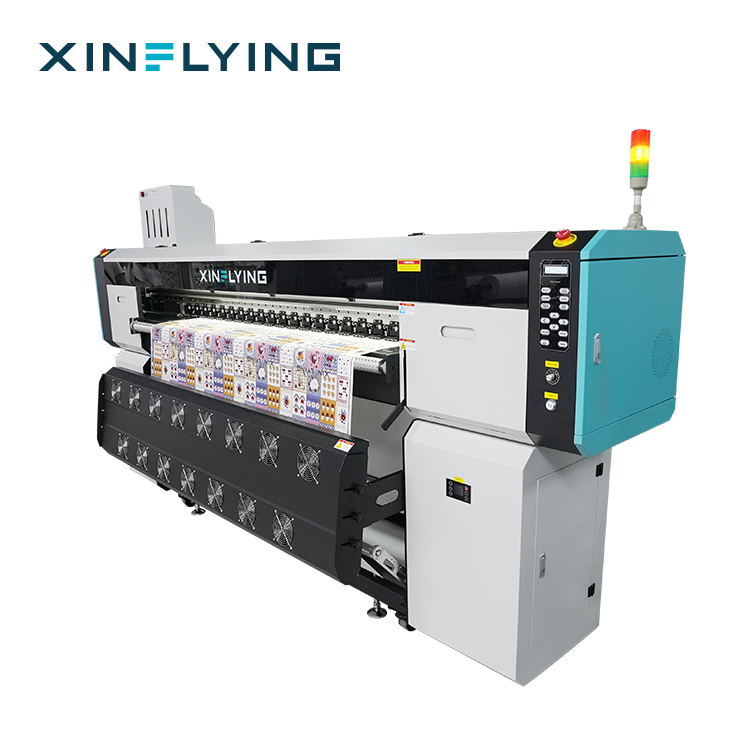
The practical check is a string comparison. On one side, the model name exactly as it appears in the certificate scope; on the other, the model name on the quotation, the proforma invoice, the packing list and the nameplate on the machine. If those do not read identically, correct the order paperwork before the audit finds the difference.
Then compare the ink side. The auditor will want to know which ink or paste products are in use on the machine that will run the order, and whether those products sit inside the documented scope. A certificate number alone does not answer that; the scope wording plus your own ink record does.
Five checks before the file leaves your desk
- Separate the request from the assumption. A brand questionnaire asking for “chemical compliance” is not always asking for an ink certificate. Ask which document family the auditor needs, and whether the review covers the ink, the printed fabric, or both.
- Read the number and the issuer aloud. SH150194016, TESTEX AG. Numbers copied from memory or from an older email thread are the most common defect in an otherwise valid file.
- Match the scope sentence to what you buy. The certificate covers textile printing inks and pastes used in the XF-450PRO. If production also consumes print paste, confirm that it falls inside the described category instead of assuming it does.
- Match the model string across documents. Certificate scope, quotation, invoice, packing list and machine nameplate should all read XF-450PRO, with no shorthand invented by your own office.
- Confirm status and market scope at the time of the audit. The certificate is valid for the global market, but a document used in a new season or a new sourcing region should be confirmed as current with the supplier or the issuing body before submission.
Keep the copy legible. A photograph of a framed certificate, cropped to the logo, tells an auditor less than a full-page scan with the scope visible. If the file is heavy, split it by page rather than by crop.
The audit pack: what travels with the certificate
A certificate on its own answers “is this ink certified”. An audit pack answers “is this the ink on my order”, which is the question that actually releases production.
- A one-page cover note naming the brand program, the order or sample reference, the machine model (XF-450PRO) and the certificate number SH150194016.
- The complete certificate, uncropped, with the scope text readable.
- Your ink and paste record for the relevant production period, using the product names that appear in the scope.
- A short process note: transfer paper, the transfer or calendering step, fabric type and the conditions under which the order will run.
- Your standard operating conditions, since print consistency and ink behaviour are linked to the production environment; Xinflying specifies 18–30 °C and 35–65 %RH for its digital textile printing applications.
- A named contact who can answer scope questions, so the brand does not route the query back through three departments.
Version control matters more than volume. One folder, one current certificate, one cover note per program. Producers who send five documents from four seasons create the impression that nobody knows which one applies.

Applying the proof to apparel, sportswear and home-textile programs
The same certificate supports different conversations depending on the end product, and the framing changes with the buyer’s risk model.
- Sportswear and team kit. Sublimation is used for jerseys, training wear and all-over polyester designs, where the print sits against skin for long periods. Brands in this segment tend to ask early, at sample stage, and usually pair the ink question with colour and wash expectations.
- Custom apparel and fashion fabric. The audit more often follows supplier onboarding than a single order, so the pack is reviewed once and referenced afterwards. Keeping the model and ink record current is what prevents a repeat review next season.
- Home textiles. Curtains, cushions and decorative polyester fabrics involve large-format runs and long print cycles. The ink question frequently arrives together with a production-stability question, because the brand is approving a multi-week run rather than a sample.
- Soft signage and promotional textile. These programs move quickly and often sit outside a brand’s core chemical program; a concise cover note is usually enough, provided the scope is visible.
In every case the certificate stays the same. What changes is how much context the brand needs around it, and how early in the process the request appears.
Where audits stall — and the fix
- Cropped or photographed certificate. Send the full page with the scope visible.
- Certificate issued for a different model. Request the correct scope; never relabel a document to fit the order.
- Scope paraphrased in the cover note. Quote the scope wording first, then explain it in your own words.
- No ink record on file. Add the product names actually consumed on the order.
- A request the certificate never covered, such as finished-fabric testing or machine safety. Route it to the correct document set or to additional testing, and say clearly which requirement sits where.
The last point protects the relationship. An auditor who discovers that a document was stretched to cover a gap will re-examine everything else in the file, including the parts that were correct.
FAQ
What does ECO PASSPORT certificate SH150194016 cover?
OEKO-TEX ECO PASSPORT certificate SH150194016 is issued by TESTEX AG and covers the textile printing inks and pastes used in the Digital Textile Printer XF-450PRO, and it is valid for the global market. It documents the ink and paste scope for that machine. It does not certify the printer’s electrical or machinery safety, the polyester fabric, or the finished garment.
How do I show a brand auditor that the certificate applies to my machine?
Present three things together: the complete certificate with SH150194016 and TESTEX AG visible; the scope sentence naming textile printing inks and pastes for the Digital Textile Printer XF-450PRO; and your own order paperwork, where the model string and ink product names match. The auditor is comparing the certificate against your production record, so both halves need to sit in the same file.
Is the certificate valid outside Europe?
The certificate is valid for the global market rather than for a single region, so it can be submitted to brand customers in different sourcing regions. Individual brands still apply their own acceptance rules and may request additional documents or finished-product testing alongside it; that is a separate decision from the certificate’s market validity.
Does ink certification add cost or delay to a sublimation order?
The certificate is a document; the cost risk sits in re-testing and re-sampling caused by incomplete submissions. Sending a full, correctly matched file the first time is the simplest way to keep an audit from adding a cycle. Where a brand requests testing beyond the certificate scope, treat that as a separate requirement to be quoted and scheduled rather than something the existing certificate can absorb.
Can I place a trial order before bulk production, and what lead time applies?
Xinflying quotes an MOQ of 1 unit, so a validation run does not require a container-scale commitment, and lead time is quoted at 5–40 days depending on configuration and order. Request the certificate copy, the model specification and the production reference together, so the brand review and the trial run can proceed in parallel. For a specific program, send the model and ink requirement to info@xin-flying.com or through the company website, and the documentation can be matched to that configuration.
Conclusion
Brand audits reward preparation rather than persuasion. The XF-450PRO already has a defined answer to the ink-safety question — OEKO-TEX ECO PASSPORT certificate SH150194016 from TESTEX AG, covering the textile printing inks and pastes used in that machine and valid for the global market — and the remaining work is presentation: matching the number, the scope, the model and the ink record before the file reaches the brand.
Producers who treat the certificate as the start of a matching process, rather than the end of a compliance task, usually pass these reviews in a single exchange. Those who forward a PDF and hope for the best tend to spend the saved time answering follow-up questions.
Guangzhou Xin Flying Digital Technology Co., Ltd. (XINFLYING) manufactures digital textile printing equipment from its 37,440 m² facility in Panyu, Guangzhou, with pre-shipment testing and 24/7 online technical support from an after-sales team of more than 50 engineers. For the XF-450PRO certificate copy, model specification or a production reference, contact the team directly.
Next step: download the XINFLYING company brochure (PDF) for the full equipment and capability overview, or request the XF-450PRO documentation set before your brand review opens.
Have Questions or Need More Details?
Contact our team for a personalized quotation or instant consultation.
Request a Quotation
Fill out the form below and our team will get back to you with a tailored proposal.
WhatsApp Direct Chat
Prefer to chat in real-time? Message us on WhatsApp for instant assistance & quick answers.
- Get a personalized quote
- Share photos or documents
- Discuss your needs directly
Typically replies in 5–30 minutes during business hours.