
CE Standards Guide for Sublimation Printer Selection
A CE mark on an industrial sublimation printer is a conformity claim, not a complete selection answer. Buyers comparing a dye sublimation printer for EU import or for a textile production line need to know which directive, which EN standard, which certificate number and which exact model the document covers. XINFLYING (Guangzhou Xin Flying Digital Technology Co., Ltd.) is a digital printing equipment manufacturer founded in 2010, with a 37,440 m² factory, 200+ employees and 20 R&D engineers; its website is www.xin-flying.com. This guide uses the supplied certificate records for XF-19E15-PRO, XF-19E8-PRO, XF-H1301X-1I32A1 and XF-H1802X-2I32A1 to turn CE MD, CE LVD, CE EMC and RoHS into practical purchasing parameters.
The central rule is simple: match the certificate to the model, match the standard to the directive, and match the machine to the textile job. A commercial sublimation printer can be listed on a certificate and still be the wrong width, speed or configuration for a sportswear line, blanket production or sampling studio. Compliance review and production-fit review should happen together, before the purchase order is approved.
Problem Definition: A CE Logo Does Not Identify the Covered Model
The main procurement risk is treating CE as a single document. In practice, a wide format sublimation printer may be assessed under several EU directives: Machinery Directive 2006/42/EC, Low Voltage Directive 2014/35/EU, EMC Directive 2014/30/EU and RoHS Directive 2011/65/EU. Each file has its own scope, standards and certificate number. A RoHS statement about materials does not prove machinery safety. An EMC report does not prove electrical safety. A certificate for one model does not automatically cover a modified configuration.
For the buyer, the problem is not a lack of paperwork. It is paperwork that is hard to connect to the quotation. The selection task is to build a compliance row for each candidate model, then verify the model name, directive, standard, certificate number, issuer, validity and configuration. This is especially important for a 1.9m sublimation printer or 1900mm sublimation printer ordered for continuous textile production, where the machine may be integrated with a heat press calender, RIP workflow and fabric handling equipment.
Industry Background: Compliance Belongs in the RFQ
Digital textile printing has moved from sampling rooms into commercial production. Roll-to-roll sublimation printers now support sportswear, team uniforms, home textiles, blankets, flags, banners and soft signage. The same machine family may be offered as a large format sublimation printer for polyester fabric, a sublimation printer for shirts or a sublimation printing machine for fabric rolls. The compliance file should follow the actual configuration, not only the catalogue family.
EU buyers also face a practical documentation chain: certificate, Declaration of Conformity, test report and nameplate. The supplier may provide these at quotation, order confirmation or pre-shipment. If the documents arrive only after the machine is packed, corrective action becomes slower. For that reason, compliance parameters should be written into the RFQ and the acceptance criteria, together with print width, head count, speed and after-sales support.
The Four Compliance Parameters to Put in the RFQ
1. CE MD: Machinery Safety
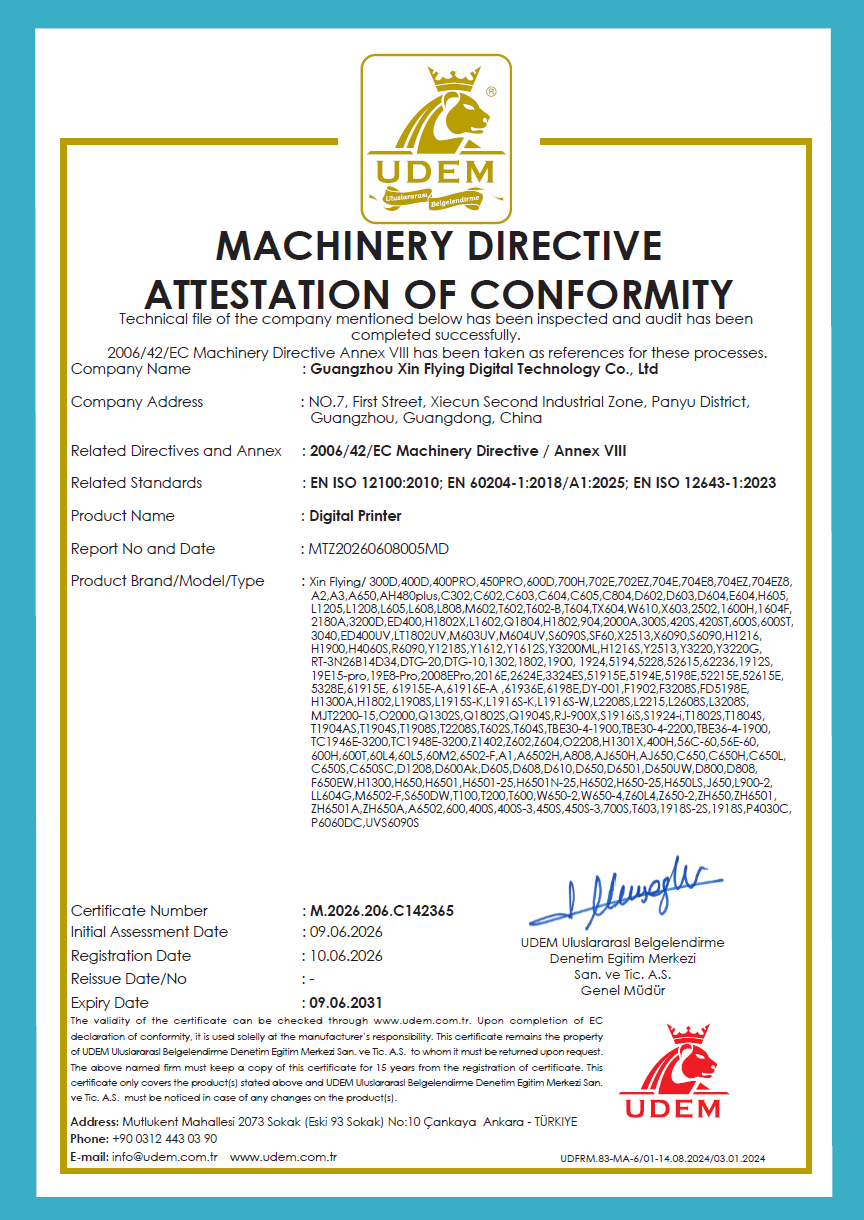
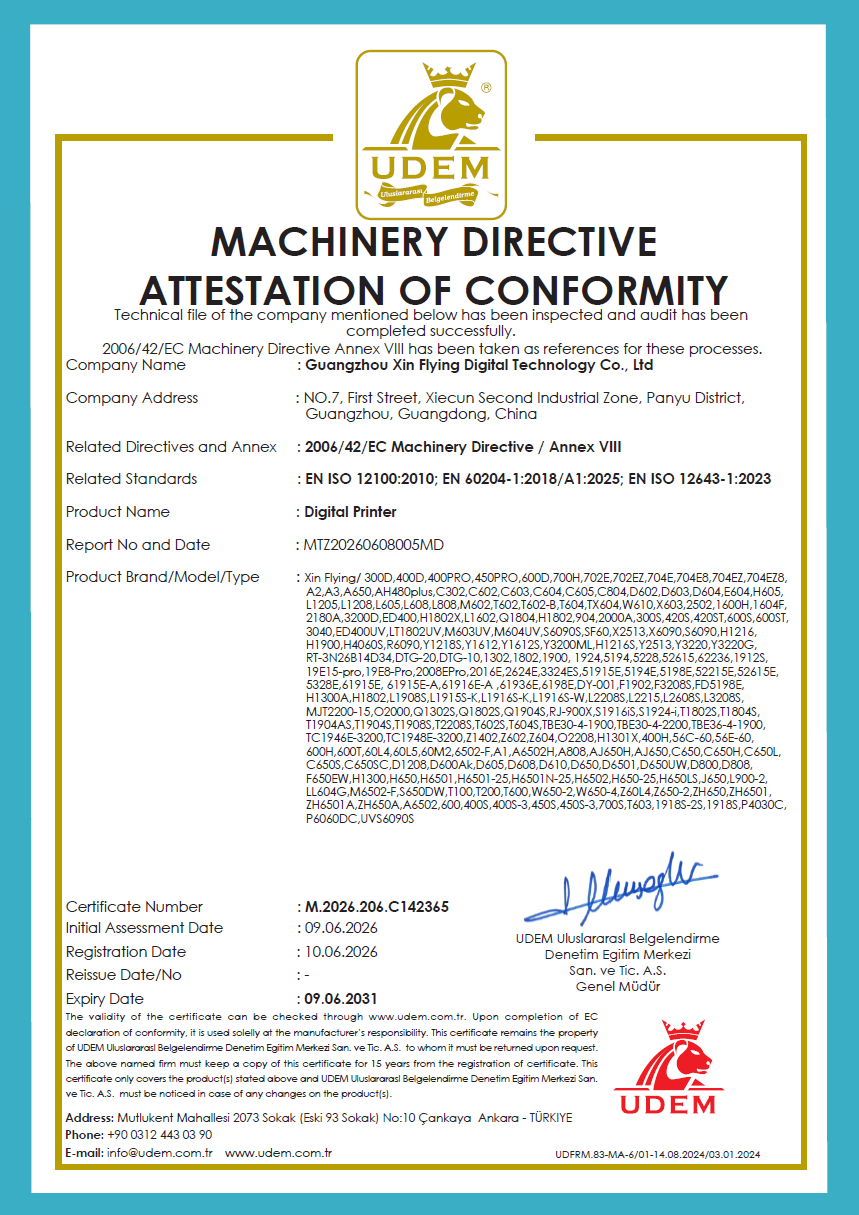
The supplied CE MD certificates M.2026.206.C142365 and M.2026.206.C142385, issued by UDEM, cite Machinery Directive 2006/42/EC and standards EN ISO 12100:2010, EN 60204-1:2018/A1:2025 and EN ISO 12643-1:2023. These certificates list XF-19E15-PRO, XF-19E8-PRO, XF-H1301X-1I32A1 and XF-H1802X-2I32A1. In selection terms, EN ISO 12100:2010 is the risk-assessment and risk-reduction reference; EN 60204-1:2018/A1:2025 covers electrical equipment of machines; EN ISO 12643-1:2023 covers safety requirements for graphic technology equipment and systems. Ask for the risk-assessment summary and confirm that guards, access points, emergency stops and control interfaces are assessed for the ordered model.
2. CE LVD: Electrical Safety
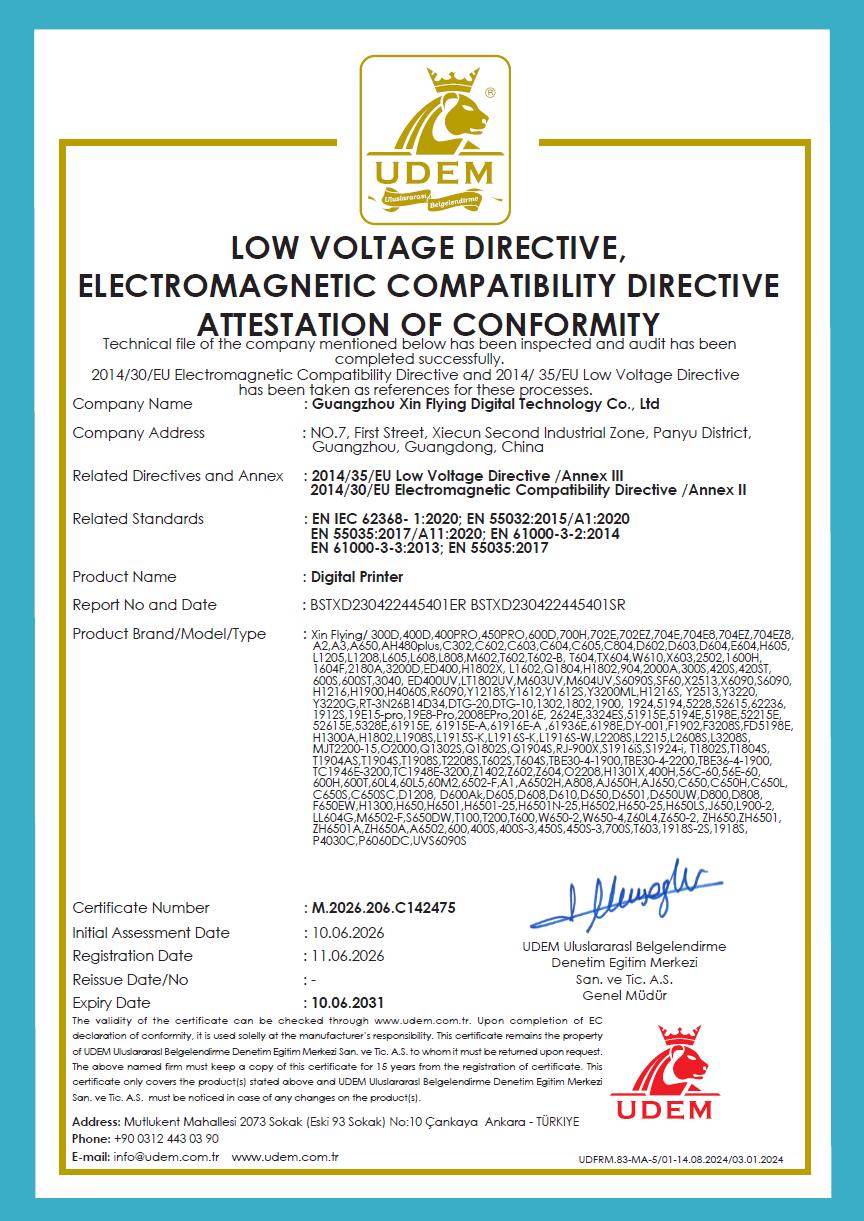
The CE LVD certificate TQT1550D271EC, issued by TQT (Shenzhen Tianqi Testing Technology Service Co., Ltd.), cites Directive 2014/35/EU and EN IEC 62368-1:2020/A11:2020. The combined LVD/EMC attestation M.2026.206.C142475 from UDEM also lists the same model family and cites EN IEC 62368-1:2020/A11:2020. For the buyer, LVD is the electrical safety layer for power supplies, control electronics and operator contact protection. Verify that the certificate scope names a digital printer or digital textile printer and that the model on the certificate matches the nameplate.
3. CE EMC: Stable Integration in a Shared Factory
The CE EMC certificate TQT1550D270EC uses EMC Directive 2014/30/EU and standards EN 55032:2015/A11:2020, EN 55035:2017/A11:2020, EN IEC 61000-3-2:2019+A1:2021 and EN 61000-3-3:2013/A2:2021. EMC is not only a customs issue. A commercial sublimation printer shares power and control networks with heat presses, cutting equipment and factory IT. The selection question is whether the EMC file represents the same configuration, including the electrical cabinet and control setup offered in the quotation.
4. RoHS: Restricted Substances and Technical Documentation
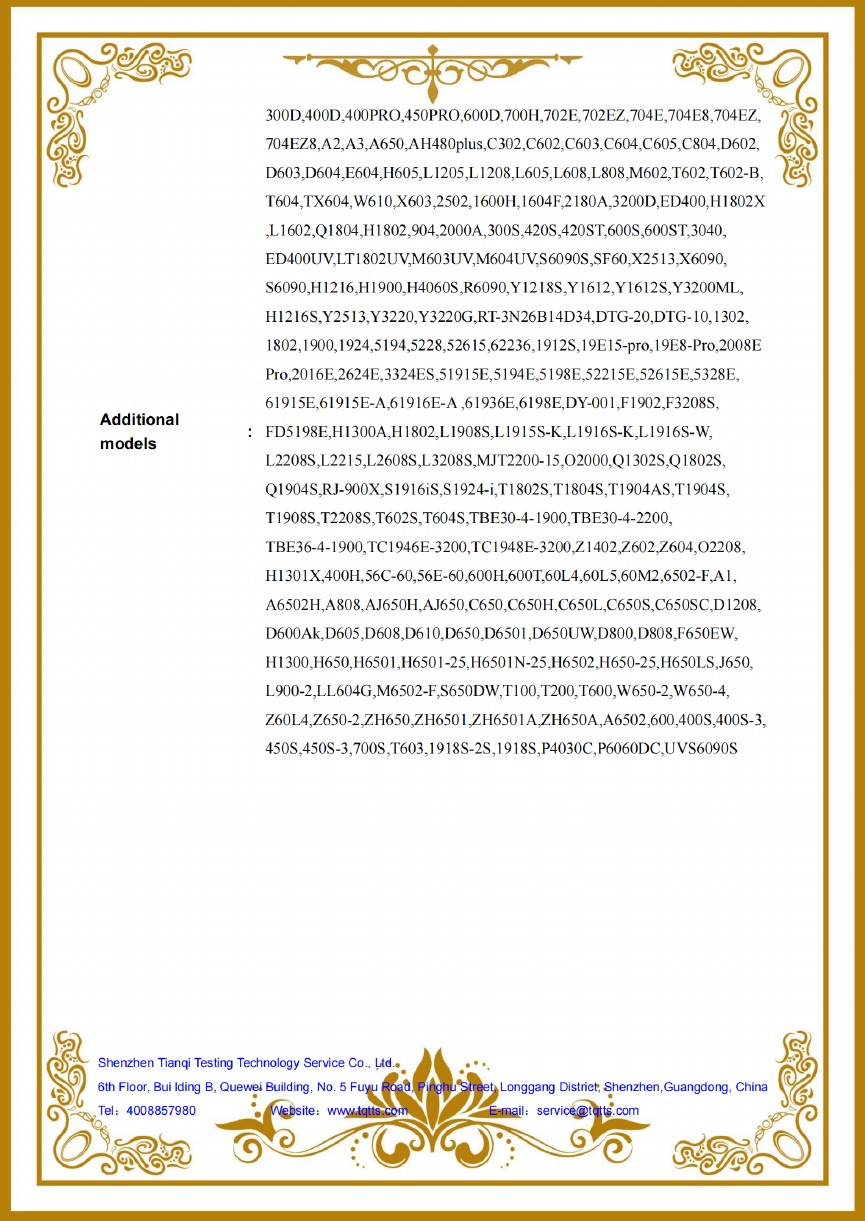
The RoHS certificate M.2026.206.C142366, issued by UDEM, cites Directive 2011/65/EU and EN IEC 63000:2018 with the EN IEC 62321 series. EN IEC 63000:2018 is the technical-documentation route for assessing RoHS compliance. It supports the environmental file but does not replace MD, LVD or EMC. Confirm that the RoHS attestation identifies the model and that the supplier can trace the documentation to the electrical and electronic assemblies in the machine.
A separate document, OEKO-TEX ECO PASSPORT SH150194016 from TESTEX AG, covers textile printing inks and printing pastes and is recorded as valid from 2025-12-11 to 2026-12-31. It is relevant to ink and skin-contact discussions, but it is not a CE machine-safety certificate. Do not accept it as a substitute for MD, LVD, EMC or RoHS.
Step-by-Step: Verify a Sublimation Printer Certificate Before You Approve the PO
- Build a compliance row for each model. Use columns for CE MD, CE LVD, CE EMC, RoHS, certificate number, issuer, standards and expiry. Do not accept a general statement that the supplier is CE certified.
- Match the model identity exactly. Compare the model name in the quotation, proforma invoice, nameplate and certificate. The supplied records list XF-19E15-PRO, XF-19E8-PRO, XF-H1301X-1I32A1 and XF-H1802X-2I32A1 across the MD, LVD, EMC and RoHS files. A certificate for the family is not a substitute for checking the ordered configuration.
- Check the directive and standard versions. Record the exact standard list. If the certificate cites a different amendment from the RFQ, ask the supplier to explain it in writing. Do not assume that one EMC standard list covers every configuration.
- Check certificate number, issuer and validity. Record numbers such as M.2026.206.C142365, TQT1550D271EC, TQT1550D270EC, M.2026.206.C142366 and M.2026.206.C142475. Confirm the issuer, the current signed copy and the expiry date. The LVD and EMC records show issue date 2026-05-19 and expiry 2099-01-01; the MD and RoHS records show expiry 2031-06-09. Always confirm current validity with the supplier and issuer.
- Request the Declaration of Conformity and test reports. The DoC should identify the manufacturer, product, directives and standards. Test reports should relate to the same model and electrical configuration. Keep these documents with the purchase order and shipping file.
- Review production fit after compliance. Compliance does not establish print width, speed, head count or fabric compatibility. Match the model to the job before signing.
- Write acceptance criteria into the PO. Use the supplied pre-shipment test as the base, then define what the test includes: nameplate, certificate package, safety labels, emergency stop, wiring, nozzle check, test print, color check and packing.
Match Certified Models to Textile Production Needs
The certificate records are necessary evidence, but they are not a production specification. The supplied model data supports the following fit logic.
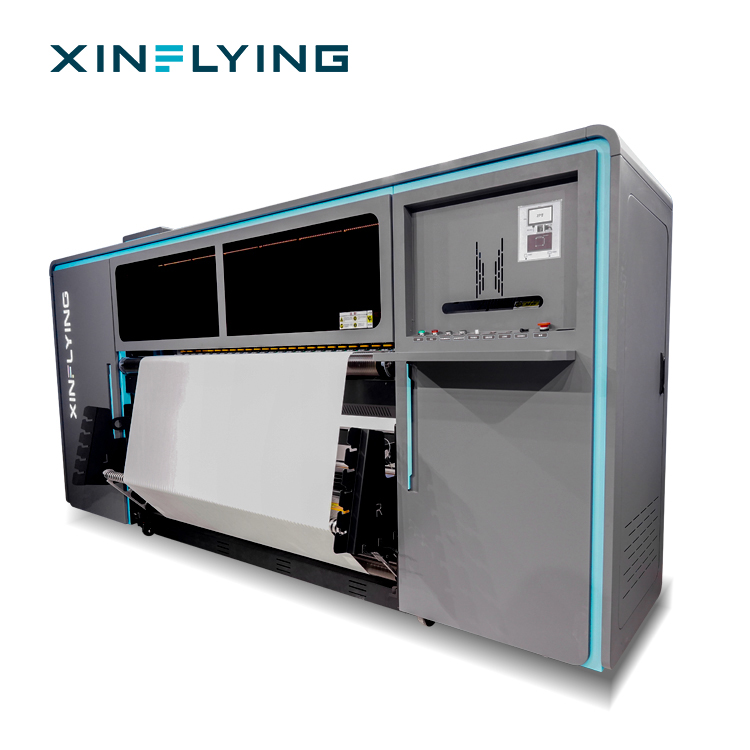
XF-H1802X-2I32A1: 2 Epson i3200-A1 printheads, 1800mm printing width and up to 52㎡/h. The supplied FAQ positions it for small and medium-sized sublimation printing businesses, custom textile production, apparel sampling and small-batch orders. It is also listed on the MD, LVD, EMC and RoHS records. For a buyer moving from beginner sublimation printing into commercial work, this is the entry-level fit to compare.
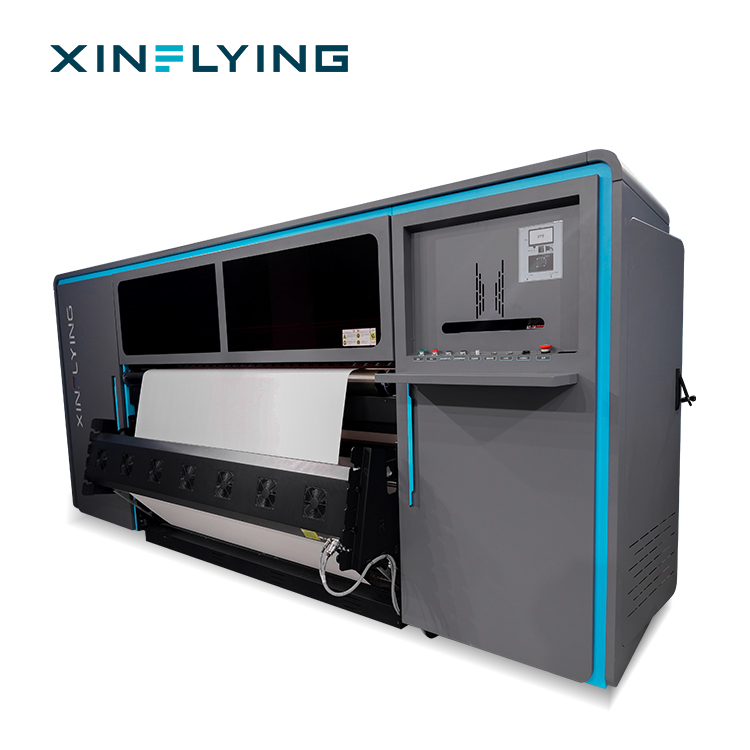
XF-19E8-PRO: 8 Epson i3200-A1 printheads, 3200dpi resolution and up to 306㎡/h. The supplied FAQ positions it for textile factories, large garment manufacturers and professional sublimation production centers. It is the high-volume model in this set. The certificate file should be checked with the same discipline as the production claim: exact model, exact configuration and current documents.
XF-19E15-PRO and XF-H1301X-1I32A1: both appear in the supplied certificate records, but the provided evidence does not give a complete production specification for them. Treat the certificate as a compliance entry point, not as proof of speed or width. Ask for the quotation, technical datasheet and configuration drawing, then match those parameters to the fabric and order profile.
The table below maps the supplied certificate coverage to the selection decision. Coverage means the model appears in the supplied certificate records; it does not replace the current signed certificate or a configuration review.
| Model | CE MD | CE LVD | CE EMC | RoHS | Production note |
|---|---|---|---|---|---|
| XF-19E15-PRO | M.2026.206.C142365; M.2026.206.C142385 | TQT1550D271EC; M.2026.206.C142475 | TQT1550D270EC; M.2026.206.C142475 | M.2026.206.C142366 | Certificate listed; confirm width, head count and speed in quotation. |
| XF-19E8-PRO | M.2026.206.C142365; M.2026.206.C142385 | TQT1550D271EC; M.2026.206.C142475 | TQT1550D270EC; M.2026.206.C142475 | M.2026.206.C142366 | 8 Epson i3200-A1 heads; 3200dpi; up to 306㎡/h; high-volume textile. |
| XF-H1301X-1I32A1 | M.2026.206.C142365; M.2026.206.C142385 | TQT1550D271EC; M.2026.206.C142475 | TQT1550D270EC; M.2026.206.C142475 | M.2026.206.C142366 | Certificate listed; confirm production configuration in quotation. |
| XF-H1802X-2I32A1 | M.2026.206.C142365; M.2026.206.C142385 | TQT1550D271EC; M.2026.206.C142475 | TQT1550D270EC; M.2026.206.C142475 | M.2026.206.C142366 | 2 Epson i3200-A1 heads; 1800mm; up to 52㎡/h; entry and sampling. |
Use Cases: Where Compliance and Production Fit Meet
For high-volume sportswear, the selection priority is stable continuous output. The supplied case record for a Brazil sportswear manufacturer describes 15 units over four years, with improved production flexibility, reduced dependence on outsourced printing and more consistent color across batches. That case supports the logic of matching an industrial roll-to-roll sublimation printer to repeated polyester sportswear orders. It does not replace a pre-shipment test on the exact model.
For custom team uniforms, the supplied case record for a sports uniform supplier in Brazil describes 8 units over five years for football kits, training uniforms and personalized names, numbers and graphics. Here the buyer should compare print width, RIP workflow and turnaround capability alongside the certificate file. For home textiles, curtains, cushions and blankets, the supplied case record for a home textile manufacturer describes 10 units over four years. Wide-format capability and consistent pattern reproduction matter more than a generic CE claim; confirm the 1900mm class and the exact model certificate.
For OEM programmes, compliance must follow the customization. XINFLYING lists OEM/ODM customization for product branding, machine appearance, color, logo, packaging and customer-specific solutions, with MOQ 1 unit, monthly capacity 1600+ units, lead time 5-40 days and pre-shipment testing. If a logo, voltage, packaging or appearance change is ordered, ask in writing whether the certificate and DoC still apply to that configuration.
Purchasing Terms and Acceptance Criteria for a CE-Compliant Order
The supplied purchasing terms are MOQ 1 unit; delivery terms EXW/FOB/CIF/DDP; acceptance criteria pre-shipment test; and payment terms T/T, Western Union and PayPal. These terms should sit beside the compliance checklist in the purchase order, not replace it.
A practical acceptance protocol should confirm the nameplate model, the certificate package, the Declaration of Conformity, safety labels, emergency stop function, electrical connections, nozzle check, test print, color check and packing condition. The supplier's stated acceptance criterion is pre-shipment test; the buyer should define what that test covers before production starts. Final payment and shipping release can then be tied to the agreed test record and document set.
FAQ
Which CE standards should appear on a sublimation printer certificate?
For the machine-safety file, check CE MD standards EN ISO 12100:2010, EN 60204-1:2018/A1:2025 and EN ISO 12643-1:2023. For electrical safety, check EN IEC 62368-1:2020/A11:2020. For EMC, check EN 55032:2015/A11:2020, EN 55035:2017/A11:2020, EN IEC 61000-3-2:2019+A1:2021 and EN 61000-3-3:2013/A2:2021. For RoHS documentation, check EN IEC 63000:2018. The certificate should also show the directive, model and issuer.
How do I verify that the certificate covers the exact model I am buying?
Compare the model name on the quotation, proforma invoice, nameplate and certificate. For example, the supplied records list XF-19E15-PRO, XF-19E8-PRO, XF-H1301X-1I32A1 and XF-H1802X-2I32A1 across MD, LVD, EMC and RoHS files. Confirm the certificate number, issuer and expiry. Ask for the current signed certificate and DoC. If the ordered configuration differs, ask for written confirmation.
What is the difference between CE MD, LVD, EMC and RoHS for a sublimation printer?
MD covers machinery safety; LVD covers electrical safety; EMC covers electromagnetic emissions and immunity; RoHS covers restrictions on hazardous substances. They are separate compliance layers. A RoHS certificate does not prove machinery safety, and an EMC report does not replace the LVD file.
Can a CE certificate alone tell me which sublimation printer fits my textile production?
No. CE compliance shows that a conformity file exists for the model; it does not establish print width, speed, head count or suitability for a fabric. Match production parameters: XF-H1802X-2I32A1 has 2 Epson i3200-A1 printheads, 1800mm width and up to 52㎡/h for entry and sampling; XF-19E8-PRO has 8 Epson i3200-A1 printheads, 3200dpi and up to 306㎡/h for high-volume production. Confirm XF-19E15-PRO and XF-H1301X-1I32A1 configuration in the quotation.
What purchasing terms and acceptance criteria should I include?
Use the supplied terms: MOQ 1 unit; EXW/FOB/CIF/DDP; pre-shipment test; T/T, Western Union and PayPal. In the PO, define the pre-shipment test to include nameplate and model check, certificate package, safety labels, emergency stop, wiring, nozzle check, test print and packing. Record lead time 5-40 days and any OEM/ODM customization in writing.
What should an OEM dye sublimation printer manufacturer provide?
An OEM/ODM supplier should provide model-specific CE MD, LVD, EMC and RoHS documents, a Declaration of Conformity, and a clear statement of which customization items are covered. XINFLYING lists OEM/ODM customization for branding, appearance, color, logo, packaging and customer-specific solutions, with MOQ 1 unit and 5-40 day lead time. For a model-specific certificate pack and quotation, contact XINFLYING to discuss your textile application.
Conclusion: Use CE Standards as a Filter, Then Verify the Model
CE MD, CE LVD, CE EMC and RoHS are useful selection parameters because they force a buyer to ask specific questions: which directive, which standard, which certificate number, which issuer, which model and which configuration. For XF-19E15-PRO, XF-19E8-PRO, XF-H1301X-1I32A1 and XF-H1802X-2I32A1, the supplied records provide a starting compliance map. The next step is to match that map to print width, speed, head count and the textile application, then write both the document check and the pre-shipment test into the order.
For a model-specific certificate pack, quotation or sample discussion, contact XINFLYING. A broader company introduction is available in the XINFLYING company introduction PDF.
Have Questions or Need More Details?
Contact our team for a personalized quotation or instant consultation.
Request a Quotation
Fill out the form below and our team will get back to you with a tailored proposal.
WhatsApp Direct Chat
Prefer to chat in real-time? Message us on WhatsApp for instant assistance & quick answers.
- Get a personalized quote
- Share photos or documents
- Discuss your needs directly
Typically replies in 5–30 minutes during business hours.