
Top 4 Sublimation Printer Models for EU Compliance: Recommendations for Textile Production
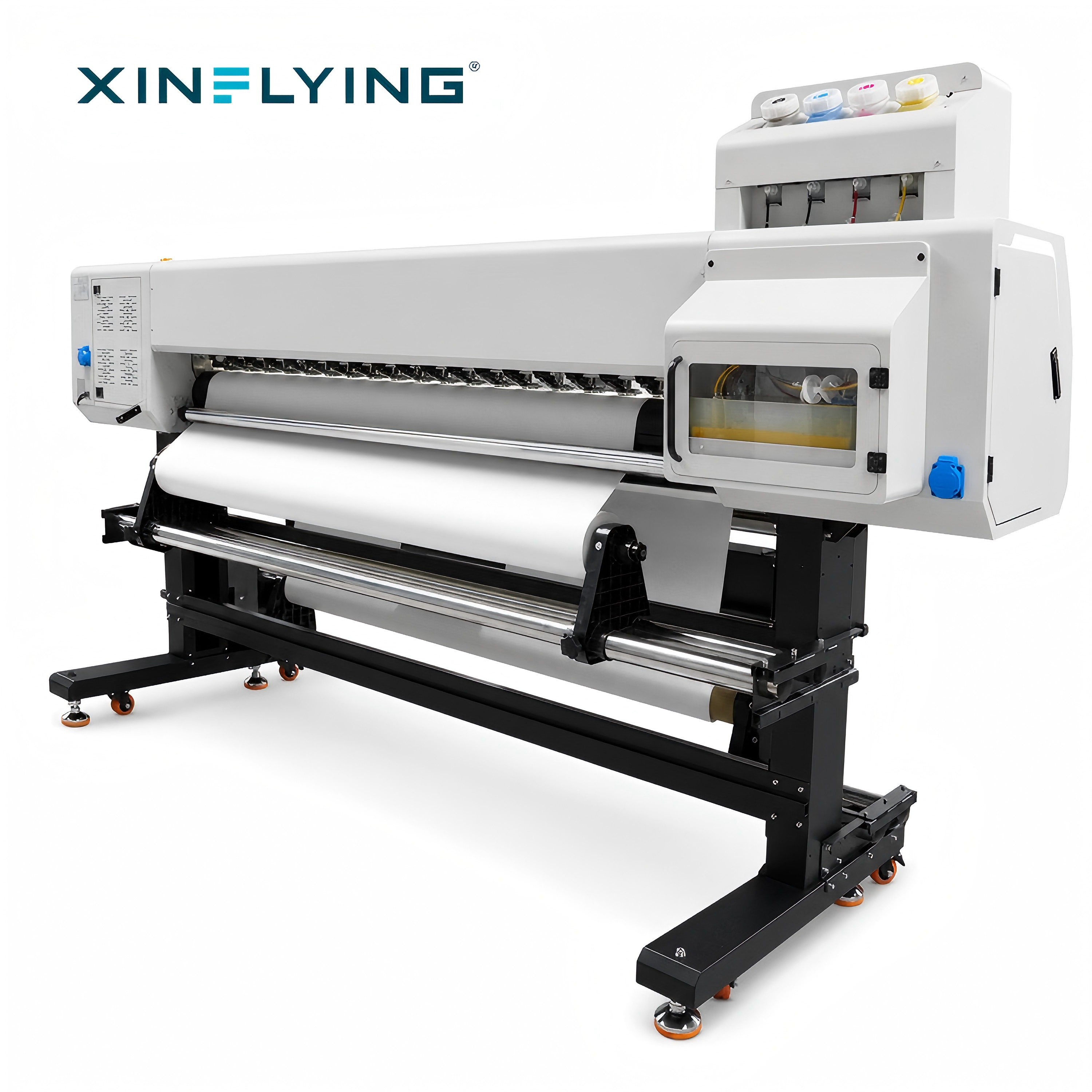
For EU textile production, the four-model shortlist ranked by the depth and relevance of the supplied compliance evidence is: 1. XF-19E15-PRO, 2. XF-19E8-PRO, 3. XF-H1802X-2I32A1, 4. XF-O2000-4I32A1. XF-450PRO and XF-C604 are included later as additional model-specific evidence: XF-450PRO for OEKO-TEX ECO PASSPORT SH150194016 covering textile printing inks and pastes, and XF-C604 for CE certificate BSTXD211021006201EC. They sit outside the Top 4 because the assigned evidence for them addresses a different part of the buying file.
This is an editorial procurement ranking built from certificate records and model facts, not a market-share ranking, an independent laboratory ranking, or a claim that one CE mark is legally stronger than another. The practical question is narrower and more useful: which model gives an EU textile buyer the clearest, most model-specific compliance evidence to put into a purchase file?
XINFLYING, formally Guangzhou Xin Flying Digital Technology Co., Ltd., is a digital printing equipment manufacturer founded in 2010. The supplied company profile lists a 37,440 m² factory, 200+ employees, 20 R&D engineers and production of DTF printers, dye sublimation printers, DTG printers, UV DTF printers, UV flatbed printers and printing consumables.
What the EU compliance question actually asks
The compliance problem is not whether a product page contains a CE logo. A usable EU evidence set answers seven checks: which directive applies, which standard was used, which certificate number exists, which authority issued it, which product model is covered, what the certificate scope says, and whether the issue and expiry dates fit the purchase and resale plan.
Those checks cannot be mixed and matched. A RoHS certificate addresses restricted hazardous substances in electrical and electronic equipment. It does not replace machinery safety evidence. A CE EMC certificate addresses electromagnetic compatibility, not electrical safety. An OEKO-TEX ECO PASSPORT for printing inks and pastes supports a material-safety review, but it is not a CE certificate for the printer. A certificate whose scope says DTF Printer should not be silently presented as a sublimation printer certificate without confirming that the exact model and configuration are covered.
For a sublimation printer used in textile production, the buying file usually needs to connect four machine-level domains: CE Machinery Directive evidence, CE Low Voltage Directive evidence, CE EMC evidence and RoHS evidence. The exact legal applicability depends on the machine and its configuration, so the buyer should request the manufacturer’s declaration of conformity and technical file. This article reviews the supplied certificate records; it is not legal advice.
Why certificate numbers matter more than generic claims
A certificate number is useful because it can be checked against an issuer, a standard list, a scope and a model association. A generic statement such as “CE certified” cannot be audited. For an EU importer, distributor or textile factory, the difference matters at three points: customs and market-surveillance questions, customer or brand compliance questionnaires, and internal maintenance of a technical file.
The model association is especially important. The supplied certificate records list related products, but the buyer should still confirm that the exact model name, optional configuration, voltage, ink system and intended market match the declaration. A certificate for one configuration does not automatically prove that every optional configuration is covered.
Ranking method: evidence depth for a textile buyer
The ranking uses four qualitative tests. First, how many core EU compliance domains are clearly identified for the model. Second, whether the evidence includes named certificate numbers, issuing bodies and standards. Third, whether there is parallel or redundant coverage that strengthens the file. Fourth, whether the model’s documented textile-production fit matches the buyer’s likely use.
No numeric scores are invented. The order reflects the depth and relevance of the supplied evidence for this assignment. A lower position does not mean a model is non-compliant; it means the assigned evidence emphasis is narrower in this review, or that the buyer must confirm more items before the file is complete.
1. XF-19E15-PRO: the most complete four-domain compliance file
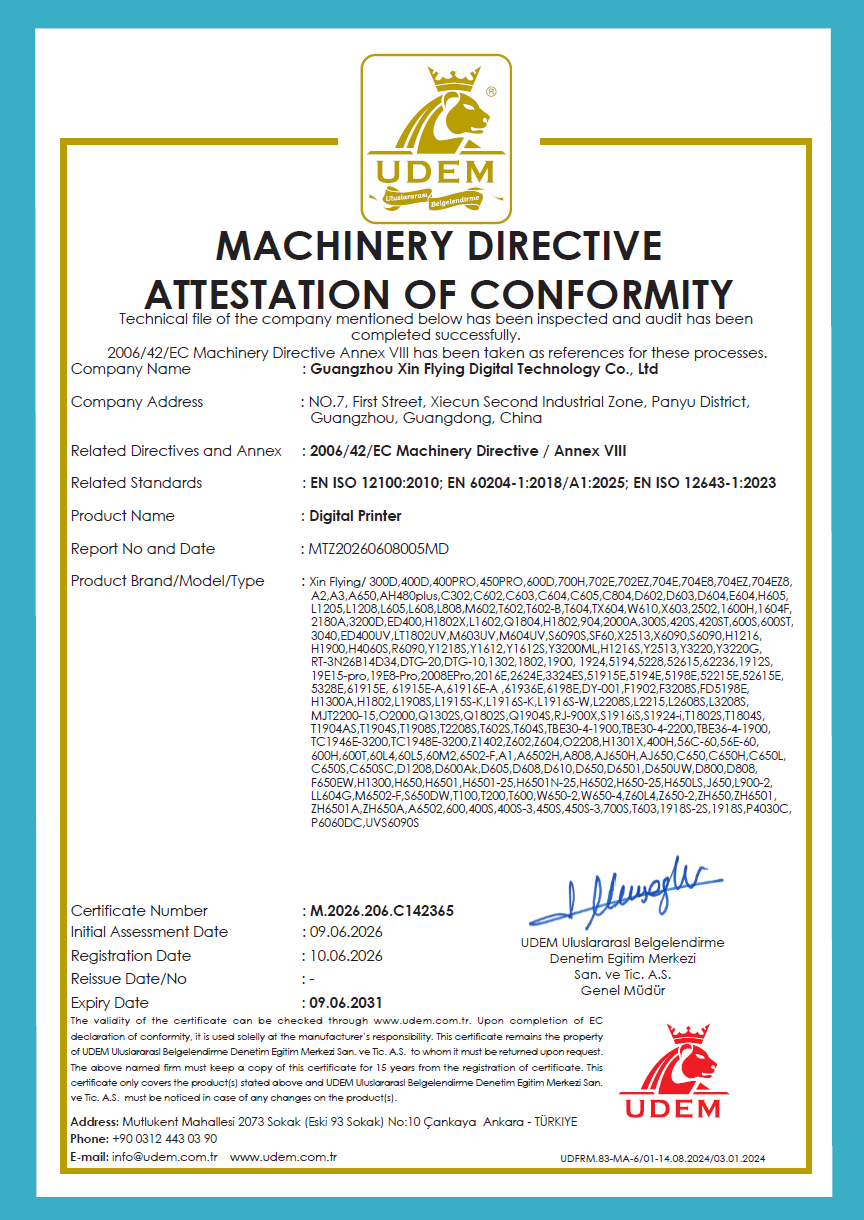
XF-19E15-PRO ranks first because the supplied evidence can be mapped across all four core domains in one model review. The machinery-safety record is CE MD Certificate of Conformity M.2026.206.C142365 from UDEM, issued 2026-06-10 and valid to 2031-06-09, covering MD 2006/42/EC with standards EN ISO 12100:2010, EN 60204-1:2018/A1:2025 and EN ISO 12643-1:2023.
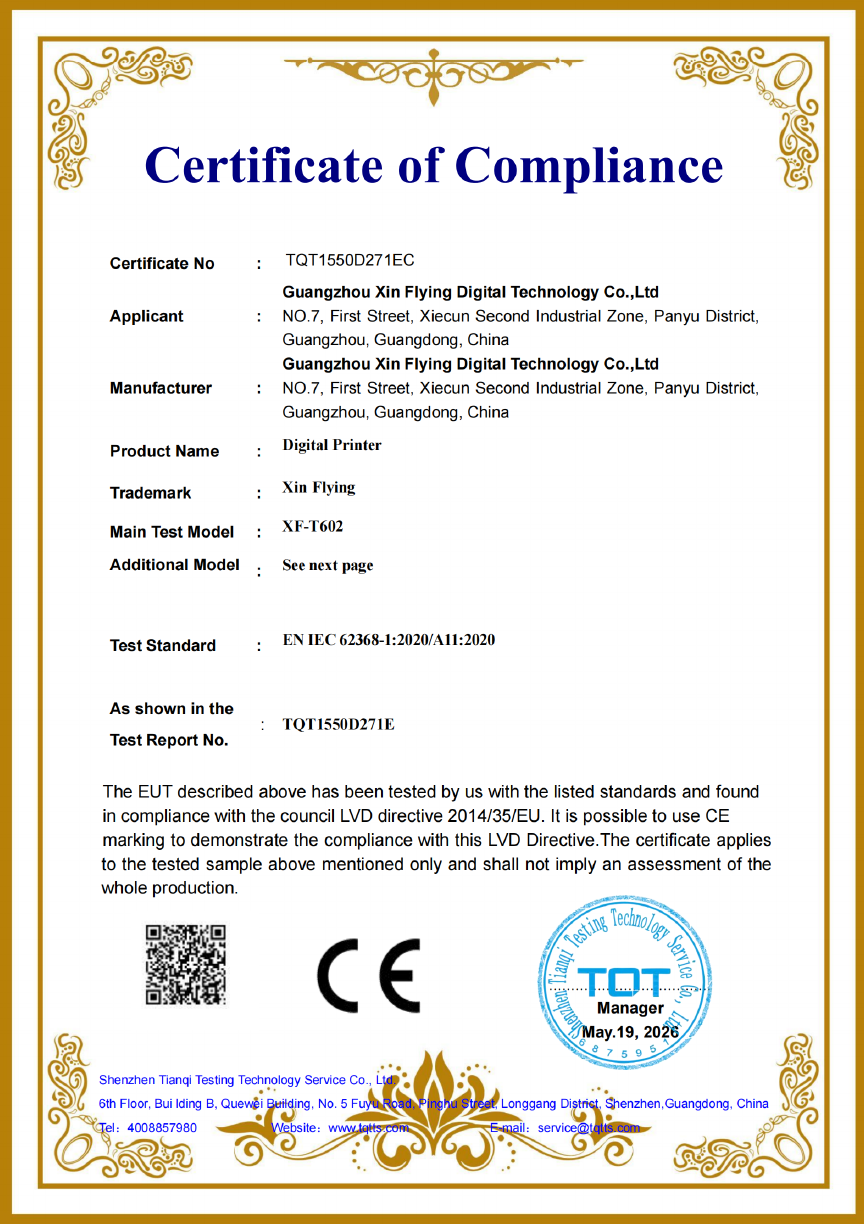
The electrical-safety record is CE LVD certificate TQT1550D271EC from TQT, issued 2026-05-19 with an expiry date of 2099-01-01, covering LVD 2014/35/EU with EN IEC 62368-1:2020/A11:2020. The EMC record is TQT1550D270EC from TQT, also issued 2026-05-19 with expiry 2099-01-01, listing EN 55032:2015/A11:2020, EN 55035:2017/A11:2020, EN IEC 61000-3-2:2019+A1:2021 and EN 61000-3-3:2013/A2:2021. The RoHS record is M.2026.206.C142366 from UDEM, issued 2026-06-10 and valid to 2031-06-09, with EN IEC 63000:2018 and the EN IEC 62321 series.
There is also a combined UDEM CE LVD and EMC attestation, M.2026.206.C142475, issued 2026-06-11 and valid to 2031-06-10. For a textile buyer, that redundancy is useful: one certificate set can be read as a machinery-safety file, an electrical-safety file, an EMC file and a substances file without switching between unrelated documents.
The buying action is still to confirm the exact XF-19E15-PRO configuration against the declaration of conformity and to request the technical file. The ranking is based on documentation breadth, not on an unstated output or price advantage.
2. XF-19E8-PRO: parallel CE coverage plus an additional CTIC record
XF-19E8-PRO ranks second because it combines the same core CE and RoHS evidence with an additional CTIC certificate in the supplied record. The model is associated with CE MD M.2026.206.C142365, CE LVD TQT1550D271EC, CE EMC TQT1550D270EC and RoHS M.2026.206.C142366. The additional record is CE certificate CTICAIQ415250900815313DC from CTIC Testing Group (Guangdong) Co., Ltd., issued 2025-08-12 with expiry 2099-01-01, listing EN 55032:2015, EN IEC 61000-3-2:2019+A1:2021, EN 61000-3-3:2013/A2:2021 and EN 55035:2017/A11:2020.
That extra EMC record is useful when a buyer wants parallel coverage in the compliance file, but the scope wording needs attention. The supplied CTIC record lists its scope as DTF Printer. Before using it in a sublimation printer file, confirm that the exact XF-19E8-PRO model and the intended sublimation configuration are covered by the declaration and technical documentation.
The model fit is strongly industrial: 8 Epson i3200-A1 printheads, 3200 dpi resolution and printing speeds up to 306 m²/h, according to the supplied knowledge record. For a textile factory or professional sublimation production center evaluating high-volume polyester work, that combination makes the model a relevant candidate once the model-specific compliance pack is confirmed.
3. XF-H1802X-2I32A1: CE MD and EN 55032/EN 55035 EMC evidence for entry and mid-volume textile work
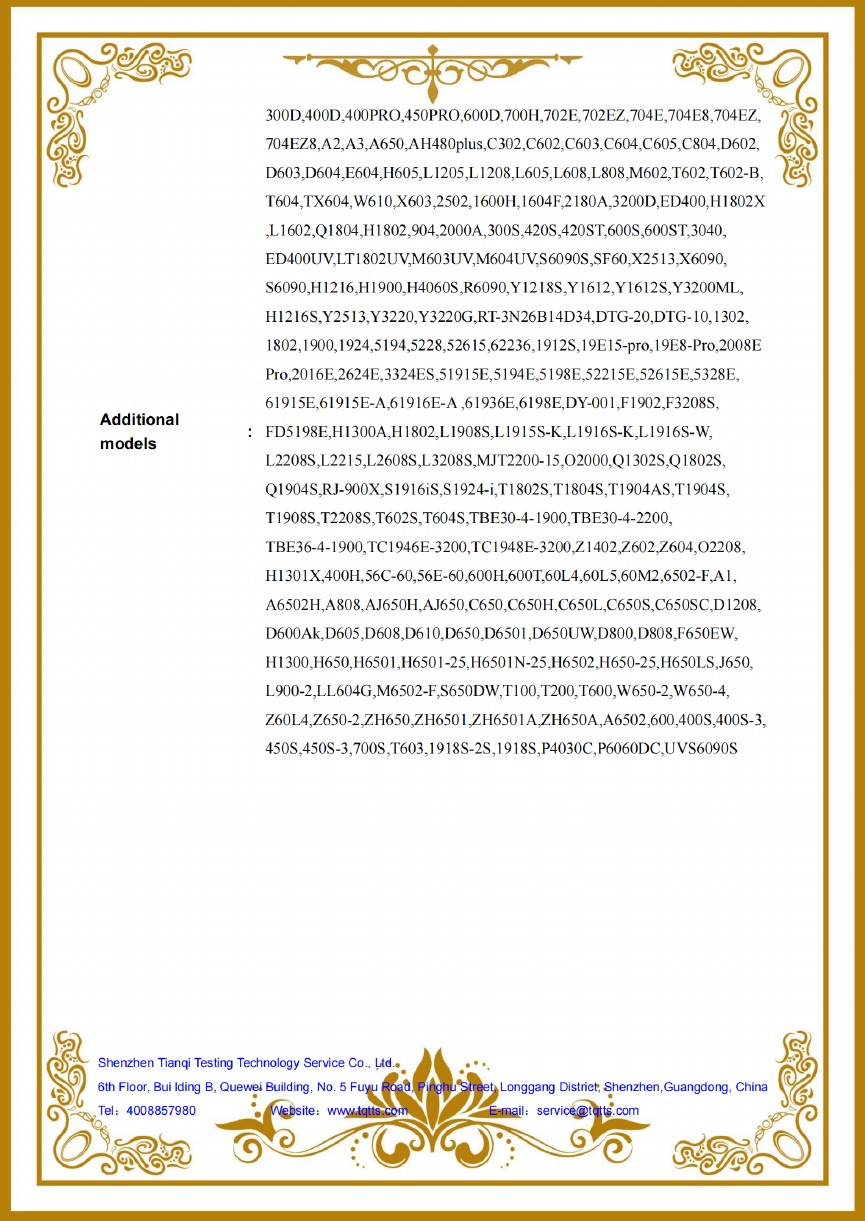
XF-H1802X-2I32A1 ranks third on the assigned evidence emphasis. The review highlights CE MD Certificate of Conformity M.2026.206.C142365 from UDEM and CE EMC certificate TQT1550D270EC from TQT, with the EMC standards EN 55032:2015/A11:2020 and EN 55035:2017/A11:2020. Those two domains matter in a textile production line because they connect machinery safety with electromagnetic compatibility.
The supplied textile fit is practical for smaller and growing operations: 2 Epson i3200-A1 printheads, an 1800 mm printing width and printing speeds up to 52 m²/h. That profile is relevant to apparel sampling, small-batch orders, custom textile production and businesses starting sublimation printing.
For an EU purchase file, the next step is to request the full model matrix and confirm whether LVD and RoHS documentation for the exact configuration is also required and supplied. The Top 4 ranking does not replace that model-specific check.
4. XF-O2000-4I32A1: UDEM CE MD and TQT LVD evidence for growing textile production
XF-O2000-4I32A1 ranks fourth on the assigned evidence emphasis. The review highlights UDEM CE MD Certificate of Conformity M.2026.206.C142365 and TQT CE LVD certificate TQT1550D271EC, with the LVD standard EN IEC 62368-1:2020/A11:2020. Those records give a buyer a clear starting point for the machinery-safety and electrical-safety sections of the file.
The model’s documented production fit is mid-range: 4 Epson i3200-A1 printheads, a 1950 mm printing width and speeds up to 180 m²/h. The supplied knowledge record positions it for growing printing companies, professional textile printers, garment businesses and continuous daily production.
Before ordering, confirm the EMC and RoHS records for the exact XF-O2000-4I32A1 configuration, and keep those records beside the MD and LVD documents in the purchase file. The model remains in the Top 4 because the assigned evidence covers two central compliance domains with named certificates and standards.
Additional model-specific evidence: XF-450PRO and XF-C604
XF-450PRO: OEKO-TEX ECO PASSPORT for textile printing inks and pastes
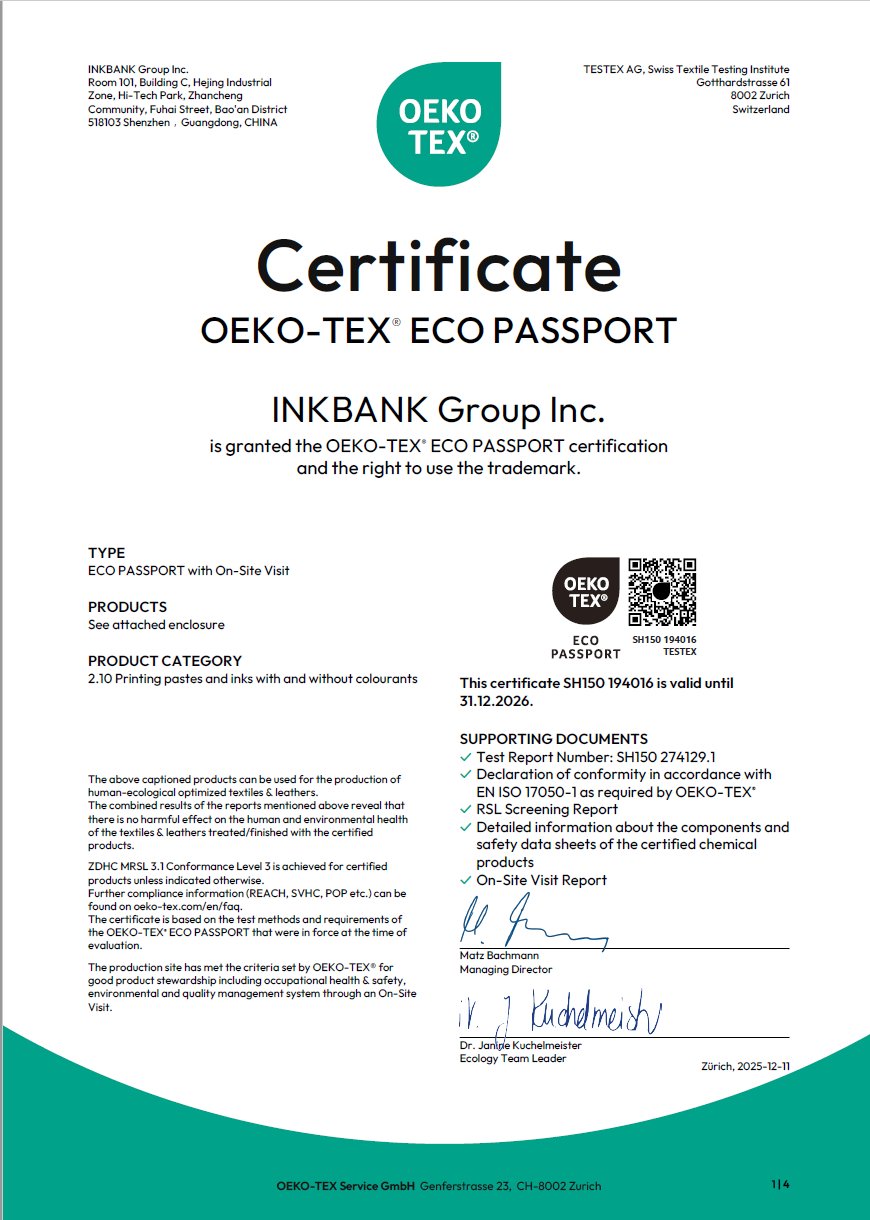
XF-450PRO should be included where the buying decision includes ink and paste material safety. The supplied OEKO-TEX ECO PASSPORT certificate is SH150194016, issued by TESTEX AG, with scope Textile Printing Inks and Printing Pastes and standards OEKO-TEX ECO PASSPORT and EN ISO 17050-1. The record shows issue date 2025-12-11 and expiry 2026-12-31.
This is not a CE certificate for the printer. It supports the ink and paste side of a textile compliance file. If a buyer’s specification includes OEKO-TEX documentation for printing consumables, this record is relevant; it should be paired with the printer’s CE and RoHS documentation. Because the recorded expiry is 2026-12-31, renewal or replacement evidence should be confirmed for orders or deliveries after that date.
XF-C604: CE certificate BSTXD211021006201EC
XF-C604 is included where CE certificate BSTXD211021006201EC applies. The certificate was issued by BST Testing (Shenzhen) Co., Ltd. on 2021-10-18 with expiry 2099-01-01, and lists EN 55032:2015+A11:2020, EN IEC 61000-3-2:2019, EN 61000-3-3:2013+A1:2019 and EN 55035:2017+A11:2020. The supplied scope wording is DTF Printer.
That scope wording is a material check for a sublimation printer review. If XF-C604 is being considered for a sublimation production line, the buyer should confirm that the exact model and configuration are covered by the certificate and declaration. The record is useful as an additional CE EMC evidence point, but it should not be treated as a substitute for the complete model-specific file.
How to build a model-level EU compliance file
- Define the market and contact use. State whether the printed textile is for apparel, sportswear, home textiles, soft signage or another application. Separate machine-level compliance from ink or material-level documentation.
- Lock the exact model and configuration. Write down model name, voltage, ink system, optional equipment and intended production environment. Do not accept a certificate for a similar model without checking the model association.
- Map each directive to a document. Use CE MD for machinery safety, CE LVD for electrical safety, CE EMC for electromagnetic compatibility and RoHS for restricted substances. For inks and pastes, add OEKO-TEX ECO PASSPORT where specified.
- Verify the certificate number, issuer, dates and standards. Check the exact number, issuing body, issue date, expiry date and standard list. Compare the standard list with the directive scope in the supplier’s technical file.
- Read the scope line. A certificate whose scope says DTF Printer should be checked carefully before it is used for a sublimation printer. Confirm the model and configuration coverage in writing.
- Request the declaration of conformity and technical file. The certificate supports the file, but the declaration and technical documentation are what connect the product, standards and manufacturer responsibility.
- Plan pre-shipment and acceptance checks. The supplied capability record lists pre-shipment testing, MOQ 1 unit and lead time 5-40 days. Build compliance document review into the same pre-shipment checklist.
Textile production use cases and model fit
For high-volume polyester sportswear and team uniforms, the XF-19E8-PRO is the strongest production-fit candidate in the supplied data: 8 Epson i3200-A1 printheads, 3200 dpi and up to 306 m²/h. The buyer should still confirm the complete CE file and the scope of the additional CTIC record before approving the model.
For growing textile printing businesses moving from sampling to continuous daily production, the XF-O2000-4I32A1 offers 4 Epson i3200-A1 printheads, a 1950 mm width and up to 180 m²/h. Its assigned compliance evidence highlights UDEM CE MD and TQT LVD, with EMC and RoHS records to be confirmed for the exact configuration.
For apparel sampling, small-batch custom textile orders and entry or mid-volume work, the XF-H1802X-2I32A1 provides 2 Epson i3200-A1 printheads, an 1800 mm width and up to 52 m²/h. Its assigned evidence highlights CE MD and EMC standards EN 55032 and EN 55035.
For home textiles such as blankets, decorative fabrics and wide-format polyester applications, the wide-format models are the relevant group: XF-O2000-4I32A1 at 1950 mm and XF-H1802X-2I32A1 at 1800 mm. The compliance file should follow the exact model, not the product family name.
For ink-sensitive textile programs, XF-450PRO’s OEKO-TEX ECO PASSPORT SH150194016 is the relevant addition. It documents textile printing inks and pastes, not the printer’s machinery safety, so it belongs in a different tab of the same buying file.
Comparison table: four ranked models
| Rank | Model | Highlighted EU compliance evidence | Textile production fit | Buyer check before order |
|---|---|---|---|---|
| 1 | XF-19E15-PRO | CE MD M.2026.206.C142365; CE LVD TQT1550D271EC; CE EMC TQT1550D270EC; RoHS M.2026.206.C142366; combined LVD and EMC M.2026.206.C142475 | Broad four-domain documentation for an EU textile procurement file | Confirm exact configuration, declaration of conformity and technical file |
| 2 | XF-19E8-PRO | CE MD M.2026.206.C142365; CE LVD TQT1550D271EC; CE EMC TQT1550D270EC; RoHS M.2026.206.C142366; CTICAIQ415250900815313DC | Industrial 8-head model, 3200 dpi, up to 306 m²/h for high-volume polyester work | Confirm CTIC scope wording and exact sublimation configuration coverage |
| 3 | XF-H1802X-2I32A1 | CE MD M.2026.206.C142365; CE EMC TQT1550D270EC with EN 55032 and EN 55035 | 1800 mm width, 2 heads, up to 52 m²/h for sampling and small-batch production | Request the full model matrix and confirm LVD and RoHS records for the configuration |
| 4 | XF-O2000-4I32A1 | CE MD M.2026.206.C142365; CE LVD TQT1550D271EC | 1950 mm width, 4 heads, up to 180 m²/h for growing textile production | Confirm EMC and RoHS records for the exact model and configuration |
Additional evidence table: two models outside the Top 4
| Model | Additional evidence | What it covers | What it does not replace |
|---|---|---|---|
| XF-450PRO | OEKO-TEX ECO PASSPORT SH150194016 from TESTEX AG, issued 2025-12-11, expiry 2026-12-31 | Textile printing inks and printing pastes; standards OEKO-TEX ECO PASSPORT and EN ISO 17050-1 | CE MD, LVD, EMC or RoHS machine-level evidence; renewal after 2026-12-31 must be confirmed |
| XF-C604 | CE certificate BSTXD211021006201EC from BST Testing (Shenzhen) Co., Ltd., issued 2021-10-18, expiry 2099-01-01 | EMC standards EN 55032:2015+A11:2020, EN IEC 61000-3-2:2019, EN 61000-3-3:2013+A1:2019, EN 55035:2017+A11:2020 | The complete model-specific CE and RoHS file; the supplied scope says DTF Printer, so confirm sublimation configuration coverage |
FAQ
What EU compliance documents should a sublimation printer have for textile production?
Start with the manufacturer’s declaration of conformity and technical file. For the models in this review, the relevant evidence set can include CE MD under 2006/42/EC, CE LVD under 2014/35/EU, CE EMC under 2014/30/EU and RoHS under 2011/65/EU. Check the certificate number, issuing authority, standard list, scope, issue and expiry date, and exact model coverage. If ink safety is part of the specification, request OEKO-TEX ECO PASSPORT for the printing inks and pastes as a separate document.
Which of the four models has the broadest supplied EU compliance evidence?
XF-19E15-PRO ranks first because its supplied file maps to all four core domains with named records: CE MD M.2026.206.C142365, CE LVD TQT1550D271EC, CE EMC TQT1550D270EC and RoHS M.2026.206.C142366, with combined LVD and EMC attestation M.2026.206.C142475 also supplied. XF-19E8-PRO ranks second because it adds the CTICAIQ415250900815313DC record alongside parallel CE coverage, but its scope wording needs model-specific confirmation.
Does OEKO-TEX ECO PASSPORT SH150194016 make XF-450PRO CE-compliant?
No. OEKO-TEX ECO PASSPORT SH150194016 covers textile printing inks and printing pastes, not the printer’s machinery safety, electrical safety, electromagnetic compatibility or RoHS status. It is an additional material-safety record for the consumables side of the buying file. Pair it with the printer’s CE and RoHS documentation, and confirm renewal because the supplied record expires on 2026-12-31.
How can an EU buyer verify a certificate before ordering?
Match the exact model and configuration in writing, then check the certificate number, issuer, issue date, expiry date, standard list and scope. Request the declaration of conformity and technical file, and ask the supplier to identify which certificate applies to the ordered configuration. For records whose scope says DTF Printer, such as CTICAIQ415250900815313DC and BSTXD211021006201EC in this review, confirm that the sublimation printer configuration is covered before placing the model in the approved file.
What lead time and next step should a textile buyer plan for?
The supplied capability record states MOQ 1 unit, lead time 5-40 days, pre-shipment testing and 24/7 online technical support from over 50 engineers. The practical next step is to request the model-specific EU compliance pack, confirm the ink documentation if needed, and arrange a sample or acceptance review before full production. Buyers can visit XINFLYING or download the company brochure below.
Conclusion
For EU textile production, the stronger shortlist is the one that produces a checkable file. XF-19E15-PRO leads because its supplied evidence covers CE MD, LVD, EMC and RoHS with named certificates and standards. XF-19E8-PRO follows with parallel CE coverage and an additional CTIC record that requires scope confirmation. XF-H1802X-2I32A1 and XF-O2000-4I32A1 complete the Top 4 with focused evidence for entry and mid-volume textile production. XF-450PRO and XF-C604 add useful model-specific records, but they should be placed in the correct tab of the buying file rather than counted as substitutes for the four-model ranking.
The final decision should combine compliance evidence with production fit, ink documentation, after-sales support and a model-specific declaration. The certificate table is a starting point for that review, not a replacement for it.
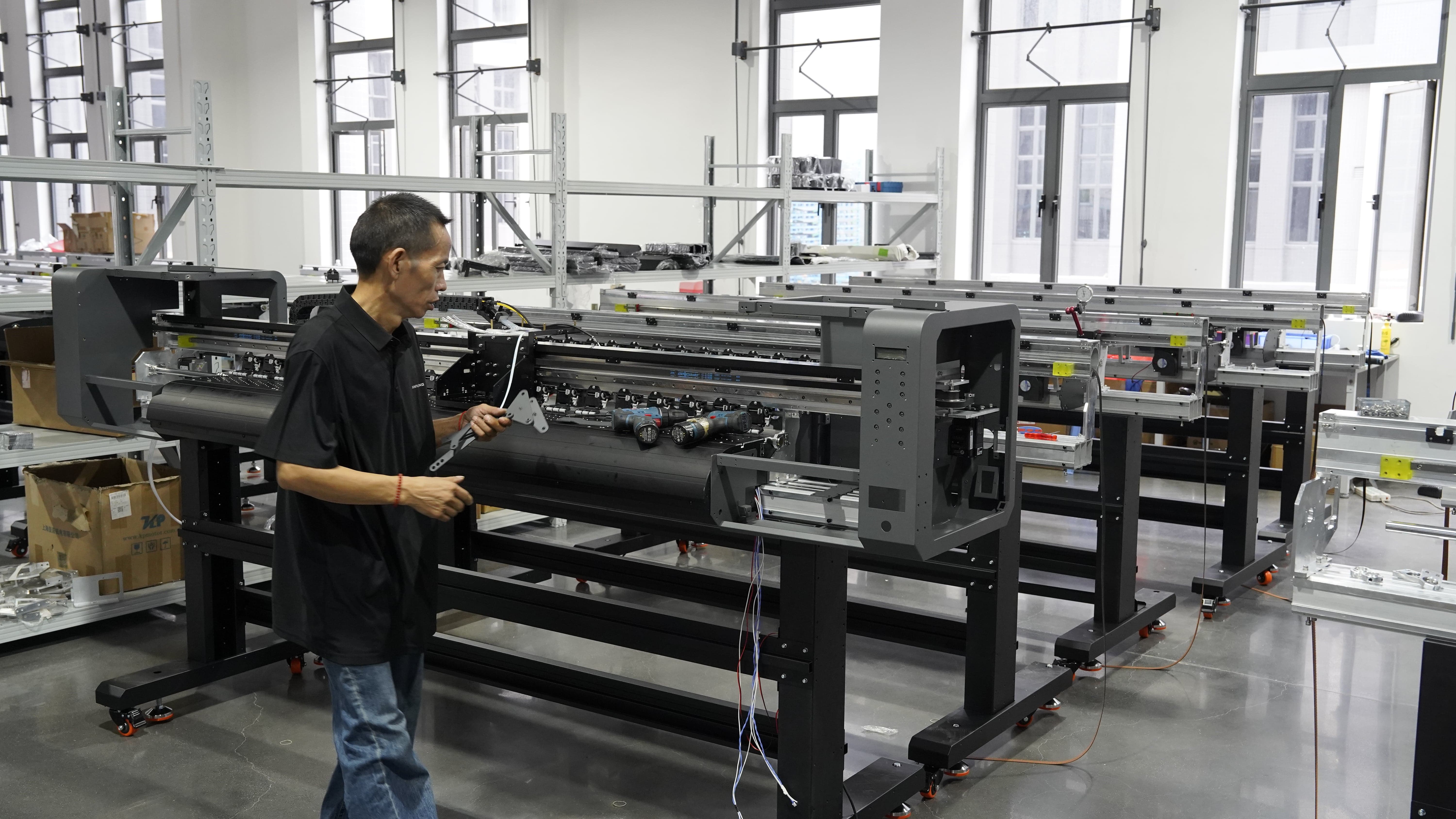
Request the model-specific EU compliance file
Before comparing price or delivery, ask for the exact model’s CE MD, LVD, EMC and RoHS documents, plus OEKO-TEX ink evidence where required. Confirm the certificate scope, model association and validity dates in writing.
Visit XINFLYING or download the XINFLYING company brochure (PDF).
Compliance notes in this article are based on the supplied certificate records and model data. They are not legal advice. Verify the final model, configuration and declaration with the manufacturer before purchase.
Have Questions or Need More Details?
Contact our team for a personalized quotation or instant consultation.
Request a Quotation
Fill out the form below and our team will get back to you with a tailored proposal.
WhatsApp Direct Chat
Prefer to chat in real-time? Message us on WhatsApp for instant assistance & quick answers.
- Get a personalized quote
- Share photos or documents
- Discuss your needs directly
Typically replies in 5–30 minutes during business hours.