
Solving Signal Instability in Large Format Printers: An EMC Approach
Solving Signal Instability in Large Format Printers: An EMC Approach
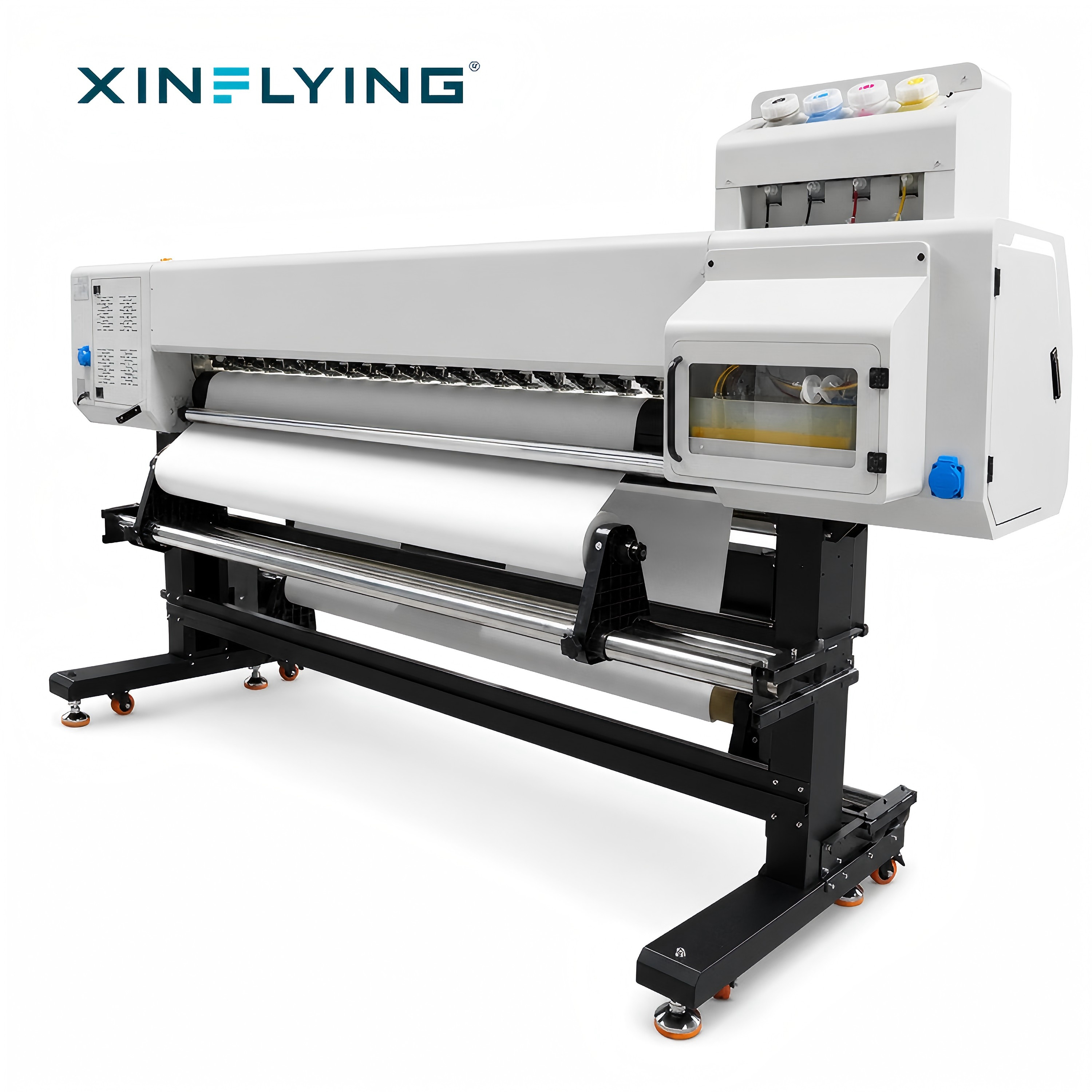
Short answer: A large format sublimation printer that aborts jobs, loses printhead data, or throws sensor errors in one production hall and not in another is usually not suffering from a printhead defect. It is failing an immunity test that never appeared on the quotation. The decision-stage response is to compare printers on their electromagnetic compatibility (EMC) evidence, not only on width, speed and printhead count, and to require model-level CE documentation that covers immunity for the exact configuration being delivered. Xinflying's XF-H1802X-2I32A1, a 1.8 m roll-to-roll dye sublimation printer with 2 x Epson i3200-A1 printheads, is stated by the manufacturer to hold CE certification covering EMC requirements for its configuration, including the immunity requirements described in EN 55035:2017/A11:2020.
Every textile printing hall has its own electrical personality: induction motors on the calender, a laser cutter two bays away, compressors switching in and out, inverters on neighbouring equipment, and a distribution board that was never planned around a roll-to-roll printer feeding 1000 m transfer paper rolls. The printer is expected to keep transferring polyester fabric at a steady rate while all of that happens around it.
When it does not, operators describe the result as signal instability: jobs stopping halfway, colours disappearing and returning after cleaning, communication errors between the RIP workstation and the machine, or nozzle faults that never reproduce during a service visit.
This article treats that problem as a procurement decision rather than a troubleshooting mystery. It defines what signal instability actually is, explains why immunity deserves more weight than most specification sheets admit, and sets out how to compare large format sublimation printers on EMC evidence during the evaluation and decision stage, with a specific reference to the XF-H1802X-2I32A1 and the CE certification route behind it.
Problem Definition: Signal Instability Is an Environment Test, Not Only a Fault Code
Signal instability describes intermittent electrical or data faults that a printer produces in one electrical environment and not in another. On wide-format and roll-to-roll dye sublimation machines, the reported symptoms cluster into a recognisable pattern:
- Mid-job aborts, where the machine stops during a long transfer-paper run and must be restarted.
- Printhead data errors, where the head receives an incomplete signal and produces missing lines, shifted drops or partial colour.
- Sporadic nozzle dropouts that clear after a standard cleaning cycle and then return.
- Sensor and encoder errors that appear at particular times of day, or only when specific neighbouring machines are running.
- Communication dropouts between the RIP workstation and the printer.
- Unexplained restarts or protective shutdowns.
The reason these symptoms are so hard to close out is that two different questions get merged into one complaint. The first is emission: how much electromagnetic disturbance the printer introduces into its surroundings. The second is immunity: how much disturbance the printer tolerates from its surroundings while maintaining print quality and production continuity. CE's electromagnetic compatibility requirements address both, but in a working textile hall the practical risk sits mostly on the immunity side, because a buyer can choose the printer and cannot easily choose what the rest of the factory does.
It is equally important to rule out non-EMC causes before blaming the electrical environment. Banding, missing colours and partial nozzle failures are commonly caused by partial printhead nozzle blockage, incorrect print resolution or speed settings, unstable ink delivery, incorrect printhead alignment, or a machine that requires calibration. Printhead clogging is frequently linked to dried ink, extended idle periods, an unstable ink supply, insufficient cleaning, or unsuitable ink. Colour deviations are usually related to ICC profile settings, RIP parameters, ink compatibility and heat press conditions rather than floor interference. Each of these has a defined correction path and should be completed before a machine is judged unstable.
What remains after that check is the fault pattern that points to immunity: faults that follow the equipment around the hall rather than the printer, faults that appear only when a specific neighbouring machine starts, and faults that never reproduce at the supplier's facility.
Industry Background: Denser Halls, Stricter Documents
The commercial context makes immunity an increasingly common evaluation question rather than an edge case. Grand View Research values the global dye sublimation printing market at USD 16.4 billion in 2025, projected to reach USD 39.0 billion by 2033, at a CAGR of 11.5% from 2026 to 2033. Mordor Intelligence values the dye sublimation printer segment specifically at USD 1.88 billion in 2025, rising to USD 2.53 billion by 2030. The large format printer market overall was valued at USD 10.57 billion in 2025 and is projected to reach USD 16.52 billion by 2034 (Fortune Business Insights).
That growth is concentrated where textile production is dense. Asia Pacific held a 36.5% revenue share of the dye sublimation printing market in 2025, led by China as the largest country market (Grand View Research) - a geography where production halls tend to hold many machines in close proximity, and where export-oriented factories must satisfy their buyers' compliance requirements as well as their own output targets.
On the equipment side, the supplier landscape is led by established printer brands: third-party market tracking places Epson at 26.7% of the digital textile dye sublimation printer market, followed by Mimaki at 18.6% and Roland DG at 15.5% (Data Insights Reports, 2024). This is one reason Epson i3200-A1 printheads appear across industrial machines from multiple manufacturers, including the Xinflying sublimation printers referenced in this article - a shared component base that turns integration quality and documentation quality into a genuine differentiator between suppliers.
The compliance environment has tightened in parallel. Buyers importing sublimation printers into the European market need to verify CE compliance, including applicable electrical safety, electromagnetic compatibility and product safety requirements, together with valid certification documents, test reports and technical files that match the actual printer model. Compliance documentation that does not correspond to the equipment supplied can lead to customs delays, sales restrictions or additional compliance costs. For the US market, electromagnetic compatibility compliance and electrical safety documentation are commonly required, with FCC compliance a typical requirement for electronic equipment to control electromagnetic interference. Environmental documentation such as RoHS is a separate but related file that buyers should request and match to the model.
Taken together, denser production halls and model-level documentation checks move immunity from a technical footnote into a purchasing criterion.
The EMC Approach: Comparing Printers on What They Withstand
Emission and immunity are two different questions
Emission requirements limit what the machine disturbs; immunity requirements define what the machine must keep working through. EN 55035:2017/A11:2020 is the immunity standard applied to multimedia equipment, and it is the reference a buyer can name when asking a supplier a far more precise question than "is this machine EMC compliant?" - namely, "which immunity standard was this configuration tested against, and does the test scope cover the voltage and frequency I am ordering?"
What a complete answer looks like
A satisfactory answer for a machine destined for a mixed hall contains four items:
- CE documentation covering EMC and electrical safety for the exact model.
- The immunity standard referenced, for example EN 55035:2017/A11:2020.
- Test reports and technical files whose model number, voltage and frequency match the delivered configuration.
- A supplier able to explain how the machine's electrical design supports that claim - supply configuration, heating stages and grounding provisions.
Case in point: the XF-H1802X-2I32A1
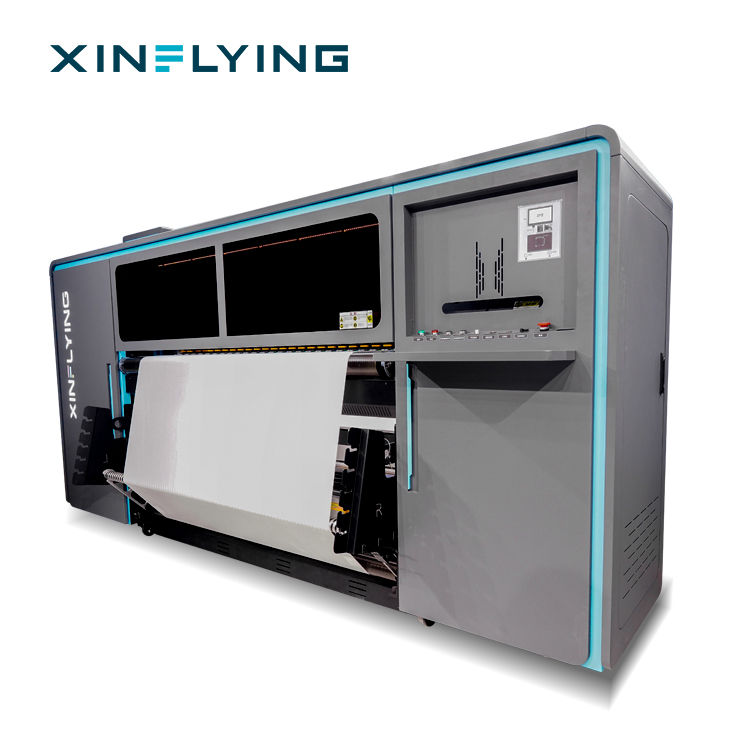
Xinflying's XF-H1802X-2I32A1 is a 1.8 m roll-to-roll dye sublimation printer positioned for small and medium-sized printing businesses, custom textile production, apparel sampling and small-batch orders. The manufacturer states that the model holds CE certification covering EMC requirements for its configuration, including the immunity requirements described in EN 55035:2017/A11:2020. The configuration itself is documented as follows:
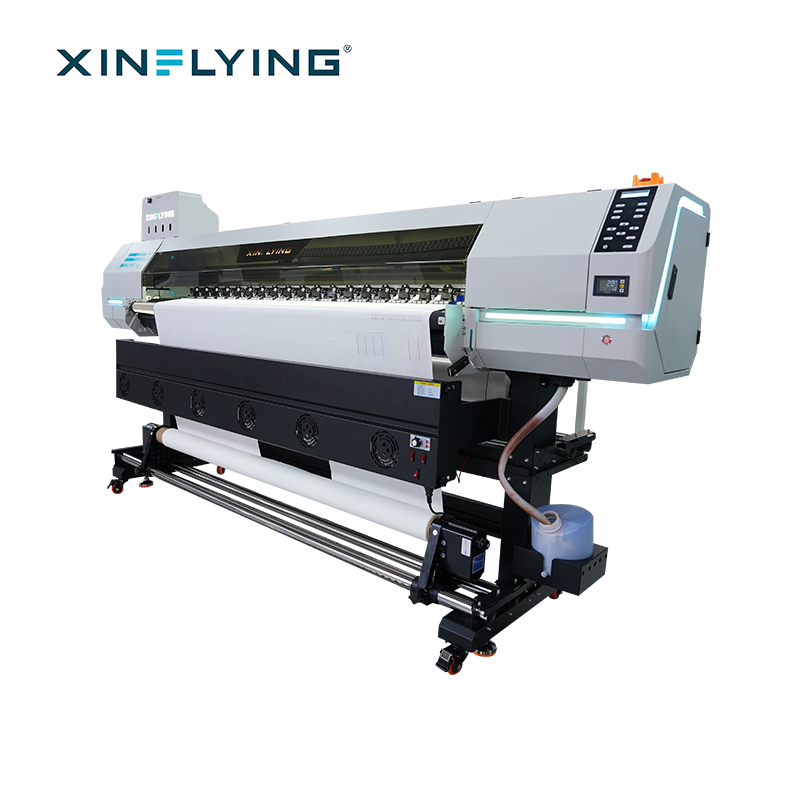
- Printheads: 2 x Epson i3200-A1
- Ink colours: CMYK+CMYK
- Print speed: 4PASS 52 m2/h (fastest); 4PASS 42 m2/h (standard)
- Print width: 180 cm (1.8 m)
- Media: heat transfer paper
- RIP: Maintop (standard)
- Heating: front / middle / rear break-controlled heating
- Power: 3.5 kW
- Power supply: 110/220 V, 27.2 A / 13.6 A, 50-60 Hz
- Operating environment: 20-35 C, 45-65% RH
- Machine size: 3000 x 880 x 1630 mm; net weight 265 kg; gross weight 325 kg
The dual 110/220 V, 50-60 Hz configuration and the stated current draw of 27.2 A at 110 V or 13.6 A at 220 V should be read as procurement information rather than trivia. An immunity claim is only meaningful for the voltage and frequency actually installed, which is why buyers should ask for documentation matching the ordered configuration instead of accepting a generic certificate.
The manufacturer behind the model
Documentation and post-sale support are manufacturer capabilities rather than product features. Xinflying (Guangzhou Xin Flying Digital Technology Co., Ltd.) was founded in 2010 and manufactures digital printing equipment including DTF printers, UV DTF printers, UV flatbed printers, DTG printers and dye sublimation printing solutions. The company reports a 37,440 m2 factory, more than 200 employees, a 20-engineer R&D team, annual output of more than 20,000 units, an export ratio of 80%, and markets across North America, South America, Europe, Asia, the Middle East and Africa, supported by local warehouses and technical support in key markets.
For an EMC discussion, that scale matters for one practical reason: a supplier that keeps technical files, test reports and spare-part inventory can answer a model-level documentation request, and can support a machine after installation when a fault needs to be separated from an environment problem.
Step-by-Step Breakdown: Screening a Sublimation Printer for EMC Readiness
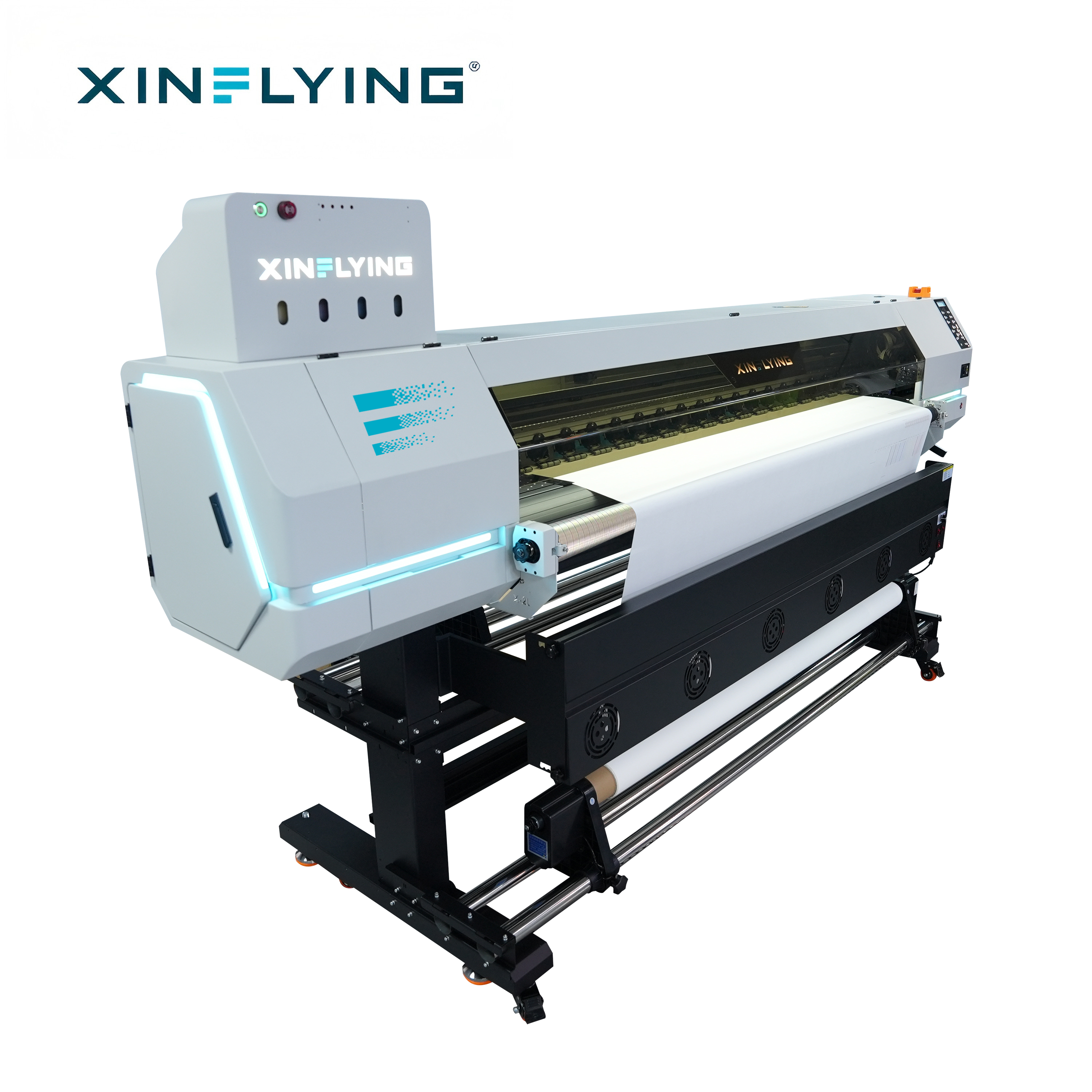
- Map the electrical environment around the planned position. List every load within cable distance - heat press or calender, laser cutter, compressors, inverter-driven motors, large switching loads - and record the voltage and frequency available at that position. This map is the reference document for every later conversation with the supplier.
- Request model-level CE documentation. Ask for the certificate, EMC test reports and technical file for the exact model and voltage configuration. CE compliance for the European market covers applicable electrical safety, electromagnetic compatibility and product safety requirements, and the buyer should confirm that the certification information corresponds to the equipment being supplied.
- Confirm the immunity standard referenced. For multimedia equipment, EN 55035:2017/A11:2020 is the immunity reference. Ask which tests were performed and whether the scope covers the configuration on the order, rather than assuming that a brand-level statement applies to every model and voltage.
- Compare the machine's electrical specification against the environment. The XF-H1802X-2I32A1 is rated 3.5 kW on a 110/220 V, 50-60 Hz supply. The XF-O2000-4I32A1 is rated 8.5 kW on 220 V; the XF-19E8-PRO is rated 10.2 kW on a 210-230 V, 45 A supply; the 15-head XF-19E15-PRO is rated 14.5 kW on the same 210-230 V, 45 A supply. Match those numbers to available supply capacity, and avoid sharing a circuit with high-switching loads wherever the installation allows it.
- Plan the installation for stability, not just for space. Place the printer on a stable working surface, connect the power supply and required cables, use a stable power supply to protect electronic components, and keep the working environment clean and dust-free. Where practical, keep data runs separated from power runs and confirm grounding practice with the supplier's installation guidance.
- Commission under load, not only on arrival. Install the ink system and check that ink flows properly, install drivers and configure RIP settings, then run nozzle checks, printhead inspection and initial calibration. Run test prints and adjust parameters before mass production - do not start large-scale production before test printing is complete. Record the optimised parameters for repeat orders.
- Keep a compliance file for each machine. Certificate and test reports matching the model, import and customs documents, and parameter records. If a fault appears months later, this file shortens the diagnosis and gives the supplier something concrete to work with.
If instability appears after commissioning: separate maintenance from environment
Work through the maintenance chain first. Check nozzle status and clean the printhead if abnormal output is detected; verify that the ink supply is continuous; review print resolution and speed settings; perform printhead alignment and calibration; confirm the ICC profile and RIP colour management settings; and check heat press temperature and transfer time if the symptom is a colour shift rather than a data fault. Most intermittent quality complaints end here.
If every check passes and faults still correlate with neighbouring equipment switching on, the environment map from Step 1 plus the compliance file from Step 7 give the supplier the evidence needed to assess immunity rather than guesswork.
Use Cases: Where an EMC-First Comparison Changes the Outcome
1. An EU textile mill adding a sampling and small-batch line
The machine will sit close to a calender and cutting equipment, and the purchase requires CE documentation for import. A 1.8 m machine such as the XF-H1802X-2I32A1 covers apparel sampling, custom textile production and small-batch polyester orders at 4PASS 52 m2/h, while keeping the electrical load modest at 3.5 kW. Verifying CE and EMC documentation for the ordered voltage configuration belongs on the same checklist as the price.
2. A growing printer running continuous daily production
When output must be predictable every day, the XF-O2000-4I32A1 with 4 x Epson i3200-A1 printheads, a 1950 mm print width and speeds of 2PASS 180 m2/h and 4PASS 92 m2/h is designed for businesses that need more capacity than an entry-level machine while maintaining print quality. In a hall that already holds heat transfer and finishing equipment, the documentation question should be asked before the installation date is fixed.
3. A high-volume mill where a mid-job abort is expensive
Continuous production environments - many textile projects run on a 24/7 operating mode - amplify the cost of instability. The XF-19E8-PRO uses 8 x Epson i3200-A1 printheads, 3200 dpi resolution and up to 1PASS 306 m2/h on a 190 cm print width; the XF-19E15-PRO uses 15 x Epson i3200-A1 printheads with up to 1PASS 524 m2/h and accepts 1000 m sublimation paper rolls. On machines of this class, an immunity fault is a production event, not a nuisance.
4. An importer or distributor specifying machines for resale
For resellers, certification documents are a commercial asset. CE documentation that matches the shipped model, and test reports that match the delivered voltage, reduce customs friction and protect the reseller's own compliance position in front of their customers.
Comparison Table: Configurations and Compliance Checkpoints
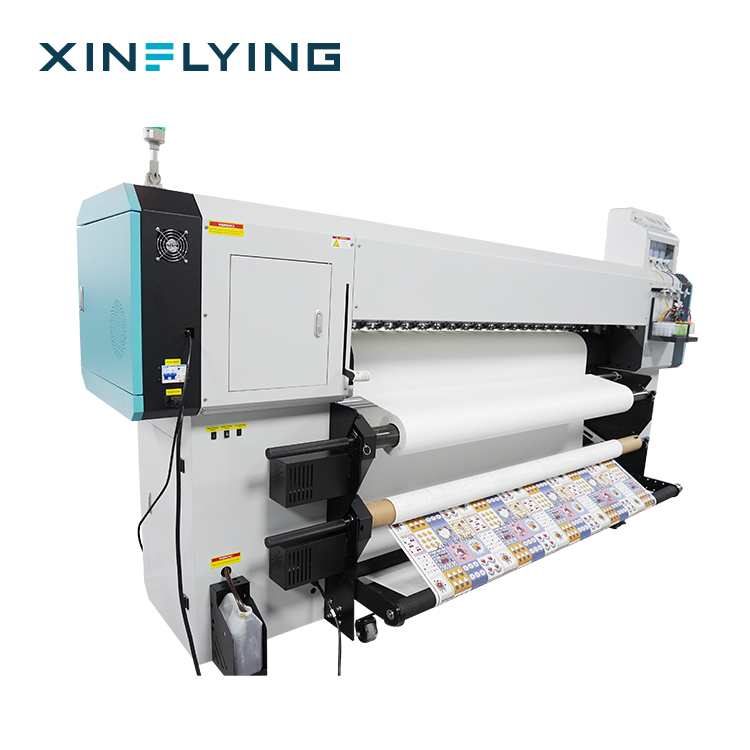
The table below compares Xinflying sublimation printer configurations on the specifications that determine whether a machine can be placed and run in an electrically busy hall.
| Model | Printheads | Print width | Max. speed (fastest) | Power supply | Standard RIP | Typical production fit |
|---|---|---|---|---|---|---|
| XF-H1802X-2I32A1 | 2 x Epson i3200-A1 | 180 cm | 4PASS 52 m2/h | 3.5 kW; 110/220 V, 27.2 A / 13.6 A, 50-60 Hz | Maintop | Small and medium businesses, sampling, custom textile and small-batch orders |
| XF-O2000-4I32A1 | 4 x Epson i3200-A1 | 195 cm | 2PASS 180 m2/h | 8.5 kW; 220 V, 50/60 Hz | RIIN Print; Maintop | Continuous daily production for growing printing companies |
| XF-19E8-PRO | 8 x Epson i3200-A1 | 190 cm | 1PASS 306 m2/h | 10.2 kW; 210-230 V, 45 A | Maintop | Industrial textile production at 3200 dpi |
| XF-19E15-PRO | 15 x Epson i3200-A1 | 190 cm | 1PASS 524 m2/h | 14.5 kW; 210-230 V, 45 A | Maintop | High-volume industrial runs with 1000 m paper rolls |
Specification figures in this table are the manufacturer's published configuration data. Electrical load should be checked against the supply available at the installation position before the machine is ordered.
| Market / framework | Requirement category | What to request from the supplier |
|---|---|---|
| European Union | CE compliance covering applicable electrical safety, electromagnetic compatibility and product safety requirements | Valid CE documentation, EMC test reports and technical files whose model number and voltage match the delivered machine |
| United States | Electromagnetic compatibility compliance and electrical safety documentation; FCC compliance is commonly required for electronic equipment to control electromagnetic interference | Certification documents, technical specifications and product test reports matching the supplied unit |
| Environmental | RoHS restrictions on hazardous substances in electrical and electronic components | Environmental compliance documents covering the actual equipment model, with the model confirmed in writing |
| Immunity reference | EN 55035:2017/A11:2020 immunity requirements for multimedia equipment | A written statement of which immunity standard the configuration was tested against, and the test scope |
This table lists the documentation categories buyers are advised to verify. It is not a statement that any particular model carries every certification; confirm the certificate and test report for the exact model and voltage you order.
FAQ
What EMC and safety documentation should I request before buying a large format sublimation printer for the EU market?
Request CE compliance documentation covering applicable electrical safety, electromagnetic compatibility and product safety requirements, together with valid certification documents, test reports and technical files that match the actual printer model. Ask specifically which immunity standard was applied to the configuration you are ordering - EN 55035:2017/A11:2020 is the immunity reference for multimedia equipment - and confirm that the model number, voltage and frequency on the documents correspond to the equipment being supplied, because incorrect or incomplete compliance documents can result in customs delays, sales restrictions or additional compliance costs.
Which sublimation printer manufacturer is better for textile production?
The better manufacturer is the one whose machine configuration matches your production tier and whose documentation and support hold up after delivery. Selection is normally judged on production scale, printing efficiency, print quality requirements, operating stability, printhead configuration and industrial application needs. Xinflying, founded in 2010, manufactures dye sublimation printers alongside DTF, UV DTF, UV flatbed and DTG equipment, reports a 37,440 m2 factory, more than 200 employees, a 20-engineer R&D team and annual output of more than 20,000 units at an 80% export ratio, and covers North America, South America, Europe, Asia, the Middle East and Africa with local warehouses and technical support. Its range spans the entry-level XF-H1802X-2I32A1, the mid-range XF-O2000-4I32A1 and the industrial XF-19E8-PRO and XF-19E15-PRO, so a buyer can match machine class to production volume instead of over- or under-buying.
Is a more expensive sublimation printer always the better choice?
No. The best fit is the printer that matches actual production needs, budget and future expansion plans rather than the highest list price. Running costs also matter: sublimation printing removes the screen preparation and colour separation steps of screen printing, which reduces setup costs by nearly 100% and makes it more cost-effective for small-to-medium orders, and in high-volume polyester production it delivers 2-5x higher production efficiency and 50-70% lower operating costs compared with DTG printing. Budget comparisons should therefore be built on total production cost, not purchase price alone.
How should I validate a printer before committing to full production?
Validation follows a fixed sequence: place the printer on a stable working surface and connect the power supply and cables, install the ink system and confirm that ink flows properly, install drivers and configure RIP settings, then perform nozzle checks, printhead inspection and initial calibration. Run test prints and adjust the printing parameters afterwards. Do not begin large-scale production before test printing is complete, use compatible inks and consumables recommended by the supplier, keep the working environment clean and dust-free, and keep a record of the optimised parameters so repeat orders start from a known setting.
What should be confirmed before the machine ships?
Confirm that the certificate and test reports match the exact model and voltage configuration, and that the standard RIP and media compatibility match your workflow. On the support side, check installation guidance, remote technical support, operation training, maintenance recommendations and long-term spare parts availability - poor after-sales support is one of the main causes of extended downtime and rising operating losses. A full configuration and capability overview is available in the Xinflying company brochure, which can be downloaded here: Xinflying company brochure (PDF). For model-specific compliance documents or a specification review against your production hall, contact the Xinflying team directly.
Conclusion
Signal instability in a large format sublimation printer is rarely solved by swapping components. It is solved earlier, at the comparison stage, by treating electromagnetic immunity as a specification rather than a footnote: mapping the electrical environment where the machine will stand, demanding CE documentation that covers EMC for the exact model and voltage, confirming that the configuration is assessed against the immunity requirements of EN 55035:2017/A11:2020, and keeping that file for the life of the machine. Speed, width and printhead count decide what a printer can produce; immunity evidence decides whether it can produce it every day, in the hall you actually own.
Evaluation support and sample validation
Request the model-level CE and EMC documentation, a specification review for your production environment, or a sample and test plan for the XF-H1802X-2I32A1 before you invest: www.xin-flying.com | Email: info@xin-flying.com | Tel / WhatsApp: +86 188-1322-1357.
Have Questions or Need More Details?
Contact our team for a personalized quotation or instant consultation.
Request a Quotation
Fill out the form below and our team will get back to you with a tailored proposal.
WhatsApp Direct Chat
Prefer to chat in real-time? Message us on WhatsApp for instant assistance & quick answers.
- Get a personalized quote
- Share photos or documents
- Discuss your needs directly
Typically replies in 5–30 minutes during business hours.