
Low-Volume, High-Mix Textile Production: A Legal & Spec Guide
Low-Volume, High-Mix Textile Production: A Legal & Spec Guide
A production house that earns its margin from sampling and short runs needs two things from a sublimation printer: the ability to change over between designs without burning paper and ink, and a compliance file that holds up when a single machine — not a full container — is shipped into the European Union. This guide covers both sides of that problem. It explains which specifications genuinely govern flexibility in a high-mix workflow, and which CE documentation scope an EU importer will ask to see before an individual unit clears customs.
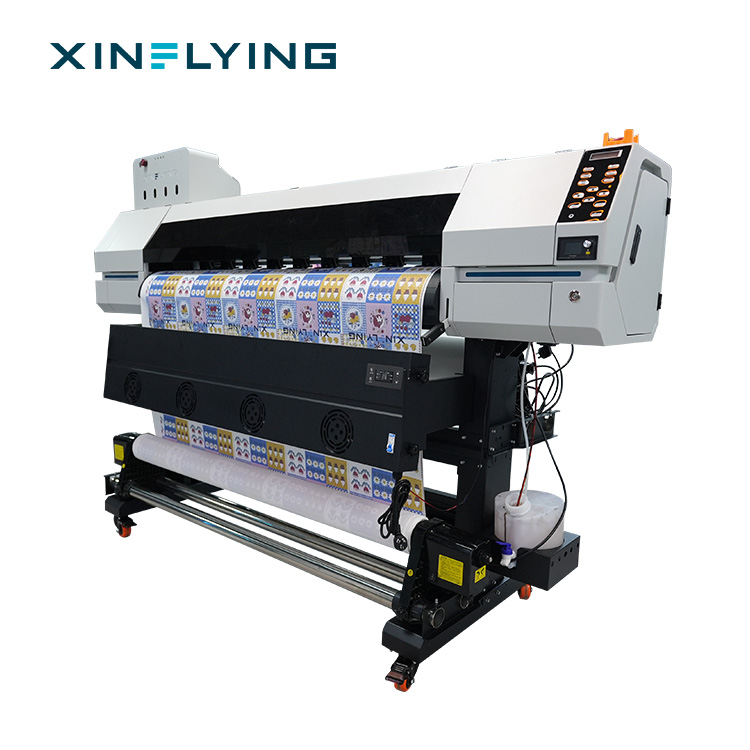
Guangzhou Xin Flying Digital Technology Co., Ltd. (XINFLYING) is a manufacturer of digital printing equipment established in 2010 and based in Panyu, Guangzhou. The company specialises in DTF printers, UV DTF printers, UV printers, DTG printers and dye sublimation printing solutions; its main products include DTF printer machines, dye sublimation printers, DTG printers, UV DTF printers, UV flatbed printer machines, printing consumables and complete digital printing solutions. It operates a 37,440 m² manufacturing facility, employs more than 200 staff with a 20-engineer R&D team, and has an annual production capacity exceeding 20,000 units.
Problem Definition: Why High-Mix Production Breaks Standard Buying Logic
Most sublimation printer comparisons are written for volume. Printhead count, maximum print speed and print width are ranked on the assumption that the machine will run long, repetitive jobs, where cost per square metre falls with every additional metre printed. That logic is correct for a mill. It is the wrong logic for a production house that runs twenty different designs in a week.
In a high-mix workflow, three cost centres replace the cost-per-square-metre calculation:
- Changeover cost. Every design change carries a fixed overhead — artwork preparation, RIP parameter selection, a nozzle check, a colour verification and a test print. On a machine sized for continuous production, that overhead disappears into thousands of running metres. On a machine producing 30–80 metre orders, it can dominate the job.
- Colour repeatability at low volume. A short run gives the operator fewer metres in which to correct drift. If the first metres of a 40-metre repeat are wrong, there is no long tail over which to amortise the error, so the remainder of the order becomes waste rather than revenue.
- Compliance at individual-unit level. Certification is normally discussed as a container-level question. A short-run producer ships individual machines, and each individual unit has to be importable on its own documentation. A CE certificate that covers a product family is not automatically the same thing as a certificate whose scope names the exact configuration sitting on the pallet.
The third point consumes the most calendar time. Buyers importing a sublimation printing machine into the European market should verify CE compliance, including applicable electrical safety, electromagnetic compatibility and product safety requirements, and should confirm that the certification information corresponds with the equipment being supplied. Incorrect or incomplete compliance documents can result in customs delays, sales restrictions or additional compliance costs — costs that a short-run business absorbs far less easily than a high-volume importer shipping monthly containers.
Industry Background: Where Short-Run Demand Comes From
The dye sublimation category is expanding on both ends of the volume spectrum at once. Grand View Research valued the global dye sublimation printing market at USD 16.4 billion in 2025 and projects USD 39.0 billion by 2033, a trajectory the same source puts at an 11.5% CAGR for 2026–2033. The narrower equipment segment follows the same curve: Mordor Intelligence values dye sublimation printers at USD 1.88 billion in 2025, rising to USD 2.53 billion by 2030.
Those headline figures should be treated with care, because research houses define the category differently. Mordor Intelligence estimates the 2025 dye sublimation printing market at USD 15.22 billion and Market Research Future at USD 42.95 billion; the gap reflects whether consumables and services sit inside or outside the boundary. Any single number is a scope-dependent estimate, not a settled measurement.
The regional picture is clearer. Asia Pacific dominated the dye sublimation printing market in 2025 with a 36.5% revenue share, led by China as the largest country market, and China’s textile and garment exports reached USD 293.6 billion in 2023 — a base that sustains local demand for industrial-scale sublimation capacity. On the demand side, the growth of personalised apparel and home decor is the primary driver behind a 13.1% CAGR in the digital textile sublimation market through 2030. Personalisation is, by definition, a high-mix business.
Two technology standards frame equipment decisions. Roll-to-roll sublimation printers at 1.9 m (1900 mm) width are the recognised format for high-volume textile and soft signage work, and inkjet production printers accounted for 87.3% of the production printer market by type in 2024. On the colour side, ISO 12647-8:2021 defines the standard for validation print processes working directly from digital data — the reference point for anyone building a repeatable colour pipeline. The broader large format printer market, valued at USD 10.57 billion in 2025 and projected to reach USD 16.52 billion by 2034, provides the surrounding supply base.
What these figures do not describe is the shape of the order book. Capacity is being added at the industrial end and at the entry end simultaneously, while the sampling and small-order segment is served by machines that are specified in industrial language but operated in a job-shop rhythm. That mismatch is where specification and legal questions converge.
Detailed Solution: What Flexibility Means in Specification Terms
“Flexible” is not a specification. For a high-mix production house it resolves into seven measurable properties, and each one has a different cost consequence depending on order mix.
1. Print width sets the ceiling on what you can accept
Width determines which jobs are even quotable. XINFLYING’s roll-to-roll sublimation range spans 130 cm (XF-H1301X-1I32A1), 180 cm (XF-H1802X-2I32A1), 190 cm (XF-19E8-PRO and XF-19E15-PRO) and 195 cm (XF-O2000-4I32A1). A sampling studio working on cut-and-sew garment panels rarely needs more than 130–180 cm; a house taking home textile, soft signage or wide all-over print work needs 190 cm or above. Sizing width to the widest repeat you expect to quote is the single decision that most often forces an upgrade later.
2. Printhead count is a run-length decision, not just a speed decision
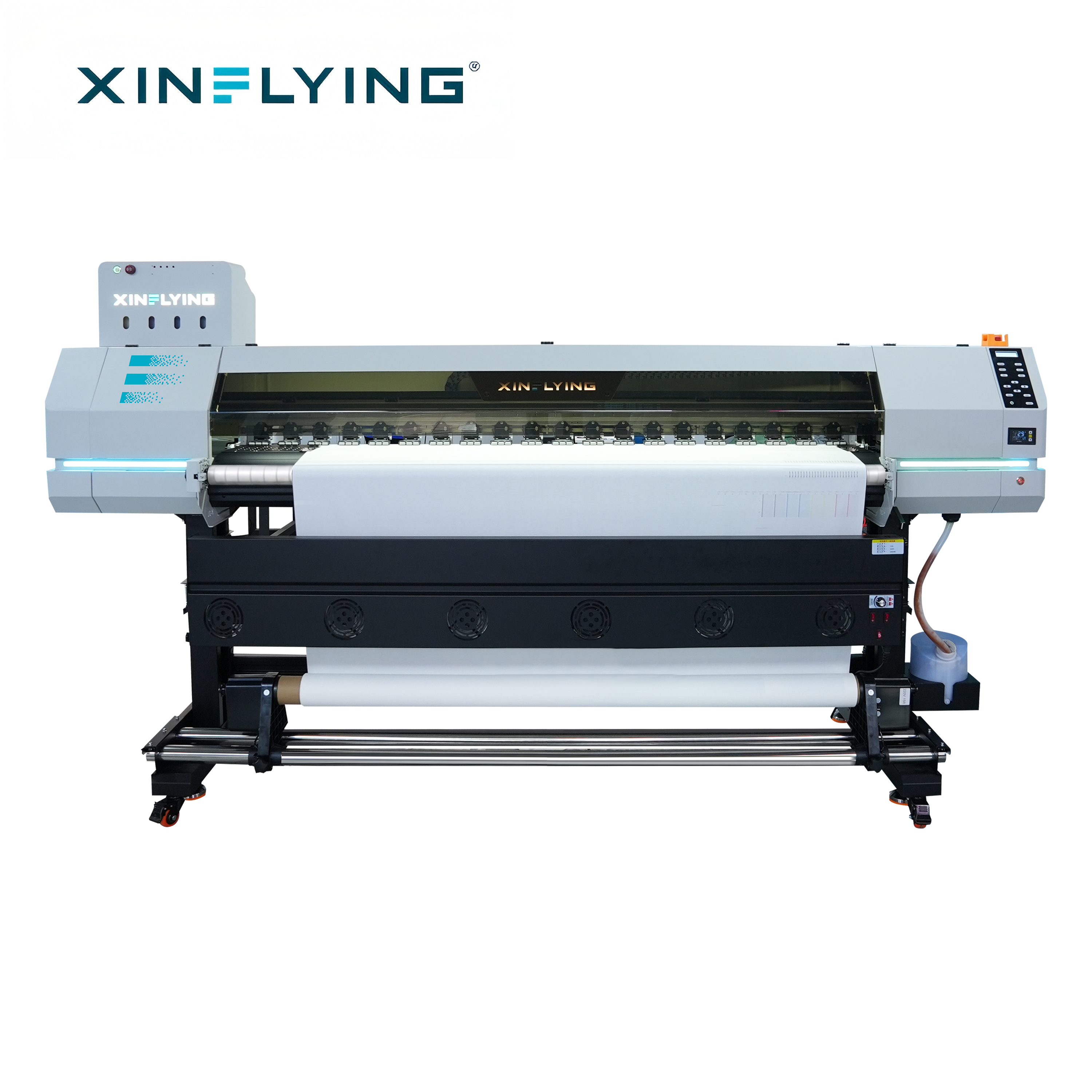
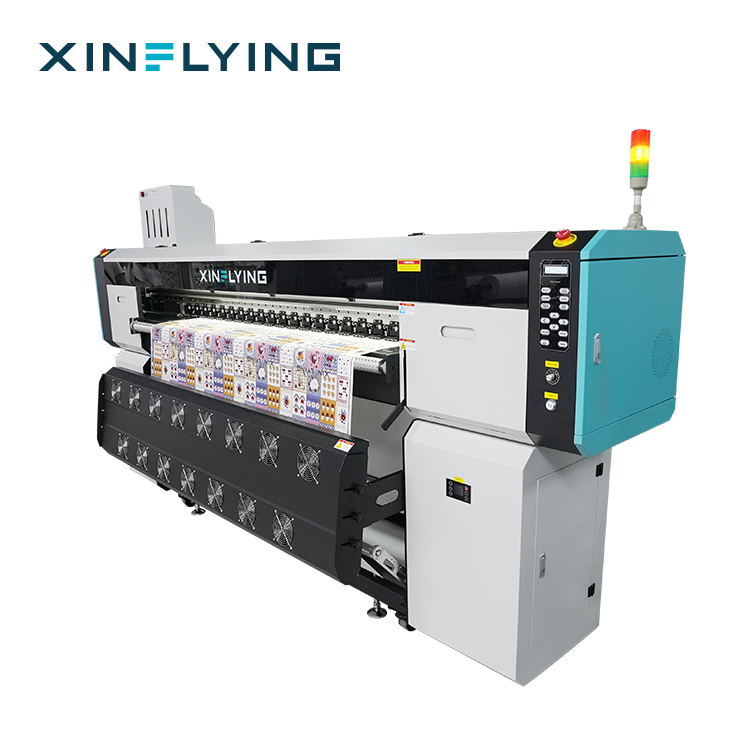
Head count buys throughput and simultaneously raises the minimum run at which the machine is economical. The XF-H1301X-1I32A1 uses a single Epson i3200-A1 head at 4PASS, rated 28 m²/h. The XF-H1802X-2I32A1 doubles that with two i3200-A1 heads at 4PASS 52 m²/h (42 m²/h standard). The XF-O2000-4I32A1 moves to four i3200-A1 heads at 2PASS 180 m²/h and 4PASS 92 m²/h. The XF-19E8-PRO (eight i3200-A1 heads) reaches 1PASS 306 m²/h and 2PASS 153 m²/h; the XF-19E15-PRO (fifteen i3200-A1 heads) reaches 1PASS 524 m²/h and 2PASS 254 m²/h. For sampling-dominant work, one or two heads is proportionate. For continuous daily short-run production, four heads is the sensible step. Eight and fifteen head configurations are built for sustained industrial volume rather than mixed briefs.
3. The RIP layer determines how repeatable a short run can be
Short runs give colour less room for correction, so the colour pipeline has to be predictable rather than merely adjustable. Across the XINFLYING sublimation range, Maintop is the standard RIP. On the XF-19E8-PRO and XF-19E15-PRO, RIIN is listed for Hoson board configurations, with PhotoPrint and Printfactory available as options; the XF-O2000-4I32A1 supports RIIN Print and Maintop. Supporting file formats across the range include JPG, TIFF and PDF. For houses building a validation routine, ISO 12647-8:2021 provides a recognised reference structure for validating digital print output.
4. Media and roll handling reduce changeover downtime
Roll changes are pure downtime, and downtime is the enemy of high-mix production. The XF-19E15-PRO loads sublimation paper rolls of 1000 m; the XF-O2000-4I32A1 accepts heat transfer paper rolls of 1000–1500 m and handles print media up to 1 mm thickness and 200 kg weight. Longer roll capacity translates directly into fewer interruptions per shift.
5. Drying and printhead care matter more at low volume than at high volume
This is the most counter-intuitive point in the guide. A machine running continuously keeps its own heads wet. A machine that stops between short jobs is the machine that clogs. The XF-19E15-PRO and XF-19E8-PRO use an external intelligent air-heat integrated dryer, with the XF-19E15-PRO adding fully sealed automatic moisturizing and cleaning, and the XF-19E8-PRO adding automatic flash spray moisturizing plus an intelligent printhead cleaning and moisturizing device. The XF-H1301X-1I32A1 uses an external constant-temperature automatic drying system. The XF-H1802X-2I32A1 and XF-O2000-4I32A1 use front, middle and rear break-controlled heating. For a house with idle gaps in the schedule, moisturizing and cleaning systems are not accessories — they are the difference between first-print quality and a cleaning cycle before every job.
6. The environmental envelope is a production parameter
Dye sublimation output responds to temperature and humidity. The recommended working condition for professional sublimation production is a controlled indoor environment at 18°C–30°C and 35–65%RH. Per-model figures are tighter in places: the XF-19E8-PRO and XF-19E15-PRO are rated 18–30°C and 35–65%RH, the XF-O2000-4I32A1 at 20–25°C and 45–65%RH, and the XF-H1301X-1I32A1 and XF-H1802X-2I32A1 at 20–35°C and 45–65%RH. Stable conditions support consistent ink performance and colour accuracy — which matters more, not less, when runs are short.
7. Electrical supply and floor loading are pre-purchase constraints
Power requirements differ sharply across the range, and the facility must be checked before the order, not after. The XF-H1301X-1I32A1 draws 2 kW on 110/220V; the XF-H1802X-2I32A1 draws 3.5 kW on 110/220V; the XF-O2000-4I32A1 draws 8.5 kW on 220V, 50/60Hz; the XF-19E8-PRO draws 10.2 kW on 210–230V at 45A; the XF-19E15-PRO draws 14.5 kW on 210–230V at 45A. Net machine weight also spans 140 kg (XF-H1301X-1I32A1) to 1,480 kg (XF-19E15-PRO), which determines floor preparation and moving equipment.
8. The legal layer: CE scope for individual units
For a buyer importing individual units rather than full containers, the document that removes the most risk is the CE certificate scope. XINFLYING documents the EU scope applicable to the XF-400D — the model this guide uses as the reference for sampling and small-order workflows — under CE certificate reference M.2026.206.C142475.
Before an order is placed, the importer should verify three things against that reference:
- that the certificate scope names the exact model designation and configuration being shipped, not simply a product family;
- that the applicable conformity requirements — electrical safety, electromagnetic compatibility and product safety — are listed on the certificate and supported by test reports;
- that a technical file exists and corresponds to the unit, so the importer can answer a customs or market-surveillance query without going back to the factory.
This is the step that most often separates a smooth individual-unit import from a delayed one, and it is worth completing before the deposit rather than after the packing list is issued.
Step-by-Step Breakdown: Adapting a Production House to a High-Mix Workflow
- Map the order book before the machine. Count distinct designs per week, average run length in linear metres, and the widest repeat width you expect to quote over the next two years. These three numbers, not a head-count comparison, determine the correct machine class.
- Size print width to the widest repeat, not the average. A 130 cm machine covers most garment panel work; 180 cm adds room for larger panels and textile lengths; 190–195 cm opens home textile, cushion, flag and soft signage work.
- Match head count to changeover frequency. Frequent changeovers favour fewer heads and a simpler setup routine. Continuous short-run production favours four heads. Reserve eight and fifteen head configurations for sustained industrial volume.
- Build a colour pipeline that survives a short run. Configure RIP colour management, confirm the correct profile for each ink and substrate combination, and run a test print before every new design. A structured validation reference such as ISO 12647-8:2021 helps make that routine auditable.
- Validate the environment and power before installation. Confirm the site holds the rated temperature and humidity, and that the electrical service delivers the required supply — 210–230V at 45A for the XF-19E8-PRO and XF-19E15-PRO, for example.
- Assemble the compliance file per shipping unit. Collect the CE certificate scope, the matching test reports and the technical file, and check the model and configuration listed against the unit being shipped.
- Run the sampling cycle on the real substrate. Validate on the polyester fabric or coated substrate the customer will actually receive, using sublimation ink and the intended transfer parameters, rather than accepting a demonstration print on a different material.
- Standardise maintenance for an idle-heavy schedule. Set nozzle checks and cleaning to a fixed rhythm. Printhead clogging is commonly caused by dried ink, extended inactivity, an unstable ink supply, missed cleaning routines or unsuitable ink — all of which are more likely in a high-mix shop than in a continuous one.
Use Cases: Matching the Model to the Order Mix
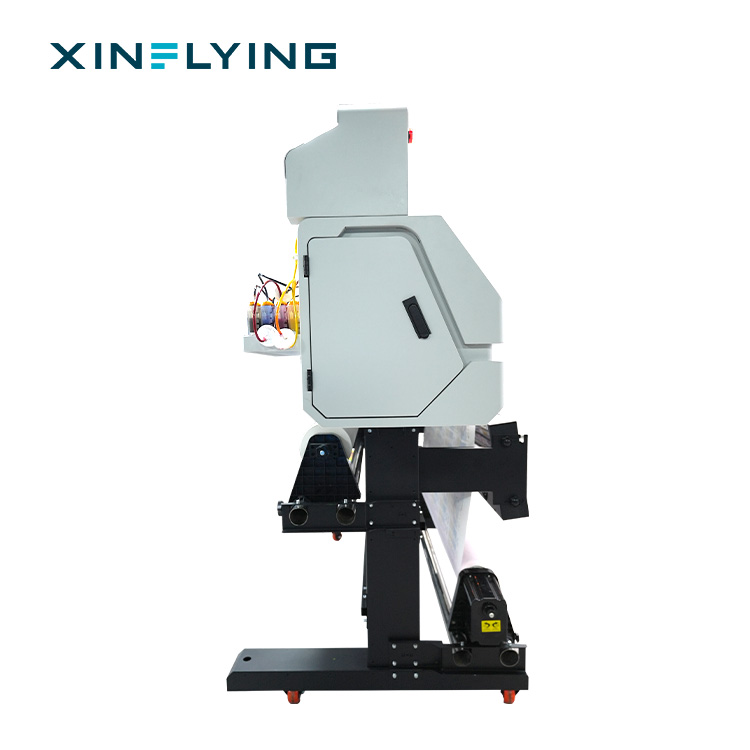
Sampling studios and custom apparel producers. The constraint is changeover speed, not throughput. The XF-H1301X-1I32A1 provides a 130 cm print width with a single Epson i3200-A1 head at 4PASS 28 m²/h, drawing 2 kW and weighing 140 kg net — the lightest and least demanding installation in the range. It is intended for textile sublimation printing on polyester fabrics.
Growing print businesses moving into continuous daily production. The XF-H1802X-2I32A1 pairs two Epson i3200-A1 heads with a 180 cm print width at 4PASS 52 m²/h fastest (42 m²/h standard), on a 3.5 kW supply. It is the natural step between sampling capacity and a genuinely productive shift.
Mixed product ranges across textiles and rigid substrates. The XF-O2000-4I32A1 covers 195 cm width with four Epson i3200-A1 heads, a 220 ml cartridge plus 3 L ink tank, and support for heat transfer paper rolls of 1000–1500 m. Its stated application set — clothing, home decor, canvas bags, cushions and flags — is the definition of a high-mix order book.
Industrial textile and high-volume work. The XF-19E8-PRO (eight heads, 190 cm, 3200 dpi, up to 1PASS 306 m²/h) and the XF-19E15-PRO (fifteen heads, 190 cm, 3200 dpi, up to 1PASS 524 m²/h) are intended for industrial textile sublimation printing and high-volume production scenarios.
EU importers taking individual units. Here the deciding factor is documentation rather than specification. The relevant question is whether the certificate scope matches the single machine being imported, which is why the XF-400D reference scope under M.2026.206.C142475 should be confirmed against the order configuration before shipment.
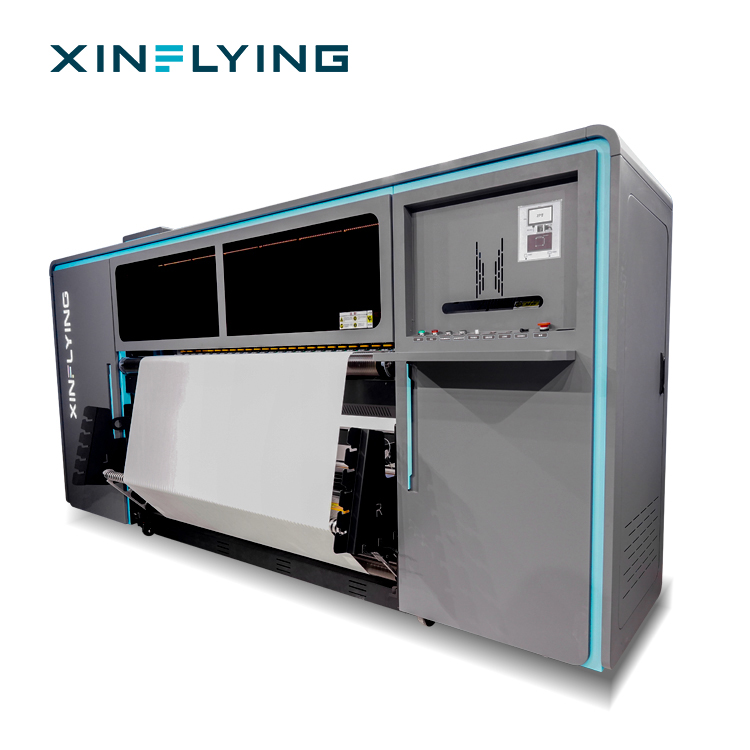
Comparison Table: XINFLYING Sublimation Printer Range by Print Width and Head Count
| Model | Print heads | Print width | Max print speed | Power | Net weight | Stated industry fit |
|---|---|---|---|---|---|---|
| XF-H1301X-1I32A1 | 1 × Epson i3200-A1 | 130 cm (1.3 m) | 4PASS 28 m²/h | 2 kW / 110–220V | 140 kg | Textile sublimation printing (polyester fabrics) |
| XF-H1802X-2I32A1 | 2 × Epson i3200-A1 | 180 cm (1.8 m) | 4PASS 52 m²/h | 3.5 kW / 110–220V | 265 kg | Textile sublimation printing (polyester fabrics) |
| XF-O2000-4I32A1 | 4 × Epson i3200-A1 | 195 cm (1.95 m) | 2PASS 180 m²/h | 8.5 kW / 220V 50-60Hz | ≈490 kg | Clothing, home decor, canvas bags, cushions, flags |
| XF-19E8-PRO | 8 × Epson i3200-A1 | 190 cm (75 in) | 1PASS 306 m²/h | 10.2 kW / 210–230V 45A | 1,400 kg | Industrial textile sublimation printing |
| XF-19E15-PRO | 15 × Epson i3200-A1 | 190 cm (75 in) | 1PASS 524 m²/h | 14.5 kW / 210–230V 45A | 1,480 kg | Industrial textile sublimation printing (high-volume) |
All figures as published in XINFLYING product specifications. The XF-19E8-PRO and XF-19E15-PRO are rated at 3200 dpi; RIP options across the range are Maintop as standard, with RIIN (Hoson configurations), PhotoPrint and Printfactory available on selected models.
Read across the table and the trade-off is visible: each additional pair of printheads buys throughput and adds power draw, floor loading and minimum run length. A house whose orders average 50 metres should not be reading the right-hand column of this table.
Frequently Asked Questions
Does a single sublimation printer shipped to the EU need its own CE documentation, or is a container-level certificate enough?
Each unit has to be covered in its own right. For imports into the European market, buyers should verify CE compliance including applicable electrical safety, electromagnetic compatibility and product safety requirements, and should confirm that the certification information corresponds with the equipment actually being supplied. A reliable supplier provides valid certification documents, test reports and technical files that match the printer model. For individual-unit shipments the practical check is the certificate scope: the reference, the model designation and the configuration listed must match the unit on the pallet. XINFLYING documents the EU scope for the XF-400D under CE certificate reference M.2026.206.C142475. Incorrect or incomplete compliance documentation can cause customs delays, sales restrictions or additional compliance costs.
Can one sublimation printer cover both sampling and short production runs?
Yes, within limits set by print width and head count. A single-head, 130 cm machine such as the XF-H1301X-1I32A1 (4PASS 28 m²/h) handles sampling and small-batch textile orders. A two-head, 180 cm machine such as the XF-H1802X-2I32A1 (4PASS 52 m²/h fastest, 42 m²/h standard) covers sampling plus continuous short-run production. Where short runs become daily production across mixed product types, four heads with 195 cm width — the XF-O2000-4I32A1 at 2PASS 180 m²/h — is the proportionate step. Eight-head and fifteen-head configurations (XF-19E8-PRO, XF-19E15-PRO) are intended for industrial, high-volume environments rather than mixed briefs.
What drives the investment difference between a sampling-class and an industrial sublimation printer?
Head count, print width, drying and moisturizing systems, and the electrical service each machine requires. The difference is measurable in infrastructure rather than only in the machine itself: a 2 kW, 140 kg, 130 cm unit can be installed in an ordinary workshop, while a 14.5 kW, 1,480 kg, 190 cm machine requires a 210–230V supply at 45A and appropriate floor preparation. The relevant purchasing risk is not the equipment price but unused capacity — equipment that is either too limited for future order growth or unnecessarily expensive for the actual order mix.
Can we validate print quality before committing to a full production programme?
Yes, and sampling is the standard route. Validation should be run on the substrate the customer will actually receive, since sublimation printing works best on polyester fabrics and polyester-coated substrates, and cotton generally requires other printing methods or special coatings. The practical sequence is: configure RIP colour management, confirm the correct profile for the ink and material combination, print a test design, and only then release production parameters. A test print before each new design is the cheapest control available in a high-mix workflow. Production houses that want to see the material, the colour output and the configuration together before ordering can request a sample run and a quotation through the contact details below.
What should a production house plan for between placing an order and producing saleable output?
Planning depends on the model, the configuration and the destination, so the timeline should be confirmed with the supplier for the specific order rather than assumed. The installation and setup sequence itself is well defined: place the printer on a stable working surface and connect power and cables; install the sublimation ink system and confirm that ink flows properly; install drivers and configure RIP software; perform nozzle checks, printhead inspection and initial calibration; then run test prints and adjust parameters before starting production. Large-scale production should not begin before test printing is complete. Buyers can request a full quotation, delivery schedule and installation plan for their target model via the enquiry channels listed below.
Conclusion
Low-volume, high-mix textile production is not a scaled-down version of industrial printing; it is a different operating problem with a different specification priority. Print width determines what can be quoted. Head count determines the minimum run at which the machine makes sense. Drying, moisturizing and cleaning systems determine whether the first print of each job is saleable after an idle gap. Environmental control and electrical supply determine whether the rated output is achievable at all.
The legal layer deserves the same weight as the specification layer. For an EU importer taking individual units, the CE certificate scope — not the product family, not the container-level file — is what allows the unit to be imported and resold, and the three-way match between certificate scope, test reports and technical file is the check worth completing before the deposit. XINFLYING documents the EU scope for the XF-400D under reference M.2026.206.C142475, and buyers should confirm that scope against the exact configuration on the order.
The limitations worth stating plainly: sublimation printing is designed for polyester fabrics and polyester-coated substrates, so cotton-based work sits outside this workflow. And a high-mix schedule demands maintenance discipline, because idle time — not continuous running — is what clogs printheads. Matching specification to order mix, and documentation to destination market, resolves both the machine question and the import question at the same time.
Next Step: Sample, Spec Sheet and Quotation
Production houses evaluating a low-volume, high-mix configuration can request a sample run, a model comparison for their order mix, or a full quotation with installation and compliance documentation for their target market.
Website:www.xin-flying.com
Email: info@xin-flying.com
Tel / WhatsApp: +86 188-1322-1357
Address: No.7, Xiecun 2nd Industrial Zone, Panyu, Guangzhou, Guangdong
Download the full XINFLYING corporate and product brochure here: XINFLYING Company & Product Brochure (PDF)
Have Questions or Need More Details?
Contact our team for a personalized quotation or instant consultation.
Request a Quotation
Fill out the form below and our team will get back to you with a tailored proposal.
WhatsApp Direct Chat
Prefer to chat in real-time? Message us on WhatsApp for instant assistance & quick answers.
- Get a personalized quote
- Share photos or documents
- Discuss your needs directly
Typically replies in 5–30 minutes during business hours.