
XF-450PRO vs XF-400D: Which Digital Textile Printer Fits Your Print Shop?
A head-to-head decision guide for shops printing on garments — including the point at which neither DTF model is the right answer and a roll-to-roll sublimation printer takes over.
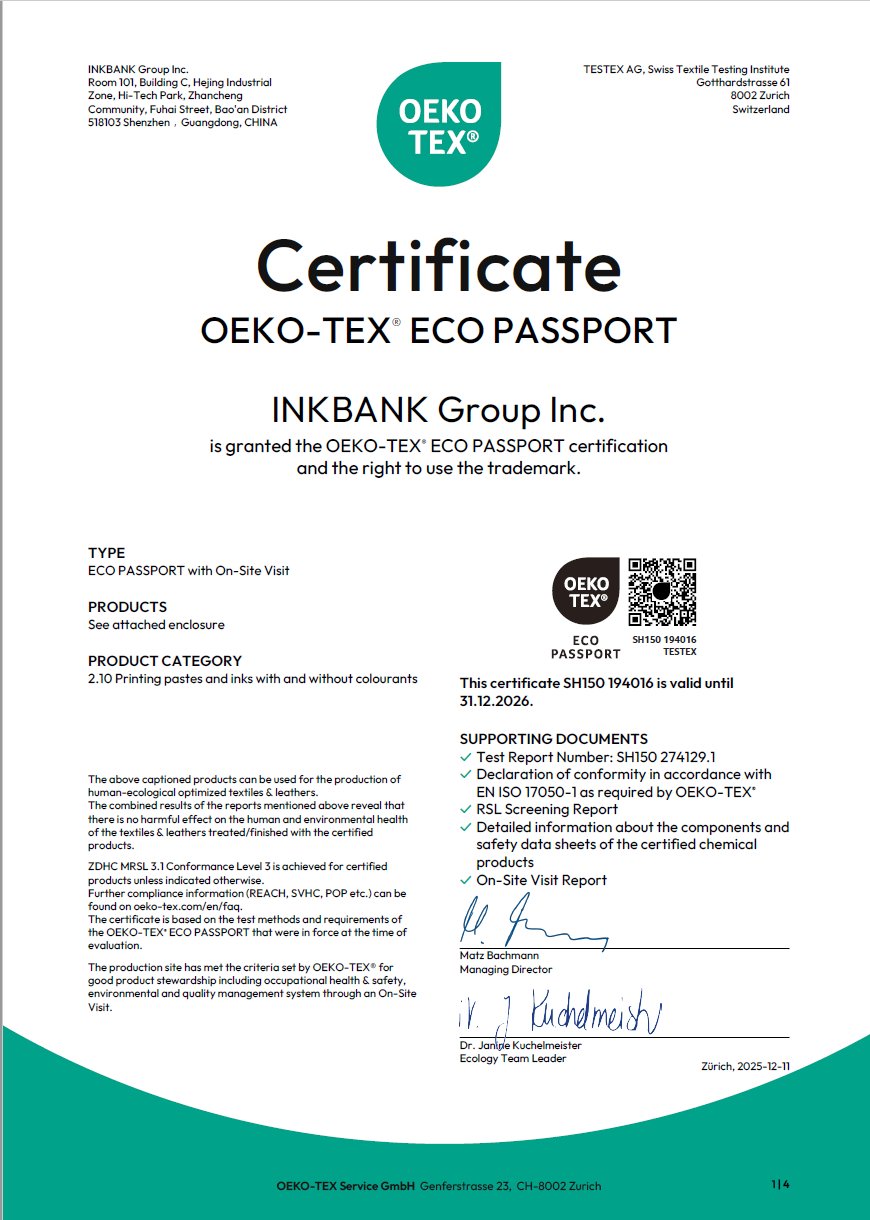
The XF-450PRO carries documented ink-safety coverage: OEKO-TEX ECO PASSPORT certificate SH150194016, issued by TESTEX AG for textile printing inks and printing pastes.
The 30-Second Answer
Most print shops reach this comparison through the same search — "which sublimation printer should I buy for my print shop?" The honest answer starts one step earlier, because the XF-450PRO and the XF-400D are DTF (direct-to-film) digital textile printers: they print a design onto PET film, which is then powdered, cured and heat pressed onto the garment. A sublimation printing machine works differently — it prints onto transfer paper and the dye turns to gas and bonds into polyester. The two routes solve different jobs, and the model choice only makes sense after that is settled.
- Choose the XF-450PRO if your work is cotton, blends and dark garments in panel sizes up to 42 cm (16.5 in), and you need throughput plus a named ink-safety file: 2 × Epson i1600-A1 printheads, CMYK+W, up to 11 m²/h at the fastest 6PASS setting (9 m²/h standard), 3.5 kW, 250 kg net.
- Choose the XF-400D if you are sampling, launching, or running low volumes in a small space: the same CMYK+W DTF process and the same standard RIP options in a 60 kg, 0.5 kW chassis, with a 30 cm (12 in) print width and up to 4.5 m²/h at 6PASS (2.5 m²/h standard).
- Choose neither if your production is polyester-based and roll-fed — sportswear, home textile, flags, soft signage. That work belongs on a roll-to-roll sublimation printer, and Xinflying builds those from 130 cm up to 195 cm print width.
Problem Definition: Two Questions Decide This Purchase
A print shop rarely loses money because a machine was "bad". It loses money when one of two things fails: the sizing decision that matched the machine to the order book, or the compliance file that proves what the ink and the machine are allowed to do in the market where the finished product is sold.
Question 1 — what must the finished product prove? Skin-contact apparel sold into regulated markets is normally supported by ink documentation, not by machine documentation. For the XF-450PRO, the textile printing inks and printing pastes are covered by OEKO-TEX ECO PASSPORT certificate SH150194016, issued by TESTEX AG in compliance with EN ISO 17050-1 and valid for the global market. That is a separate document from the CE and RoHS file that covers the machine. Buyers who treat the two as one document usually discover the gap at the customer-audit or customs stage.
Question 2 — what must the machine physically handle? Print width, transfer route, and square metres per hour. A 42 cm machine and a 30 cm machine can share the same ink set, the same RIP options and the same working conditions, yet suit completely different order books.
Answer both questions before requesting a quote, and the XF-450PRO vs XF-400D decision usually collapses into a single step: width first, then throughput.
Industry Background: Growth With a Documentation Tail
The equipment category behind this decision is expanding, and the compliance layer is expanding with it.
- The global dye sublimation printing market was valued at USD 16.4 billion in 2025 and is projected to reach USD 39.0 billion by 2033, growing at a CAGR of 11.5% from 2026 to 2033 (Grand View Research).
- Asia Pacific held a 36.5% revenue share in 2025, with China the largest single country market (Grand View Research).
- The dye sublimation printers segment alone was valued at USD 1.88 billion in 2025 and is expected to reach USD 2.53 billion by 2030 (Mordor Intelligence).
- Demand for personalised apparel and home decor is a primary driver of digital textile printing growth, projected at a 13.1% CAGR through 2030 (Grand View Research).
- Roll-to-roll sublimation printers at 1.9 m (1900 mm) width are the industry standard for high-volume textile and soft signage work (FESPA Insights).
- By installed brand share, Epson, Mimaki and Roland DG are the largest names in the digital textile dye sublimation printer market at 26.7%, 18.6% and 15.5% respectively (Data Insights Reports, 2024) — relevant when you compare printhead families and file compatibility.
For a shop, the practical reading is simple: the demand is coming from short-run, colour-rich, customised work, and the machines that stay sellable are the ones whose certificate file already names the model and the ink.
Detailed Solution: The Two Machines and the Documentation Layer
XF-450PRO — width, throughput and a named ink file
The XF-450PRO is a Digital Textile Printer of the DTF type, positioned for textile and garment customisation. It carries 2 × Epson i1600-A1 printheads, CMYK+W ink, and runs DTF PET film. Print width is 42 cm (16.5 in). Speed is published in two sets: fastest at 6PASS 11 m²/h, 8PASS 9 m²/h and 12PASS 7 m²/h; standard at 6PASS 9 m²/h, 8PASS 7 m²/h and 12PASS 5 m²/h. RIP support is RIIN / Printfactory as standard, with Maintop, PhotoPrint and CADlink optional. Power draw is 3.5 kW on 110–220 V, 16 A/32 A, 50–60 Hz, on Windows 10/11 (64-bit). The chassis measures 1950×1065×1350 mm and weighs 250 kg net; recommended working conditions are 20–30 °C and 45–65% RH.
What makes this model the reference point in the comparison is its documentation, as recorded in the Xinflying certificate set:
- Ink safety: OEKO-TEX ECO PASSPORT certificate SH150194016 covers the textile printing inks and printing pastes used in the XF-450PRO. It is issued by TESTEX AG, complies with EN ISO 17050-1, is valid for the global market, was issued on 2025-12-11 and expires on 2026-12-31.
- Electrical and EMC: CE EMC & Low Voltage Directive certificate M.2026.206.C142475 covers the XF-450PRO; CE LVD certificate TQT1550D271EC is based on EN IEC 62368-1:2020/A11:2020 and CE EMC certificate TQT1550D270EC is based on the EN 55032 / EN 55035 / EN 61000-3-2 / EN 61000-3-3 family.
- General CE of compliance: certificate BSTXD211021006201EC covers the XF-450PRO Digital Textile Printer and lists standards including EN 55032:2015+A11:2020, EN IEC 61000-3-2:2019, EN 61000-3-3:2013+A1:2019 and EN 55035:2017+A11:2020.
- Machinery safety: CE Machinery Directive certificates issued by UDEM (including M.2026.206.C142365 and M.2026.206.C142385) support the machine range that includes the XF-450PRO, with standards EN ISO 12100:2010, EN 60204-1:2018/A1:2025 and EN ISO 12643-1:2023.
- Substance compliance: RoHS compliance certificate M.2026.206.C142366, based on EN IEC 63000:2018 and the EN IEC 62121 series, is valid to 2031-06-09.
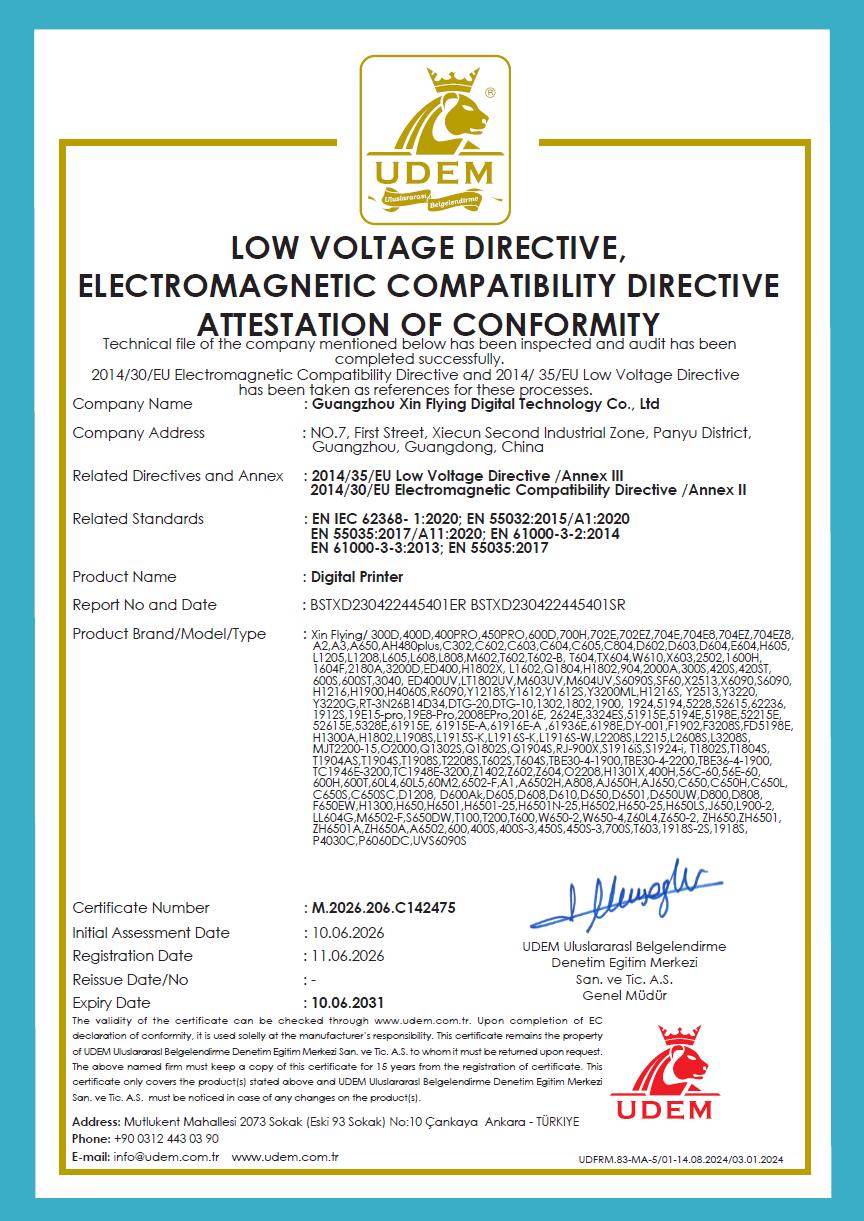
Machine-safety and EMC documentation is issued separately from the ink certificate — buyers should hold both files, not one.
XF-400D — the compact entry point in the same process
The XF-400D is also a Digital Textile Printer of the DTF type, for textile and garment customisation, and it keeps the same CMYK+W ink set and the same standard RIP options (RIIN / Printfactory standard; Maintop, PhotoPrint, CADlink optional). What changes is scale. Printheads are 2 × Epson i1600-A1/XP600. Print width is 30 cm (12 in). Speed at the fastest setting is 6PASS 4.5 m²/h and 8PASS 3.5 m²/h; standard speed is 6PASS 2.5 m²/h and 8PASS 1.5 m²/h. Power draw is 0.5 kW on 110–220 V, 2.3 A/4.5 A, 50/60 Hz. Machine size is 960×770×1220 mm, packing size 1010×570×850 mm, net weight 60 kg and gross weight 95 kg; working conditions are 20–30 °C and 45–65% RH.
The XF-400D is listed alongside the rest of the CE-certified Xinflying range in the CE EMC, CE LVD, CE Machinery Directive and RoHS certificate records. Because a certificate record lists a product family, the correct buying step is to ask for the certificate number that names the exact model and serial number you will receive, together with the ink certificate scope for the ink set you plan to run.
Who builds these machines
Both models come from Guangzhou Xin Flying Digital Technology Co., Ltd. (Xinflying), founded in 2010 and manufacturing DTF printers, dye sublimation printers, DTG printers, UV DTF printers, UV flatbed printers and printing consumables. The company operates a 37,440 m² facility with 200+ employees and a 20-engineer R&D team, produces 20,000+ units a year, exports roughly 80% of output, and serves North America, South America, Europe, Asia, the Middle East and Africa, supported by local warehouses and technical support in key markets.
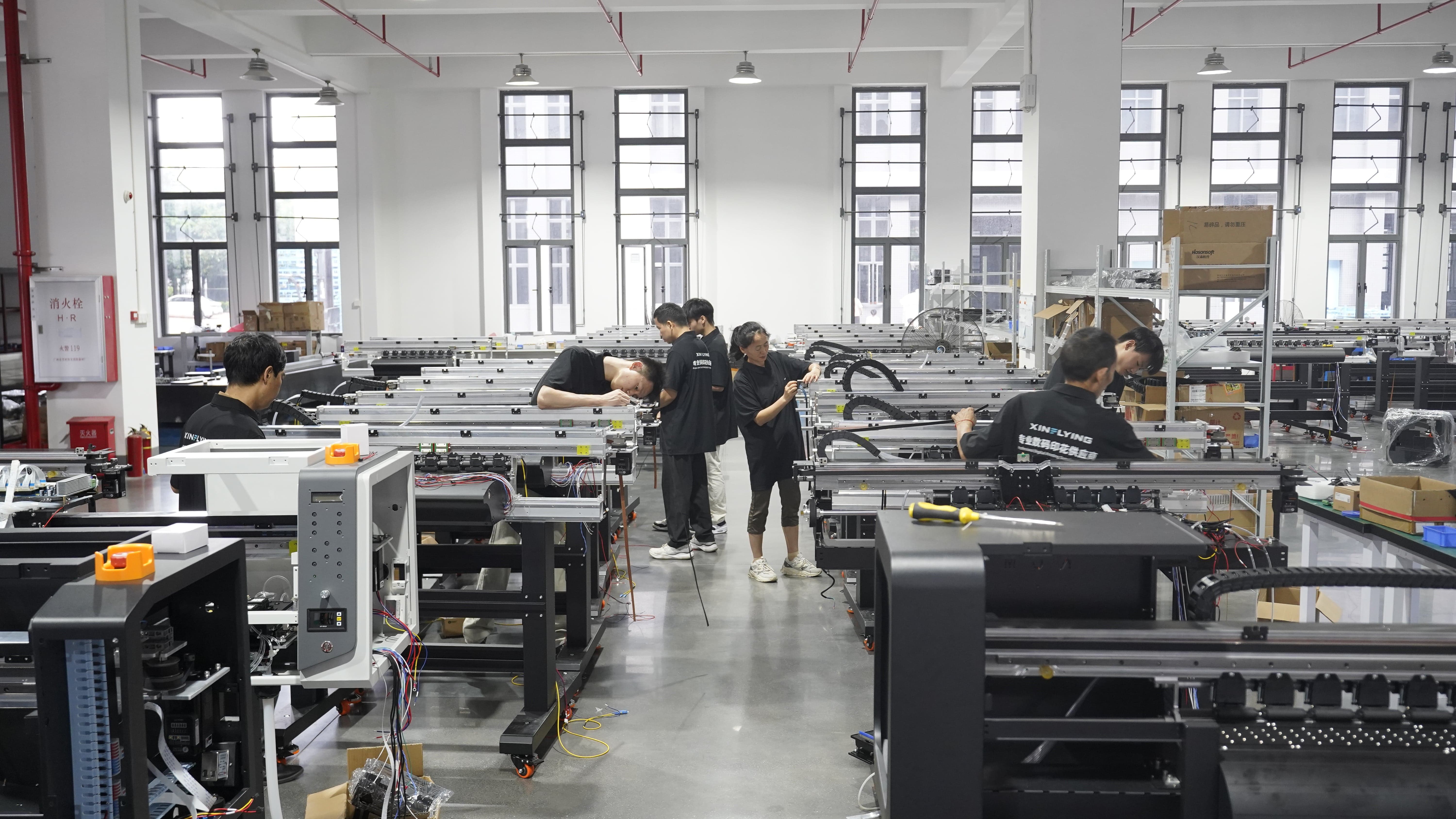
Assembly, wiring and inspection of Xinflying DTF printers in Guangzhou — the same production base that builds the XF-450PRO and XF-400D.
Documented manufacturing capability for both models: monthly capacity of 1600+ units, MOQ of 1 unit, lead time of 5–40 days, OEM/ODM customisation covering product branding, machine appearance, colour, logo and packaging, pre-shipment testing as the quality-control step, and after-sales support from over 50 engineers providing 24/7 online technical assistance.
Step-by-Step: Choosing Between Them in Five Checks
Step 1 — Match the transfer route to the fabric. DTF prints onto PET transfer film, which is coated with adhesive powder, cured and heat pressed onto the garment; it works across cotton, polyester, blends and dark-coloured fabrics. Sublimation printing prints onto transfer paper and the dye sublimates into polyester-based materials. If your job list is mixed cotton and blends, stay with DTF. If it is polyester roll fabric, move to the sublimation side of the range.
Step 2 — Size the width to the panel, not to the printer. 42 cm (XF-450PRO) against 30 cm (XF-400D) is the difference between comfortably placing a full front panel or a large back print on a 42 cm film, and planning and joining narrower panels. For all-over prints on wide fabric, neither is intended for that job — roll-to-roll sublimation starts at 130 cm and reaches 195 cm, with 1.9 m recognised as the standard high-volume width.
Step 3 — Convert your order book into square metres per hour. Always compare the same PASS mode. At 6PASS fastest, the XF-450PRO publishes 11 m²/h against 4.5 m²/h for the XF-400D; at 6PASS standard, 9 m²/h against 2.5 m²/h. Quoting a fast-mode figure against a standard-mode figure is the most common mistake in internal capacity planning.
Step 4 — Check the certificate path against the destination market and the product claim. Two files matter: the ink file (OEKO-TEX ECO PASSPORT SH150194016 for the XF-450PRO's textile printing inks and pastes, valid to 2026-12-31 — confirm renewal status before signing) and the machine file (CE EMC & LVD M.2026.206.C142475; CE BSTXD211021006201EC; CE LVD TQT1550D271EC; CE EMC TQT1550D270EC; CE Machinery Directive certificates issued by UDEM; RoHS M.2026.206.C142366). Check three things: does the certificate name the model, is the ink batch you will run inside the certified scope, and is the document still valid on your shipping date.
Step 5 — Validate with a sample and a pre-shipment test. MOQ is 1 unit and lead time is 5–40 days, so validation can be built into the order rather than treated as a separate project. Run your own artwork, your own film and your own press settings, and request the certificate copies together with the equipment so the file arrives with the machine.
Use Cases: Which Model Fits Which Shop
Sampling and startup shops. Shops that need to prove a business case before scaling — sample panels, single-piece jobs, pilot orders for local teams — are best served by the XF-400D. It needs 960×770×1220 mm of floor space, draws 0.5 kW and weighs 60 kg net, so it can sit in an existing workshop without electrical or layout work.
Growing garment decorators. Once orders include full-front or back panels, mixed cotton and blend fabrics, and repeat production runs, the XF-450PRO becomes the more practical machine. The 42 cm width reduces panel joins, the 6PASS output of up to 11 m²/h absorbs rush orders, and the named OEKO-TEX ECO PASSPORT coverage for its printing inks answers the documentation requests that apparel buyers and brand customers increasingly raise.
Polyester roll producers. Sportswear, home textile and soft signage producers who print on continuous fabric should look past both DTF models. Xinflying's documented sublimation deployments include a sportswear manufacturer in Brazil running 15 units over four years for football jerseys and basketball uniforms, a Brazilian sports uniform supplier running 8 units over five years for customised kits with names, numbers and graphics, a home textile manufacturer running 10 units over four years for curtains, cushions and decorative fabrics, and a digital textile printing service provider running 5 units over three years for sportswear brands and apparel factories.
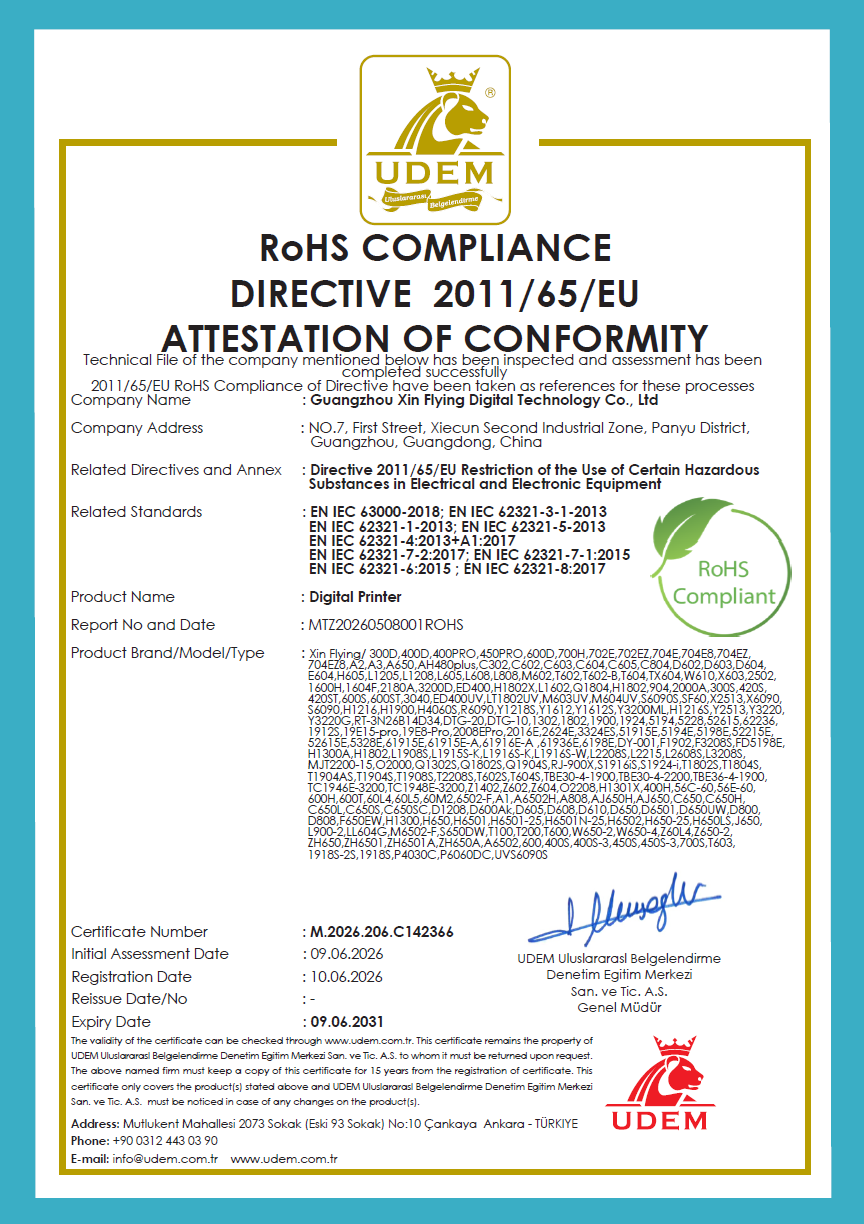
Substance compliance travels with the machine file: RoHS certificate M.2026.206.C142366 is valid to 2031-06-09.
Comparison Table: XF-450PRO vs XF-400D
| Decision factor | XF-450PRO | XF-400D |
|---|---|---|
| Printer type | Digital Textile Printer (DTF) | Digital Textile Printer (DTF) |
| Print width | 42 cm (16.5 in) | 30 cm (12 in) |
| Printheads | 2 × Epson i1600-A1 | 2 × Epson i1600-A1 / XP600 |
| Ink colours | CMYK+W | CMYK+W |
| Speed (fastest) | 6PASS 11 m²/h; 8PASS 9 m²/h; 12PASS 7 m²/h | 6PASS 4.5 m²/h; 8PASS 3.5 m²/h |
| Speed (standard) | 6PASS 9 m²/h; 8PASS 7 m²/h; 12PASS 5 m²/h | 6PASS 2.5 m²/h; 8PASS 1.5 m²/h |
| Media | DTF PET film | DTF PET film |
| RIP support | RIIN / Printfactory standard; Maintop, PhotoPrint, CADlink optional | RIIN / Printfactory standard; Maintop, PhotoPrint, CADlink optional |
| Power | 3.5 kW | 0.5 kW |
| Power supply | 110–220 V, 16 A/32 A, 50–60 Hz | 110–220 V, 2.3 A/4.5 A, 50/60 Hz |
| Machine size / net weight | 1950×1065×1350 mm / 250 kg | 960×770×1220 mm / 60 kg |
| Working conditions | 20–30 °C, 45–65% RH | 20–30 °C, 45–65% RH |
| Documented ink-safety coverage | OEKO-TEX ECO PASSPORT SH150194016 covering textile printing inks and pastes (TESTEX AG; valid to 2026-12-31) | Confirm the ECO PASSPORT scope for the specific ink set you plan to run |
| EU machine documentation | CE EMC & LVD M.2026.206.C142475; CE BSTXD211021006201EC; CE LVD TQT1550D271EC; CE EMC TQT1550D270EC; CE MD by UDEM; RoHS M.2026.206.C142366 | Listed in the CE EMC, CE LVD, CE MD and RoHS records; request the certificate number naming your unit |
All specifications above are the published Xinflying product parameters; certificate numbers and validity dates are taken from the Xinflying certificate records.
If your fabric is polyester: the roll-to-roll sublimation alternatives
Shops searching for a commercial sublimation printer, a large format sublimation printer or a 1.9 m (1900 mm) wide format sublimation printer are usually solving a roll-fed polyester problem, not a garment-panel problem. In that case the relevant comparison inside the same range looks like this:
| Model | Print width | Printheads | Published speed |
|---|---|---|---|
| XF-H1301X-1I32A1 | 130 cm (1.3 m) | 1 × Epson i3200-A1 | 4PASS 28 m²/h |
| XF-H1802X-2I32A1 | 180 cm (1.8 m) | 2 × Epson i3200-A1 | 4PASS 52 m²/h fastest; 42 m²/h standard |
| XF-O2000-4I32A1 | 195 cm (1.95 m) | 4 × Epson i3200-A1 | 2PASS 180 m²/h; 4PASS 92 m²/h |
| XF-19E8-PRO | 190 cm (75 in) | 8 × Epson i3200-A1 | 1PASS 306 m²/h; 2PASS 153 m²/h |
| XF-19E15-PRO | 190 cm (75 in) | 15 × Epson i3200-A1 | 1PASS 524 m²/h; 2PASS 254 m²/h |
Shops entering the category for the first time, and buyers looking for a sublimation printer for beginners, typically start at the narrow end of that table rather than at the top of it: the 1.3 m machine keeps the investment and the floor space proportionate to early order volumes, while the 1.8 m to 1.95 m models are the ones designed for continuous production on sportswear, home textile and soft signage rolls.
FAQ
Does the OEKO-TEX ECO PASSPORT certificate cover the XF-450PRO machine, or only the ink?
It covers the textile printing inks and printing pastes used in the XF-450PRO. Certificate SH150194016 is issued by TESTEX AG, complies with EN ISO 17050-1, is valid for the global market, was issued on 2025-12-11 and expires on 2026-12-31. The machine itself is covered by separate documents: CE EMC & Low Voltage Directive certificate M.2026.206.C142475, CE LVD certificate TQT1550D271EC, CE EMC certificate TQT1550D270EC, CE Certificate of Compliance BSTXD211021006201EC, CE Machinery Directive certificates issued by UDEM, and RoHS certificate M.2026.206.C142366 (valid to 2031-06-09). Buyers should hold both files and confirm that the ink batch they will run sits inside the certified scope.
How much more output does the XF-450PRO deliver than the XF-400D?
At the fastest 6PASS setting, the XF-450PRO publishes 11 m²/h against 4.5 m²/h for the XF-400D, and at standard 6PASS it publishes 9 m²/h against 2.5 m²/h. The XF-450PRO also prints 42 cm wide versus 30 cm, uses 2 × Epson i1600-A1 printheads versus 2 × Epson i1600-A1/XP600, and draws 3.5 kW versus 0.5 kW. Both run CMYK+W on DTF PET film with the same standard RIP options.
Which machine costs less to buy and to run?
No list price is published in this guide, so the comparison has to be made on cost drivers rather than on a single number. The XF-400D draws 0.5 kW and occupies 960×770×1220 mm at 60 kg net, so it needs less electrical capacity and floor space. The XF-450PRO draws 3.5 kW, occupies 1950×1065×1350 mm at 250 kg net, and produces roughly two to three times more square metres per hour in the same PASS mode, which changes the cost per square metre. Both use CMYK+W ink on DTF PET film. Request a quote that covers the machine, RIP licensing, installation and spare parts so the total is comparable.
Can I validate print quality and ink documentation before committing to an order?
Yes. The documented minimum order quantity is 1 unit, and pre-shipment testing is part of the quality-control process, so validation can be built into the order itself. OEM/ODM customisation is available across product branding, machine appearance, colour, logo and packaging if the machines will carry your own brand. Ask for the certificate copies — ink and machine — together with the equipment, and run test prints on your own film, artwork and press settings before full production.
What is the lead time and what support comes after delivery?
Documented lead time is 5–40 days depending on configuration and order volume, with a monthly production capacity of 1600+ units behind it. After delivery, Xinflying provides support from over 50 engineers delivering 24/7 online technical assistance, alongside installation guidance and operation training. To start a comparison for your own shop, send your substrate mix, target panel sizes and monthly square metres to info@xin-flying.com or message +86 188-1322-1357 on WhatsApp and request a model recommendation plus the matching certificate file.
Conclusion: Decide on Substrate First, Width Second, Certificates Third
The XF-450PRO and the XF-400D are not competing answers to the same question — they are two sizes of the same DTF process. Choose the XF-450PRO when a 42 cm print width, up to 11 m²/h at 6PASS and a named OEKO-TEX ECO PASSPORT file for its textile printing inks are what your order book and your customers require. Choose the XF-400D when a compact, 0.5 kW, 60 kg machine with a 30 cm width is enough to sample, launch and grow. Choose a roll-to-roll sublimation printer — 130 cm to 195 cm wide — when the fabric itself is polyester and the work is continuous.
In all three cases, the purchase is only complete when the paperwork matches the machine: certificate numbers that name the model, an ink certificate whose scope covers the ink you will actually run, and validity dates that are still live on the day you ship.
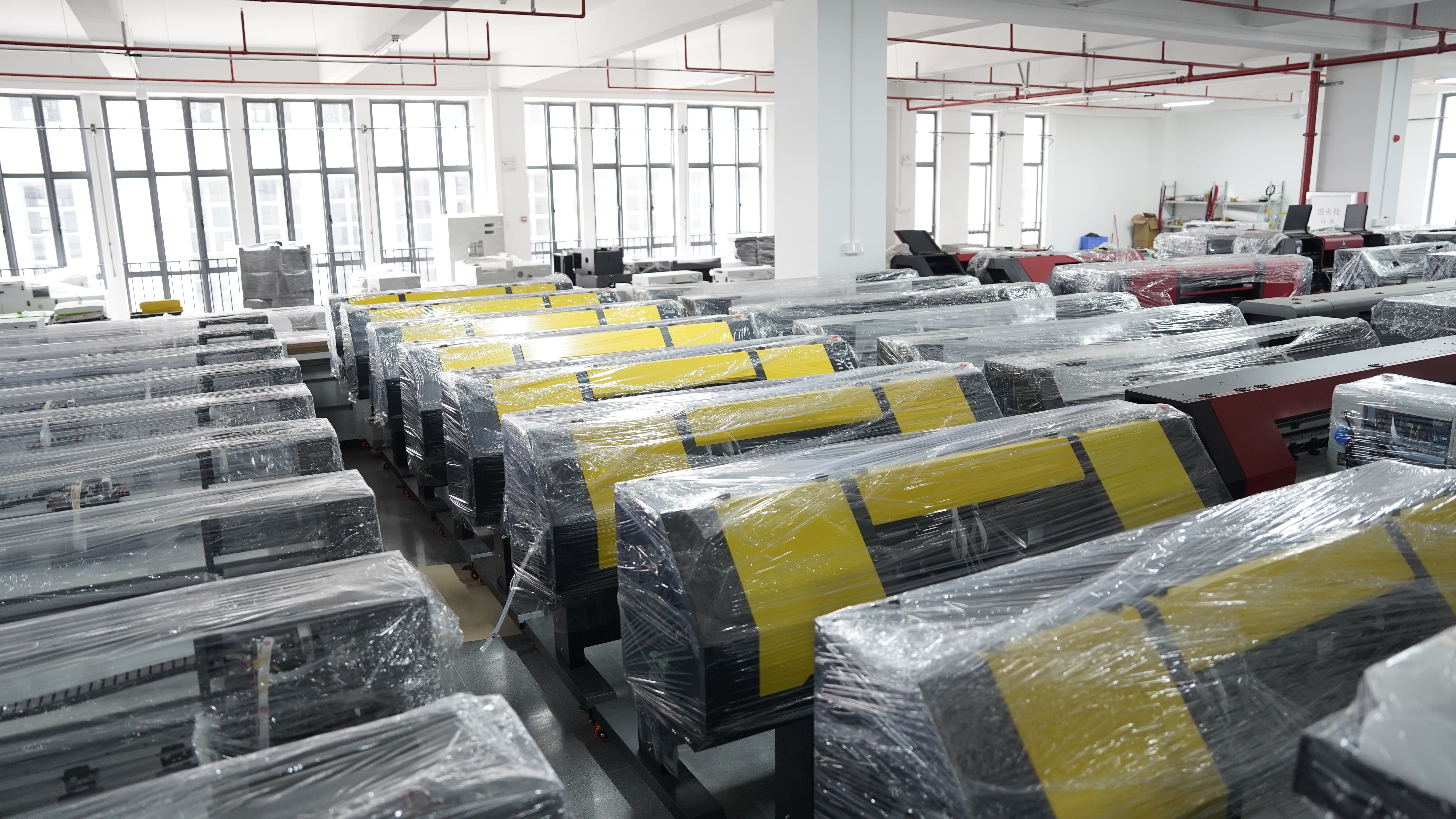
Units are wrapped and staged for delivery from the Guangzhou facility; MOQ is 1 unit with a 5–40 day lead time.
Next step: download the Xinflying company and product catalogue (PDF), or request a quote and sample validation for the XF-450PRO, the XF-400D or a roll-to-roll sublimation model directly from the factory at www.xin-flying.com.
Guangzhou Xin Flying Digital Technology Co., Ltd. — No.7, Xiecun 2nd Industrial Zone, Panyu, Guangzhou, Guangdong. Email: info@xin-flying.com | Tel / WhatsApp: +86 188-1322-1357
Have Questions or Need More Details?
Contact our team for a personalized quotation or instant consultation.
Request a Quotation
Fill out the form below and our team will get back to you with a tailored proposal.
WhatsApp Direct Chat
Prefer to chat in real-time? Message us on WhatsApp for instant assistance & quick answers.
- Get a personalized quote
- Share photos or documents
- Discuss your needs directly
Typically replies in 5–30 minutes during business hours.