
What Does 'CE Certification' Actually Mean for a Sublimation Printer?
What Does 'CE Certification' Actually Mean for a Sublimation Printer?
A sublimation printer is not 'CE certified' by one document. The CE mark is the visible outcome of conformity with several separate EU directives that apply at the same time — most commonly the Machinery Directive 2006/42/EC, the EMC Directive 2014/30/EU and the Low Voltage Directive 2014/35/EU. Each directive covers a different risk, references a different set of harmonised standards, and is normally evidenced by its own certificate or technical file. A concrete example is the XF-H1301X-1I32A1, a 130 cm roll-to-roll dye sublimation printer from Guangzhou Xin Flying Digital Technology Co., Ltd. (XINFLYING), whose Machinery Directive documentation is built on EN ISO 12100:2010 and EN 60204-1:2018/A1:2025. This article separates the directives, explains what each document actually proves, and shows how a buyer can verify the file before placing an order.
Why 'CE Certified' Is Not a Complete Answer
Buyers usually ask one question: 'Is this sublimation printer CE certified?' The technically correct answer is a sequence of four: which directive, which standard, which model, and which certificate number. A 1.3 m or 1.9 m roll-to-roll sublimation printer contains motors, a media transport system, a heated drying unit and an electrical cabinet. That combination normally triggers more than one directive, and each is assessed separately.
Four problems appear repeatedly during supplier evaluation:
- Single-document substitution. An EMC test report is presented as 'the CE certificate'. It proves electromagnetic compatibility only; it says nothing about mechanical guarding, risk assessment or electrical safety.
- Model mismatch. Certificates list specific equipment models. XF-H1301X-1I32A1 and XF-H1802X-2I32A1 are different machines with different widths, weights and drive configurations, and they are documented as separate line items.
- Standard editions. A document citing an outdated edition of a standard does not demonstrate conformity with the current harmonised version.
- Validity and issuing body. Certificate numbers, issuing organisations and validity dates must be readable and independently checkable.
It also helps to remember the legal structure. The CE mark is a manufacturer's declaration supported by a technical file. The certificates and attestations of conformity a supplier sends you are the evidence layer sitting behind that declaration. That is why what the document says matters far more than the CE logo printed in a brochure.
Industry Background: Why Compliance Evidence Now Shapes Purchasing
The commercial context has changed. Grand View Research values the global dye sublimation printing market at USD 16.4 billion in 2025 and projects it to reach USD 39.0 billion by 2033, growing at a CAGR of 11.5% between 2026 and 2033. The dye sublimation printer segment alone was valued at USD 1.88 billion in 2025 by Mordor Intelligence, which expects it to reach USD 2.53 billion by 2030. Research houses size the market differently depending on whether consumables and services are included, so absolute figures vary between sources — but the direction is consistent.
Asia Pacific held a 36.5% revenue share of the dye sublimation printing market in 2025, with China as the largest single country market (Grand View Research). China's textile and garment exports reached USD 293.6 billion in 2023, according to figures cited by The Cannata Report, which reflects how concentrated machine building and textile production are in the region. For European buyers, that means most dye sublimation printers under evaluation are built in a region where EU compliance documentation has become a standard part of the export package rather than an optional extra.
Two structural facts shape the equipment itself. FESPA Insights describes 1.9 m (1900 mm) roll-to-roll widths as standard for high-volume textile and soft signage work, and inkjet production printers accounted for 87.3% of the production printer market by type in 2024 (Grand View Research). Brand visibility is measured separately: Data Insights Reports puts Epson at a 26.7% share of the digital textile dye sublimation printer market in 2024, followed by Mimaki at 18.6% and Roland DG at 15.5%. Those figures describe platform and printhead visibility — they do not tell you which directives a specific machine conforms to. Compliance is documented machine by machine, not by brand reputation.
The Three Directives Behind a CE Mark on a Sublimation Printer
Machinery Directive 2006/42/EC: Where EN ISO 12100 and EN 60204-1 Sit
The Machinery Directive is the directive that most directly describes what a sublimation printer is: a machine with moving parts, a driven transport system, an operator interface and a control system. It requires a risk assessment and risk reduction process, and it requires the electrical equipment of the machine to be designed to the applicable standard. Conformity is normally demonstrated against a set of harmonised standards rather than a single test result.
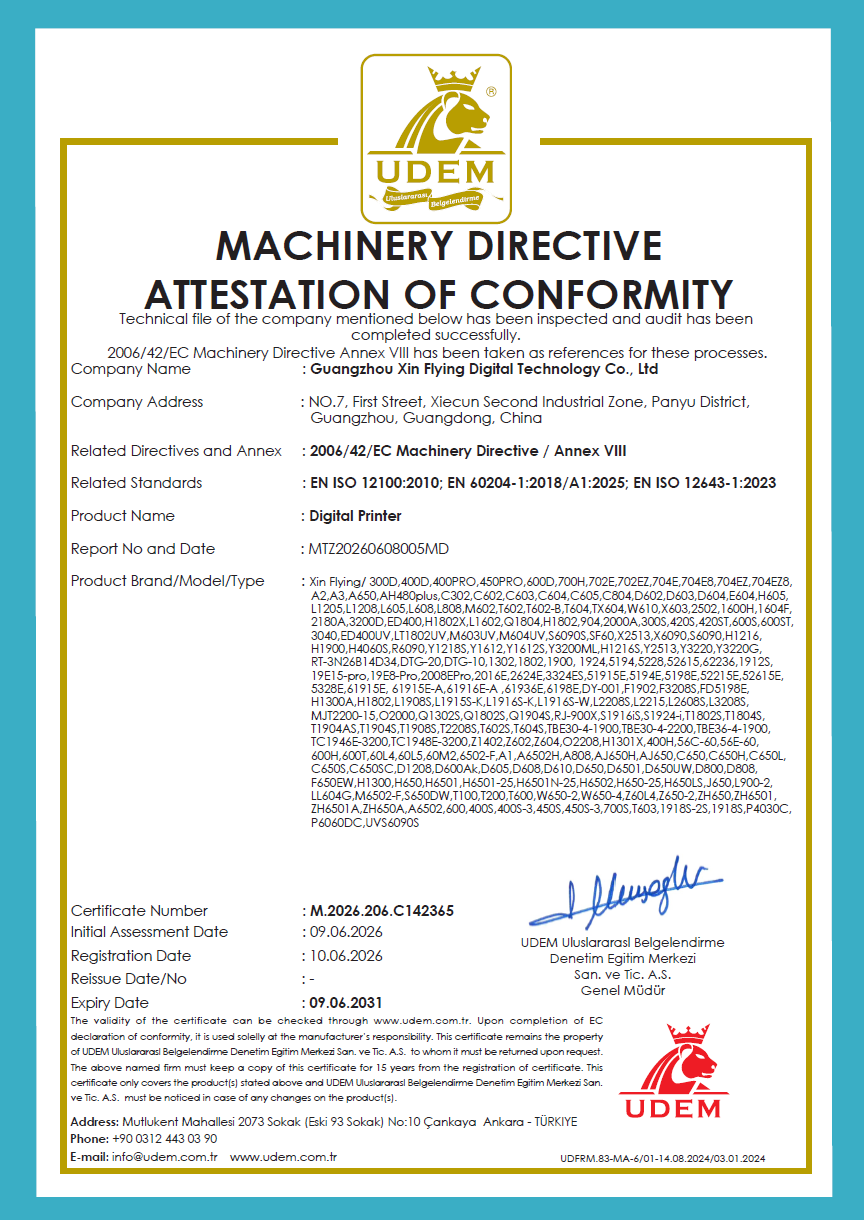
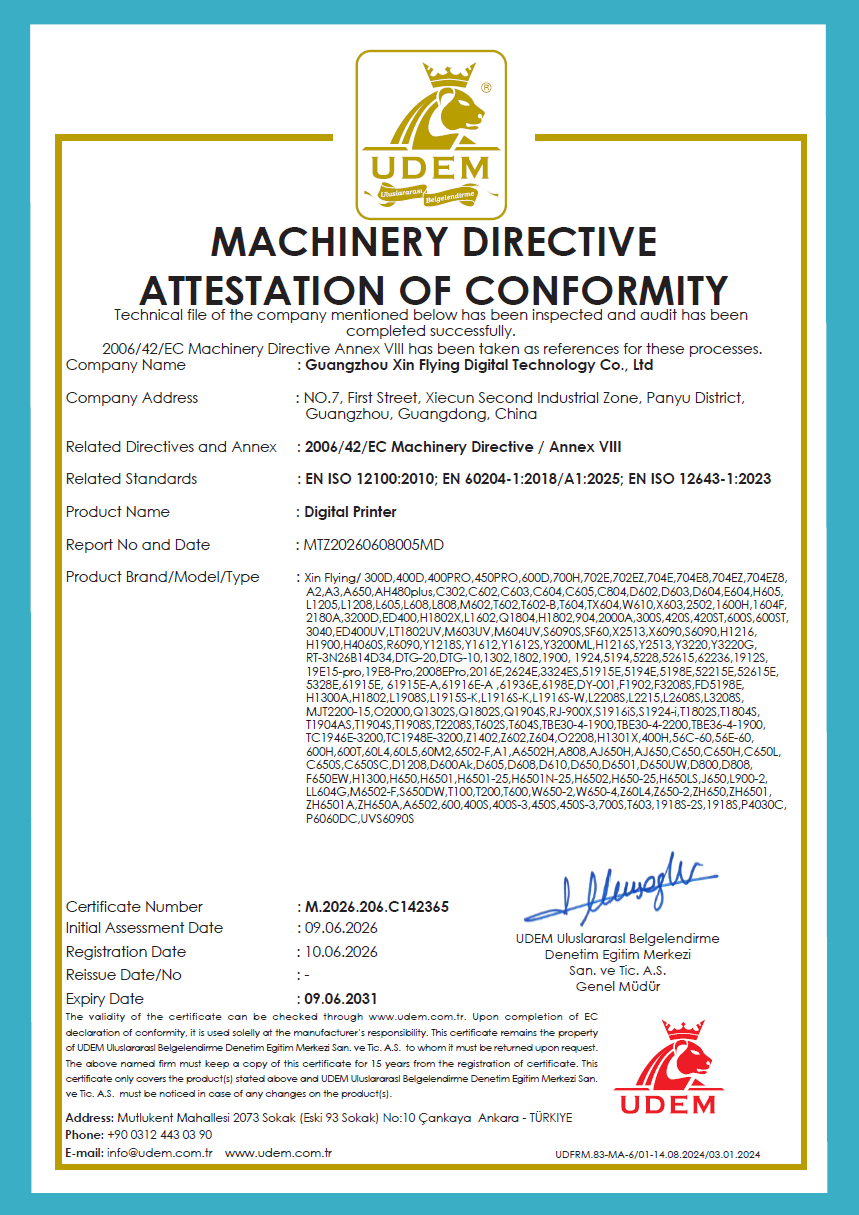
XINFLYING's CE MD Certificate of Conformity, certificate number M.2026.206.C142365, was issued by UDEM International Certification Auditing Training Centre Industry and Trade Inc. Co. on 2026-06-10 and is valid through 2031-06-09. Its declared scope is Machinery Safety Compliance under MD 2006/42/EC, and the standards listed on the certificate are:
- EN ISO 12100:2010 — safety of machinery: general principles for design, risk assessment and risk reduction.
- EN 60204-1:2018/A1:2025 — electrical equipment of machines: general requirements covering protection, control functions, bonding and marking.
- EN ISO 12643-1:2023 — safety requirements for graphic technology equipment and systems.
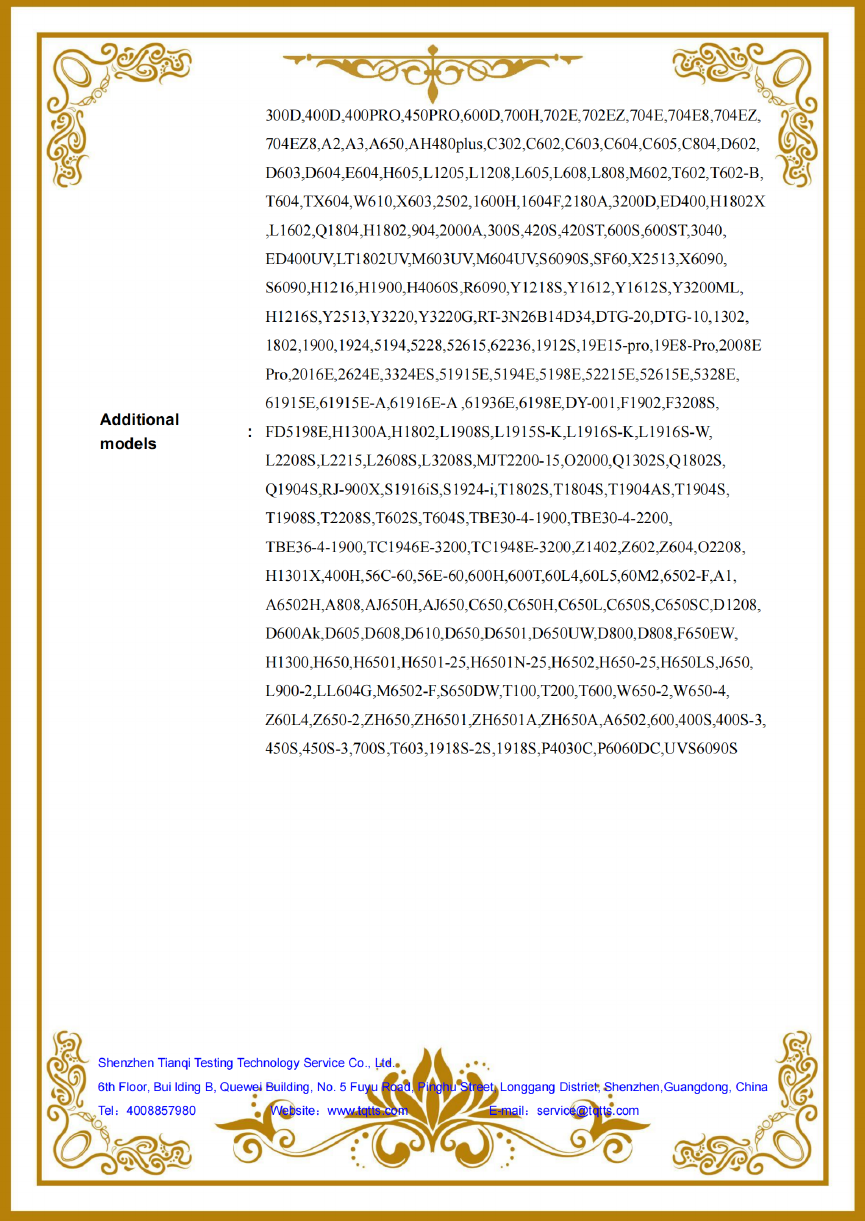
A second attestation of conformity, M.2026.206.C142385, was issued by the same body with the same standard set and the same validity window, covering a further group of models.
The practical meaning of EN ISO 12100:2010 is that the manufacturer must be able to show a documented risk assessment: where the hazards are, which ones were designed out, which are guarded, and which remain as residual risks communicated in the operating manual. EN 60204-1 is why emergency stop functions, protective bonding and control-circuit reliability are treated as machine-level design requirements rather than optional conveniences. For a roll-to-roll sublimation printer, that framework applies to media feed, drying and the control cabinet together.
EMC Directive 2014/30/EU: Emissions, Immunity and the Power Cabinet
EMC compliance addresses a different risk entirely: whether the machine disturbs other equipment, and whether it keeps working when disturbed. On a dye sublimation printer the relevant sources include printhead drive electronics, servo and stepping motors, heater controllers for the drying unit, and the power supply itself.
XINFLYING's CE EMC Certificate of Compliance, number TQT1550D270EC, was issued by TQT on 2026-05-19 under EMC Directive 2014/30/EU. The standards listed are EN 55032:2015/A11:2020, EN 55035:2017/A11:2020, EN IEC 61000-3-2:2019+A1:2021 and EN 61000-3-3:2013/A2:2021.
Read as a group, those four standards cover emission limits (EN 55032), immunity requirements (EN 55035), harmonic current emissions (EN IEC 61000-3-2) and voltage fluctuations and flicker (EN 61000-3-3). The last two matter commercially: a machine with a large heating load draws significant current, and these are the standards that describe how that load interacts with the local supply network.
Low Voltage Directive 2014/35/EU: Electrical Safety of the Machine
The LVD covers the electrical safety of equipment operating within its voltage range. It is assessed separately from EMC, because emissions and immunity say nothing about whether a live enclosure, a protective earth connection or a power supply module is safe to operate.
The XINFLYING CE LVD Certificate of Compliance, number TQT1550D271EC, was issued by TQT (Shenzhen Tianqi Testing Technology Service Co., Ltd.) on 2026-05-19 and covers electrical safety under LVD 2014/35/EU for digital printer products. The standard listed is EN IEC 62368-1:2020/A11:2020, the hazard-based safety standard widely applied to the electronic assemblies of printing machinery.
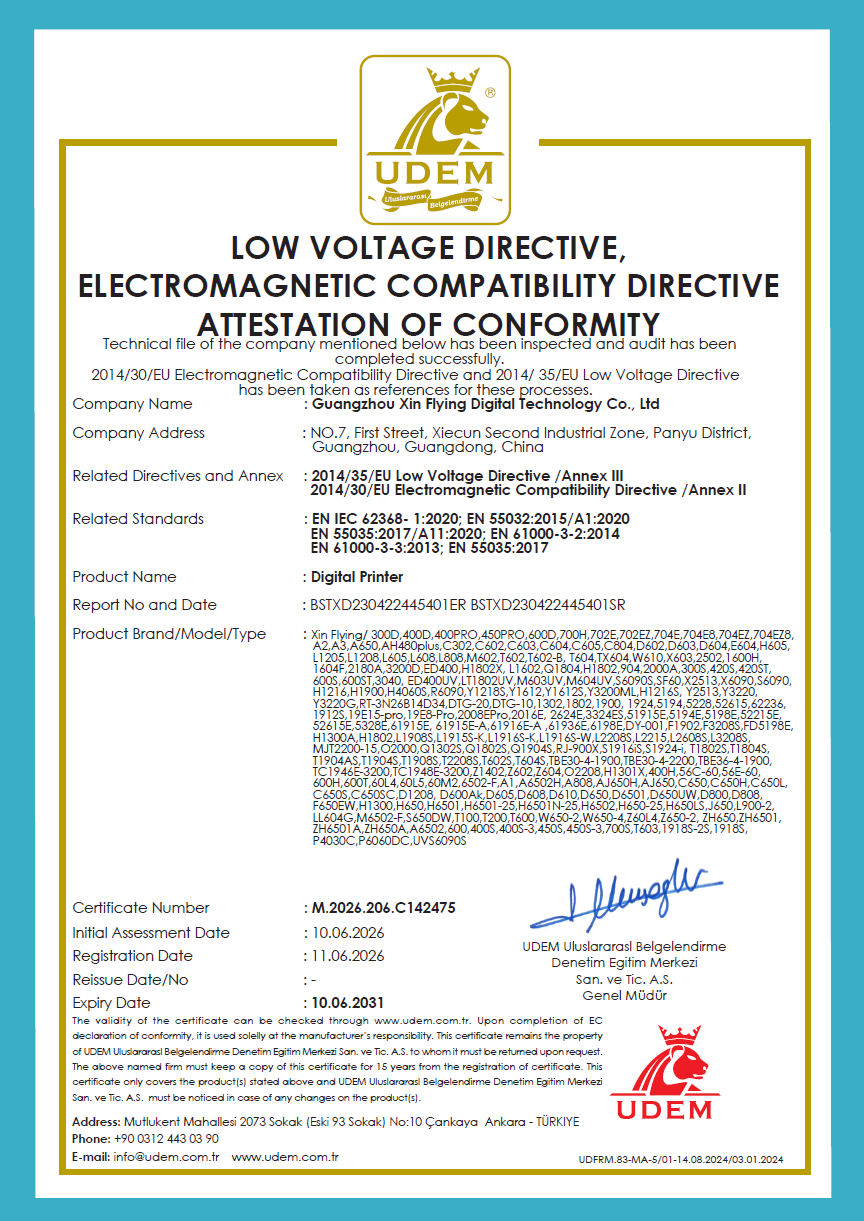
A combined LVD and EMC attestation also exists: M.2026.206.C142475, issued by UDEM on 2026-06-11 and valid through 2031-06-10, listing EN IEC 62368-1:2020, EN 55032:2015/A11:2020, EN 55035:2017/A11:2020, EN 61000-3-2:2014 and EN 61000-3-3:2013. This is the document most often mislabelled as 'the CE certificate' — it demonstrates two directives, not all of them.
RoHS 2011/65/EU — and Why Ink Certification Is a Different Question
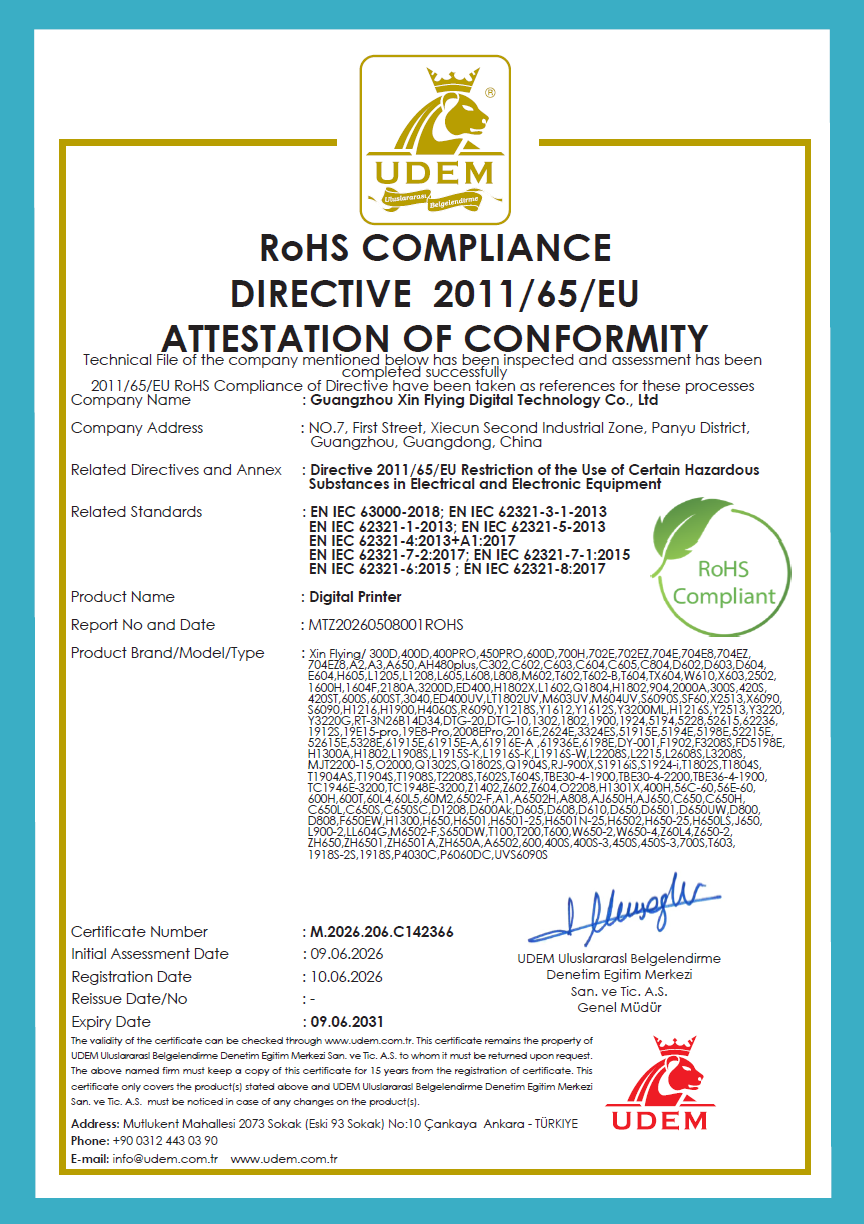
RoHS is an environmental directive, not a safety directive. It restricts hazardous substances in electrical and electronic equipment. XINFLYING's RoHS compliance certificate, number M.2026.206.C142366, was issued by UDEM on 2026-06-10 and is valid through 2031-06-09, with the standard EN IEC 63000:2018.
Inks and print pastes sit outside the machine directives and follow different schemes. XINFLYING's OEKO-TEX ECO PASSPORT certificate SH150194016, issued by TESTEX AG, covers textile printing inks and printing pastes, with validity recorded through 2026-12-31. Buyers producing textiles for skin contact should treat this as a separate checklist item from the printer's CE documentation, and should confirm current validity at the time of ordering.
It is equally important to separate voluntary industry standards from EU legislation. ISO 12647-8:2021, for example, defines requirements for validation print processes working directly from digital data. It is a useful reference for colour consistency, but it is not a CE directive and does not substitute for Machinery, EMC or LVD evidence.
Worked Example: What the Paperwork Behind the XF-H1301X-1I32A1 Actually Contains
The XF-H1301X-1I32A1 is a 130 cm (1.3 m) roll-to-roll sublimation printer built for polyester fabric work: one Epson i3200-A1 printhead, CMYK sublimation ink, print speeds up to 28 m²/h at 4PASS, heat transfer paper as the media, Maintop RIP as standard, and an external constant-temperature automatic drying system. The machine measures 2220 × 870 × 1540 mm, weighs 140 kg net (200 kg gross), runs on 2 kW with a 110/220 V, 18 A/9 A, 50–60 Hz supply, and is rated for 20–35 °C and 45–65% RH operating conditions.
For a European buyer, the decisive part is not the specification sheet but the compliance trail attached to this model:
- The model appears on the equipment list of CE MD Certificate of Conformity M.2026.206.C142365 (Machinery Directive 2006/42/EC; EN ISO 12100:2010, EN 60204-1:2018/A1:2025, EN ISO 12643-1:2023).
- The model appears on the equipment list of CE EMC Certificate of Compliance TQT1550D270EC (EMC Directive 2014/30/EU).
- The model appears on the equipment list of CE LVD Certificate of Compliance TQT1550D271EC (LVD 2014/35/EU; EN IEC 62368-1:2020/A11:2020).
- The model appears on the equipment list of RoHS compliance certificate M.2026.206.C142366 (Directive 2011/65/EU; EN IEC 63000:2018).
The same pattern repeats across the range, including the 1.8 m XF-H1802X-2I32A1 and the 1.9 m class industrial models XF-19E8-PRO, XF-19E15-PRO and XF-O2000-4I32A1, which are listed on the same Machinery Directive, EMC, LVD and RoHS documents. The compliance architecture is consistent from entry level through industrial large format sublimation printers — but the model list still has to be checked line by line, because the documents are only valid for the equipment they name.
Step-by-Step: How to Verify CE Documentation Before You Order
- Ask for directive-level documents, not a logo. Request the Machinery Directive document, the EMC document and the LVD document separately. One combined PDF covering 'CE' is a warning sign, not a convenience.
- Match the exact model string. Confirm that the model you are buying — for example XF-H1301X-1I32A1 — appears in the equipment list. Model families are not interchangeable for compliance purposes.
- Read the standard list. Check that EN ISO 12100:2010 and EN 60204-1:2018/A1:2025 appear on the Machinery Directive document, and that the EMC and LVD documents cite standards appropriate to their own directives.
- Record certificate numbers, issuing bodies and validity dates. XINFLYING's MD certificate M.2026.206.C142365, for example, was issued by UDEM on 2026-06-10 with validity through 2031-06-09; the EMC and LVD certificates TQT1550D270EC and TQT1550D271EC were issued by TQT on 2026-05-19.
- Confirm the machine-level items. Verify that the nameplate, the declaration of conformity and the manual match the certificates, and that the electrical rating on the label matches the ordered configuration (110/220 V, 18 A/9 A, 50–60 Hz on the XF-H1301X-1I32A1).
- Treat consumables separately. Ink and print paste certifications follow different schemes from machine directives; the ECO PASSPORT document for printing inks is not part of the CE file.
Use Cases: How Different Buyers Use the Same Compliance File
The same document set serves different purposes depending on who is buying.
- EU importers and distributors. They need directive-level evidence at customs and for their own resale obligations. A missing LVD document is a commercial problem, not a paperwork detail.
- Digital textile printing service providers. One provider running a five-unit fleet for three years, serving sportswear brands, apparel factories and customised textile businesses, needed repeatable machine-level documentation across more than one machine, not a single reference certificate.
- Sportswear and teamwear manufacturers. A sportswear manufacturer in Brazil has operated 15 units over four years for football jerseys, basketball uniforms and full-colour polyester printing; a sports uniform supplier in the same market has run 8 units for five years on small-batch customisation. Neither is an EU buyer, yet both use a supplier's documentation discipline as a proxy for manufacturing control when auditing equipment.
- Home textile producers. A home textile manufacturer running 10 units over four years for curtains, cushions and decorative fabrics depends on large-format stability, which is exactly where machinery-safety design and consistent electrical performance show up in daily operation.
Directive-by-Directive Comparison and Model Snapshot
The table below summarises what each directive covers and which document evidences it, using the certificate data held for the XINFLYING sublimation printer range.
| Directive | Risk it covers | Document held | Standards listed | Issuing body | Validity |
|---|---|---|---|---|---|
| Machinery Directive 2006/42/EC | Mechanical and machine-level electrical safety: risk assessment, guarding, control functions, emergency stop, bonding | CE MD Certificate of Conformity M.2026.206.C142365 | EN ISO 12100:2010; EN 60204-1:2018/A1:2025; EN ISO 12643-1:2023 | UDEM | Issued 2026-06-10, valid to 2031-06-09 |
| EMC Directive 2014/30/EU | Electromagnetic emissions, immunity, harmonic current and voltage fluctuation | CE EMC Certificate of Compliance TQT1550D270EC | EN 55032:2015/A11:2020; EN 55035:2017/A11:2020; EN IEC 61000-3-2:2019+A1:2021; EN 61000-3-3:2013/A2:2021 | TQT | Issued 2026-05-19 (expiry recorded 2099-01-01) |
| Low Voltage Directive 2014/35/EU | Electrical safety of the machine and its electronic assemblies | CE LVD Certificate of Compliance TQT1550D271EC | EN IEC 62368-1:2020/A11:2020 | TQT (Shenzhen Tianqi Testing Technology Service Co., Ltd.) | Issued 2026-05-19 (expiry recorded 2099-01-01) |
| LVD + EMC (combined attestation) | Electrical safety and electromagnetic compatibility together | Attestation of Conformity M.2026.206.C142475 | EN IEC 62368-1:2020; EN 55032:2015/A11:2020; EN 55035:2017/A11:2020; EN 61000-3-2:2014; EN 61000-3-3:2013 | UDEM | Issued 2026-06-11, valid to 2031-06-10 |
| RoHS Directive 2011/65/EU | Restriction of hazardous substances in electrical and electronic equipment | RoHS Compliance Certificate M.2026.206.C142366 | EN IEC 63000:2018 | UDEM | Issued 2026-06-10, valid to 2031-06-09 |
A further CE MD Certificate of Conformity, M.2026.206.C142385, is held alongside M.2026.206.C142365, issued by UDEM with the same standard set and the same validity period. Together the two documents cover the wider model list rather than a single machine.
XF-H1301X-1I32A1 Specification and Document Snapshot
| Attribute | Value |
|---|---|
| Machine type | Roll-to-roll sublimation printer (digital textile printer) |
| Print width | 130 cm (1.3 m) |
| Printheads | 1 × Epson i3200-A1 |
| Ink colours | CMYK (sublimation ink) |
| Print speed (fastest) | 4PASS 28 m²/h |
| Media | Heat transfer paper |
| RIP (standard) | Maintop |
| Drying | External constant-temperature automatic drying system |
| Power | 2 kW |
| Power supply | 110/220 V, 18 A/9 A, 50–60 Hz |
| Operating conditions | 20–35 °C, 45–65% RH |
| Machine size | 2220 × 870 × 1540 mm |
| Net / gross weight | 140 kg / 200 kg |
| Primary industry | Textile sublimation printing (polyester fabrics) |
| Machinery Directive document | M.2026.206.C142365 (UDEM, valid to 2031-06-09) |
| EMC document | TQT1550D270EC (TQT, issued 2026-05-19) |
| LVD document | TQT1550D271EC (TQT, issued 2026-05-19) |
| RoHS document | M.2026.206.C142366 (UDEM, valid to 2031-06-09) |
Frequently Asked Questions
How many separate CE-related documents should a sublimation printer supplier be able to show?
For a roll-to-roll sublimation printer, expect at least four document sets rather than one: Machinery Directive 2006/42/EC, EMC Directive 2014/30/EU, Low Voltage Directive 2014/35/EU and RoHS Directive 2011/65/EU. XINFLYING holds CE MD Certificate of Conformity M.2026.206.C142365 issued by UDEM (2026-06-10 to 2031-06-09; EN ISO 12100:2010, EN 60204-1:2018/A1:2025, EN ISO 12643-1:2023), CE EMC Certificate of Compliance TQT1550D270EC issued by TQT on 2026-05-19, CE LVD Certificate of Compliance TQT1550D271EC issued by TQT on 2026-05-19, and RoHS certificate M.2026.206.C142366 issued by UDEM. The XF-H1301X-1I32A1 is listed on those equipment lists. A supplier able to show only one document has demonstrated only one directive.
Can a China-based sublimation printer manufacturer supply documentation and customisation together?
Yes, where the manufacturer operates an OEM/ODM programme alongside its compliance system. XINFLYING, founded in 2010, offers OEM/ODM with product branding, machine appearance, colour, logo and packaging customisation plus solutions built to customer requirements, at a minimum order quantity of one unit and a lead time of 5–40 days. Production capacity is stated at 1600+ units per month, quality control includes pre-shipment testing, and technical support is provided 24/7 by more than 50 engineers. The company operates from a 37,440 m² facility with 200+ employees and 20 R&D engineers, exporting to North America, South America, Europe, Asia, the Middle East and Africa.
Does weak CE documentation add cost to a sublimation printer project later?
The cost of a compliance gap rarely appears on the invoice; it appears as delay and rework. If the certificate does not list the exact model being shipped, the buyer may be asked to supply additional verification, which can hold up customs clearance or resale. If the standards cited are outdated, the file may need to be reassessed before the machine can be placed on the EU market. The practical budget rule is therefore to verify directive coverage, model listing, standard editions and validity dates before payment, and to treat a complete document set as part of the delivered equipment rather than an after-sales request. Buyers should compare suppliers on documented conformity and total project risk, not on document quantity.
Can I validate a sublimation printer on a small order before committing to a production line?
Sample and small-batch validation is possible. XINFLYING's minimum order quantity is one unit, and pre-shipment testing is performed as part of its quality control process, so a buyer can run test prints on polyester heat transfer paper before scaling up. The XF-H1301X-1I32A1 is the entry-level roll-to-roll option at 130 cm with Maintop RIP as standard, which makes it suitable for custom textile production, apparel sampling and small-batch orders, while the 1.8 m and 1.9 m class models are intended for continuous production. When validating, check the physical nameplate against the certificate model list at the same time as checking print output.
What is the lead time, and how do I start the qualification process?
Lead time for XINFLYING sublimation printers runs from 5 to 40 days depending on configuration, order volume and production scheduling, supported by a stated monthly capacity of 1600+ units and 24/7 online technical support from over 50 engineers. To start, request the directive-level documents for the exact model you intend to buy, confirm that the model appears on the Machinery Directive, EMC, LVD and RoHS equipment lists, and then move to a sample or pilot order. You can download the company and product brochure here: XINFLYING company and product brochure (PDF), or send your model list and destination market to info@xin-flying.com and the team will return the matching certificates for verification.
Conclusion: From 'Is It CE?' to 'Which Directive, Which Standard, Which Model?'
The useful question is never whether a sublimation printer is 'CE certified', but which directives it conforms to, under which harmonised standards, for which named model, and until when. For a machine like the XF-H1301X-1I32A1, the answer is specific: Machinery Directive 2006/42/EC evidenced by certificate M.2026.206.C142365 built on EN ISO 12100:2010 and EN 60204-1:2018/A1:2025; EMC Directive 2014/30/EU evidenced by TQT1550D270EC; LVD 2014/35/EU evidenced by TQT1550D271EC; and RoHS 2011/65/EU evidenced by M.2026.206.C142366. Buyers who evaluate at that level of detail protect their import schedule, their resale position and their production uptime — and they make a better equipment decision, because a supplier able to produce that file is usually a supplier able to control the machine behind it.
Check the Documents, Then Check the Machine
Send your target model, print width requirement and destination market to the XINFLYING team, and you will receive the matching directives, standards, certificate numbers and validity dates for verification — before you place an order.
Email: info@xin-flying.com | Tel / WhatsApp: +86 188-1322-1357 | Website: www.xin-flying.com
Download the brochure: XINFLYING company and product brochure (PDF)
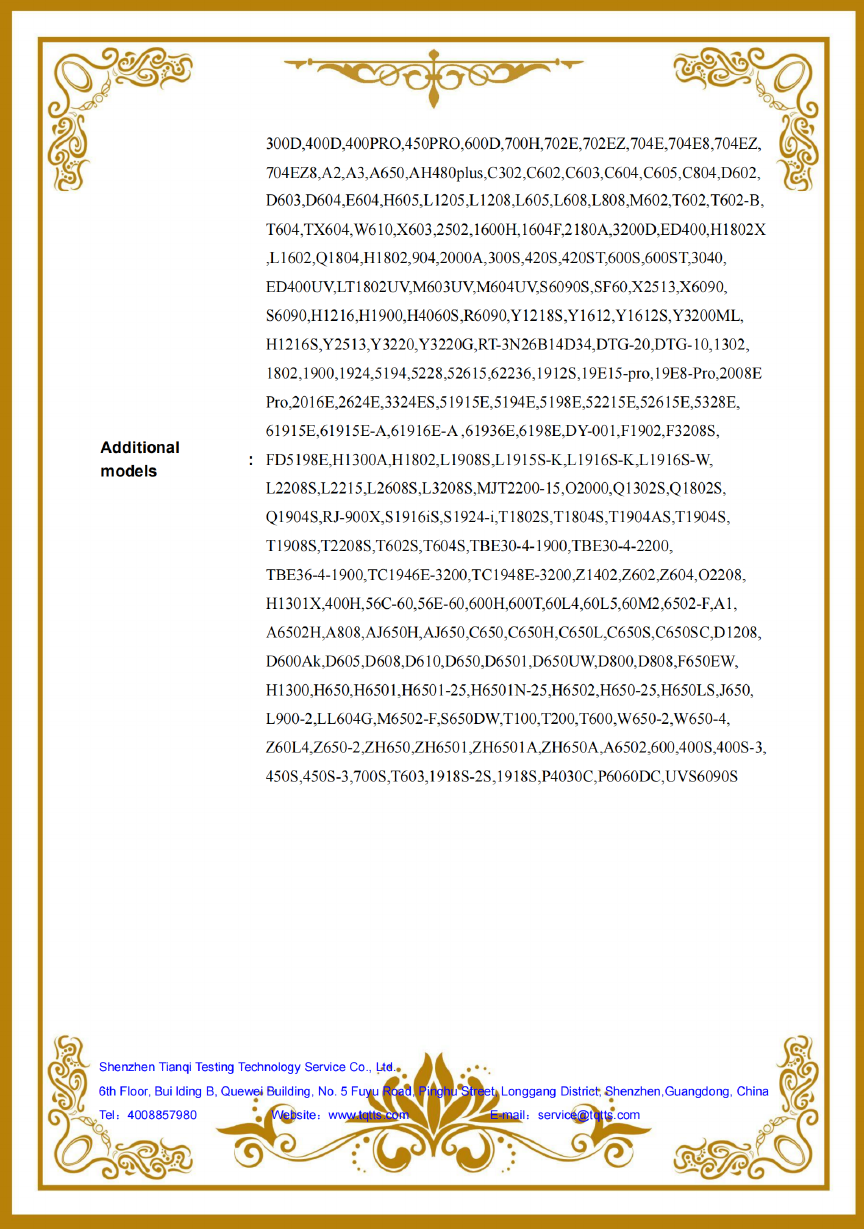
Compliance details in this article refer to the XINFLYING documents and equipment lists listed above. Buyers should confirm current validity and model coverage at the time of ordering.
Have Questions or Need More Details?
Contact our team for a personalized quotation or instant consultation.
Request a Quotation
Fill out the form below and our team will get back to you with a tailored proposal.
WhatsApp Direct Chat
Prefer to chat in real-time? Message us on WhatsApp for instant assistance & quick answers.
- Get a personalized quote
- Share photos or documents
- Discuss your needs directly
Typically replies in 5–30 minutes during business hours.