
Verifying a Sublimation Printer Supplier: Certificate and Model Cross-Checks
A compliance certificate proves what it names — nothing more. When a sublimation printer supplier sends a documentation pack alongside a quotation, the buyer's real task is a four-field cross-check: does the certificate number belong to a traceable document, is the issuing body a named testing or certification organisation, does the cited standard match the directive being claimed, and is the machine model you are actually buying listed on that document? A certificate that clears all four checks is evidence you can attach to the purchase file. One that fails the fourth check is a sales attachment.
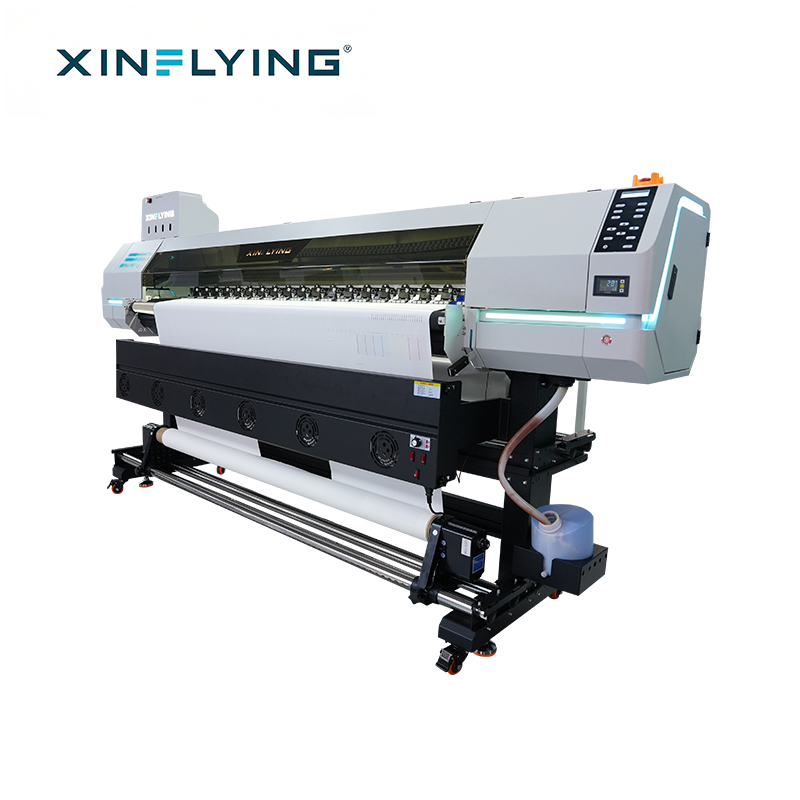
This walkthrough applies that cross-check to a named certificate set covering XINFLYING sublimation printer models, including XF-19E15-PRO, XF-19E8-PRO, XF-H1301X-1I32A1 and XF-O2000-4I32A1. The four fields are the same for any supplier, which is the point: the method travels, the document set does not.
What a Certificate Cross-Check Should Let You Do
- Separate a model-specific certificate from a broad family certificate before a deposit is released.
- Confirm that the directive named in a sales email is the directive the document actually cites.
- Identify a document scoped to a different product family, such as a DTF-scoped CE file presented for a roll-to-roll sublimation machine.
- Build a purchase file in which every compliance statement has a number, an issuer, a standard and a model behind it.
Problem Definition: Why “CE Certified” Is Not a Verification Result
Certificate disputes in sublimation printer procurement rarely involve a forged document. They involve a mismatched one — and mismatches happen in three recognisable patterns.
Pattern 1: Family scope read as model scope
A single certificate frequently lists a range of machines built on the same platform. That is normal and useful: one document can demonstrate that a supplier has tested a printer family against a directive. The error is assuming a family document automatically covers every model a supplier sells. Coverage is defined by the named-product field, and that field is finite.
Pattern 2: Directive mismatch
Machinery safety, electrical safety, electromagnetic compatibility and hazardous-substance restriction are four different claims, each supported by a different standard set. A RoHS attestation says nothing about machinery guarding. An EMC file says nothing about electrical insulation. When a supplier answers a safety question with an EMC certificate, the correct response is to request the missing document rather than accept the substitute.
Pattern 3: Product-family mismatch
Suppliers that build more than one printer category hold certificates for each. Within the same XINFLYING document set, two CE files are scoped to “DTF Printer” — BSTXD211021006201EC, issued by BST Testing (Shenzhen) Co., Ltd., and CTICAIQ415250900815313DC, issued by CTIC Testing Group (Guangdong) Co., Ltd. Both are legitimate documents for a different product family. Neither names a roll-to-roll sublimation model, and neither should be presented as if it did.
Industry Background: More Machines, More Documents, More Scope Confusion
The volume of certification paperwork in this category is rising because the category itself is rising. Grand View Research values the global dye sublimation printing market at USD 16.4 billion in 2025, with a projected path to USD 39.0 billion by 2033 and a compound annual growth rate of 11.5% from 2026 to 2033. Within that, the dye sublimation printer segment specifically was valued at USD 1.88 billion in 2025 and is expected to reach USD 2.53 billion by 2030, according to Mordor Intelligence.
Asia Pacific accounted for a 36.5% revenue share of the dye sublimation printing market in 2025, with China as the largest country market (Grand View Research). Buyers in Europe and North America therefore spend a substantial share of their evaluation time on documents produced by manufacturers based outside their own regulatory area — which is precisely why the cross-check matters more than the claim. FESPA Insights notes that roll-to-roll sublimation printers at 1.9 m (1900 mm) width are a standard configuration for high-volume textile and soft signage work, so the machines most often shortlisted are also the ones whose certificates list the longest product families.
On the regulatory side, four EU instruments recur in sublimation printer purchasing conversations: the Machinery Directive 2006/42/EC, the Low Voltage Directive 2014/35/EU, the EMC Directive 2014/30/EU and the RoHS Directive 2011/65/EU. Each maps to a different document, a different standard list and a different question.
The Four Fields, Defined
1. Certificate number
The number is the handle. It should appear on the face of the document, it should be quotable in an email, and it should be unique to that document. Cross-checking means finding the number inside the file and confirming it matches the number quoted by the sales contact. Example from the set discussed here: TQT1550D270EC, a CE EMC Certificate of Compliance.
2. Issuing body
The issuer is the organisation that tested or certified the product. A named issuer makes a document traceable; an unnamed one does not. Two issuers appear in the XINFLYING set: Shenzhen Tianqi Testing Technology Service Co., Ltd. (shown as TQT on the EMC and LVD documents) and UDEM International Certification Auditing Training Centre Industry and Trade Inc. Co. (shown as UDEM on the Machinery Directive, RoHS and combined LVD & EMC documents). A buyer should be able to state, in one line, who signed the document they are relying on.
3. Applicable standard
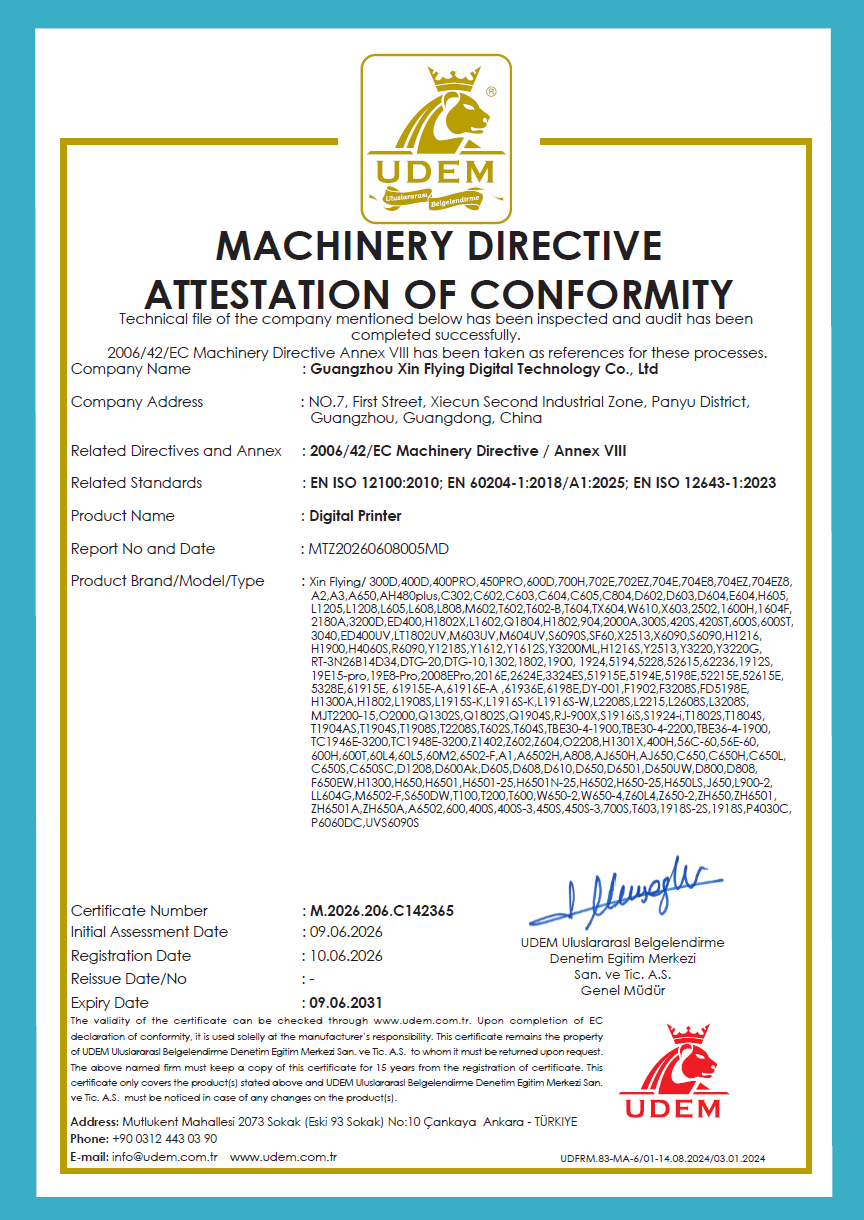
The standard list is where directive claims become checkable. A document claiming compliance with the EMC Directive 2014/30/EU should cite EMC standards. Example: the CE EMC Certificate of Compliance TQT1550D270EC cites EN 55032:2015/A11:2020, EN 55035:2017/A11:2020, EN IEC 61000-3-2:2019+A1:2021 and EN 61000-3-3:2013/A2:2021. A document claiming machinery safety should cite machinery safety standards — the CE MD Certificate of Conformity M.2026.206.C142365 cites EN ISO 12100:2010, EN 60204-1:2018/A1:2025 and EN ISO 12643-1:2023. If the standards do not fit the claim, the claim is not supported.
4. Named product
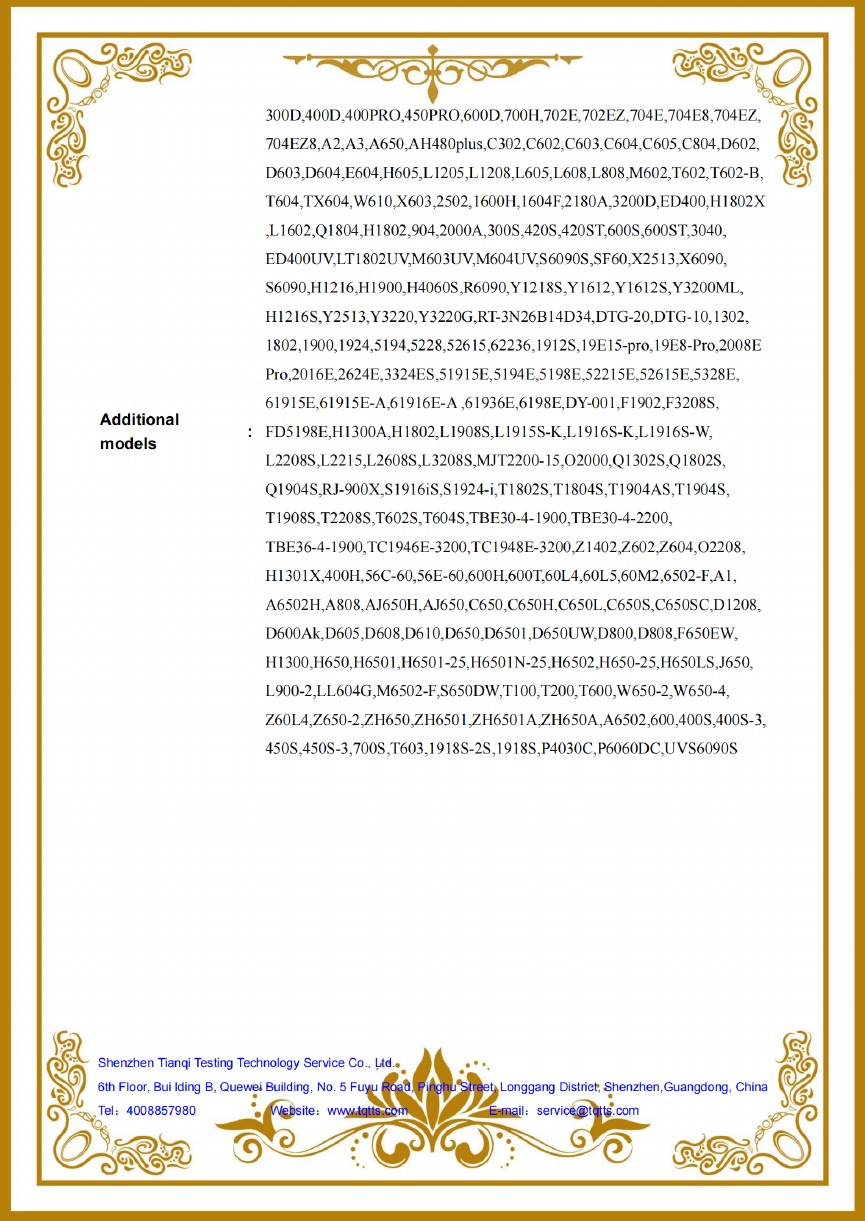
This is the field buyers skip. Every certificate carries a product description, and that description is the boundary of coverage. Read it against the model on the quotation, character by character, for the models you care about.
Step-by-Step: A Six-Step Verification Walkthrough
Step 1 — Map every quotation line to a document
Build a simple table before you open any certificate: model number in column one, required directive in column two, document requested from the supplier in column three. For a sublimation printer order the minimum set is usually a Machinery Directive document, an LVD document, an EMC document and a RoHS attestation.
Step 2 — Read the certificate number off the document, not the email
Open the file. Confirm the number is printed on it. If the sales contact quoted a number that does not appear in the PDF, stop and ask which document that number belongs to.
Step 3 — Confirm the issuing body
Identify the issuer and record its full name. Two issuers can legitimately sign documents for the same supplier; that is normal when different test houses handle different directives.
Step 4 — Match the standard list to the directive
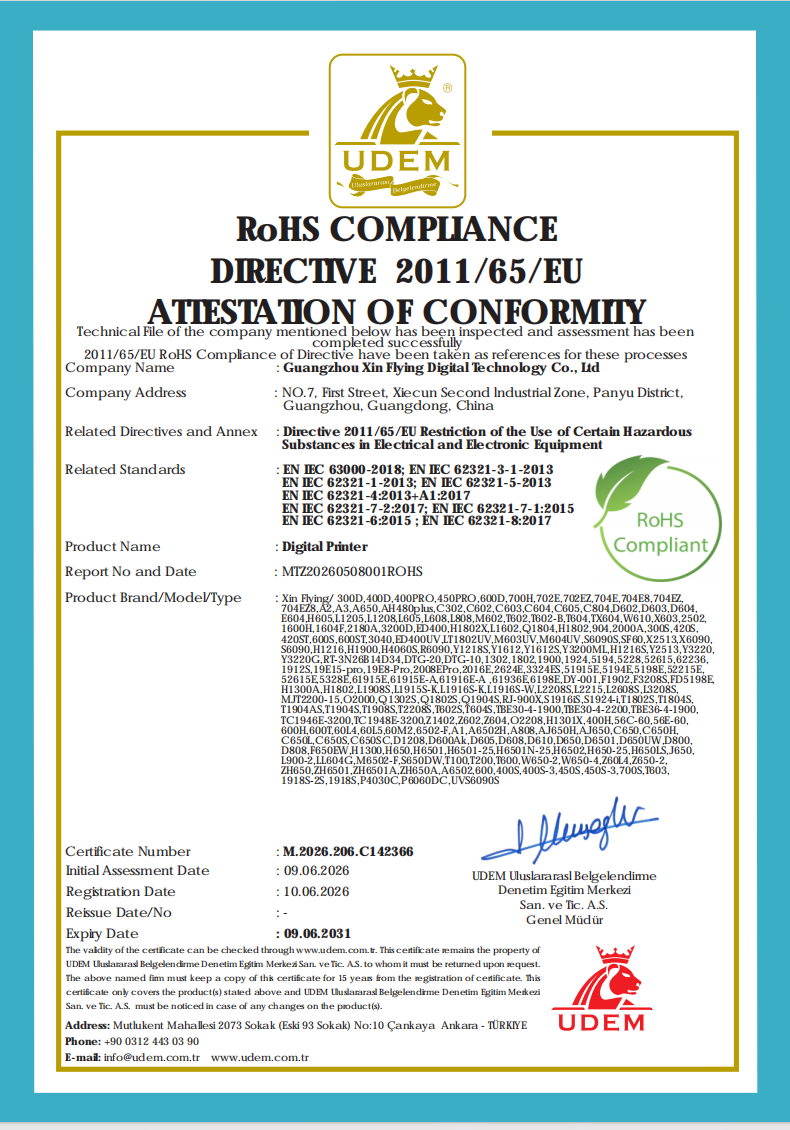
Check that the standards cited belong to the directive claimed. EMC claims should carry EMC standards; safety claims should carry safety standards; RoHS claims should carry EN IEC 63000:2018 and the EN IEC 62321 series, as the RoHS Compliance Certificate M.2026.206.C142366 does.
Step 5 — Find your model on the document
Now look for the exact model string. This is where the check succeeds or fails. Working through the specific documents in this set:
- The CE EMC Certificate of Compliance TQT1550D270EC names digital textile printers including XF-19E15-PRO, XF-19E8-PRO, XF-H1301X-1I32A1 and XF-O2000-4I32A1.
- The CE MD Certificate of Conformity M.2026.206.C142365 names the same machine family under the Machinery Directive.
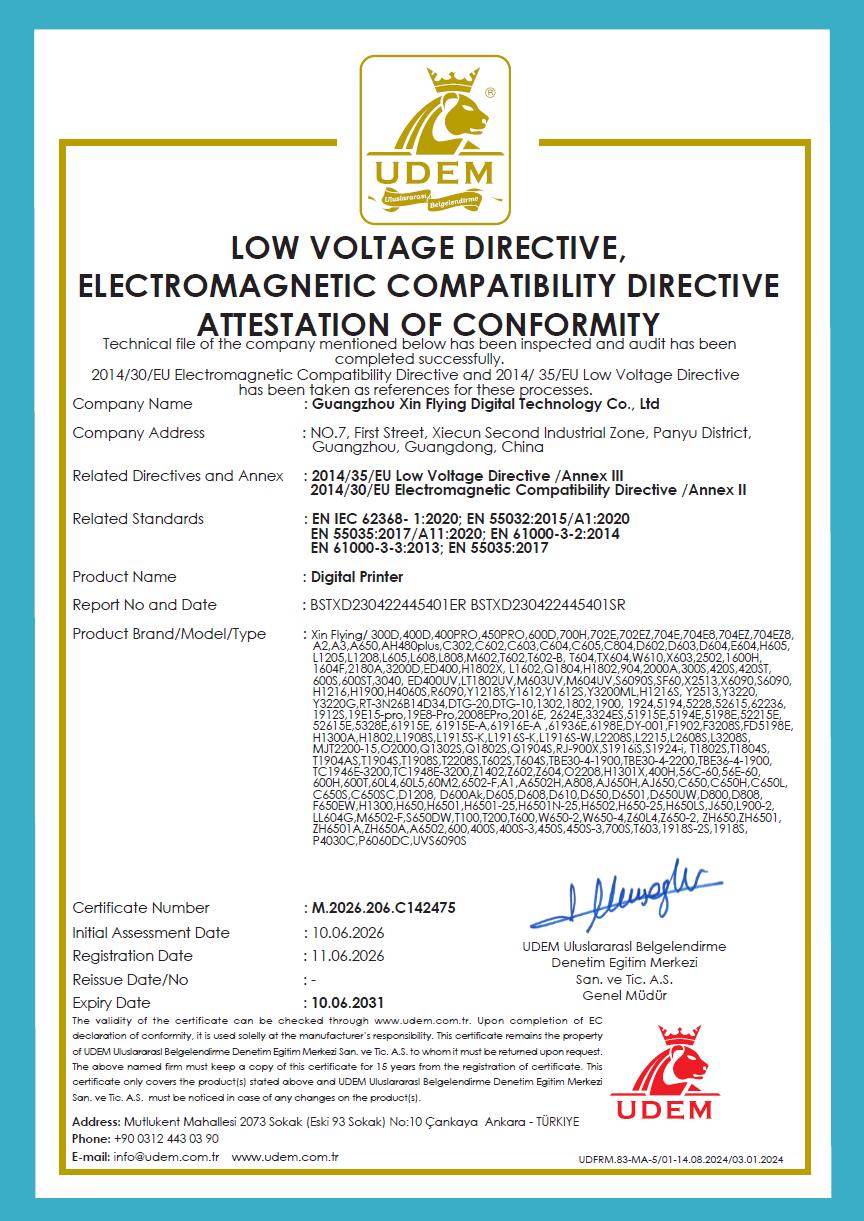
- The CE LVD & EMC certificate M.2026.206.C142475 combines electrical safety and EMC coverage and lists a family of sublimation and DTF printers.
- The RoHS Compliance Certificate M.2026.206.C142366 places hazardous-substance coverage in the same UDEM certification block.
Note the pattern: the UDEM numbers M.2026.206.C142365, M.2026.206.C142475 and M.2026.206.C142366 share a block prefix, which indicates that they were issued as a set for the same equipment scope. That is a useful signal, but it is not a substitute for reading the product field on each document individually.
Step 6 — Check issue and expiry dates
Dates convert a certificate from a document into a current document. In this set, the TQT EMC and LVD documents were issued on 2026-05-19; the UDEM Machinery Directive and RoHS documents were issued on 2026-06-10; the combined LVD & EMC document was issued on 2026-06-11. Expiry dates differ by issuer and document type: the UDEM set carries expiry dates of 2031-06-09 and 2031-06-10, while the TQT EMC and LVD documents show an expiry of 2099-01-01, a convention used for documents that are not time-limited. Where a document has a real expiry date, diarise it — a certificate that lapses during your equipment's service life becomes a problem you own.
Use Cases: How the Cross-Check Changes a Decision
Use case 1 — A European textile mill shortlisting 190 cm machines
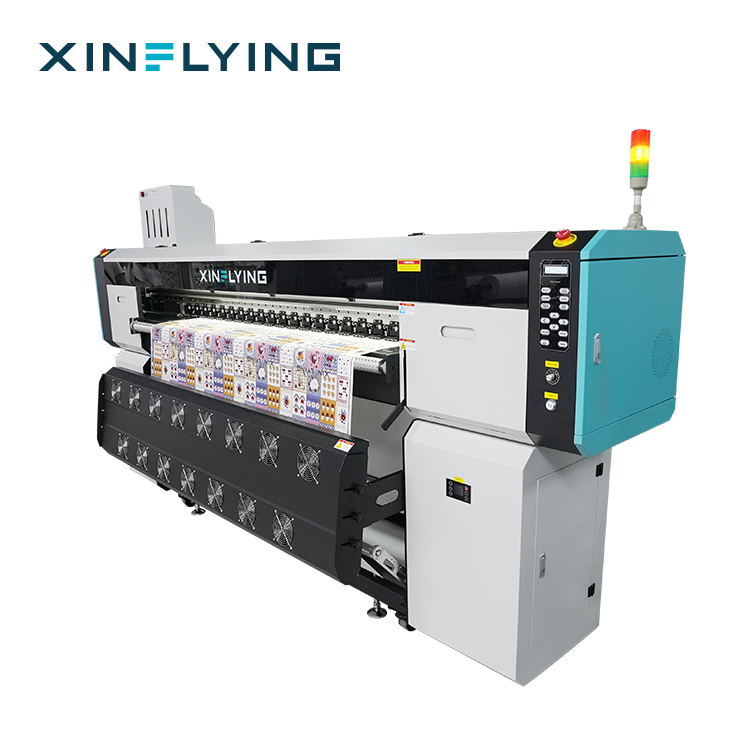
A mill evaluating 1.9 m roll-to-roll sublimation printers for polyester fabric and soft signage will receive several documentation packs. The check that separates them is model naming. A quotation for XF-19E15-PRO (15 × Epson i3200-A1 printheads, 190 cm print width, 3200 dpi, up to 524 m²/h in 1PASS mode, 14.5 kW) or XF-19E8-PRO (8 printheads, 190 cm, up to 306 m²/h in 1PASS mode, 10.2 kW) should be supported by documents that name those exact strings — not by a generic “digital textile printer” description.
Use case 2 — A growing apparel printer buying a 1950 mm machine
A business moving from job work to continuous daily production often shortlists the XF-O2000-4I32A1: 4 × Epson i3200-A1 printheads, 195 cm (1.95 m) print width, up to 180 m²/h in 2PASS and 92 m²/h in 4PASS, 8.5 kW, and support for transfer paper rolls of 1000–1500 m. Because the 195 cm platform sits just outside the 1.9 m group, a buyer should confirm that the quoted model appears on the certificate rather than assuming that width class carries over.
Use case 3 — A first-time buyer scaling into sublimation
Buyers entering sublimation production sometimes start with a narrower machine such as XF-H1301X-1I32A1 (1 × Epson i3200-A1 printhead, 130 cm print width, up to 28 m²/h at 4PASS, 2 kW). Smaller machines are still machinery: the same Machinery Directive, electrical safety, EMC and RoHS questions apply, and the same four-field check applies to the documents.
Use case 4 — A workshop running both DTF and sublimation
A workshop operating DTF printers alongside a roll-to-roll sublimation machine will receive overlapping files. This is where DTF-scoped CE documents become a trap for the careless: BSTXD211021006201EC and CTICAIQ415250900815313DC cover DTF printers. Keep the two families' documents in separate folders and check the scope line every time one is opened.
Evidence Ranking: Which Document Ranks Above the Others
When two suppliers present different document sets, ranking the evidence before ranking the machine keeps the comparison honest. From strongest to weakest, for the purpose of supporting one specific model:
- Model-named certificate — the exact quoted model string appears in the product field, with a named issuer, a directive-appropriate standard list and a current date range.
- Family certificate that includes the model — coverage is real but shared across a family; acceptable when the model string is present.
- Family certificate that excludes the model — the document may be genuine, but it does not support the quotation as written.
- Certificate for a different product family — DTF-scoped documents presented for a sublimation machine. Not evidence for this purchase at all.
- Certificate with no traceable number or issuer — unverifiable by definition.
Applied to this set, the CE EMC Certificate of Compliance TQT1550D270EC, the CE MD Certificate of Conformity M.2026.206.C142365, the CE LVD & EMC certificate M.2026.206.C142475 and the RoHS Compliance Certificate M.2026.206.C142366 sit at rank 1 or rank 2 for the sublimation models they name, while the DTF-scoped files sit at rank 4 for those same models.
Comparison Table: The Certificate Set at a Glance
| Document | Certificate number | Issuing body | Directive / scope | Key standards cited | Named-model relevance |
|---|---|---|---|---|---|
| CE EMC Certificate of Compliance | TQT1550D270EC | Shenzhen Tianqi Testing Technology Service Co., Ltd. (TQT) | EMC Directive 2014/30/EU | EN 55032:2015/A11:2020; EN 55035:2017/A11:2020; EN IEC 61000-3-2:2019+A1:2021; EN 61000-3-3:2013/A2:2021 | Names XF-19E15-PRO, XF-19E8-PRO, XF-H1301X-1I32A1, XF-O2000-4I32A1 and other digital textile printers |
| CE LVD Certificate of Compliance | TQT1550D271EC | Shenzhen Tianqi Testing Technology Service Co., Ltd. (TQT) | LVD 2014/35/EU — electrical safety for digital printer products | EN IEC 62368-1:2020/A11:2020 | Digital printer scope; check model string per quotation |
| CE MD Certificate of Conformity | M.2026.206.C142365 | UDEM | MD 2006/42/EC — machinery safety | EN ISO 12100:2010; EN 60204-1:2018/A1:2025; EN ISO 12643-1:2023 | Names the sublimation printer family |
| CE MD Certificate of Conformity | M.2026.206.C142385 | UDEM | MD 2006/42/EC — machinery safety | EN ISO 12100:2010; EN 60204-1:2018/A1:2025; EN ISO 12643-1:2023 | Names the sublimation printer family |
| CE LVD & EMC Compliance | M.2026.206.C142475 | UDEM | LVD 2014/35/EU & EMC 2014/30/EU | EN IEC 62368-1:2020/A11:2020; EN 55032:2015/A1:2020; EN 55035:2017; EN 61000-3-2:2014; EN 61000-3-3:2013 | Family scope listing sublimation and DTF printers |
| RoHS Compliance Certificate | M.2026.206.C142366 | UDEM | RoHS Directive 2011/65/EU | EN IEC 63000:2018; EN IEC 62321 series | Hazardous-substance coverage for the named printer family |
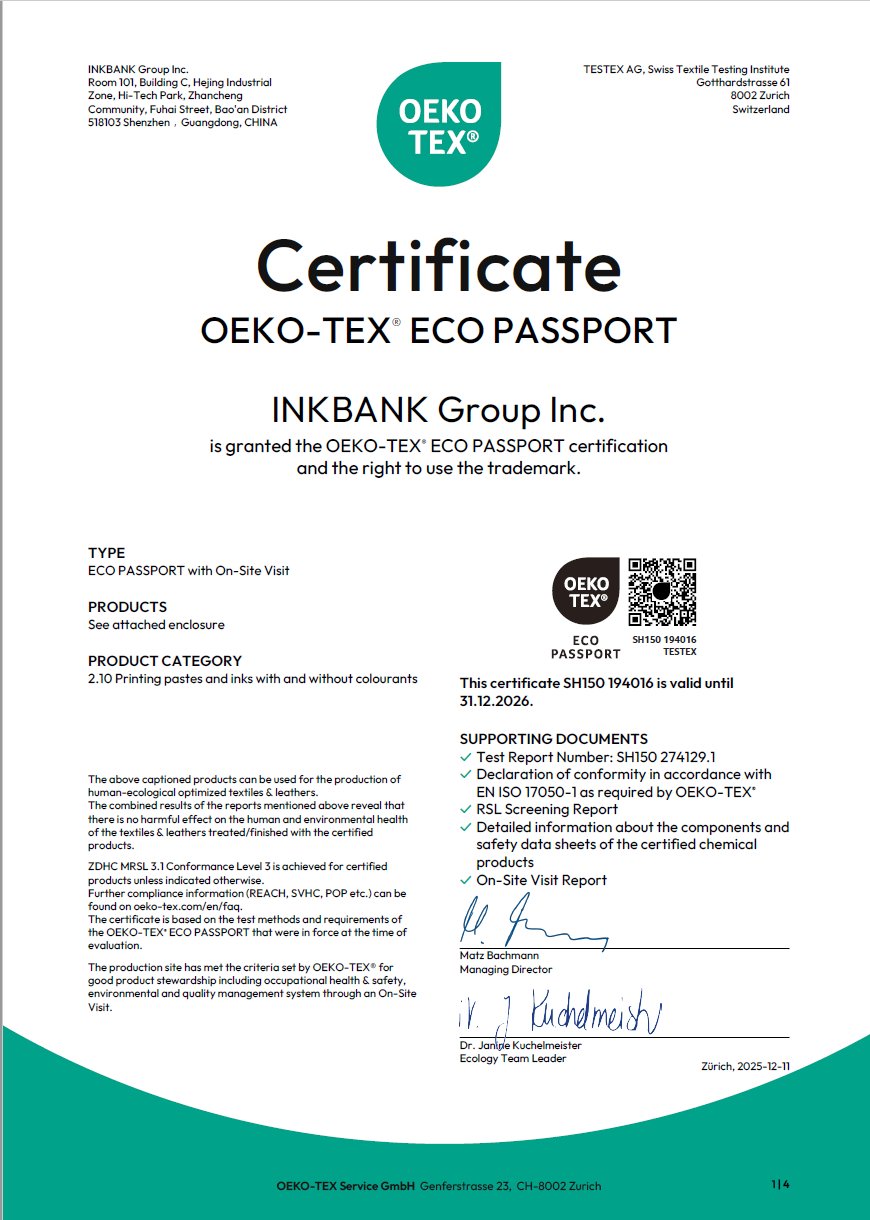
| OEKO-TEX ECO PASSPORT | SH150194016 | TESTEX AG | Textile printing inks & printing pastes | OEKO-TEX ECO PASSPORT; EN ISO 17050-1 | Consumables scope — not machine safety evidence |
| CE Certificate of Compliance | BSTXD211021006201EC | BST Testing (Shenzhen) Co., Ltd. | Scope: DTF Printer | EN 55032:2015+A11:2020; EN IEC 61000-3-2:2019; EN 61000-3-3:2013+A1:2019; EN 55035:2017+A11:2020 | DTF scope — not model evidence for sublimation printers |
| CE Certificate of Compliance | CTICAIQ415250900815313DC | CTIC Testing Group (Guangdong) Co., Ltd. | Scope: DTF Printer | EN 55032:2015; EN IEC 61000-3-2:2019+A1:2021; EN 61000-3-3:2013/A2:2021; EN 55035:2017/A11:2020 | DTF scope — not model evidence for sublimation printers |
Verification Checklist Before You Release a Deposit
The checklist below is structured around the four fields that determine whether a compliance document supports the machine in your quotation. It can be applied to any supplier's pack, not only to the set used as an example here.
| Field | What to check | Pass condition | Where to look |
|---|---|---|---|
| Certificate number | The number quoted by the sales contact appears in the document itself | Number on the PDF matches the number in the email exactly | Document header and footer |
| Issuing body | A named testing or certification organisation is identified | Full legal name of the issuer can be written in one line | Signature block and header |
| Applicable standard | The cited standards belong to the directive being claimed | EMC claim cites EMC standards; safety claim cites safety standards; RoHS claim cites EN IEC 63000:2018 and EN IEC 62321 series | Standard list on the certificate |
| Named product | The exact model string on the quotation appears in the product field | Quoted model, character for character, is listed | Product description field |
| Scope line | The document is scoped to the correct product family | Scope reads as a digital textile / sublimation printer, not a DTF printer or an ink | Scope or product-type field |
| Issue date | The document post-dates the current machine build | Issue date is recent relative to the equipment configuration | Issue date field |
| Expiry date | The document remains valid through your planned service period | Expiry date is in the future, or the document is explicitly not time-limited | Validity field |
Frequently Asked Questions
Does one CE certificate cover every sublimation printer model in a supplier's catalogue?
No. Coverage is defined entirely by the named-product field, and that field is limited. In the XINFLYING document set, the CE EMC Certificate of Compliance TQT1550D270EC names a defined list of digital textile printers that includes XF-19E15-PRO, XF-19E8-PRO, XF-H1301X-1I32A1 and XF-O2000-4I32A1. A model that does not appear on that list is not covered by that document. Two other CE files in the same set — BSTXD211021006201EC issued by BST Testing (Shenzhen) Co., Ltd. and CTICAIQ415250900815313DC issued by CTIC Testing Group (Guangdong) Co., Ltd. — are scoped to DTF Printer, a different product family, and do not extend coverage to sublimation models. The practical rule is to read the product field before reading anything else.
How can I tell whether a certificate covers the printer itself or only the ink?
Read the scope and product-type lines. The OEKO-TEX ECO PASSPORT certificate SH150194016, issued by TESTEX AG, is scoped to “Textile Printing Inks & Printing Pastes” and cites the OEKO-TEX ECO PASSPORT scheme together with EN ISO 17050-1. It is evidence about consumables, not about machine safety. Machine-level evidence in the same set lives in different documents: the CE MD Certificate of Conformity M.2026.206.C142365, issued by UDEM under Machinery Directive 2006/42/EC and citing EN ISO 12100:2010, EN 60204-1:2018/A1:2025 and EN ISO 12643-1:2023, addresses machinery safety; the RoHS Compliance Certificate M.2026.206.C142366 addresses hazardous substances; the CE EMC Certificate of Compliance TQT1550D270EC addresses electromagnetic compatibility. If a supplier answers a machine-safety question with an ink certificate, the requested document is still missing.
Does verifying certificates add cost or delay to a sublimation printer purchase?
The verification step itself is documentary and does not change the equipment price: it requires a document pack, a checklist and a short review before the deposit is released. What changes the commercial outcome is discovering a coverage gap after the order rather than before it, because that can trigger additional conformity work, documentation queries at import, and equipment that cannot be presented with a matching file. Certificate review is therefore a small amount of work placed at the earliest possible point in the purchase, when the buyer still has negotiating leverage. The document set in this example is already issued for the named models, so buyers evaluating the XF-19E15-PRO, XF-19E8-PRO, XF-H1301X-1I32A1 or XF-O2000-4I32A1 should ask for the mapped certificate pack at quotation stage rather than at shipment stage.
What should I verify on a sample machine that a certificate cannot tell me?
Certificates cover safety, electromagnetic compatibility and hazardous substances. They do not cover print quality, colour consistency or configuration. A certificate names a model, not a build; a sample review should therefore confirm that the delivered configuration matches the quoted configuration. On an industrial sublimation printer such as the XF-19E15-PRO, that means confirming the stated 15 × Epson i3200-A1 printheads, the 190 cm (75 inch) print width, the 3200 dpi resolution, the 14.5 kW / 210–230 V, 45 A power specification and the 1480 kg net machine weight against the physical unit. On an XF-O2000-4I32A1, the equivalents are 4 × Epson i3200-A1 printheads, 195 cm (1.95 m) print width, 2PASS 180 m²/h and 4PASS 92 m²/h output, 8.5 kW and a net weight of approximately 490 kg. Certificates and sample checks are complementary, not interchangeable.
Can the certificate pack be supplied with the machine, and what lead time applies?
Yes. Documentation is prepared as part of the order rather than after it. XINFLYING, the Guangzhou-based manufacturer whose certificate set is used as the worked example here, operates OEM/ODM production with a minimum order quantity of one unit, a lead time of 5–40 days depending on configuration and quantity, and a monthly capacity of 1600+ units. Pre-shipment testing is performed as part of the quality control process, and after-sales support is delivered by over 50 engineers providing 24/7 online technical assistance. For a purchase file, the practical next step is to request the certificate set mapped to your exact quoted model — certificate number, issuer, standard and named product, line by line — so that the compliance position is settled before the production slot is booked. Requests can be sent to info@xin-flying.com or via WhatsApp on +86 188-1322-1357.
Conclusion
Supplier evaluation in the sublimation printer category has become a documentation exercise as much as a specification exercise. The machines are comparable on paper — printhead counts, print widths, output speeds and power ratings are all published — so the variable that most often decides which shortlist entry survives scrutiny is whether the compliance claim behind the quotation can be traced. Traceability requires four fields: a certificate number that exists inside the file, an issuing body with a name, a standard list that fits the directive being claimed, and a named product that matches the model being bought.
The worked example in this guide shows both outcomes. Documents such as the CE EMC Certificate of Compliance TQT1550D270EC, the CE MD Certificate of Conformity M.2026.206.C142365, the CE LVD & EMC certificate M.2026.206.C142475 and the RoHS Compliance Certificate M.2026.206.C142366 name a defined set of digital textile printers, which is what allows a buyer to attach them to a specific machine order. Documents scoped to DTF Printer, or to printing inks, do not do the same job even when they come from the same supplier. Separating broad family certificates from model-specific evidence is the whole of the exercise, and it is the reason delivery assurance and after-sale confidence rest on documentation that can be read — not on documentation that can only be asserted.
Run the checklist once per quotation, keep the results with the purchase file, and diarise every real expiry date. That is a repeatable process, and it works on any supplier's pack.
Request the certificate pack mapped to your quoted model
Ask for the full document set — certificate number, issuing body, applicable standard and named product — for the exact sublimation printer model you are evaluating.
Email: info@xin-flying.com | WhatsApp: +86 188-1322-1357
Website: www.xin-flying.com | Company brochure: download the XINFLYING corporate brochure (PDF)
Guangzhou Xin Flying Digital Technology Co., Ltd. — founded 2010, No.7, Xiecun 2nd Industrial Zone, Panyu, Guangzhou, Guangdong.
Have Questions or Need More Details?
Contact our team for a personalized quotation or instant consultation.
Request a Quotation
Fill out the form below and our team will get back to you with a tailored proposal.
WhatsApp Direct Chat
Prefer to chat in real-time? Message us on WhatsApp for instant assistance & quick answers.
- Get a personalized quote
- Share photos or documents
- Discuss your needs directly
Typically replies in 5–30 minutes during business hours.