
Top 5 Certified Sublimation Printers for European Textile Mills
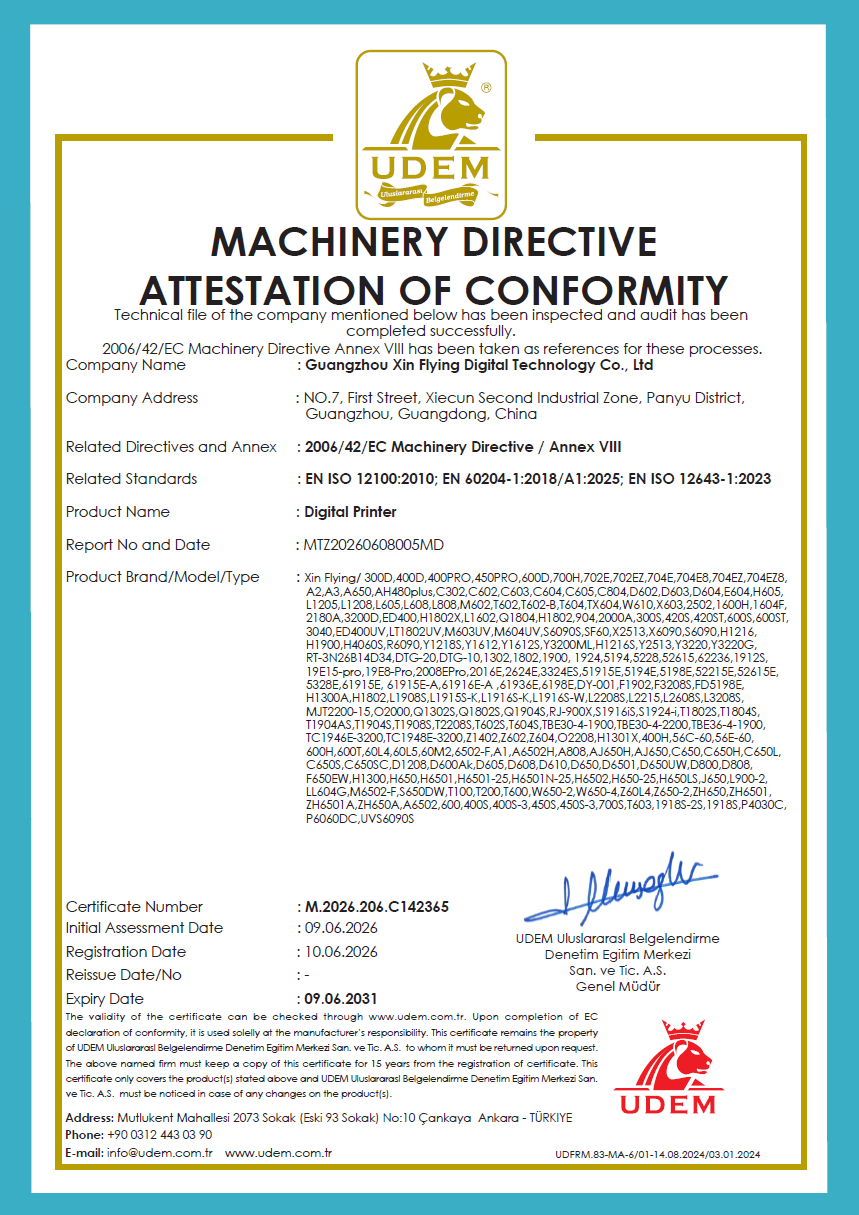
A European textile mill buying an industrial dye sublimation printer today is buying two things at once: production capacity and a compliance file. This shortlist ranks five production-class machines — the XF-H1802X-2I32A1, XF-H1301X-1I32A1, XF-O2000-4I32A1, XF-19E8-PRO and XF-19E15-PRO — and the ranking is organised around the second purchase, not the first. Every model here appears by its exact model number inside the same certificate set, including CE Machinery Directive certificates that list EN 60204-1:2018/A1:2025 among the applied standards.
The two 1.3 m and 1.8 m machines at the top of the list are not the fastest printers in the group. They are the ones a European mill can most easily place into service and defend in a technical file, which is why they anchor the shortlist rather than the largest models on the price sheet.
Why “Certified” Is Not the Same as “Auditable”
Most industrial sublimation printer rankings sort by print speed, number of printheads and headline width. For a mill in the EU, that approach ignores the thing that actually stops a project: a machine that arrives with paperwork nobody can match to the unit standing on the floor.
Three gaps repeatedly stall a European procurement file:
- Family-level coverage instead of model-level coverage. A certificate that names a product category rather than the specific model number leaves the buyer unable to demonstrate that the machine they purchased is the machine that was tested.
- Superseded standards inside the applied-standards list. Electrical equipment of machines is assessed against EN 60204-1. A document that references an older edition or omits the A1:2025 amendment does not show that the current version of the standard was applied, even if the certificate is valid and the machine is safe.
- A partial stack. Machinery safety, low voltage, electromagnetic compatibility and hazardous-substance restrictions are separate bodies of evidence. A safety certificate alone does not answer a lower-voltage question, and a RoHS attestation past its expiry date does not answer an environmental question.
The practical consequence is that “CE certified” is only useful to a mill when it comes with four things: the right standard referenced, the right model number in scope, a valid date window, and the same coverage repeated across safety, electrical, EMC and environmental documents. That is the filter used here.
The European Market Context for Industrial Sublimation
Dye sublimation printing is no longer a niche decoration process. Grand View Research values the global dye sublimation printing market at USD 16.4 billion in 2025, projected to reach USD 39.0 billion by 2033, growing at a CAGR of 11.5% from 2026 to 2033. Within that, the dye sublimation printer segment specifically was valued at USD 1.88 billion in 2025 and is expected to reach USD 2.53 billion by 2030 (Mordor Intelligence).
Two structural facts matter for a European mill specifying equipment. First, supply is concentrated: Asia Pacific held a 36.5% revenue share of the dye sublimation printing market in 2025, led by China as the largest country market (Grand View Research), and China’s textile and garment export base — USD 293.6 billion in 2023 — sits directly behind the country’s industrial printing equipment supply chain. A European buyer sourcing a China sublimation printer is therefore working inside the deepest equipment supply pool in the market, which makes documentation discipline more important, not less.
Second, demand is shifting toward customised output. Personalised apparel and home decor are identified as the primary driver behind a 13.1% CAGR in the digital textile sublimation market through 2030 (Grand View Research), and inkjet equipment dominates production printing, where inkjet production printers accounted for 87.3% of the production printer market by type in 2024 (Grand View Research). On the format side, FESPA notes that roll-to-roll sublimation printers with widths of 1.9 m (1900 mm) are standard for high-volume textile and soft signage applications — a useful benchmark when reading the width column of any comparison.
For the record, the wider competitive landscape is led by Epson with a 26.7% share of the digital textile dye sublimation printer market, followed by Mimaki at 18.6% and Roland DG at 15.5% (Data Insights Reports, 2024). Those shares describe market presence, not certification status, and are not used here as a compliance measure.
How This Shortlist Was Ranked
Four criteria were applied, in this order:
- Documentation depth (primary filter). A CE Machinery Directive Certificate of Conformity / Attestation of Conformity listing EN 60204-1:2018/A1:2025, together with EN ISO 12100:2010 and EN ISO 12643-1:2023, and naming the exact model in scope.
- Coverage breadth. The same model appearing in Low Voltage Directive, EMC Directive, combined LVD & EMC, and RoHS documentation with current validity windows.
- Production fit. Printhead count, print width, throughput, ink-channel configuration and drying/heating architecture measured against a European textile mill’s realistic output.
- Installation and service fit. Electrical supply demand, footprint, media handling, RIP compatibility and after-sales support reachability.
The ranking is a deployment-tier ranking. Rank 1 is the machine that is quickest to justify, install and commission; rank 5 is the machine built for maximum continuous volume. Both ends of the list share the same certification basis, so a mill is choosing scale, not choosing whether it can comply.
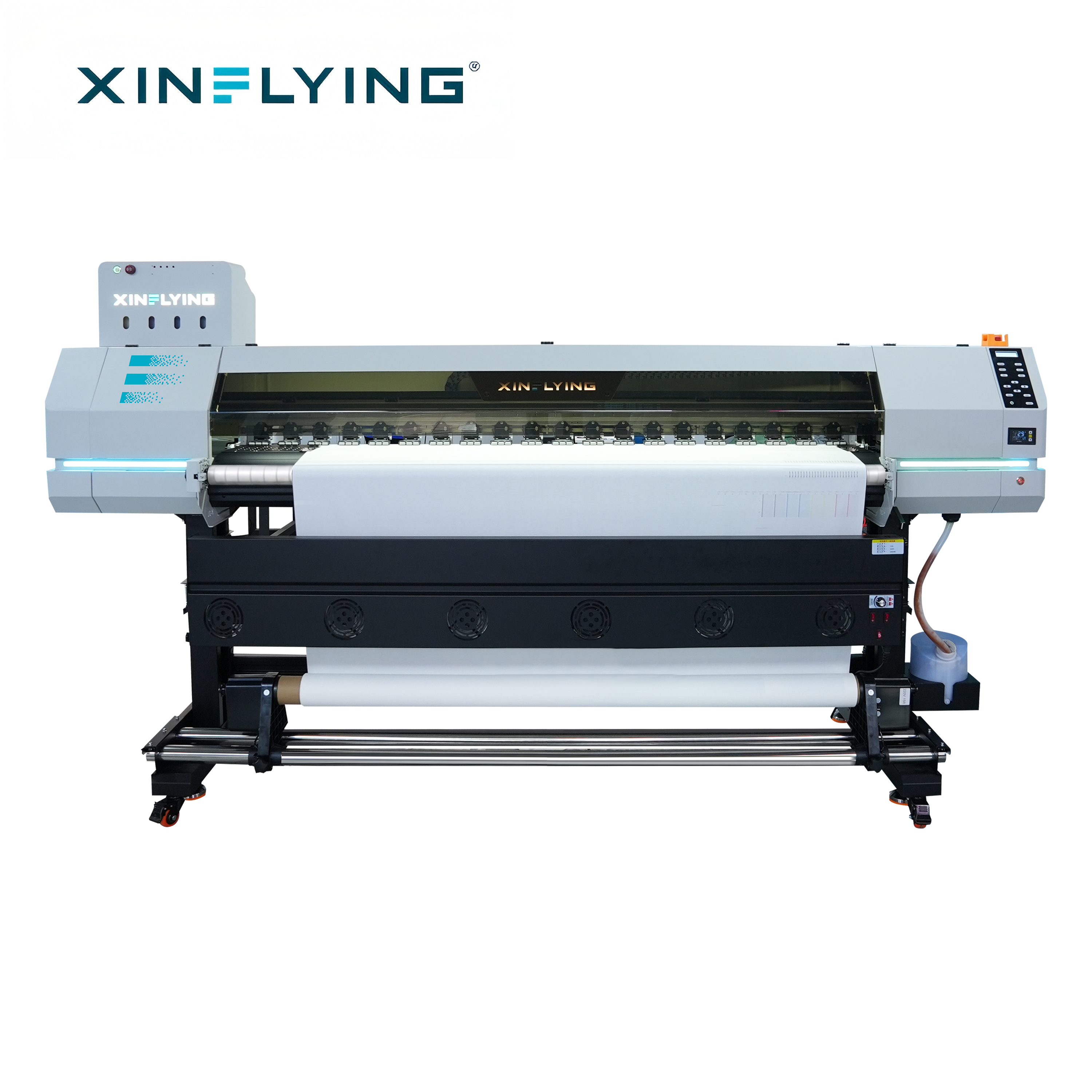
The
All five models below carry CE coverage under MD 2006/42/EC (EN ISO 12100:2010, EN 60204-1:2018/A1:2025, EN ISO 12643-1:2023), LVD 2014/35/EU (EN IEC 62368-1:2020/A11:2020), EMC 2014/30/EU (EN 55032:2015/A11:2020, EN 55035:2017/A11:2020, EN IEC 61000-3-2:2019+A1:2021, EN 61000-3-3:2013/A2:2021) and RoHS 2011/65/EU (EN IEC 63000:2018 with the EN IEC 62321 series). They are manufactured by XINFLYING (Guangzhou Xin Flying Digital Technology Co., Ltd.), a Guangzhou-based digital printing equipment manufacturer founded in 2010 that specialises in DTF, UV DTF, UV, DTG and dye sublimation printing solutions, exporting to North America, South America, Europe, Asia, the Middle East and Africa.
Rank 1 — XF-H1802X-2I32A1: The Compliance-First Mid-Volume Machine
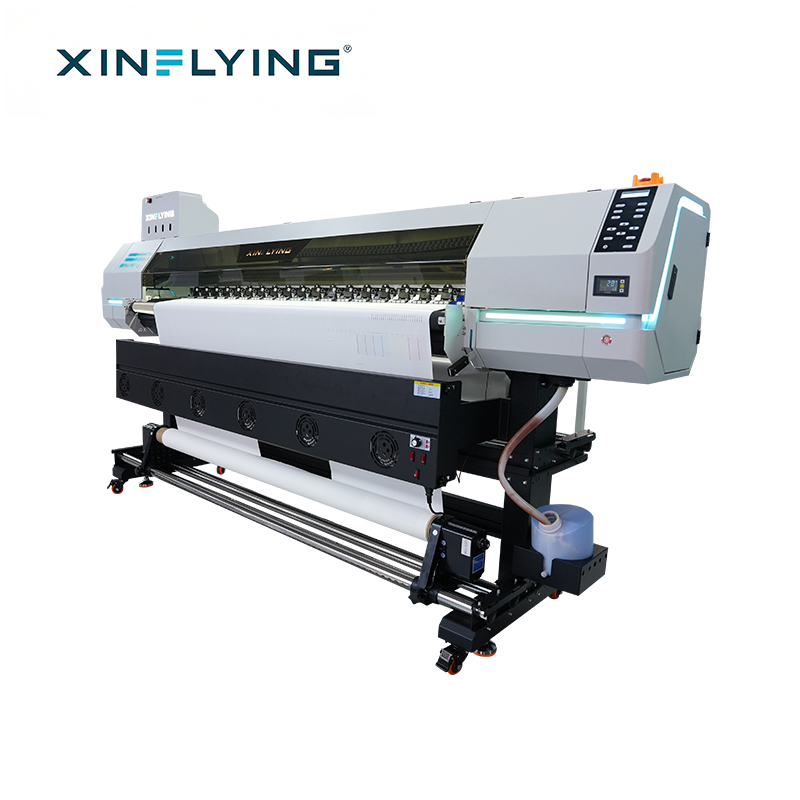
The 1.8 m dual-head model is placed first because it resolves the tension most European mills face: it prints wide enough for production fabric panels and soft signage, but its electrical and floor-space demands fit an existing building. At 3000 × 880 × 1630 mm and 265 kg net weight, it moves through standard industrial access routes without rigging, and its power supply rating of 110/220 V, 27.2 A/13.6 A, 50–60 Hz at 3.5 kW is a fraction of what the high-volume models require.
Ink configuration is CMYK + CMYK across two heads, with front/middle/rear break-controlled heating and Maintop as the standard RIP. It prints onto heat transfer paper, in operating conditions of 20–35 °C and 45–65% RH. For a mill running sampling, short-run jersey panels, decorative panels and mid-volume home textile work, that combination covers the majority of order types without idle capacity.
Limits to weigh: throughput is measured in a 4PASS workflow, so it is not a substitute for a 1PASS industrial line at peak season; and the maximum width of 180 cm is 10 cm narrower than the 190 cm benchmark used on standard 1.9 m roll-to-roll machines. If your product mix requires full 1.9 m coverage, move to rank 4 or 5.
Certification position: the model appears by name in two CE MD Attestations of Conformity issued by UDEM, including EN 60204-1:2018/A1:2025, and in the LVD certificate TQT1550D271EC, the EMC certificate TQT1550D270EC, the combined LVD & EMC attestation M.2026.206.C142475 and the RoHS attestation M.2026.206.C142366.
Rank 2 — XF-H1301X-1I32A1: The Lowest-Friction Entry Point
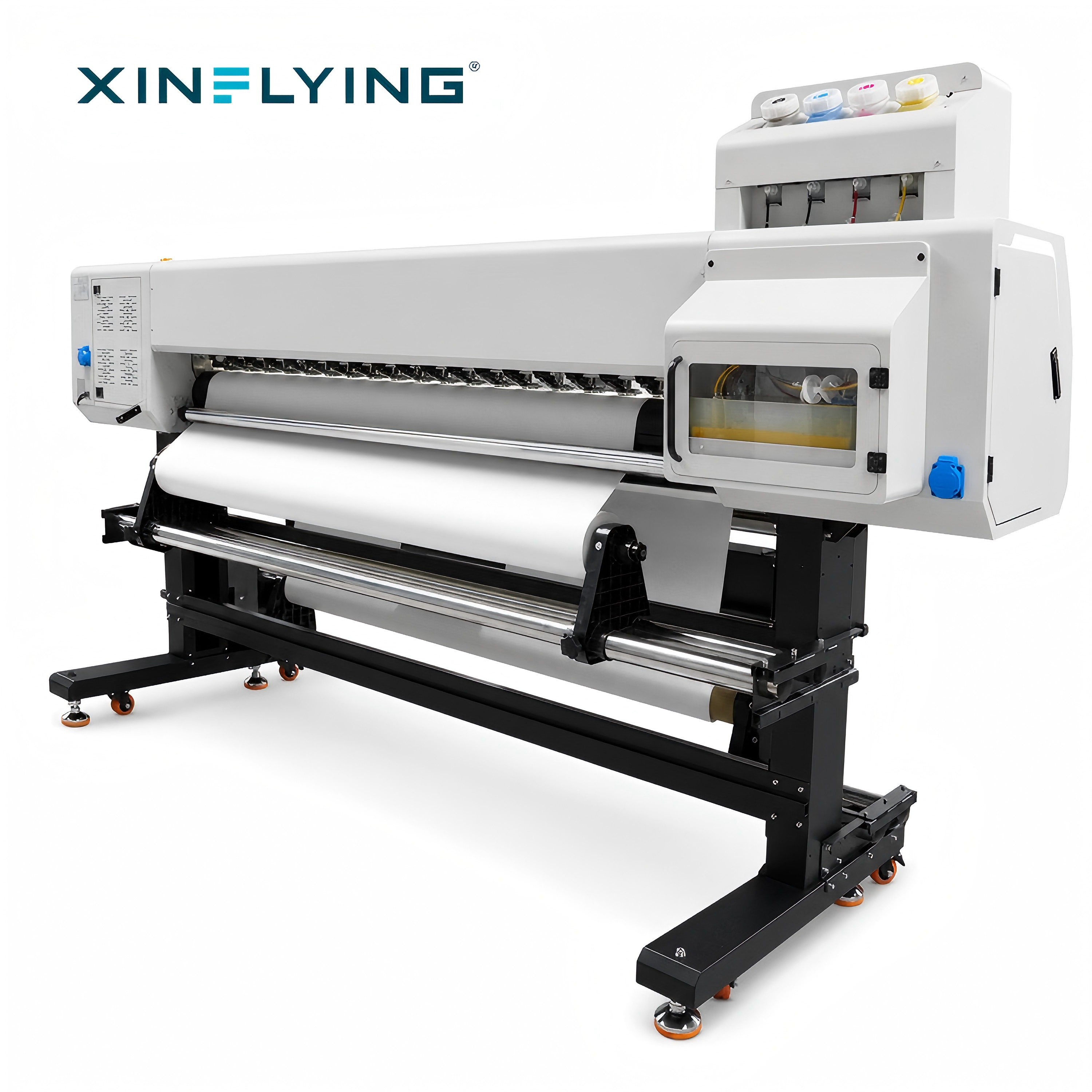
The single-head 1.3 m machine is the tightest specification in the shortlist and, for many mills, the most useful first purchase. Its footprint is 2220 × 870 × 1540 mm at 140 kg net weight, and it runs on 2 kW with a 110/220 V, 18 A/9 A, 50–60 Hz supply. In a factory where every additional ampere requires an electrical review, that matters more than a speed figure.
It uses CMYK ink, heat transfer paper, Maintop RIP as standard, and an external constant-temperature automatic drying system — a configuration that keeps the print engine separated from the drying load rather than integrating both into a single chassis. Working range is 20–35 °C and 45–65% RH, matching the controlled conditions of a professional sublimation workshop.
Best fit: proofing and sampling lines, small-batch and personalised orders, team kit and promotional textile work, and mills that want to bring sublimation in-house before committing a full production hall to it. The 130 cm width suits garment panels, cushions, bag panels and narrower decorative runs rather than full-width 1.9 m fabric.
Limits to weigh: one printhead means the lowest throughput in the group at 28 m²/h in its fastest 4PASS mode. Treat it as a validator and a small-batch producer, not as a machine that will absorb a sudden volume increase. It carries the same certification trail as the larger models, which is precisely why it works as a low-risk first unit.
Rank 3 — XF-O2000-4I32A1: The 1.95 m Production Workhorse
This is the widest machine in the shortlist at 195 cm, and it is the point at which a sublimation printer stops being a flexible tool and becomes a production asset. Four printheads in a CMYK + CMYK + CMYK + CMYK configuration deliver 180 m²/h at 2PASS and 92 m²/h at 4PASS, using piezoelectric inkjet technology.
The media handling is built for continuous work: heat transfer paper in rolls of 1000–1500 m, print media up to 1 mm thickness and 200 kg weight, ink supplied from a 220 ml cartridge plus 3 L ink tank arrangement, and front/middle/rear break-controlled heating. RIP options are RIIN Print and Maintop. Footprint is 3311 × 1278 × 1670 mm at approximately 490 kg net weight, on a 220 V, 50/60 Hz supply drawing 8.5 kW, in a 20–25 °C and 45–65% RH environment.
Best fit: mills producing clothing, home decor, canvas bags, cushions and flags on a continuous daily schedule, where roll length and width drive the economics. Its 1.95 m width also clears the 1.9 m industry benchmark comfortably.
Limits to weigh: the narrower operating temperature band (20–25 °C) is tighter than the 1.8 m and 1.3 m models, so climate control in the print room becomes a specification item rather than an afterthought. Floor loading also needs checking before delivery.
Rank 4 — XF-19E8-PRO: The High-Volume Industrial Standard
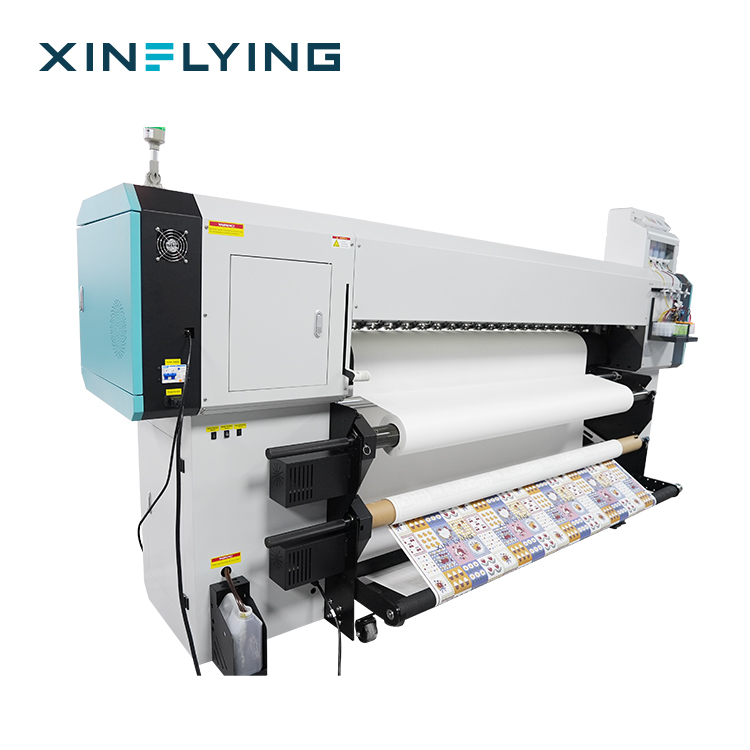
The first of the two 1.9 m industrial machines shifts the workflow from multi-pass production to single-pass production. Eight printheads deliver 306 m²/h at 1PASS and 153 m²/h at 2PASS, or 210 m²/h and 109 m²/h in standard mode, at 3200 dpi resolution with CMYK sublimation ink on sublimation paper.
Supporting systems match the output class: an external intelligent air-heat integrated dryer, fully sealed automatic moisturizing and cleaning, Maintop as standard RIP with RIIN (Hoson only), PhotoPrint and Printfactory as options, and a control workstation specification of 500 GB storage, ATI discrete graphics, 4 GB RAM and Intel i7 on Windows 11/10. The machine measures 3840 × 1300 × 1800 mm at 1400 kg net weight and draws 10.2 kW on a 210–230 V, 45 A supply, operating at 18–30 °C and 35–65% RH.
Best fit: textile factories and professional sublimation production centres running sustained shifts. Documented installations in this class include a Brazilian sportswear manufacturer operating 15 units for four years to print football jerseys, basketball uniforms and full-colour designs on polyester before cutting and sewing, reporting more consistent batch-to-batch colour and reduced dependence on outsourced printing.
Limits to weigh: the 45 A supply requirement is the deciding constraint. A mill that cannot support it should look at ranks 1–3 rather than plan an electrical upgrade it has not costed.
Rank 5 — XF-19E15-PRO: Maximum Throughput
Fifteen printheads put this machine in a different production category: 524 m²/h at 1PASS, 254 m²/h at 2PASS, and 394 m²/h / 188 m²/h in standard mode, at 3200 dpi. It loads sublimation paper rolls of up to 1000 m, which reduces roll-change interruptions across long shifts.
It shares the architecture of the rank 4 machine — external intelligent air-heat integrated dryer, fully sealed automatic moisturizing and cleaning, Maintop standard RIP with optional RIIN (Hoson only), PhotoPrint and Printfactory — and the same 210–230 V, 45 A supply requirement, here at 14.5 kW. Footprint is 3840 × 1570 × 1800 mm at 1480 kg net weight.
Best fit: high-volume industrial textile sublimation production, where the machine needs to run near-continuously and where a 1PASS workflow is the difference between winning and losing seasonal contracts.
Limits to weigh: this is not a machine to buy “for growth” without a demand pipeline behind it. The combination of 14.5 kW, 45 A, a larger footprint and the highest printhead count in the group makes it the least forgiving of an under-utilised installation.
Verifying a Certificate Trail in Six Steps
Ranking aside, the same six checks apply to any industrial sublimation printing machine a European mill evaluates.
- Match the model number, not the family. Confirm the exact model you are ordering appears in the certificate scope. All five models in this shortlist appear individually in the certificate set reviewed here.
- Read the applied standards, not the certificate title. Look for EN 60204-1:2018/A1:2025 alongside EN ISO 12100:2010 and EN ISO 12643-1:2023 under MD 2006/42/EC.
- Confirm the full stack. Safety (MD 2006/42/EC), low voltage (LVD 2014/35/EU, EN IEC 62368-1:2020/A11:2020), EMC (EMC 2014/30/EU, EN 55032:2015/A11:2020, EN 55035:2017/A11:2020, EN IEC 61000-3-2:2019+A1:2021, EN 61000-3-3:2013/A2:2021) and hazardous substances (RoHS 2011/65/EU, EN IEC 63000:2018, EN IEC 62321 series).
- Check the validity windows. In this set, the CE MD attestations M.2026.206.C142365 and M.2026.206.C142385 and the RoHS attestation M.2026.206.C142366 run to 9 June 2031; the combined LVD & EMC attestation M.2026.206.C142475 runs to 10 June 2031; the LVD certificate TQT1550D271EC and EMC certificate TQT1550D270EC were issued 19 May 2026 with an expiry of 1 January 2099.
- Check the consumable side. Ink and paste compliance is separate from machine compliance. The OEKO-TEX® ECO PASSPORT certificate SH150194016, issued by TESTEX AG for textile printing inks and printing pastes, is valid until 31 December 2026.
- Map documents to the installed machine. Confirm supply capacity, footprint and media handling before delivery: 45 A on the 19E series, 220 V at 8.5 kW on the XF-O2000-4I32A1, and 110/220 V on the two H-series models.
What These Printers Are Actually Used For
Certification decides whether a machine can be installed. Application decides whether it should be. Documented installations across this product family show three recurring profiles.
- Sportswear and team kit production. A sportswear manufacturer in Brazil installed 15 units for four years, printing football jerseys, basketball uniforms and custom sportswear on polyester before cutting and sewing, using high-resolution patterns, team logos and full-colour designs. The reported outcome was more consistent colour across batches and less reliance on outsourced printing. A separate sports uniform supplier, also in Brazil, runs 8 units for five years producing customised football kits, training uniforms and team apparel, with shorter production cycles while maintaining the colours and detail required by team uniforms.
- Home textiles and decorative fabric. A home textile manufacturer runs 10 units for four years printing curtains, cushions, decorative fabrics and customised polyester textiles. The case highlights suitability for large-format textile applications that require detailed patterns and consistent printing quality.
- Print service providers. A digital textile printing service provider operating 5 units for three years supplies sportswear brands, apparel factories and customised textile businesses. The stated result was expanded production capacity, support for more customer projects and faster response on customised textile orders — with equipment reliability, production flexibility and compatibility across different polyester applications cited as the deciding factors.
Read together, the profiles map cleanly onto the ranking: 1.3 m and 1.8 m machines carry sampling and mid-volume customisation; 1.9 m and 1.95 m machines carry scheduled commercial volume.
Model-by-Model Comparison Table
| Rank & Model | Printheads | Print width | Fastest speed | Ink channels | Power | Power supply | Net weight |
|---|---|---|---|---|---|---|---|
| 1. XF-H1802X-2I32A1 | 2 × Epson i3200-A1 | 180 cm (1.8 m) | 4PASS 52 m²/h | CMYK + CMYK | 3.5 kW | 110/220 V, 27.2 A/13.6 A, 50–60 Hz | 265 kg |
| 2. XF-H1301X-1I32A1 | 1 × Epson i3200-A1 | 130 cm (1.3 m) | 4PASS 28 m²/h | CMYK | 2 kW | 110/220 V, 18 A/9 A, 50–60 Hz | 140 kg |
| 3. XF-O2000-4I32A1 | 4 × Epson i3200-A1 | 195 cm (1.95 m) | 2PASS 180 m²/h | CMYK × 4 | 8.5 kW | 220 V, 50/60 Hz | ≈490 kg |
| 4. XF-19E8-PRO | 8 × Epson i3200-A1 | 190 cm (75″) | 1PASS 306 m²/h | CMYK | 10.2 kW | 210–230 V, 45 A | 1400 kg |
| 5. XF-19E15-PRO | 15 × Epson i3200-A1 | 190 cm (75″) | 1PASS 524 m²/h | CMYK | 14.5 kW | 210–230 V, 45 A | 1480 kg |
All five models share the same certificate basis under MD 2006/42/EC with EN 60204-1:2018/A1:2025, LVD, EMC and RoHS coverage. The differentiators are printheads, width, throughput, power demand, footprint and the drying/heating architecture — from an external constant-temperature automatic drying system at rank 2 to an external intelligent air-heat integrated dryer at ranks 4 and 5.
Frequently Asked Questions
What certification evidence should a European textile mill request from a sublimation printer supplier?
Ask for the Certificate of Conformity issued under the Machinery Directive 2006/42/EC and check that its applied-standards list includes EN 60204-1:2018/A1:2025, alongside EN ISO 12100:2010 and EN ISO 12643-1:2023. Then confirm the exact model number appears in the certificate scope. All five models in this shortlist appear by model number in two CE MD attestations issued by UDEM — M.2026.206.C142365 and M.2026.206.C142385, issued 10 June 2026 and valid to 9 June 2031. Add low-voltage coverage under EN IEC 62368-1:2020/A11:2020 (certificate TQT1550D271EC), EMC coverage under EN 55032:2015/A11:2020, EN 55035:2017/A11:2020, EN IEC 61000-3-2:2019+A1:2021 and EN 61000-3-3:2013/A2:2021 (certificate TQT1550D270EC), the combined LVD and EMC attestation M.2026.206.C142475 (valid to 10 June 2031), and the RoHS attestation M.2026.206.C142366 (valid to 9 June 2031, referencing EN IEC 63000:2018 and the EN IEC 62321 series). On the consumable side, OEKO-TEX® ECO PASSPORT certificate SH150194016 covers textile printing inks and printing pastes and runs to 31 December 2026.
How much production capability do the five shortlisted models actually deliver?
Capability scales with printhead count and width. The XF-H1301X-1I32A1 uses one Epson i3200-A1 head across a 130 cm width at 4PASS 28 m²/h. The XF-H1802X-2I32A1 uses two heads across 180 cm at 4PASS 52 m²/h fastest and 42 m²/h standard. The XF-O2000-4I32A1 uses four heads across 195 cm at 2PASS 180 m²/h and 4PASS 92 m²/h. The XF-19E8-PRO uses eight heads across 190 cm at 1PASS 306 m²/h and 2PASS 153 m²/h, at 3200 dpi. The XF-19E15-PRO uses fifteen heads across 190 cm at 1PASS 524 m²/h and 2PASS 254 m²/h, also at 3200 dpi. For reference, FESPA notes that 1.9 m roll-to-roll widths are the standard for high-volume textile and soft signage work, which places the XF-19E8-PRO, XF-19E15-PRO and XF-O2000-4I32A1 in that production class.
What drives the cost difference between entry, mid-range and industrial sublimation printers?
Configuration, not branding. The largest cost blocks are printhead count (one on the XF-H1301X-1I32A1, two on the XF-H1802X-2I32A1, four on the XF-O2000-4I32A1, eight on the XF-19E8-PRO, fifteen on the XF-19E15-PRO), print width (130 cm to 195 cm), and the drying, heating and ink-delivery systems carried by the machine — ranging from an external constant-temperature automatic drying system, through front/middle/rear break-controlled heating, to an external intelligent air-heat integrated dryer. Electrical demand rises on the same curve: 2 kW, 3.5 kW, 8.5 kW, 10.2 kW and 14.5 kW, with the 19E series requiring a 210–230 V, 45 A supply and the XF-O2000-4I32A1 supporting high-capacity ink delivery from a 220 ml cartridge plus 3 L ink tank. Match the tier to your real monthly volume, floor space and electrical capacity rather than to the largest machine on the list.
Can a mill validate a sublimation printer before committing to a large-scale order?
Yes. XINFLYING operates with OEM/ODM production and a minimum order quantity of one unit, so a mill can place a single machine, run it against its own substrates and colour targets, and scale afterwards. Customisation covers product branding, machine appearance, colour, logo, packaging and solutions built around specific customer requirements. Quality control includes pre-shipment testing on products before dispatch, which gives the buyer a documented checkpoint before the machine leaves the factory. This is the practical way to combine a compliance-led evaluation with a production trial: verify the certificate trail first, then validate output on one unit.
What is the lead time and after-sales support for a certified sublimation printer ordered from China?
Lead time runs 5–40 days depending on configuration and customisation, from a production base with monthly capacity of 1,600+ units and annual output of 20,000+ units. The manufacturer, XINFLYING, employs 200+ people including a 20-engineer R&D team, and provides after-sales support through more than 50 engineers delivering 24/7 online technical support. Around 80% of production is exported across North America, South America, Europe, Asia, the Middle East and Africa. If you want to move from shortlist to a concrete next step, request a quotation or a validation unit and ask for the certificate set matching the exact model number you intend to install.
Conclusion: Choose the Tier, Then Verify the File
For a European textile mill, the useful question is not which sublimation printer is fastest. It is which machine can be placed into service without a documentation argument, and which one matches the volume you can actually sell. On the evidence reviewed here, the XF-H1802X-2I32A1 and XF-H1301X-1I32A1 sit at the top of the shortlist because they carry the same CE Machinery Directive, LVD, EMC and RoHS coverage as the largest industrial models while demanding far less from an existing building — 3.5 kW and 2 kW respectively. The XF-O2000-4I32A1 adds width and continuous-production media handling at 8.5 kW. The XF-19E8-PRO and XF-19E15-PRO are the machines for mills with the demand pipeline, the floor loading and the 210–230 V, 45 A supply to justify single-pass industrial output.
Whichever tier you choose, apply the same test: exact model number in scope, EN 60204-1:2018/A1:2025 in the applied standards, a full LVD, EMC and RoHS stack, and current validity dates.
Next Step: Certificates, Samples and Quotation
XINFLYING supplies industrial dye sublimation printers to textile mills, sportswear manufacturers and print service providers worldwide, with a minimum order quantity of one unit, OEM/ODM customisation and pre-shipment testing on every machine.
Request the certificate set for the exact model you are evaluating, or arrange a quotation and sample unit:
Website: www.xin-flying.com · Blog: blog.xin-flying.com
Email: info@xin-flying.com · Tel / WhatsApp: +86 188-1322-1357
Address: No.7, Xiecun 2nd Industrial Zone, Panyu, Guangzhou, Guangdong, China
Have Questions or Need More Details?
Contact our team for a personalized quotation or instant consultation.
Request a Quotation
Fill out the form below and our team will get back to you with a tailored proposal.
WhatsApp Direct Chat
Prefer to chat in real-time? Message us on WhatsApp for instant assistance & quick answers.
- Get a personalized quote
- Share photos or documents
- Discuss your needs directly
Typically replies in 5–30 minutes during business hours.