
Sublimation for Soft Signage and Home Textile Large Runs
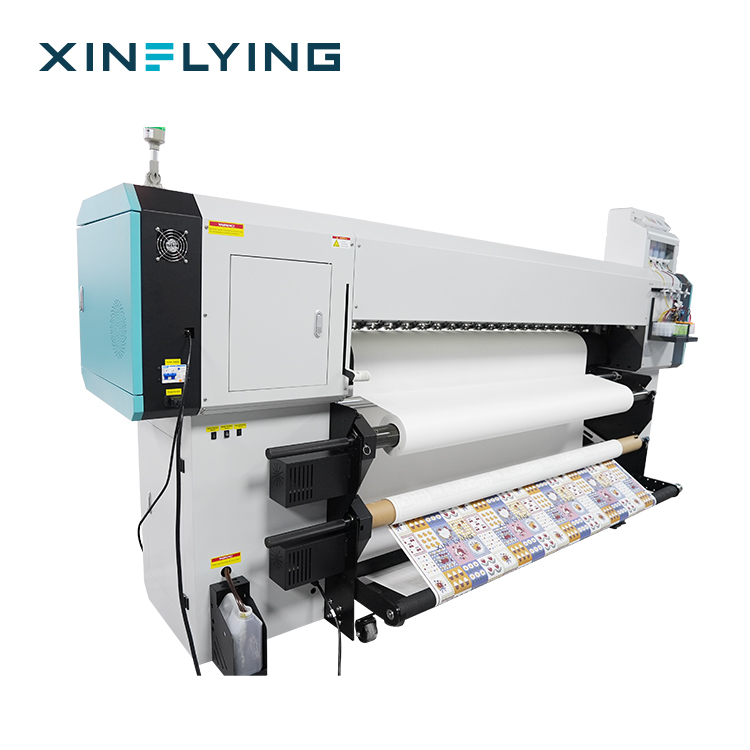
Quick answer: Soft signage and home textile orders are roll-goods jobs, so the machine has to be chosen for the longest single run rather than for a single test print. For higher-volume roll work, the XF-O2000-4I32A1 pairs a 195 cm print width with four Epson i3200-A1 printheads and speeds of 180 m²/h in 2PASS and 92 m²/h in 4PASS. For 1.8 m roll goods at moderate volume, the XF-H1802X-2I32A1 uses two Epson i3200-A1 printheads with a 180 cm print width and speeds of 52 m²/h (4PASS, fastest) and 42 m²/h (4PASS, standard). Both print onto heat transfer paper and use front/middle/rear break-controlled heating.
A banner, flag, curtain or cushion cover is printed as a continuous web, and the buyer judges the result across the whole length of the order, panel to panel and batch to batch. That is a different production problem from printing garment panels, and it changes how a sublimation printer is specified.
This guide is written for that problem. It sets out what typically breaks in a large roll-goods run, what the market context looks like, and then works through the workflow step by step using two XINFLYING models as project solutions: the XF-H1802X-2I32A1 (1.8 m, two heads) and the XF-O2000-4I32A1 (1.95 m, four heads). Scale, speed and printhead quality are the three variables that decide between them.
Problem Definition: What Breaks in a Large Roll-Goods Run
The failure modes in soft signage and home textile production are consistency, uptime and finishing fit, not the appearance of an isolated sample. Seven issues show up repeatedly when a workshop moves from short garment runs to long roll runs.
- Continuous running. A banner, flag or curtain order is often one uninterrupted design length. Any stop for nozzle recovery, re-threading or media reload has to be managed, because an interruption inside a long run is usually visible in the finished piece.
- Panel matching. Finished goods are frequently specified wider than the single-pass print width of any roll-to-roll sublimation printer, including the 1.8 m XF-H1802X-2I32A1 and the 1.95 m XF-O2000-4I32A1. The job is planned as matched panels, and colour consistency between those panels becomes the acceptance criterion rather than the quality of one panel.
- Ink volume per shift. Decorative fabric and banner work draws a large ink volume per running hour. The XF-O2000-4I32A1 is therefore specified with a 220 ml cartridge plus a 3 L ink tank.
- Media handling. Both machines print onto heat transfer paper; the XF-O2000-4I32A1 is specified to support transfer paper rolls of 1000–1500 m, which sets the practical run length between reloads.
- Drying before rewind. Both models use front/middle/rear break-controlled heating. A web that is rewound before it is dry produces set-off and ghosting later in the process, not at the printer.
- Export documentation. CE and RoHS files for the machine, and textile-level documentation for the ink, are now part of the order rather than an afterthought.
- Environment. The two machines are specified for different conditions: 20–35 °C and 45–65 %RH for the XF-H1802X-2I32A1, and 20–25 °C and 45–65 %RH for the XF-O2000-4I32A1. A workshop that cannot hold the narrower band has effectively made the decision already.
The decision rule that follows is straightforward: choose the smallest configuration that can complete the longest realistic single order without stopping, then confirm that the environment, the ink supply architecture and the compliance file all match the market being served.
Industry Background: Why Personalised Roll Goods Are Scaling
Demand for printed roll goods is being pushed by the same trend that reshaped garment printing: personalisation. Three sets of published figures frame the opportunity.
- The global dye sublimation printing market was valued at USD 16.4 billion in 2025 and is projected to reach USD 39.0 billion by 2033, growing at an 11.5 % CAGR from 2026 to 2033 (Grand View Research). Within that total, the dye sublimation printer segment was valued at USD 1.88 billion in 2025 and is expected to reach USD 2.53 billion by 2030 (Mordor Intelligence).
- Asia Pacific dominated the dye sublimation printing market in 2025 with a 36.5 % revenue share, led by China as the largest country market (Grand View Research). China's textile and garment exports reached USD 293.6 billion in 2023 (The Cannata Report, citing Grand View Research), which sustains domestic demand for industrial-scale sublimation capacity.
- Demand for personalised apparel and home decor is cited as the primary driver of a 13.1 % CAGR in the digital textile sublimation market through 2030 (Grand View Research). Inkjet production printers accounted for 87.3 % of the production printer market by type in 2024 (Grand View Research).
Two structural facts matter when specifying equipment. First, roll-to-roll sublimation printers with a 1.9 m (1900 mm) width are described as standard for high-volume textile and soft signage applications (FESPA Insights), which places the 180 cm and 195 cm print widths discussed here in the mainstream of the format rather than at its edge. Second, vendor concentration is high: Epson leads the digital textile dye sublimation printer market with a 26.7 % share, followed by Mimaki at 18.6 % and Roland DG at 15.5 % (Data Insights Reports, 2024). For a buyer, that is a reminder to check how the specified printhead family will be supported across the machine's service life, since the XF-H1802X-2I32A1 and the XF-O2000-4I32A1 are both built around Epson i3200-A1 printheads.
Colour validation has a published reference point as well: ISO 12647-8:2021 defines the standard for graphic technology validation print processes working directly from digital data (ISO). For soft signage and home textile contracts that repeat across seasons, agreeing a validation method before the first production run removes most of the arguments that follow.
The Solution: Two Roll-to-Roll Configurations
Guangzhou Xin Flying Digital Technology Co., Ltd. (XINFLYING) is a digital printing equipment manufacturer founded in 2010 in Panyu, Guangzhou, producing DTF printers, dye sublimation printers, DTG printers, UV DTF printers and UV flatbed printers for apparel businesses, textile manufacturers, printing companies and distributors. For soft signage and home textile roll goods, the two configurations that match the workflow above are the XF-H1802X-2I32A1 and the XF-O2000-4I32A1.
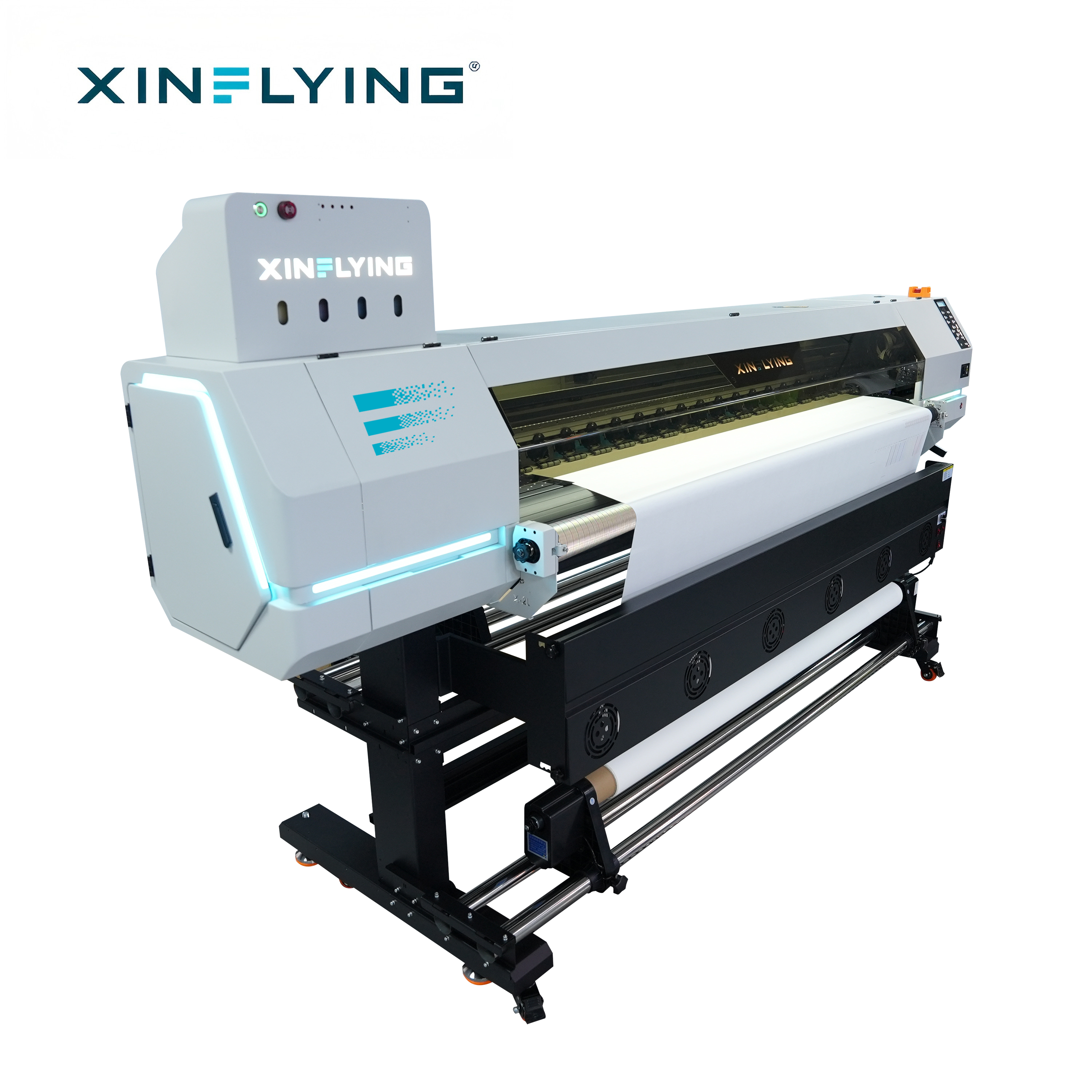
XF-H1802X-2I32A1: the 1.8 m, two-head configuration
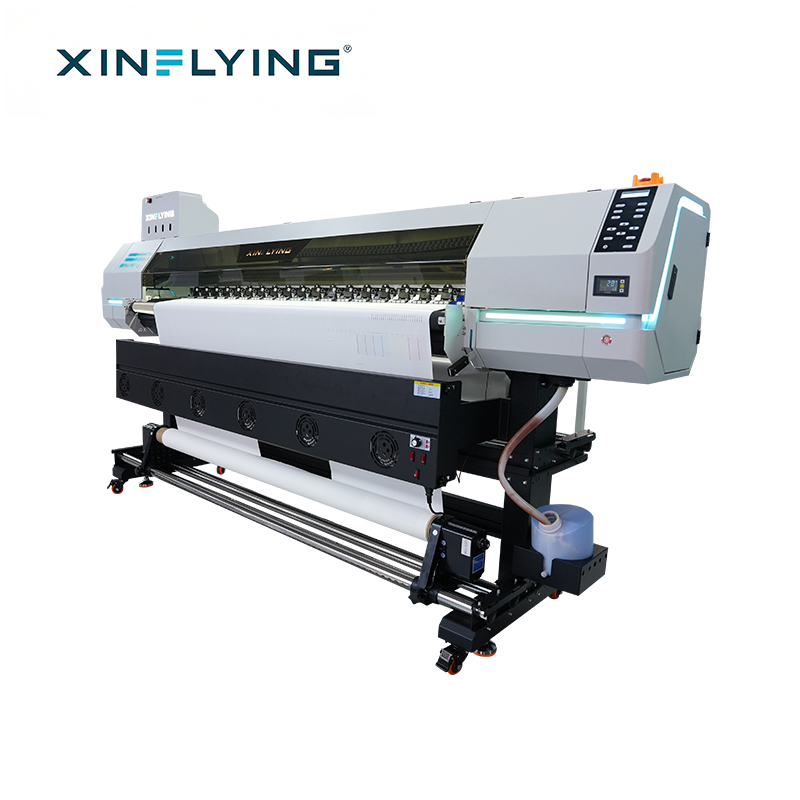
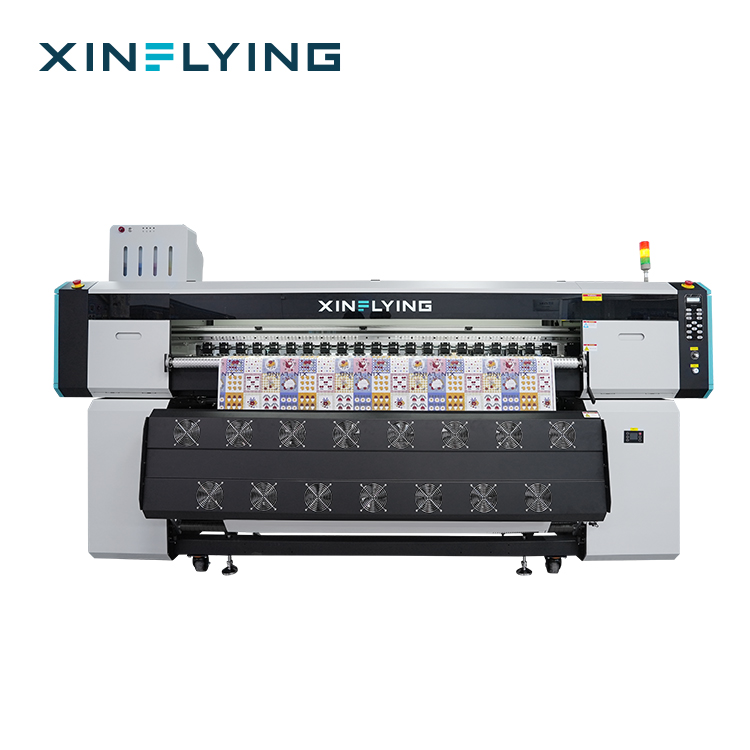
The XF-H1802X-2I32A1 is a roll-to-roll dye sublimation printer built on two Epson i3200-A1 printheads with CMYK plus CMYK ink channels. It prints onto heat transfer paper at 52 m²/h in 4PASS (fastest mode) and 42 m²/h in 4PASS (standard mode) across a 180 cm (1.8 m) print width. RIP control is provided by Maintop as standard, and media handling is supported by front/middle/rear break-controlled heating. Power draw is 3.5 kW on a 110/220 V, 50–60 Hz supply (27.2 A / 13.6 A). Operating conditions are 20–35 °C and 45–65 %RH. The machine measures 3000 × 880 × 1630 mm and weighs 265 kg net (325 kg gross); its listed application is textile sublimation printing on polyester fabrics.
For a soft signage or home textile workshop, the practical reading is this: the format covers a large share of banner, flag, curtain and cushion specifications in a single pass, the power and floor-space demands are modest, and the wider 20–35 °C temperature window makes it easier to place inside an existing production hall.
XF-O2000-4I32A1: the 1.95 m, four-head configuration
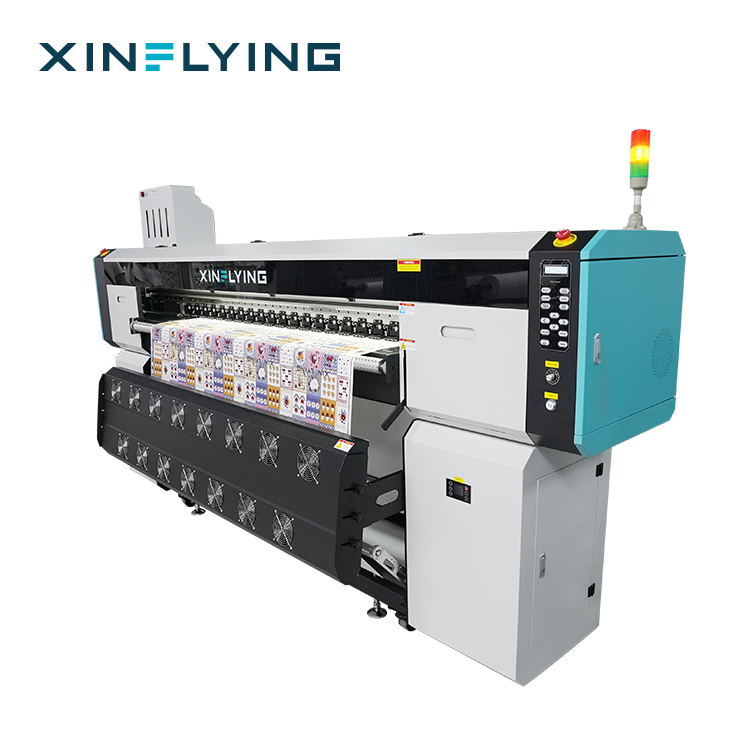
The XF-O2000-4I32A1 moves up in both format and head count: four Epson i3200-A1 printheads in a CMYK × 4 channel arrangement, a 195 cm (1.95 m) print width, and print speeds of 180 m²/h in 2PASS and 92 m²/h in 4PASS. It is a piezoelectric inkjet machine that uses sublimation ink supplied from a 220 ml cartridge plus a 3 L ink tank, and it is specified to support heat transfer paper rolls of 1000–1500 m, with media handling rated for 1 mm thickness. RIP control can be run through RIIN Print or Maintop, and heating is front/middle/rear break-controlled, as on the smaller machine.
Power draw is 8.5 kW on a 220 V, 50–60 Hz supply, and the specified operating window is 20–25 °C at 45–65 %RH. The machine measures 3311 × 1278 × 1670 mm, weighs approximately 490 kg net (approximately 675 kg gross), and is listed for textile sublimation printing across clothing, home decor, canvas bags, cushions and flags, the closest match in this pair to a mixed soft signage and home textile order book.
Why printhead configuration drives the outcome
Printhead count is not a marketing figure in roll-goods production; it changes three things at once. More heads lay down more ink per pass, which is why the four-head machine reaches 180 m²/h in 2PASS while the two-head machine runs 52 m²/h at its fastest setting. More heads also spread the duty across more nozzles, so a single degraded nozzle affects a smaller share of the image. And head count determines the ink channel layout, CMYK plus CMYK on the XF-H1802X-2I32A1 against CMYK × 4 on the XF-O2000-4I32A1, which in turn determines how the RIP distributes ink and how colour is validated for repeat orders.
Manufacturing, service and supply support
Both machines are produced by a manufacturer operating a 37,440 m² facility with more than 200 employees, a 20-engineer R and D team and an annual output of more than 20,000 units, with 80 % of production exported to North America, South America, Europe, Asia, the Middle East and Africa. Production capability is stated at 1,600+ units per month, with a minimum order quantity of one unit and a lead time of 5–40 days. OEM and ODM scope covers product branding, machine appearance, colour, logo and packaging customisation, plus customised solutions based on customer requirements. Quality control is performed as pre-shipment testing, and after-sales support is delivered by more than 50 engineers providing 24/7 online technical assistance.
Step-by-Step: Setting Up the Workflow
Nine steps cover the set-up path from order analysis to the first production run. Each one is a decision point, and each one is where a roll-goods project usually fails if it is skipped.
Step 1 — Classify the order and define finished dimensions
Start from the largest finished item the business expects to sell: a wide banner, a flag, a curtain panel, a cushion run. Record whether those items can be produced in a single pass at 180 cm or 195 cm, or whether they will be built from matched panels. This determines the print width requirement before any machine is compared.
Step 2 — Match print width to the order mix
The 180 cm XF-H1802X-2I32A1 and the 195 cm XF-O2000-4I32A1 sit inside the 1.9 m width that FESPA describes as standard for high-volume textile and soft signage work. The additional 15 cm of the XF-O2000-4I32A1 reduces the number of panels in wide soft signage jobs and leaves more usable width for home textile roll goods. If most orders sit comfortably inside 1.8 m, the smaller format is usually the more efficient choice.
Step 3 — Size head count to the longest realistic run
Compare the two speed specifications against the required output: 52 m²/h fastest and 42 m²/h standard for the XF-H1802X-2I32A1, against 180 m²/h in 2PASS and 92 m²/h in 4PASS for the XF-O2000-4I32A1. The question is not which number is larger, but whether the smaller machine can finish the longest realistic single order inside the promised delivery window without an interruption.
Step 4 — Confirm ink supply for shift length
Long decorative fabric and banner runs consume ink steadily. The XF-O2000-4I32A1 is specified with a 220 ml cartridge plus a 3 L ink tank, which reduces manual interventions during a shift. Match this to the transfer paper roll length in use, since the XF-O2000-4I32A1 supports rolls of 1000–1500 m.
Step 5 — Lock RIP and colour management
Maintop is supplied as standard on the XF-H1802X-2I32A1; the XF-O2000-4I32A1 can be driven by RIIN Print or Maintop. Because colour accuracy across panels depends on the profile rather than the printer alone, define the colour management workflow and the ICC profiles at set-up stage, and use ISO 12647-8:2021 as the reference for validating a print process that works directly from digital data.
Step 6 — Configure heating and drying to the web speed
Both machines use front/middle/rear break-controlled heating. Higher web speed means more ink carrier to remove per unit of time, so drying performance should be verified at the speed the job will actually run, not at a demonstration setting.
Step 7 — Verify the production environment
The XF-H1802X-2I32A1 is specified for 20–35 °C and 45–65 %RH; the XF-O2000-4I32A1 for 20–25 °C and 45–65 %RH. Measuring the worst week of the year in the intended production hall is a cheap step that prevents an expensive mismatch.
Step 8 — Plan power, footprint and rigging
Power draw is 3.5 kW for the XF-H1802X-2I32A1 on a 110/220 V supply and 8.5 kW for the XF-O2000-4I32A1 on a 220 V supply. Footprint and mass differ accordingly: 3000 × 880 × 1630 mm and 265 kg net for the smaller machine, against 3311 × 1278 × 1670 mm and approximately 490 kg net for the four-head machine. Plan door access, floor loading and the path to the install position before the crate arrives.
Step 9 — Assemble the compliance file and the shipping check
Both models appear on XINFLYING's CE LVD certificate TQT1550D271EC (EN IEC 62368-1:2020/A11:2020), CE EMC certificate TQT1550D270EC, CE Machinery Directive certificate M.2026.206.C142365 and RoHS certificate M.2026.206.C142366. The machinery and RoHS certificates were issued by UDEM on 10 June 2026 and are valid to 9 June 2031. Ink and printing paste documentation is covered separately by OEKO-TEX ECO PASSPORT certificate SH150194016 issued by TESTEX AG, valid to 31 December 2026. Confirm that the applicable model list on each certificate names the exact model ordered, and that pre-shipment testing is scheduled before dispatch.
Use Cases: How These Configurations Run in Production
Four installed cases show how roll-to-roll sublimation behaves in production. Client identities are generalised, but the configurations, durations and quantities are as recorded.
Home textile manufacturing — 10 units, four years
A home textile manufacturer uses sublimation printing for curtains, cushions, decorative fabrics and customised polyester textile products. The installation covers 10 units in continuous use for four years. The project produced customised textile collections with rich patterns, accurate colours and flexible production capability, and the case is recorded as suitable for large-format textile applications that require detailed patterns and consistent printing quality.
Digital textile printing service provider — 5 units, three years
A printing service provider serving sportswear brands, apparel factories and customised textile businesses runs five sublimation printers for three years. The result was expanded production capacity, support for more customer projects and faster response on customised textile orders. The recorded strengths are reliable equipment performance, production flexibility and compatibility with different polyester textile applications.
Sportswear manufacturers and uniform suppliers — 15 and 8 units in Brazil
Two Brazilian cases show the upper end of roll-goods volume. A sportswear manufacturer operates 15 units after four years, printing high-resolution patterns, team logos and full-colour designs on polyester fabric before cutting and sewing; the outcome was more consistent colour across production batches and reduced dependence on outsourced printing. A sports uniform supplier operates 8 units after five years for customised football kits, training uniforms and team apparel, achieving shorter production cycles while holding the colours and detailed patterns required by team uniforms. Both cases are recorded as suitable for personalised sportswear production, small-batch customisation and continuous commercial printing.
Soft signage printing, flag printing and banner printing are listed among the supported production functions for these roll-to-roll configurations, which is why the same platform can serve a home textile collection and a signage contract in the same month.
Specification Comparison: XF-H1802X-2I32A1 vs XF-O2000-4I32A1
| Specification | XF-H1802X-2I32A1 | XF-O2000-4I32A1 |
|---|---|---|
| Printheads | 2 × Epson i3200-A1 | 4 × Epson i3200-A1 |
| Ink colours | CMYK + CMYK | CMYK × 4 |
| Print width | 180 cm (1.8 m) | 195 cm (1.95 m) |
| Print speed (fastest) | 4PASS 52 m²/h | 2PASS 180 m²/h |
| Print speed (standard) | 4PASS 42 m²/h | 4PASS 92 m²/h |
| Media | Heat transfer paper | Heat transfer paper; rolls of 1000–1500 m; media thickness 1 mm |
| Ink supply | Not specified in this comparison | Sublimation ink; 220 ml cartridge + 3 L ink tank |
| RIP software | Maintop (standard) | RIIN Print; Maintop |
| Heating | Front/middle/rear break-controlled | Front/middle/rear break-controlled |
| Printing technology | Roll-to-roll dye sublimation | Piezoelectric inkjet |
| Power | 3.5 kW; 110/220 V, 50–60 Hz (27.2 A / 13.6 A) | 8.5 kW; 220 V, 50–60 Hz |
| Operating temperature | 20–35 °C | 20–25 °C |
| Operating humidity | 45–65 %RH | 45–65 %RH |
| Machine size | 3000 × 880 × 1630 mm | 3311 × 1278 × 1670 mm |
| Net / gross weight | 265 kg / 325 kg | ≈490 kg / ≈675 kg |
| Listed applications | Textile sublimation printing (polyester fabrics) | Textile sublimation printing: clothing, home decor, canvas bags, cushions, flags |
| Typical fit | 1.8 m roll goods at moderate volume, wider temperature tolerance | Higher-volume mixed soft signage and home textile runs, longer roll lengths |
Where an order book outgrows a 195 cm four-head machine, the same roll-to-roll architecture continues in XINFLYING's industrial models: the XF-19E8-PRO with eight Epson i3200-A1 printheads, a 190 cm print width, 3200 dpi resolution and speeds up to 306 m²/h in 1PASS, and the XF-19E15-PRO with fifteen Epson i3200-A1 printheads, 3200 dpi resolution and speeds up to 524 m²/h in 1PASS on sublimation paper rolls of 1000 m.
FAQ
Do sublimation printers for soft signage and home textiles need CE and RoHS documentation?
For EU-facing orders, yes, and both models in this comparison are covered. The XF-H1802X-2I32A1 and the XF-O2000-4I32A1 appear on XINFLYING's CE LVD certificate TQT1550D271EC (EN IEC 62368-1:2020/A11:2020), CE EMC certificate TQT1550D270EC, CE Machinery Directive certificate M.2026.206.C142365 and RoHS certificate M.2026.206.C142366. The machinery and RoHS certificates, issued by UDEM on 10 June 2026, are valid to 9 June 2031. Ink and printing paste compliance is documented separately by OEKO-TEX ECO PASSPORT certificate SH150194016 from TESTEX AG, valid to 31 December 2026. Before ordering, check that the applicable model list on each certificate names the exact model and configuration being supplied.
Which of the two models handles the higher output, and when is the smaller one enough?
The XF-O2000-4I32A1 carries the higher output: four Epson i3200-A1 printheads, a 195 cm print width, and 180 m²/h in 2PASS or 92 m²/h in 4PASS. The XF-H1802X-2I32A1 runs two Epson i3200-A1 printheads at 52 m²/h in 4PASS (fastest) and 42 m²/h in 4PASS (standard) across 180 cm. The smaller machine is sufficient when the longest realistic single order can be completed inside the delivery window without stopping, and when the production hall cannot hold the narrower 20–25 °C window specified for the four-head model. The four-head machine earns its place when reduced panel counts, longer runs per shift and fewer media and ink interventions justify the higher power and footprint.
How should budget be compared between a 1.8 m two-head and a 1.95 m four-head machine?
Compare cost drivers rather than a headline figure, because the differences compound over the life of the machine. The XF-O2000-4I32A1 draws 8.5 kW on a 220 V supply against 3.5 kW on 110/220 V for the XF-H1802X-2I32A1; it occupies a larger footprint (3311 × 1278 × 1670 mm versus 3000 × 880 × 1630 mm) and carries more mass (approximately 490 kg net versus 265 kg net), which affects handling and floor planning; and it requires a tighter temperature band. In exchange it delivers substantially higher throughput in its fastest mode and supports transfer paper rolls of 1000–1500 m. XINFLYING quotes on configuration rather than from a published list, and OEM/ODM scope covers branding, appearance, colour, logo and packaging customisation, so the configuration itself can be matched to the budget.
Can we validate output on our own polyester fabric before committing to a run?
Validation works in two stages. The first is specification: XINFLYING's OEM/ODM scope includes customised solutions based on customer requirements, and the minimum order quantity is one unit, so the configuration can be reviewed against the actual fabric, panel plan and colour target before an order is placed. The second is pre-shipment testing, which is performed as part of quality control before dispatch. Once the machine is installed, run a first-article print on your own transfer paper and polyester, then check panel-to-panel colour matching, drying before rewind and colour accuracy against the agreed reference before releasing the full order.
What is the lead time for a roll-to-roll sublimation printer?
Standard lead time is 5–40 days, depending on configuration and the level of customisation requested. Production capability is stated at 1,600+ units per month, and the minimum order quantity is one unit. Because lead time moves with the specification, the practical step is to send the panel plan, the required print width and the target order volume with the inquiry so that schedule and configuration can be confirmed together. Requests can be sent to info@xin-flying.com or by WhatsApp on +86 188-1322-1357, and the XINFLYING catalogue is available as a PDF download below.
Conclusion: The Workflow Decision Comes First
Soft signage and home textile production rewards a workflow decision rather than a specification decision. The sequence that works is: define the largest finished item, match print width to it, size head count against the longest realistic run, then confirm ink supply, drying, environment, power and compliance documentation before the machine is ordered. On that method, the XF-H1802X-2I32A1 covers 1.8 m roll goods with modest power demand and a wide temperature window, while the XF-O2000-4I32A1 covers a mixed signage and home textile order book at higher volume with a 195 cm format and four Epson i3200-A1 printheads.
Check the Configuration Against Your Own Order Book
Send the panel plan, the fabric type and the monthly volume, and XINFLYING will confirm the model, the ink and RIP configuration and the delivery schedule. Sample arrangements, quotations and the full catalogue are available on request.
Email: info@xin-flying.com | Tel / WhatsApp: +86 188-1322-1357 | Web: www.xin-flying.com | Blog: blog.xin-flying.com
Have Questions or Need More Details?
Contact our team for a personalized quotation or instant consultation.
Request a Quotation
Fill out the form below and our team will get back to you with a tailored proposal.
WhatsApp Direct Chat
Prefer to chat in real-time? Message us on WhatsApp for instant assistance & quick answers.
- Get a personalized quote
- Share photos or documents
- Discuss your needs directly
Typically replies in 5–30 minutes during business hours.