
Sublimation Printing for Skin-Contact Apparel: An Application Guide Using OEKO-TEX Certified Inks
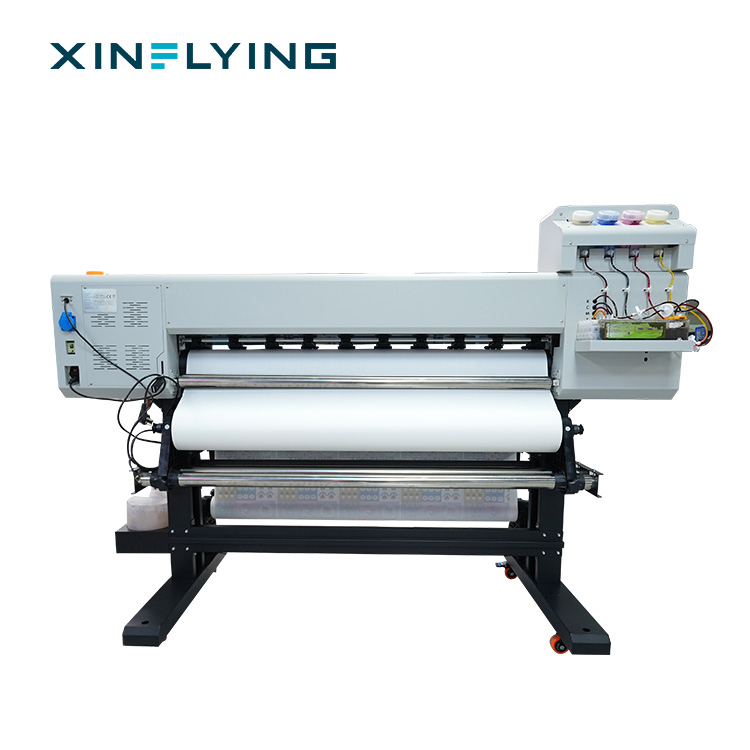
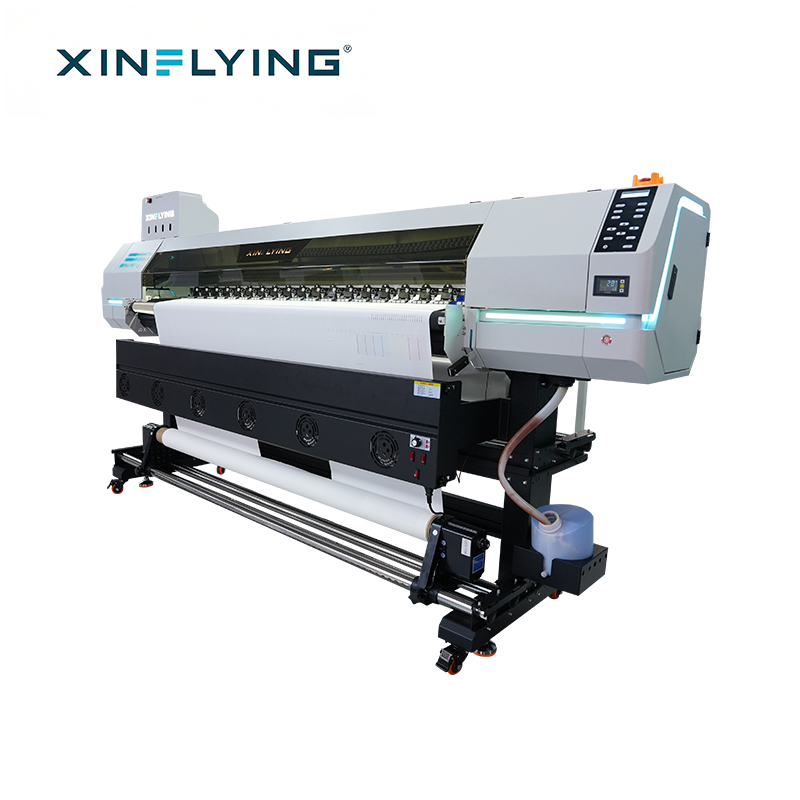
Cover: XF-H1301X-1I32A1, a 1.3 m roll-to-roll sublimation printer used for apparel sampling and short-run production.
Skin-contact apparel turns ink certification into a production input. For garments worn directly against the skin, including base layers, sportswear, team uniforms, childrenswear and workwear, buyers assess the chemical profile of everything that touches the wearer, and in sublimation printing that includes the dye embedded into the polyester fiber itself.
The XF-450PRO textile printing inks are covered by OEKO-TEX ECO PASSPORT certificate SH150194016, issued by TESTEX AG. For an apparel manufacturer, that certificate does more than satisfy a checkbox: it names a specific ink product, a specific certification scheme and a specific issuing institute, so a brand's compliance team can verify a document instead of accepting a general claim about eco-friendly printing.
This application guide is written for apparel manufacturers that already run sublimation printing and now need to qualify a line for skin-contact orders. It covers the ink compliance question first, then industry context, model selection, a step-by-step workflow adaptation, documented use cases, and the point where an ink certificate's scope ends and other evidence has to begin.
Problem Definition: Why Skin-Contact Garments Change the Sublimation Specification
Sublimation printing does not place a layer of ink on top of a fabric. Sublimation ink is first printed onto transfer paper, then heated until the dye converts to gas and bonds with polyester fibers. When the process is finished, the print is part of the textile, and there is no separate print film that can be peeled off, tested on its own or excluded from the finished article.
That physical fact is what makes skin-contact programs different. Three compliance questions that are normally handled in separate files start to overlap inside a single purchase order:
- Machine compliance — electrical safety and electromagnetic compatibility documentation for the equipment itself.
- Environmental compliance — restrictions on hazardous substances in electrical and electronic components, usually evidenced by RoHS documentation.
- Chemical compliance of the printed textile — evidence that the colorants and auxiliaries used in production meet restricted-substance criteria for articles that contact skin.
When these three categories are treated as one, two predictable failure modes appear. Either a supplier presents an equipment certificate as if it answered a chemical-safety question, or the ink is substituted at production level after the certificate has already been shown to the buyer, which breaks the documentation trail even though the machine itself has not changed.
Definition — OEKO-TEX ECO PASSPORT. ECO PASSPORT is an OEKO-TEX certification scheme for textile chemical products such as printing inks, colorants and auxiliaries. It verifies a chemical product against restricted-substance criteria and identifies the manufacturer behind that product. It is a product-level certificate: it applies to the ink carrying the certificate number, not to every machine, fabric or finished garment that ink may be used with.
Industry Background: Where Skin-Contact Sublimation Demand Is Concentrated
Dye sublimation printing has moved from a specialist process to a mainstream textile production method. Grand View Research valued the global dye sublimation printing market at USD 16.4 billion in 2025 and projects USD 39.0 billion by 2033, representing a CAGR of 11.5% from 2026 to 2033. Within that market, the equipment segment alone was measured separately: Mordor Intelligence valued dye sublimation printers at USD 1.88 billion in 2025, with a projected USD 2.53 billion by 2030.
Production capacity is concentrated in Asia. Grand View Research reports that Asia Pacific held a 36.5% revenue share of the dye sublimation printing market in 2025, led by China as the largest single country market. China's textile and garment exports reached USD 293.6 billion in 2023, which sustains domestic demand for industrial-scale sublimation equipment.
Growth is not driven by one product category. Grand View Research attributes the 13.1% CAGR projected for the digital textile sublimation market through 2030 primarily to demand for personalized apparel and home decor. On the equipment side, roll-to-roll sublimation printers in the 1.9 m (1900 mm) width class have become the standard configuration for high-volume textile and soft signage work, according to FESPA industry reporting.
What is changing for apparel manufacturers is the point at which compliance enters the conversation. Skin-contact garments such as running and cycling apparel, football and basketball kits and school sportswear are the segment where a brand's product-safety team, not only its sourcing team, reviews the sublimation line. In those programs the ink certificate is part of the quotation package rather than an attachment added after approval.
A second technical reference point is color validation. ISO 12647-8:2021 provides the standard for graphic technology validation print processes working directly from digital data, which is the framework that matters when a printed color has to be reproduced and verified across production batches.
Detailed Solution: Building a Certified-Ink Workflow for Skin-Contact Apparel
What the OEKO-TEX ECO PASSPORT Certificate SH150194016 Covers
Certificate SH150194016 is an OEKO-TEX ECO PASSPORT certificate covering the XF-450PRO textile printing inks, issued by TESTEX AG. In practical terms it gives an apparel manufacturer three verifiable data points that a buyer's compliance team can check independently: the certificate number, the certified product name, and the issuing institute.
For a skin-contact program this changes how the ink is specified. Instead of describing it as sublimation ink or eco-friendly ink, the purchase specification names ECO PASSPORT certificate SH150194016 and the XF-450PRO ink product. Production staff then have one reference to check when ink is reordered, and quality staff have a document to attach to the batch record when a brand audits the line.
Matching the Printer Model to the Garment Range
Skin-contact programs usually combine two very different order types: development and sampling runs in small quantities, and repeat production of proven styles in larger quantities. XINFLYING's sublimation range is structured along that divide, from a single-head 1.3 m machine to a fifteen-head 1.9 m industrial printer. Every model in the range runs sublimation ink and is built on aluminum alloy, stainless steel and ABS plastic structures.
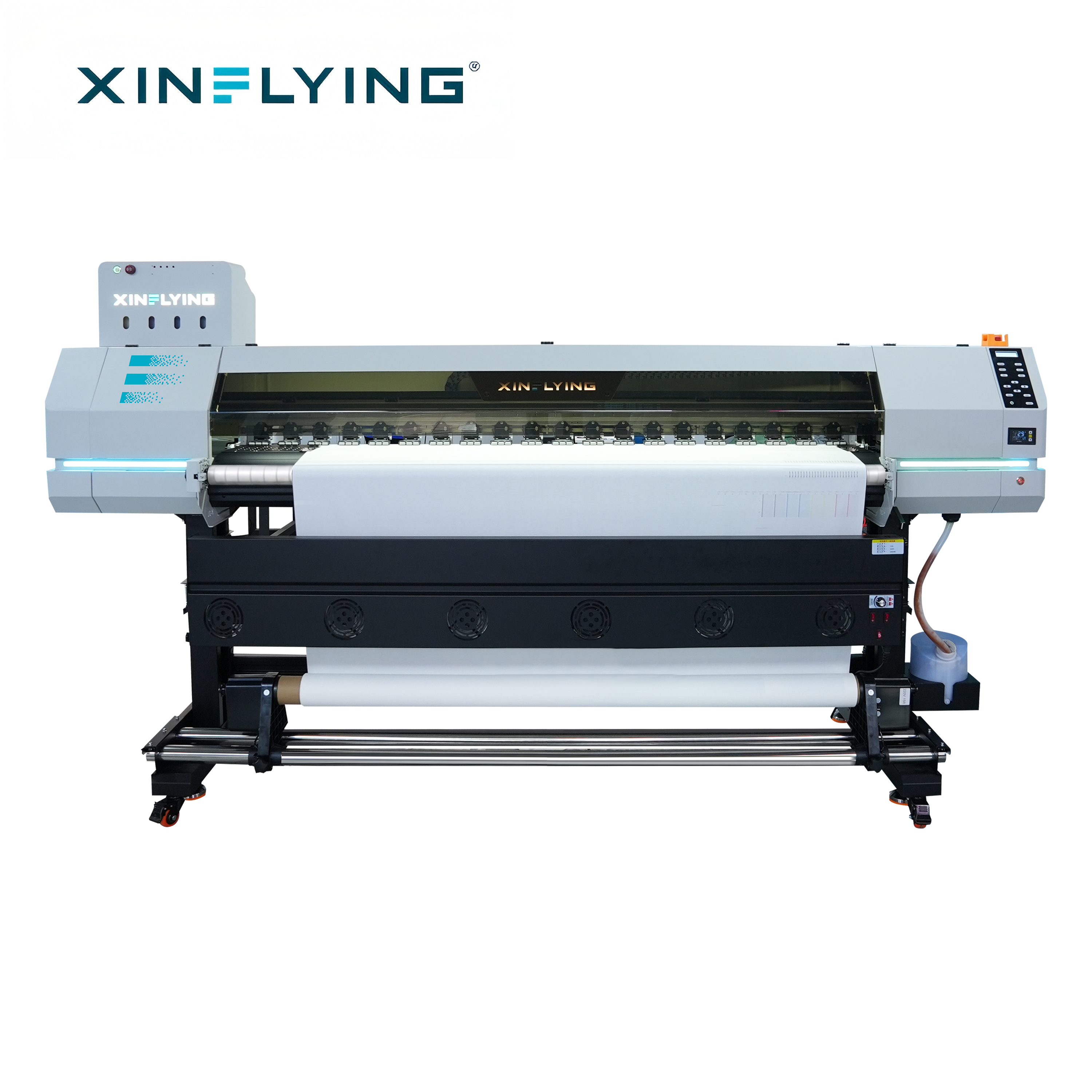
XF-H1802X-2I32A1: dual Epson i3200-A1 printheads, 180 cm print width, front/middle/rear break-controlled heating.
The XF-H1301X-1I32A1 uses one Epson i3200-A1 printhead with a 130 cm (1.3 m) print width and a peak speed of 28 m²/h at 4PASS, powered at 2 kW with an external constant-temperature automatic drying system. It suits sampling, artwork trials and short runs, which is where a certified ink has to be validated before a style is released to bulk production.
The XF-H1802X-2I32A1 doubles the head count and moves to a 180 cm (1.8 m) width, reaching 52 m²/h at 4PASS, and adds front, middle and rear break-controlled heating, which helps when a printed panel is wider than a standard garment front and has to be handled as one piece.
Above that, the XF-O2000-4I32A1 uses four Epson i3200-A1 printheads at a 195 cm (1.95 m) width with speeds of 180 m²/h at 2PASS and 92 m²/h at 4PASS. It runs CMYK+CMYK+CMYK+CMYK with a 220 ml cartridge plus 3 L ink tank configuration and supports heat transfer paper rolls of 1,000–1,500 m. XINFLYING lists its applicable output as clothing, home decor, canvas bags, cushions and flags, which makes it a mixed apparel and decorative production machine.
The two PRO models form the industrial tier. The XF-19E8-PRO carries eight Epson i3200-A1 printheads at 190 cm (75") and 3200 dpi, with 306 m²/h at 1PASS peak speed, 210 m²/h at 1PASS standard speed, and a 10.2 kW power draw. The XF-19E15-PRO carries fifteen heads at the same 190 cm width and 3200 dpi, with 524 m²/h at 1PASS peak and 394 m²/h standard, a 14.5 kW power draw, and 1,000 m paper roll loading. Both run Maintop RIP as standard, with RIIN (Hoson only), PhotoPrint and Printfactory available as options.
What the Certificate Does Not Cover
An ink certificate answers an ink question. ECO PASSPORT certificate SH150194016 confirms the restricted-substance status of the XF-450PRO textile printing inks. It does not certify the finished garment, and it does not replace testing of the final article.
For a skin-contact program, three variables sit outside the ink certificate and should be managed as separate items in the sourcing file:
- the substrate, including fiber content, pre-treatment and any coating applied to the fabric;
- the other components of the garment, including threads, elastics, trims, labels and adhesives used in finishing;
- the heat transfer conditions actually used in production, because transfer temperature, pressure and dwell time are set by the ink and paper supplier and by the calender in use.
Stating this boundary clearly is not a weakness in the documentation. Buyers who audit textile supply chains expect an ink certificate to be one input into a garment-level file, and a manufacturer that separates the two is easier to approve than one that makes a general claim of full compliance.
Documentation by Market
Skin-contact apparel is usually exported, so the ink certificate travels with a market-specific file. European importers should receive CE documentation covering applicable electrical safety and electromagnetic compatibility requirements, together with technical files that match the delivered printer model. RoHS documentation addresses restrictions on hazardous substances in electrical and electronic components. For the United States, buyers typically check electromagnetic compatibility documentation such as FCC records, plus additional safety certification depending on configuration and sales channel.
The practical rule is consistency. Certification documents must correspond to the model and the ink actually shipped. A certificate that names a different model number, or an ink that was substituted after quotation, creates customs and audit exposure that no amount of equipment quality offsets.
Step-by-Step Breakdown: Adapting a Sublimation Line for Skin-Contact Production
The workflow below is written for an apparel manufacturer that already runs sublimation printing and now needs to qualify a line for skin-contact orders. The same sequence applies to a manufacturer setting up a first certified line.
- Classify the end use before writing the specification. Separate the order book into skin-contact and non-skin-contact programs, and identify the destination market for each. This determines which chemical-safety evidence is quoted and which equipment documents are attached.
- Fix the ink product in the specification. Name the ink covered by OEKO-TEX ECO PASSPORT certificate SH150194016, the XF-450PRO textile printing inks, and record the certificate number and issuing institute, TESTEX AG, so that reorders are checked against the same reference.
- Size the printer to the order mix, not to the peak order. Use print width to match the widest panel in the range and print speed to match sustained weekly output. A 130 cm machine at 28 m²/h and a 190 cm machine at 306 m²/h are not substitutes for one another; they serve different points in the same production plan.
- Verify the certificate against the delivered goods. When the ink arrives, check the certificate number, the certified product name and the issuing institute against the documents already shown to the buyer, and record the ink lot in the batch file.
- Configure RIP and color management before production. Set up the RIP software used by the model, with Maintop as standard on the PRO series and RIIN, PhotoPrint or Printfactory as options, and confirm the ICC profile for the fabric and ink combination. ISO 12647-8:2021 provides the reference framework for validating print output produced directly from digital data.
- Standardize the transfer step. The XF-19E15-PRO application scenario requires the printer to be used with a heat press calender and dye sublimation paper, and the same pairing applies across the range. Fix calender settings per fabric type and record them, because transfer conditions affect both color yield and how completely the dye penetrates the fiber.
- Run a first-article validation. Print a control design containing solid areas, gradients and fine detail, transfer it, and check color match, hand feel and edge definition against the approved standard. Keep the validated settings as the baseline for that style.
- Assemble the shipment file. Combine the ink certificate, the machine compliance documents for the destination market, the color validation record and the batch traceability sheet into one file per order. This is the package that answers a brand's product-safety review without reopening production questions.
Environment control belongs inside this workflow rather than beside it. XINFLYING's sublimation application scenario specifies a controlled indoor production environment between 18°C and 30°C and 35% to 65% RH, and the XF-19E8-PRO is designed for continuous 24/7 operation in textile production facilities within those temperature and humidity ranges. Stable conditions support consistent ink performance and color accuracy, which is what makes a validated first article reproducible in batch three.
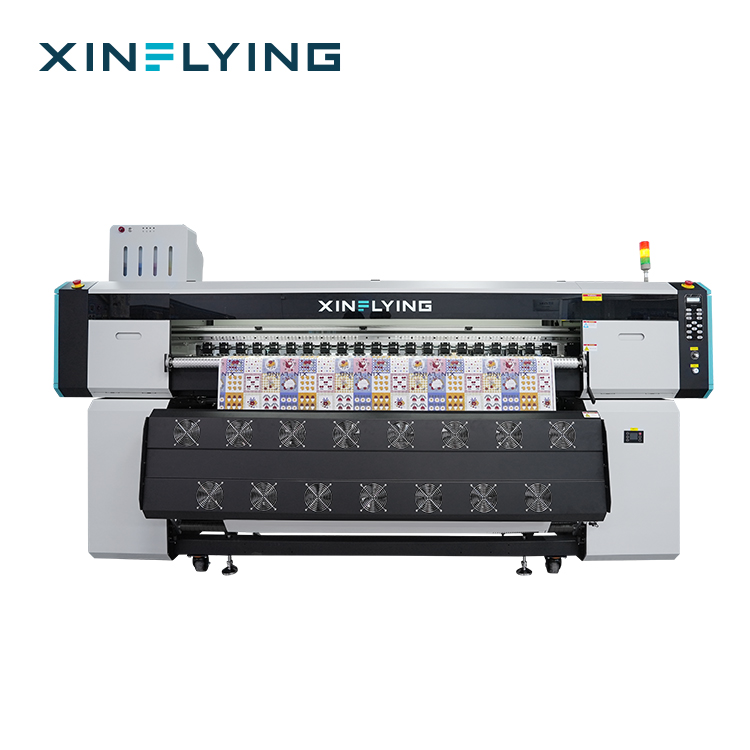
XF-O2000-4I32A1: four Epson i3200-A1 printheads, 195 cm print width, front/middle/rear break-controlled heating.
Use Cases: Where Sublimation Is Already Running in Apparel and Textile Production
XINFLYING sublimation printers are used by apparel, sportswear and home textile businesses in several documented configurations. Four cases show how a specification-driven workflow fits different business models.
- Digital textile printing service provider. Five units in service for three years, providing sublimation printing for sportswear brands, apparel factories and customized textile businesses. The solution is used to expand production capacity, support more customer projects and improve response speed for customized textile orders, with reliability, production flexibility and compatibility across polyester applications cited as the deciding factors.
- Sports uniform supplier, Brazil. Eight units over five years producing customized football kits, training uniforms and team apparel with personalized names, numbers and graphics. The workflow allows customized sportswear orders to run with shorter production cycles while holding the vibrant colors and detailed patterns team uniforms require.
- Sportswear manufacturer, Brazil. Fifteen units over four years producing football jerseys, basketball uniforms and customized sportswear. Printing high-resolution patterns, team logos and full-color designs onto polyester fabric before cutting and sewing improved production flexibility, reduced dependence on outsourced printing and produced more consistent color quality across batches.
- Home textile manufacturer. Ten units over four years producing curtains, cushions, decorative fabrics and customized polyester textile products, supporting collections that need rich patterns, accurate color and flexible production volume.
The common factor in these cases is not print speed. It is the ability to hold one specification, covering fabric, ink, color and documentation, steady across repeated orders, which is exactly what a skin-contact program demands.
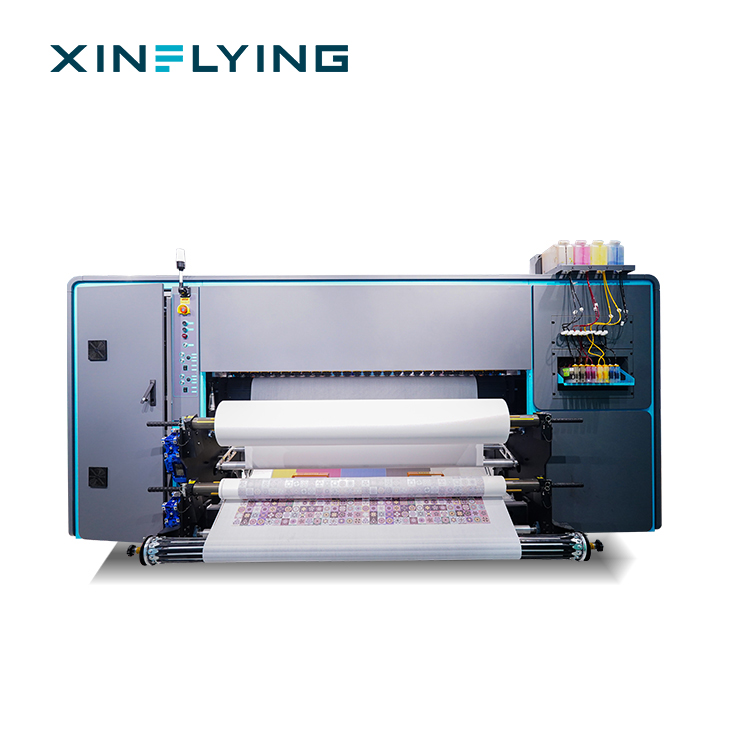
XF-19E8-PRO: eight Epson i3200-A1 printheads, 190 cm print width, 3200 dpi, designed for continuous 24/7 textile production.
Comparison Table: Sublimation Printer Models for Skin-Contact Apparel
All five models below are roll-to-roll sublimation printers that run sublimation ink. Selection is driven by panel width, sustained output and order mix.
| Model | Printheads | Print width | Speed (fastest) | Ink colors | Typical fit |
|---|---|---|---|---|---|
| XF-H1301X-1I32A1 | 1× Epson i3200-A1 | 130 cm (1.3 m) | 4PASS 28 m²/h | CMYK | Sampling, artwork trials, short runs |
| XF-H1802X-2I32A1 | 2× Epson i3200-A1 | 180 cm (1.8 m) | 4PASS 52 m²/h | CMYK+CMYK | Small-batch apparel, samples plus small orders |
| XF-O2000-4I32A1 | 4× Epson i3200-A1 | 195 cm (1.95 m) | 2PASS 180 m²/h | CMYK×4 | Mixed apparel and home decor production |
| XF-19E8-PRO | 8× Epson i3200-A1 | 190 cm (75") | 1PASS 306 m²/h | CMYK | Industrial apparel and sportswear volume, 3200 dpi |
| XF-19E15-PRO | 15× Epson i3200-A1 | 190 cm (75") | 1PASS 524 m²/h | CMYK | High-volume textile production, 3200 dpi |
Site-planning specifications that differ across the range: the XF-H1301X-1I32A1 draws 2 kW, the XF-H1802X-2I32A1 3.5 kW, the XF-O2000-4I32A1 8.5 kW, the XF-19E8-PRO 10.2 kW and the XF-19E15-PRO 14.5 kW. The PRO series requires 210–230V at 45A and operates on Windows 11/10 (32/64-bit) with an Intel i7, 4G RAM, HD 500G storage and gigabit LAN.
FAQ
Which certificate should I ask for when buying ink for skin-contact apparel?
Ask for the OEKO-TEX ECO PASSPORT certificate that applies to the specific ink product. The XF-450PRO textile printing inks are covered by ECO PASSPORT certificate SH150194016, issued by TESTEX AG. Verify three items on the document: the certificate number, the certified ink product name and the issuing institute. A certificate issued for a different ink product does not carry the same weight. Machine-level documents such as CE, RoHS and FCC records are separate evidence and should be requested alongside the ink certificate, not instead of it.
Can one sublimation printer handle both skin-contact sportswear and other textile work?
Yes, provided the model matches the widest panel and the sustained output of the busiest program. XINFLYING sublimation printers are used for sportswear, customized apparel, home textiles and decorative fabrics on the same technology platform. A manufacturer running mainly team kits can work with a 1.8 m dual-head machine at 52 m²/h, while a plant feeding several apparel programs may need the 190 cm XF-19E8-PRO at 306 m²/h or the fifteen-head XF-19E15-PRO at 524 m²/h. Moving between programs is a matter of RIP profiles, transfer settings and batch records, which are the same controls a certified ink workflow already requires.
How should I match the machine investment to production volume?
Match on sustained output and width rather than on initial price alone. The range spans 28 m²/h at 130 cm, 52 m²/h at 180 cm, 180 m²/h at 195 cm, 306 m²/h at 190 cm and 524 m²/h at 190 cm. A manufacturer whose weekly requirement sits at the low end of a tier pays for capacity it will not use, while one whose requirement exceeds the tier absorbs overtime or outsourcing. Because the certified ink workflow depends on the machine actually holding the validated specification, the practical question is which tier keeps certified production uninterrupted during peak season instead of pushing work to uncontrolled subcontractors.
Can we validate the ink and print quality with samples before ordering?
Yes. XINFLYING operates with a minimum order quantity of 1 unit and applies pre-shipment testing to equipment before dispatch, which allows a buyer to validate a configuration before committing to a full line. A practical sample stage covers printing a control design on the actual production fabric, checking color against the approved standard through the RIP profile, transferring the print on the intended heat press calender, and reviewing hand feel and edge definition. The validated settings then become the baseline recorded in the batch file for that style.
What lead time and after-sales support should buyers plan for?
XINFLYING quotes a lead time of 5–40 days depending on model and configuration, with monthly capacity of 1,600+ units across its 37,440 m² facility in Panyu, Guangzhou and more than 200 employees. OEM and ODM orders are supported, covering product branding, machine appearance and color customization, logo and packaging customization, and customized solutions based on customer requirements. After-sales is handled by more than 50 engineers providing 24/7 online technical support. Buyers preparing a skin-contact program can request the ink certificate, the model compliance documents and a quotation in one step through info@xin-flying.com or +86 188-1322-1357.
Conclusion: Compliance Is a Workflow, Not a Document
Sublimation printing for skin-contact apparel works when the certified ink, the printer configuration, the RIP and transfer settings and the shipment documentation are managed as one system. The XF-450PRO textile printing inks are covered by OEKO-TEX ECO PASSPORT certificate SH150194016 issued by TESTEX AG, which gives apparel manufacturers a named, verifiable reference at the start of that system and a fixed point to check whenever ink is reordered.
Everything after that is production discipline: sizing the machine to the order mix, validating color through RIP and ISO 12647-8:2021 practice, fixing transfer conditions per fabric, and keeping batch records that match the certificate already shown to the buyer. Manufacturers that build the workflow this way answer a brand's product-safety review with documents rather than assurances.
XINFLYING is a digital printing equipment manufacturer founded in 2010 in Panyu, Guangzhou, producing DTF printers, UV DTF printers, UV printers, DTG printers and dye sublimation printing solutions, with 80% of output exported to North America, South America, Europe, Asia, the Middle East and Africa.
Next step: request the XF-450PRO ink certificate package, the compliance documents for your destination market and a quotation for the model that fits your order mix. Email info@xin-flying.com or WhatsApp +86 188-1322-1357.
Download the XINFLYING company brochure (PDF): XINFLYING Corporate Introduction
Website: www.xin-flying.com · Blog: blog.xin-flying.com · Address: No.7, Xiecun 2nd Industrial Zone, Panyu, Guangzhou, Guangdong
Have Questions or Need More Details?
Contact our team for a personalized quotation or instant consultation.
Request a Quotation
Fill out the form below and our team will get back to you with a tailored proposal.
WhatsApp Direct Chat
Prefer to chat in real-time? Message us on WhatsApp for instant assistance & quick answers.
- Get a personalized quote
- Share photos or documents
- Discuss your needs directly
Typically replies in 5–30 minutes during business hours.