Sublimation Printer ROI and Long-Term Partnership: Questions Buyers Ask
Short answer: the return on a sublimation printer is decided far less by the invoice price than by four lifecycle variables, the stability of the machine certification, the cost structure of consumables and maintenance, the availability of spare parts and technical assistance after delivery, and whether the supplier is organised to support the same model years after installation. This guide answers the questions buyers actually ask during the research and evaluation stage of a dye sublimation printer purchase, and shows how to verify the answers instead of accepting them.
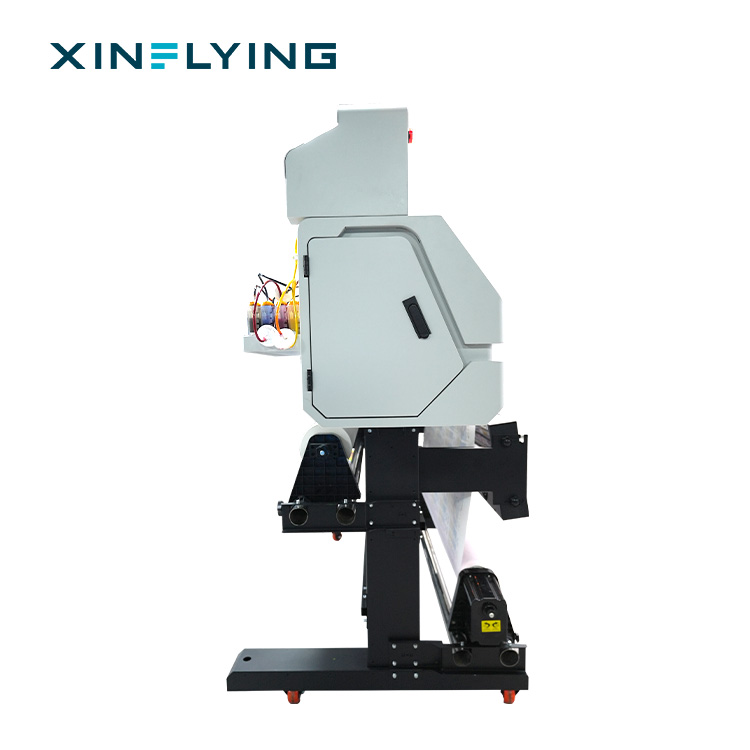
Why the Invoice Price Is the Least Useful Number in the Decision
Most evaluations of a large format sublimation printer open with three figures: printing width, maximum output per hour, and price. Those figures describe the first day of ownership. They say very little about year three.
A dye sublimation printer is one component inside a production workflow that also includes RIP software, transfer paper, sublimation ink, a heat press calender, and downstream cutting equipment. When buyers search for sublimation printer ROI, what they are usually trying to estimate is whether that entire workflow keeps producing sellable output without unpredictable interruption.
Three failure modes account for most disappointing purchases:
- Compliance that does not survive scrutiny. A supplier states that a machine is CE certified but cannot attach a certificate number to the exact model being shipped, or the document covers a different configuration.
- A service gap after delivery. The machine installs and runs, but there is no defined technical support channel, no spare parts pipeline, and no one who owns the problem when a printhead, board, or pump fails.
- A scale mismatch. The machine is sized for the first customer rather than the next one, so capacity becomes the constraint instead of the market.
All three are partnership questions rather than specification questions. That is why the rest of this article is organised around what a supplier commits to over time, and how those commitments can be checked before an order is placed.
Industry Background: A Market That Rewards Continuity
The commercial context explains why long-term questions now carry more weight than they did a decade ago.
Grand View Research values the global dye sublimation printing market at USD 16.4 billion in 2025, projected to reach USD 39.0 billion by 2033, growing at a CAGR of 11.5% from 2026 to 2033. Within that total, Asia Pacific held a 36.5% revenue share in 2025, led by China as the largest country market. Mordor Intelligence sizes the dye sublimation printer equipment segment specifically at USD 1.88 billion in 2025, expected to reach USD 2.53 billion by 2030.
Demand is not concentrated in one application. China textile and garment exports reached USD 293.6 billion in 2023, and the growth of personalised apparel and home decor continues to pull digital textile sublimation capacity forward.
Two structural details matter when buyers compare equipment:
- Format standardisation. Roll-to-roll sublimation printers at 1.9 m (1900 mm) width are treated as standard for high-volume textile and soft signage applications. A 1900 mm or 1950 mm machine therefore fits mainstream production, while a 1300 mm or 1800 mm machine fits a narrower or more flexible order mix.
- Platform dependence. In the digital textile dye sublimation printer market, Epson leads with a 26.7% share, followed by Mimaki at 18.6% and Roland DG at 15.5%, according to Data Insights Reports data for 2024. Printhead platforms such as the Epson i3200-A1 sit inside that ecosystem, which turns printhead support into a commercial question, not only a technical one.
What a Long-Term Sublimation Printer Partnership Actually Covers
Xinflying (Guangzhou Xin Flying Digital Technology Co., Ltd.) is a digital printing equipment manufacturer founded in 2010 that produces DTF printers, UV DTF printers, UV printers, DTG printers and dye sublimation printing solutions. The company employs more than 200 people, operates a research and development team of 20 engineers, and reports annual output of more than 20,000 units with monthly capacity of over 1,600 units. Roughly 80% of output is exported to customers in North America, South America, Europe, Asia, the Middle East and Africa.
Using that operating profile as a reference, a long-term sublimation printer partnership normally rests on six pillars.
1. Certification Stability: the Same Certificate, Attached to the Same Model
The clearest early indicator of supplier reliability is whether a certificate stays attached to the same model over time, and whether the supplier can show the document rather than describe it.
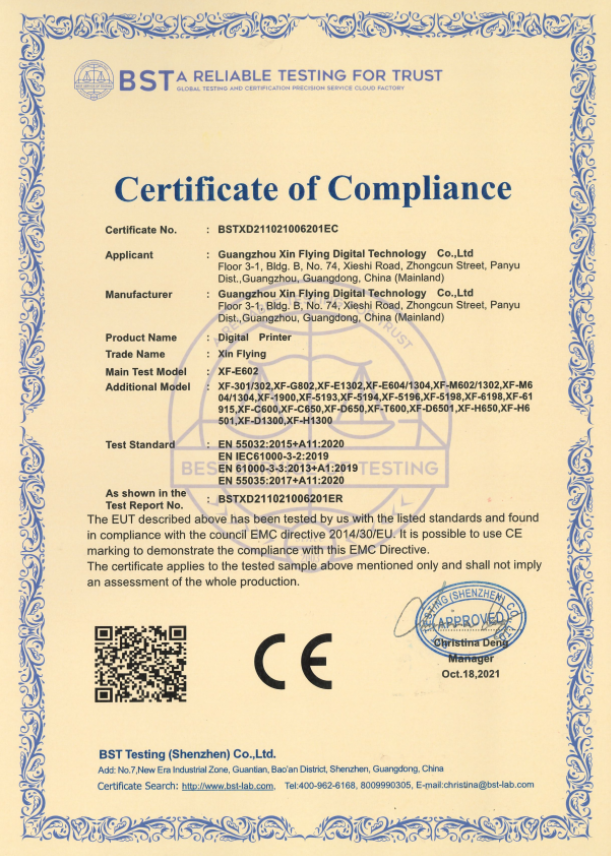
The XF-H1802X-2I32A1 sublimation printer is a useful example. It is covered by CE Certificate of Compliance number BSTXD211021006201EC, issued by BST Testing (Shenzhen) Co., Ltd. on 18 October 2021 and applicable to the EU market. The certificate references EN 55032:2015+A11:2020, EN IEC 61000-3-2:2019, EN 61000-3-3:2013+A1:2019 and EN 55035:2017+A11:2020, with a recorded expiry date of 1 January 2099.
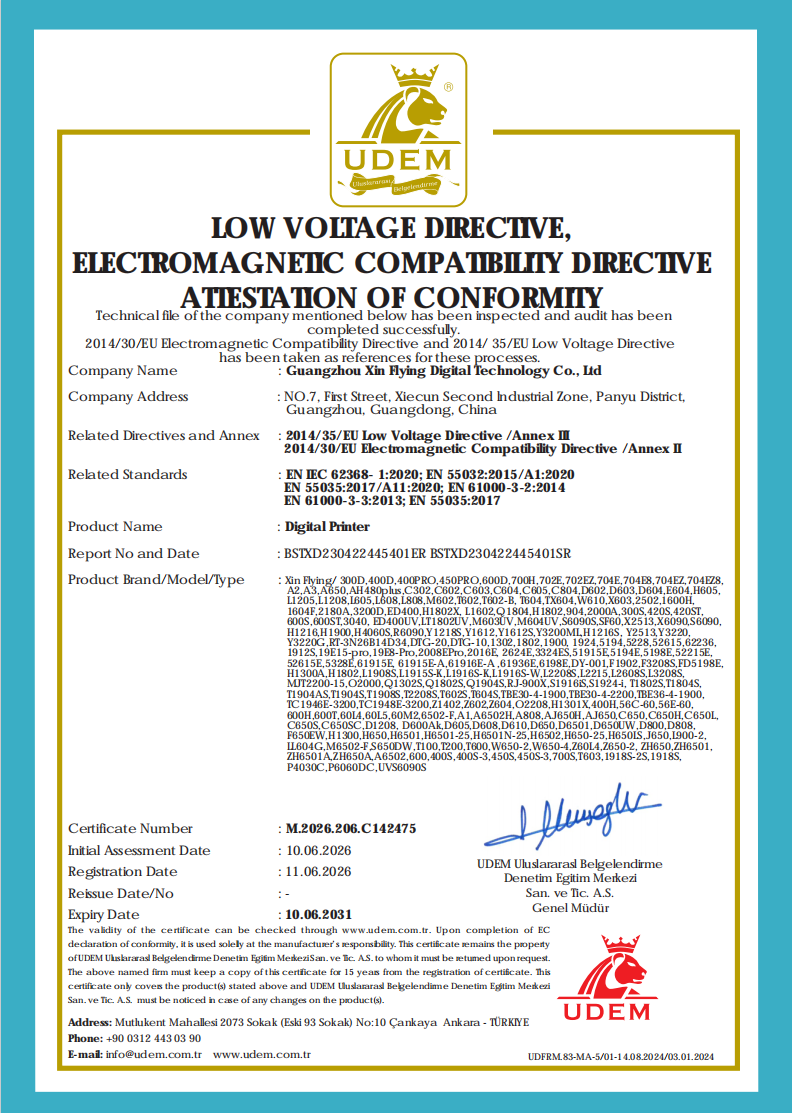
The same model additionally holds CE LVD & EMC certificate M.2026.206.C142475, which complies with EN IEC 62368-1:2020, and is certified to the CE Machinery Directive. RoHS compliance for the platform is covered by certificate M.2026.206.C142366 under Directive 2011/65/EU.
For ROI purposes this matters in a practical way. A documented, model-linked compliance trail reduces import friction, avoids renegotiating conformity when a second or third unit is added, and lets a buyer expand the same production line without re-validating the equipment basis. Certificate continuity is one of the few reliability signals available before a machine is installed.
2. Consumables and Process Continuity
Consumable supply is where quiet cost creep usually appears. A sublimation printing machine depends on transfer paper, sublimation ink, RIP software, and a heat press calender, plus optional downstream equipment such as a laser cutting machine.
Configuration choices affect how flexible that supply chain can be. The XF-H1802X-2I32A1 uses Maintop as standard RIP software with two Epson i3200-A1 printheads and CMYK+CMYK ink coverage. The XF-O2000-4I32A1 supports Maintop and RIIN Print and uses a 220 ml cartridge plus a 3 L ink tank, accepting transfer paper rolls of 1,000 to 1,500 m. The XF-19E8-PRO and XF-19E15-PRO load sublimation paper rolls up to 1,000 m and offer Maintop as standard with RIIN, PhotoPrint and Printfactory available as options.
The partnership question to ask is direct: for this exact model, which papers, inks and RIP versions are validated, and who supplies them in year two and year three?
3. Maintenance Structure
Maintenance cost is largely determined at the design stage, because the hardware decides how often intervention is needed.
- The XF-H1802X-2I32A1 uses front, middle and rear break-controlled heating, an aluminium ink rack and a retraction system.
- The XF-19E8-PRO adds a Japan THK silent linear guide, an anti-collision device at both ends, a fully sealed automatic moisturising and cleaning system, an external intelligent air-heat integrated dryer, and a liquid level and waste ink alarm.
- The XF-19E15-PRO pairs a fully sealed automatic moisturising and cleaning system with a linear motor and magnetic grid.
- The XF-H1301X-1I32A1 relies on an external constant-temperature automatic drying system.
When reviewing a maintenance agreement, ask what is covered, who pays for printheads, what the response channel is, whether remote diagnostics are included, and what parts lead time is guaranteed.
4. Spare Parts and Post-Purchase Technical Assistance
This is the pillar buyers regret underestimating. Xinflying maintains an after-sales engineering team of more than 50 engineers providing 24/7 online technical support, and units undergo pre-shipment testing before dispatch.
Before signing, request a parts list mapped to your specific model, the name of the contact channel you will use, the escalation path when a fault cannot be resolved remotely, and confirmation of operator training. Support that is described in a brochure but not attached to a model number is difficult to enforce later.
5. Production Fit: Environment, Duty Cycle and Power
An industrial sublimation printer only reaches its rated output inside its operating envelope. The XF-19E8-PRO and XF-19E15-PRO are specified for 18 to 30 degrees Celsius and 35% to 65% relative humidity. The XF-H1301X-1I32A1 and XF-H1802X-2I32A1 are specified for 20 to 35 degrees Celsius and 45% to 65% relative humidity, while the XF-O2000-4I32A1 operates at 20 to 25 degrees Celsius and 45% to 65% relative humidity. Production lines built around these machines are designed for continuous, 24/7 operation with stable temperature and humidity.
Rated power varies widely across the range, from 2 kW on the XF-H1301X-1I32A1 to 14.5 kW on the XF-19E15-PRO. Supply requirements also differ: some models run on 110/220V, while the XF-19E8-PRO and XF-19E15-PRO require 210 to 230V at 45A. Electrical preparation is a genuine part of the investment and should be costed before purchase.
6. Commercial Terms: MOQ, Lead Time and Customisation
Xinflying accepts a minimum order quantity of 1 unit, with a lead time of 5 to 40 days. OEM and ODM support covers product branding, machine appearance customisation, colour customisation, logo customisation, packaging customisation, and customised solutions based on customer requirements. Customisation extends the schedule, so the practical question is not only what the lead time is, but what the lead time is for your specific configuration.
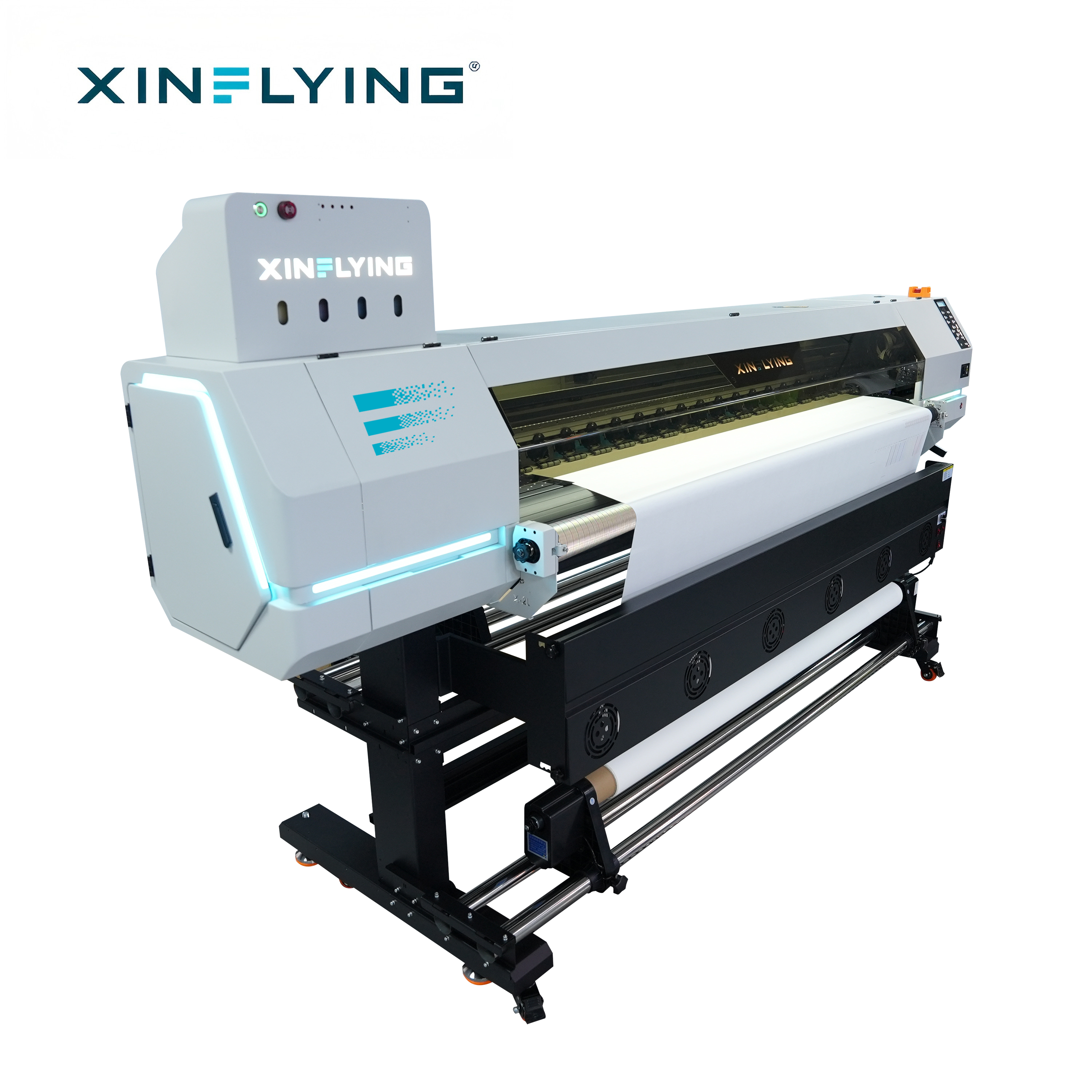
Step-by-Step: How to Evaluate a Sublimation Printer Partner in Six Steps
- Define the production envelope. Fix the print width your product mix requires, the fabric or substrate range, expected daily output, and the physical environment. The 1.9 m format is the standard entry point for high-volume textile and soft signage work, while a 1300 mm or 1800 mm machine suits sampling, custom apparel and narrower order books.
- Match the certificate to the model number. Ask for the certificate document, then confirm that the model designation, certificate number, issuing body and listed standards all refer to the machine you are buying. A certificate that covers a sister model is not the same as a certificate for your model.
- Build a multi-year cost model. Include the machine, ink, transfer paper, RIP software, electrical preparation, maintenance, and downtime risk. Compare total cost of ownership rather than purchase price alone.
- Put the service model in writing. Confirm the technical support window, the responsive contact channel, remote diagnostic capability, and who is accountable when an issue cannot be resolved remotely.
- Validate with a test print or single-unit order. Because the minimum order quantity is 1 unit, a validation purchase is commercially realistic. Test on your own fabric and colour profiles, not on a supplier sample.
- Confirm the scale path and the commercial terms. Establish lead time for the exact configuration, customisation scope and how quickly additional capacity can be added.
Use Cases: What Long-Term Partnerships Look Like in Practice
The clearest evidence that lifetime questions are real is the length of existing relationships and the way capacity is added over time.
- Sportswear manufacturer, Brazil, 15 units, 4 years. The customer produces football jerseys, basketball uniforms and customised sportswear, printing high-resolution patterns, team logos and full-colour designs onto polyester fabric before cutting and sewing. The reported outcome was greater flexibility for customised orders, reduced dependence on outsourced printing, and more consistent colour across batches.
- Sports uniform supplier, Brazil, 8 units, 5 years. The customer produces customised football kits, training uniforms and team apparel with personalised names, numbers and graphics, and reports shorter production cycles while maintaining vibrant colours and detailed patterns.
- Digital textile printing service provider, 5 units, 3 years. Serving sportswear brands, apparel factories and customised textile businesses, the customer expanded production capacity, supported more customer projects, and improved response speed for customised textile orders.
- Home textile manufacturer, 10 units, 4 years. The customer applies sublimation printing to curtains, cushions, decorative fabrics and customised polyester products, developing customised collections with rich patterns, accurate colours and flexible production capability.
What these cases share is not a single machine specification. It is a relationship measured in years, in which equipment, consumables, service and capacity planning are handled as one continuous arrangement.
Model Comparison: Matching Configuration to Production Stage
The table below compares the profile of five roll-to-roll sublimation printers using published configuration and certification data only. Print speeds are the fastest quoted figures for each model.
| Model | Printheads | Print width | Max. speed (fastest) | Rated power | EU certification coverage |
|---|---|---|---|---|---|
| XF-H1301X-1I32A1 | 1 x Epson i3200-A1 | 130 cm (1.3 m) | 4PASS 28 m2/h | 2 kW | CE LVD & EMC M.2026.206.C142475; CE Machinery Directive (EN ISO 12100:2010; EN 60204-1:2018/A1:2025; EN ISO 12643-1:2023) |
| XF-H1802X-2I32A1 | 2 x Epson i3200-A1 | 180 cm (1.8 m) | 4PASS 52 m2/h | 3.5 kW | CE BSTXD211021006201EC; CE LVD & EMC M.2026.206.C142475 (EN IEC 62368-1:2020); CE Machinery Directive |
| XF-O2000-4I32A1 | 4 x Epson i3200-A1 | 195 cm (1.95 m) | 2PASS 180 m2/h | 8.5 kW | CE BSTXD211021006201EC; CE LVD & EMC M.2026.206.C142475; CE EMC TQT1550D270EC; CE Machinery Directive; RoHS M.2026.206.C142366 |
| XF-19E8-PRO | 8 x Epson i3200-A1 | 190 cm (75 in) | 1PASS 306 m2/h | 10.2 kW | CE MD M.2026.206.C142385; CE LVD TQT1550D271EC; CE EMC TQT1550D270EC; RoHS M.2026.206.C142366 |
| XF-19E15-PRO | 15 x Epson i3200-A1 | 190 cm (75 in) | 1PASS 524 m2/h | 14.5 kW | CE MD M.2026.206.C142365; CE LVD TQT1550D271EC; CE EMC TQT1550D270EC; RoHS M.2026.206.C142366 |
A second useful exercise is to separate the recurring cost drivers from the one-off costs, so that the multi-year picture is visible before the order is placed.
| Lifecycle cost driver | What it depends on | Question to put to the supplier |
|---|---|---|
| Printhead replacement | Number of Epson i3200-A1 printheads fitted, from 1 on the XF-H1301X-1I32A1 to 15 on the XF-19E15-PRO | What is the unit price and delivery time of a replacement printhead for this model? |
| Ink and ink system | Configuration, for example CMYK+CMYK on the XF-H1802X-2I32A1 or a 220 ml cartridge plus 3 L tank on the XF-O2000-4I32A1 | Which sublimation inks are validated, and is supply local or imported? |
| Transfer paper | Roll length and width the model accepts, up to 1,000 m, or 1,000 to 1,500 m on the XF-O2000-4I32A1 | Which paper widths and roll lengths are validated for this machine? |
| Electrical preparation | Rated power from 2 kW to 14.5 kW, and supply format of 110/220V or 210 to 230V at 45A | Does my site support the specified supply requirements without modification? |
| Maintenance | Heating control, moisturising and cleaning systems, linear guides, alarms | What is included in a maintenance agreement, and what is excluded? |
| Downtime risk | Parts availability, remote support capability, engineer reach | What is the response channel and the parts lead time in writing? |
FAQ: Sublimation Printer ROI and Partnership Questions
Check four items against the document itself: the certificate number, the exact model designation, the issuing body, and the standards listed. As a worked example, CE Certificate of Compliance number BSTXD211021006201EC was issued by BST Testing (Shenzhen) Co., Ltd. on 18 October 2021 for the EU market and applies to the XF-H1802X-2I32A1 sublimation printer, referencing EN 55032:2015+A11:2020, EN IEC 61000-3-2:2019, EN 61000-3-3:2013+A1:2019 and EN 55035:2017+A11:2020. That model is also covered by CE LVD & EMC certificate M.2026.206.C142475, complying with EN IEC 62368-1:2020, and by CE Machinery Directive coverage. If a certificate covers a different model in the same range, it does not certify the machine on your order.
Support should be specific enough to be enforceable. Xinflying maintains an after-sales engineering team of more than 50 engineers who provide 24/7 online technical support, and machines undergo pre-shipment testing before dispatch. Buyers should additionally request a spare parts list mapped to the exact model, a named support channel, remote diagnostic assistance, operator training, and a stated parts lead time. Machine design also affects parts exposure over time: the XF-19E8-PRO uses a Japan THK silent linear guide with anti-collision devices at both ends and a fully sealed automatic moisturising and cleaning system, while the XF-H1802X-2I32A1 uses front, middle and rear break-controlled heating with a retraction system.
The main drivers are printhead replacement, ink and ink system configuration, transfer paper consumption, RIP software, electrical preparation, maintenance, and downtime risk. Printhead count is the single largest structural difference between models in this range: 1 head on the XF-H1301X-1I32A1, 2 on the XF-H1802X-2I32A1, 4 on the XF-O2000-4I32A1, 8 on the XF-19E8-PRO and 15 on the XF-19E15-PRO. Power requirements are the second structural variable, ranging from 2 kW to 14.5 kW, with the XF-19E8-PRO and XF-19E15-PRO requiring 210 to 230V at 45A. Because these costs recur, comparing purchase price alone systematically understates the difference between configurations.
Yes, and validation is commercially practical because the minimum order quantity is 1 unit. A sound validation should test the machine on your own polyester fabric, your own artwork and your own colour profiles, and should include nozzle checks, printhead inspection and initial calibration before full production. Speed figures should be confirmed against your quality requirement rather than the fastest headline rate, since the XF-H1802X-2I32A1 is quoted at 4PASS 52 m2/h at its fastest setting and 4PASS 42 m2/h at standard settings. Testing before full production is also the recommended way to avoid wide-format problems such as banding, colour deviation and nozzle blockage.
Xinflying accepts a minimum order quantity of 1 unit with a lead time of 5 to 40 days. OEM and ODM customisation, covering product branding, machine appearance, colour, logo, packaging and customised solutions, affects where your order sits within that window, so lead time should be confirmed for the specific configuration rather than quoted as a general figure. To move from evaluation to a concrete answer on cost, configuration and schedule, you can request a quotation or the company brochure and discuss your production envelope directly with the technical team.
Conclusion: The Questions That Decide the Return
Sublimation printer ROI is not a single calculation. It is the sum of compliance that holds up under inspection, consumables and maintenance costs that are known in advance, spare parts and technical support that exist after delivery, a production envelope that matches your site, and commercial terms that make it possible to add capacity without starting the evaluation over again.
Certification continuity is the most verifiable of these signals, because it can be checked before an order is placed. Design features such as break-controlled heating, sealed moisturising and cleaning systems, and silent linear guides determine how much intervention the machine will require. Support structure and parts availability determine how quickly production resumes when something does fail. Buyers who ask about all three tend to end up with a production partner rather than a transaction.
Request a Quote or Sample Validation

If you are evaluating a dye sublimation printer for a textile, sportswear, home textile or soft signage project, Xinflying can provide model-specific specifications, certification documents, a quotation, and a single-unit validation order.
Website: www.xin-flying.com
Email: info@xin-flying.com
Tel / WhatsApp: +86 188-1322-1357
Address: No.7, Xiecun 2nd Industrial Zone, Panyu, Guangzhou, Guangdong
Have Questions or Need More Details?
Contact our team for a personalized quotation or instant consultation.
Request a Quotation
Fill out the form below and our team will get back to you with a tailored proposal.
WhatsApp Direct Chat
Prefer to chat in real-time? Message us on WhatsApp for instant assistance & quick answers.
- Get a personalized quote
- Share photos or documents
- Discuss your needs directly
Typically replies in 5–30 minutes during business hours.