
Sublimation Printer Long-Term Partnership FAQ: Certificates, Acceptance and After-Sales
A sublimation printer is bought once and lived with for years. This FAQ answers the questions textile manufacturers actually raise at the evaluation stage: which certificate applies to which model, what acceptance should record, how purchasing terms are fixed in writing, and how after-sales support survives a five-year horizon.
Short answer: a long-term sublimation printer partnership rests on four things that can be checked rather than promised — a machine certificate set that names the exact model, a separate ink and paste certificate covering skin-contact textile printing, written purchasing terms covering MOQ, lead time and customization scope, and an acceptance and after-sales protocol that leaves a record on both sides of the order.
For the five XINFLYING models most often requested at this stage — XF-19E15-PRO, XF-19E8-PRO, XF-450PRO, XF-C604 and XF-O2000-4I32A1 — the four machine certificates are CE EMC TQT1550D270EC, CE LVD TQT1550D271EC, CE MD M.2026.206.C142365 and RoHS M.2026.206.C142366. The ink and paste side is covered separately by OEKO-TEX ECO PASSPORT SH150194016.
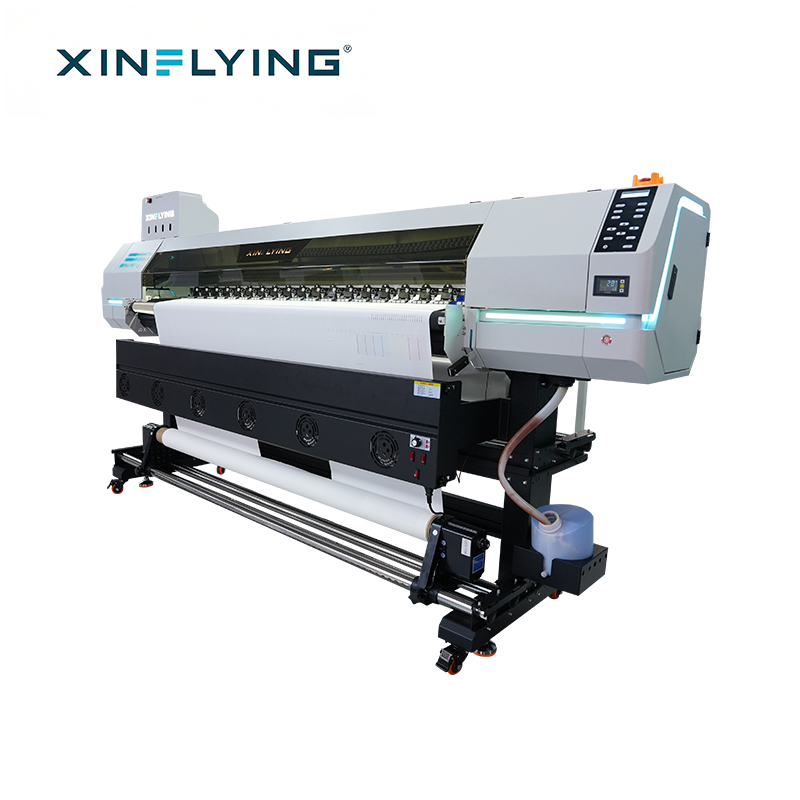
A roll-to-roll sublimation printer in the XINFLYING range — the class of machine this partnership checklist is written for.
Why Partnership Due Diligence Starts After the Shortlist
Most buyers approach a sublimation printer purchase as a specification problem: print width, head count, throughput, power supply, ink configuration. Those numbers narrow the field quickly and they are easy to compare. What they do not predict is what happens in year three, when a printhead needs replacing, when the OEKO-TEX file reaches its expiry date, or when a customs officer asks why the certificate in the folder lists a different model than the crate in front of them.
That is the shift this article addresses. Once a buyer reaches the evaluation stage — machines shortlisted, budget roughly framed, three or four suppliers still in play — the remaining risk sits in documentation and continuity rather than in print quality. Three failure modes account for most of the disappointment in this segment.
- A certificate without a model number. A CE file that does not list the exact printer being shipped is a document, not evidence. The model string on the certificate and the model string on the machine plate have to match character for character.
- An acceptance that produces no record. If the first print run is judged by eye and nobody writes down the nozzle check, the colour target or the ambient conditions, there is no baseline to argue from when a dispute appears eight months later.
- After-sales described as an intention rather than a team. “We support you forever” is not a service level. A named engineering headcount and a stated support window is.
The practical rule for buyers at this stage is simple: request the certificate file before the quotation, not after the deposit. A supplier that has to go and search for it will usually take just as long to answer a technical question in year four.
What the Dye Sublimation Market Looks Like in 2026
The partnership question is worth asking because the installed base keeps growing. Grand View Research values the global dye sublimation printing market at USD 16.4 billion in 2025, with a projection of USD 39.0 billion by 2033 and a CAGR of 11.5% from 2026 to 2033. Asia Pacific accounted for a 36.5% revenue share in 2025, led by China as the largest single country market.
The equipment layer moves on a different curve from the consumables layer. Mordor Intelligence sizes the dye sublimation printers segment at USD 1.88 billion in 2025, rising to USD 2.53 billion by 2030. Published totals vary with segment definition — Mordor puts the wider dye sublimation printing market at USD 15.22 billion for 2025, while Market Research Future reports USD 42.95 billion for 2024 — which is a useful reminder to check which segment a headline figure describes before quoting it in an internal business case.
Two structural facts matter for supplier selection. First, inkjet technology dominates production printing: inkjet production printers accounted for 87.3% of the production printer market by type in 2024, according to Grand View Research. Second, format standardisation has already happened at the industrial end — FESPA-published industry insight treats roll-to-roll sublimation printers at 1.9 m (1900 mm) width as the standard for high-volume textile and soft signage work. China’s textile and garment exports reached USD 293.6 billion in 2023, which is the demand base that keeps 1900 mm and 1950 mm roll-fed machines in continuous production.
For a buyer, the implication is that the machine itself is rarely the scarce item. What is scarce is a supplier whose paperwork still lines up with the machine five years after delivery, and whose engineering team is still reachable when a production line stops on a Friday afternoon.
The Four-Part Evidence File a Long-Term Supplier Should Hand Over
1. A machine certificate set that names the model
Machine compliance in the EU market is not one document. It is a set: electromagnetic compatibility, electrical safety, machinery safety and hazardous substance restriction. Each has its own directive, its own standards list and its own issuing body. A supplier who sends a single blurred CE image is not demonstrating compliance; they are demonstrating that nobody has organised the file.
2. A separate certificate for inks and pastes
Printers and consumables are certified under different regimes. A machine certificate says nothing about what happens to the ink when it sits against skin. For apparel, sportswear and home textiles, the consumable side needs its own document — in the XINFLYING case, OEKO-TEX ECO PASSPORT SH150194016, issued by TESTEX AG for textile printing inks and printing pastes.
3. Purchasing terms written down before the deposit
MOQ, lead time, customization scope and monthly capacity belong in the agreement, not in a chat thread. Guangzhou Xin Flying Digital Technology Co., Ltd. — trading as XINFLYING, a digital printing equipment manufacturer founded in 2010 in Panyu, Guangzhou, producing dye sublimation printers, DTF printers, DTG printers and UV printers for export markets — publishes a MOQ of 1 unit, a lead time of 5–40 days and a monthly capacity of 1600+ units. Those three numbers are the ones that decide whether a partnership can absorb a sudden order spike.
4. An acceptance and after-sales protocol
Acceptance turns a shipment into a reference point. After-sales turns that reference point into a relationship. XINFLYING performs pre-shipment testing as part of its quality control process and supports customers through more than 50 engineers delivering 24/7 online technical support. Both are checkable claims: ask what the pre-shipment test covers, and ask which engineers answer at 02:00 local time.
Certificate Register: The Five Files Behind the Five Models
The table below reproduces the certificate details exactly as recorded, so a buyer can match them against the physical file before signing. Nothing here is inferred; the numbers, issuing bodies and standards are the ones printed on the documents.
| Certificate | Number / issuing body | Directive and standards | Issued | Valid to |
|---|---|---|---|---|
| CE EMC Certificate of Compliance | TQT1550D270EC / TQT | EMC Directive 2014/30/EU; EN 55032:2015/A11:2020; EN 55035:2017/A11:2020; EN IEC 61000-3-2:2019+A1:2021; EN 61000-3-3:2013/A2:2021 | 2026-05-19 | 2099-01-01 |
| CE LVD Certificate of Compliance | TQT1550D271EC / TQT (Shenzhen Tianqi Testing Technology Service Co., Ltd.) | LVD 2014/35/EU; EN IEC 62368-1:2020/A11:2020 | 2026-05-19 | 2099-01-01 |
| CE MD Certificate of Conformity | M.2026.206.C142365 / UDEM | Machinery Directive 2006/42/EC; EN ISO 12100:2010; EN 60204-1:2018/A1:2025; EN ISO 12643-1:2023 | 2026-06-10 | 2031-06-09 |
| RoHS Compliance Certificate | M.2026.206.C142366 / UDEM | Directive 2011/65/EU; EN IEC 63000:2018; EN IEC 62321 series | 2026-06-10 | 2031-06-09 |
| OEKO-TEX ECO PASSPORT | SH150194016 / TESTEX AG | OEKO-TEX ECO PASSPORT; EN ISO 17050-1; scope: textile printing inks and printing pastes | 2025-12-11 | 2026-12-31 |
Certificate register as recorded in the XINFLYING compliance file. The EMC and LVD files carry a 2099-01-01 expiry; the MD and RoHS files run to 2031-06-09.
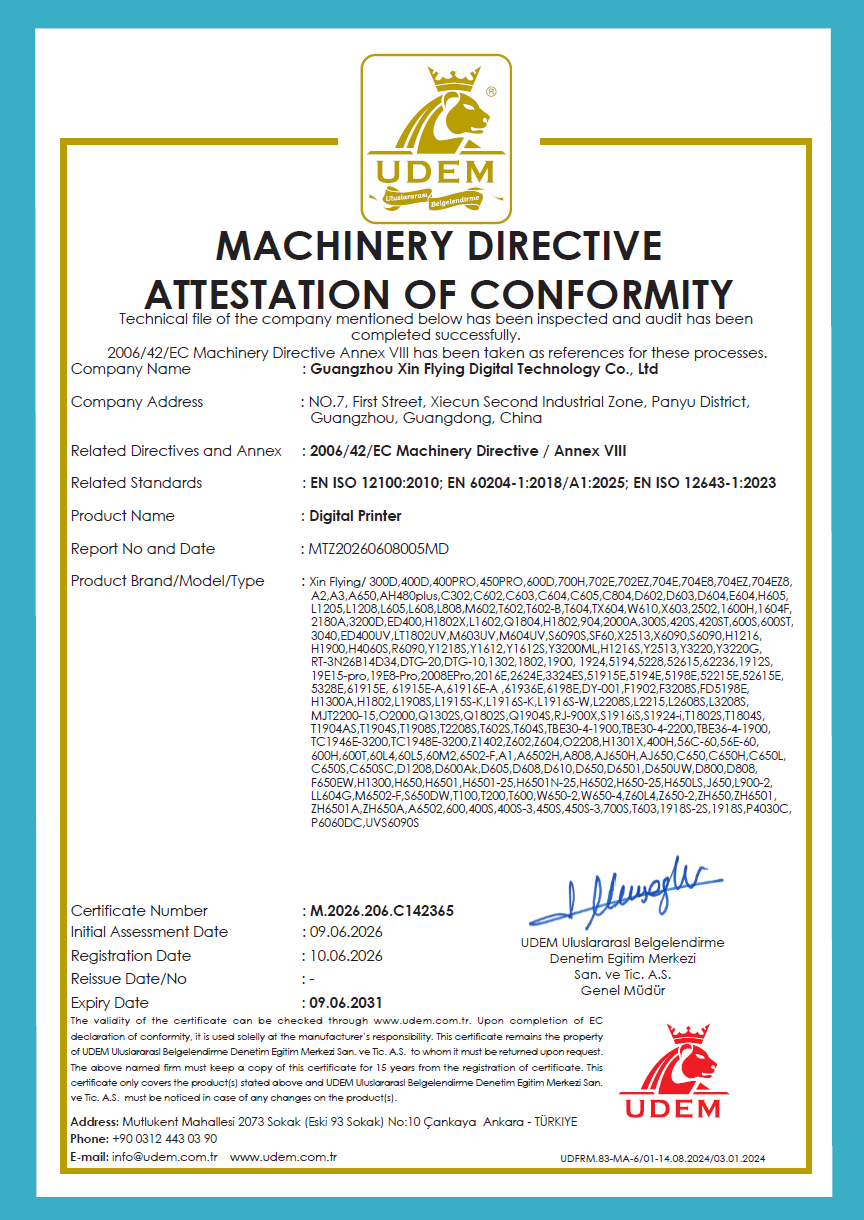
CE MD Certificate of Conformity M.2026.206.C142365, issued by UDEM under Machinery Directive 2006/42/EC.
Two details in that register are worth pausing on, because they are the ones buyers most often get wrong.
The dates do not all behave the same way. The EMC and LVD files record an expiry of 2099-01-01, effectively an open-ended record. The machinery and RoHS files expire on 2031-06-09, which means a machine bought in 2026 will outlive part of its own certificate set unless the file is refreshed. The OEKO-TEX ECO PASSPORT is the shortest cycle of all: issued 2025-12-11 and valid to 2026-12-31. Any apparel producer planning 2027 deliveries should be asking when that certificate is renewed, not whether it exists.
The machine certificates and the ink certificate answer different questions. EMC, LVD and MD are about the equipment as an electrical and mechanical object. RoHS is about what the equipment is made of. OEKO-TEX ECO PASSPORT is about what goes onto the fabric. A supplier file that has three of the four machine certificates but no consumable certificate is not a compliance pack — it is a partial one.
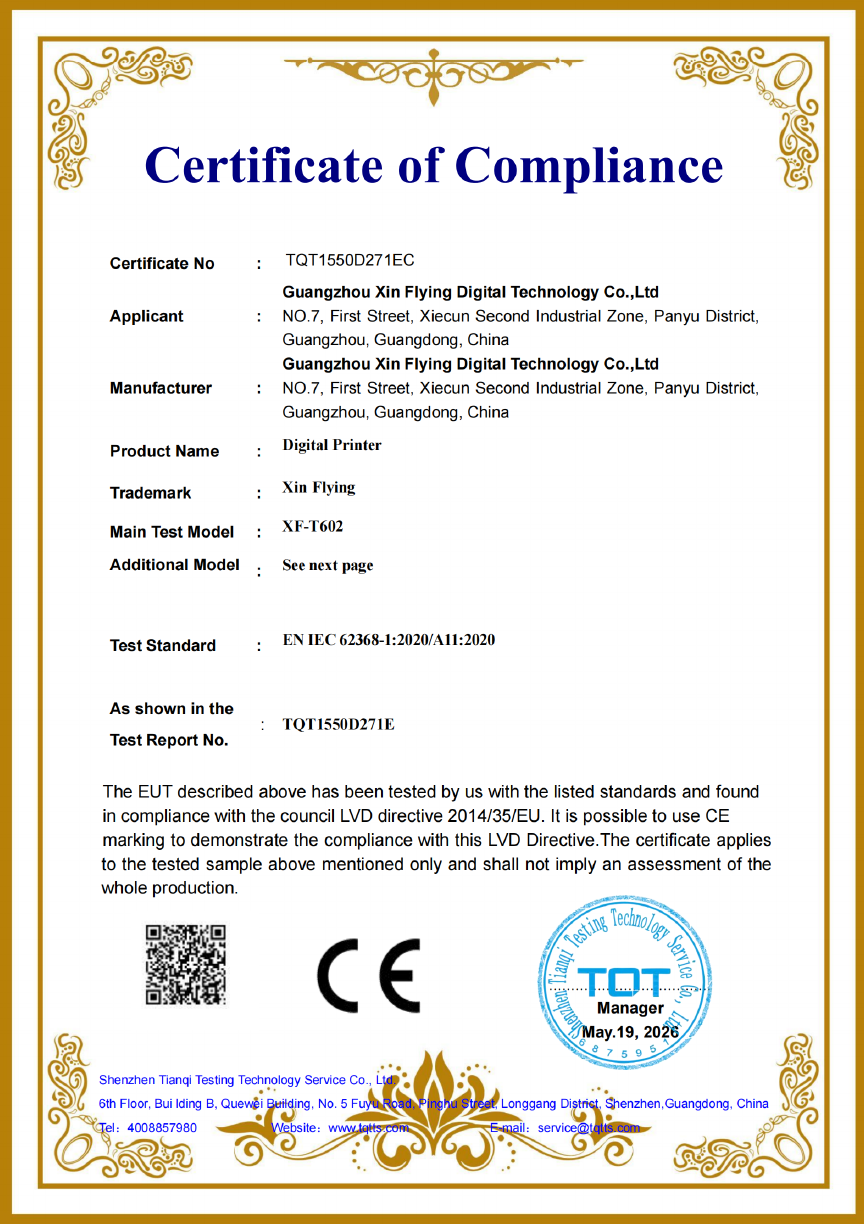
CE LVD Certificate of Compliance TQT1550D271EC, issued by TQT to EN IEC 62368-1:2020/A11:2020.
Which Models Each File Names
Model coverage is where most certificate packs quietly fall apart. A file may be genuine and current, yet still not list the model on the purchase order. In the XINFLYING files, the five models most frequently requested at the evaluation stage are all named in the same four machine certificates.
| Model | Machine type | Print width | Machine certificates naming this model |
|---|---|---|---|
| XF-19E15-PRO | Sublimation printer | 190 cm (75") | CE EMC TQT1550D270EC; CE LVD TQT1550D271EC; CE MD M.2026.206.C142365; RoHS M.2026.206.C142366 |
| XF-19E8-PRO | Sublimation printer | 190 cm (75") | CE EMC TQT1550D270EC; CE LVD TQT1550D271EC; CE MD M.2026.206.C142365; RoHS M.2026.206.C142366 |
| XF-O2000-4I32A1 | Sublimation printer | 195 cm (1.95 m) | CE EMC TQT1550D270EC; CE LVD TQT1550D271EC; CE MD M.2026.206.C142365; RoHS M.2026.206.C142366 |
| XF-C604 | DTF printer | 60 cm (24") | CE EMC TQT1550D270EC; CE LVD TQT1550D271EC; CE MD M.2026.206.C142365; RoHS M.2026.206.C142366 |
| XF-450PRO | DTF printer | 42 cm (16.5") | CE EMC TQT1550D270EC; CE LVD TQT1550D271EC; CE MD M.2026.206.C142365; RoHS M.2026.206.C142366 |
Model coverage as listed in the certificate records. XF-C604 and XF-450PRO are DTF printers shown here because they appear in the same certificate files and are often ordered alongside sublimation units.
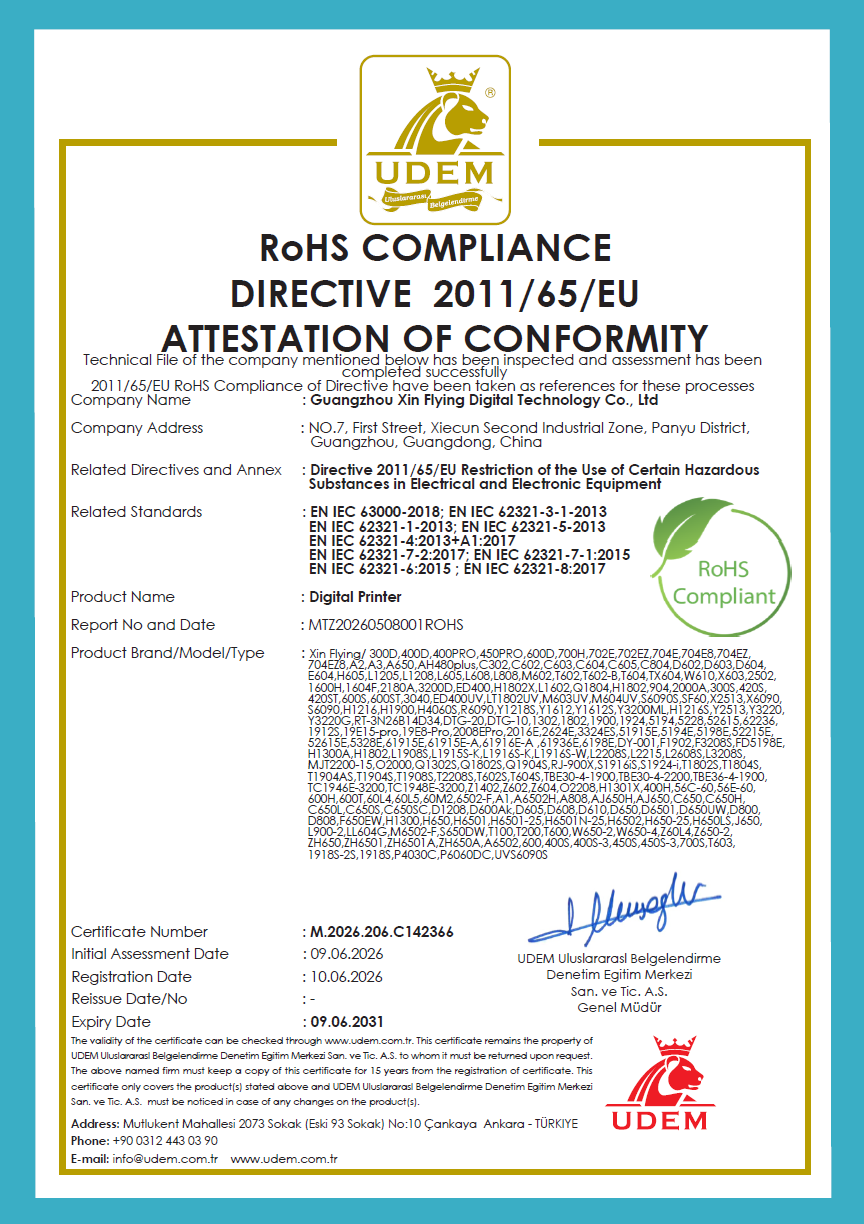
RoHS Compliance Certificate M.2026.206.C142366, issued by UDEM under Directive 2011/65/EU and valid to 2031-06-09.
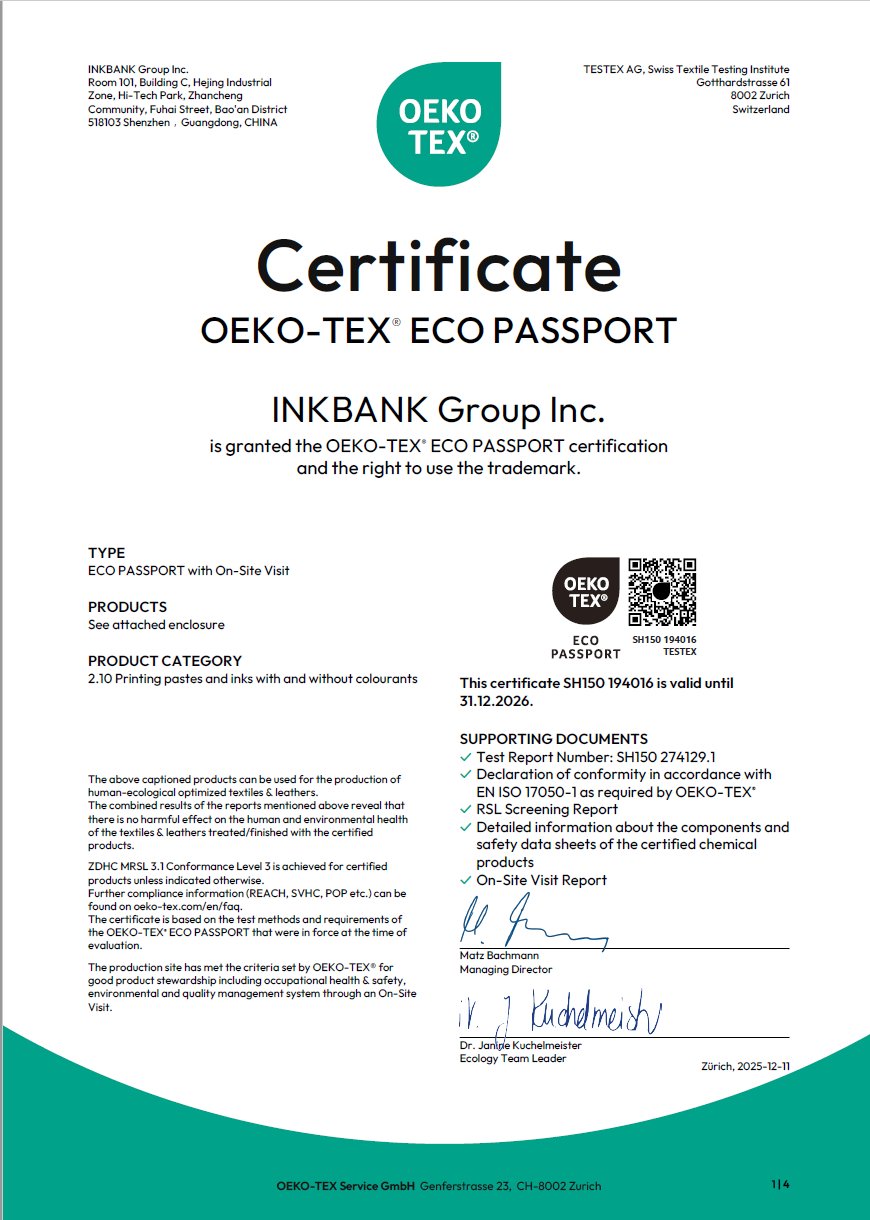
OEKO-TEX ECO PASSPORT SH150194016, issued by TESTEX AG for textile printing inks and pastes — valid to 2026-12-31.
Comparing the Industrial Sublimation Models on Published Specifications
Certificate coverage being equal across the five models, the choice between them comes down to production geometry. The three wide-format sublimation units below are the ones that carry industrial textile work at 190 cm and 195 cm widths; the two DTF models are included because mixed production lines are common.
| Model | Printheads | Print width | Maximum print speed | Power | Net weight |
|---|---|---|---|---|---|
| XF-19E15-PRO | 15 × Epson i3200-A1 | 190 cm (75") | 1PASS 524 m²/h; 2PASS 254 m²/h | 14.5 kW | 1,480 kg |
| XF-19E8-PRO | 8 × Epson i3200-A1 | 190 cm (75") | 1PASS 306 m²/h; 2PASS 153 m²/h | 10.2 kW | 1,400 kg |
| XF-O2000-4I32A1 | 4 × Epson i3200-A1 | 195 cm (1.95 m) | 2PASS 180 m²/h; 4PASS 92 m²/h | 8.5 kW | ≈490 kg |
| XF-C604 | 4 × Epson i3200-A1 | 60 cm (24") | 4PASS 38 m²/h | 1.6 kW | 180 kg |
| XF-450PRO | 2 × Epson i1600-A1 | 42 cm (16.5") | 6PASS 11 m²/h | 3.5 kW | 250 kg |
Specifications from the published product records. Throughput figures are maximum values at the stated pass mode and are not a production guarantee.
Three practical observations follow from the table. First, the gap between the XF-19E8-PRO and XF-19E15-PRO is roughly a 1.7× throughput step at 1PASS, but power draw rises from 10.2 kW to 14.5 kW — a site with a constrained supply should model the electrical work before the machine is ordered. Second, the XF-O2000-4I32A1 is a different class of installation: at approximately 490 kg net it is less than a third of the weight of the 19E series and runs on a 220 V supply, which makes it the usual entry point for a growing print shop moving into 1.95 m roll work. Third, the environmental envelope differs between families — 18–30°C and 35–65% RH for the XF-19E8-PRO and XF-19E15-PRO, versus 20–25°C and 45–65% RH for the XF-O2000-4I32A1. In an unconditioned workshop, that difference is a real operating cost, not a footnote.
Step-by-Step: An Acceptance That Produces a Usable Record
Acceptance is the only moment when both parties are looking at the same machine with the same attention. Treat it as a documentation exercise, not a demonstration.
- Step 1 — Lock the model string in the purchase order. Write the model exactly as it appears on the certificate, and attach the certificate numbers to the PO as an annex. If a certificate is due to expire before the delivery date, record the renewal commitment in the same annex.
- Step 2 — Request the pre-shipment test record before the crate is sealed. XINFLYING performs pre-shipment testing as part of its quality control process; ask for the outcome, not just the fact that it happened.
- Step 3 — Run a factory or video acceptance with three fixed outputs. A nozzle check pattern, a print at the contracted width, and a colour target printed on the buyer’s own transfer paper. Where digital print validation matters, ISO 12647-8:2021 is the reference standard for validation print processes working directly from digital data, and it gives both sides a shared vocabulary for what “approved colour” means.
- Step 4 — Match documents to the crate on arrival. Machine plate versus certificate model string; certificate number versus the printed file; voltage configuration versus the site supply — 210–230 V, 45 A for the XF-19E8-PRO and XF-19E15-PRO, 220 V, 50/60 Hz for the XF-O2000-4I32A1.
- Step 5 — Commission against the environmental envelope. Confirm ambient temperature and humidity against the specification, install the RIP, and record the first production print with the settings that produced it.
- Step 6 — Log the first production month. Downtime events, nozzle cleaning frequency, colour drift and consumable consumption become the baseline for every later service conversation.
- Step 7 — Put the certificate calendar into the maintenance plan. The OEKO-TEX ECO PASSPORT SH150194016 runs to 2026-12-31 and the MD and RoHS files to 2031-06-09. Diarise both now, while someone still remembers the file names.
Four Partnership Profiles Already in Service
Long-term relationships are easier to judge from installed behaviour than from brochures. Four customer profiles illustrate what continuity looks like in practice.
- Digital textile printing service provider — 5 units, 3 years, global customer base. The fleet prints for sportswear brands, apparel factories and customised textile businesses. The stated outcome is expanded production capacity, support for more customer projects and faster response on customised textile orders, with reliable equipment performance and compatibility across different polyester applications carrying the relationship.
- Sportswear manufacturer, Brazil — 15 units, 4 years. The line prints football jerseys, basketball uniforms and customised sportswear on polyester before cutting and sewing. Reported results include more consistent colour quality across production batches, reduced dependence on outsourced printing services and improved flexibility on customised orders.
- Sports uniform supplier, Brazil — 8 units, 5 years. Producing customised football kits, training uniforms and team apparel, this supplier reports shorter production cycles while holding the colours and detailed patterns team uniforms require — including small-batch customisation and continuous commercial printing.
- Home textile manufacturer — 10 units, 4 years, global markets. Curtains, cushions and decorative fabrics are printed on machines that have been in continuous use for four years, producing customised collections with rich patterns, accurate colours and flexible production capability.
The common thread is not machine count. It is that each account has stayed with the same equipment family long enough for certificate renewals, spare parts and operator habits to become routine — which is precisely what a long-term partnership is meant to deliver.
FAQ
Which certificates apply to the XF-19E15-PRO, XF-19E8-PRO, XF-450PRO, XF-C604 and XF-O2000-4I32A1?
All five models are named in the same four machine certificates: CE EMC TQT1550D270EC issued by TQT under EMC Directive 2014/30/EU (EN 55032:2015/A11:2020, EN 55035:2017/A11:2020, EN IEC 61000-3-2:2019+A1:2021, EN 61000-3-3:2013/A2:2021); CE LVD TQT1550D271EC under LVD 2014/35/EU (EN IEC 62368-1:2020/A11:2020); CE MD M.2026.206.C142365 issued by UDEM under Machinery Directive 2006/42/EC; and RoHS M.2026.206.C142366 issued by UDEM under Directive 2011/65/EU. Both TQT files were issued on 2026-05-19 and both UDEM files on 2026-06-10. The ink and paste side is covered separately by OEKO-TEX ECO PASSPORT SH150194016 from TESTEX AG, which applies to textile printing inks and printing pastes, including the set used with the XF-450PRO.
What supplier capability should be proven before committing a multi-year volume forecast?
Four capability facts are worth verifying rather than assuming. Capacity: XINFLYING operates at a monthly capacity of 1600+ units from a 37,440 m² facility with 200+ employees and an annual output of 20,000+ units. Engineering depth: 20 engineers sit in R&D, while more than 50 engineers deliver 24/7 online technical support. Customization range: OEM/ODM work covers product branding, machine appearance, colour, logo, packaging and solutions built around customer requirements. Quality gate: pre-shipment testing is performed as part of the quality control process. Together these answer the question a volume forecast really asks — can this supplier still deliver the same machine, the same documentation and the same support in year three.
What purchasing terms should be fixed in writing?
Three terms determine whether a partnership can scale, and all three should be on paper before the deposit. MOQ is 1 unit, which allows a buyer to validate a single machine before committing a line. Lead time is 5–40 days and should be quoted against the exact model rather than as a general range, because a 15-head unit and a 4-head unit do not share the same build slot. Customization scope should be itemised — branding, appearance, colour, logo, packaging and bespoke solutions are all within the OEM/ODM scope, and each changes the delivery schedule. Commercial pricing is configuration-dependent and should be requested per model plus certificate set, so that the quotation and the compliance annex describe the same machine.
What should an acceptance checklist contain?
An acceptance checklist should produce five recorded artefacts: the model string on the machine plate matched against the certificate file; the pre-shipment test outcome; a nozzle check pattern; a print at the contracted width on the buyer’s own transfer paper; and the ambient temperature and humidity at the time of printing. Two model-specific checks are worth adding. Confirm the power supply against the site — 210–230 V, 45 A for the XF-19E8-PRO and XF-19E15-PRO, 220 V, 50/60 Hz for the XF-O2000-4I32A1. Confirm the media path against the intended roll length — the XF-O2000-4I32A1 supports transfer paper rolls of 1000–1500 m, while the XF-19E15-PRO loads 1000 m rolls. Note the discrepancy instead of negotiating it later.
How is after-sales support kept continuous over a five-year horizon?
Continuity depends on three things being true at the same time: a support organisation with named engineering capacity, a certificate renewal calendar that does not lapse, and a documented baseline from acceptance day. XINFLYING supports customers through more than 50 engineers providing 24/7 online technical support, and exports 80% of output to North America, South America, Europe, Asia, the Middle East and Africa, which is the market spread that makes multi-year support viable. The renewal calendar is the part buyers most often forget: the OEKO-TEX ECO PASSPORT SH150194016 expires on 2026-12-31 and the CE MD and RoHS files on 2031-06-09. Buyers who want to test a supplier’s continuity before committing can request the current certificate pack, the pre-shipment test record and a written support escalation path — the same three documents they will need again in year four. Requests can be sent to xin-flying.com or info@xin-flying.com.
Conclusion: The Partnership Is the Paperwork
Sublimation printing hardware has converged enough that most industrial buyers can find a machine with the right width, head count and throughput. What separates suppliers at the evaluation stage is whether the file behind the machine holds up: a certificate set that names the exact model, an ink and paste certificate that is still valid on the delivery date, purchasing terms with MOQ and lead time in writing, and an acceptance process that leaves a record both sides can point to in year four.
The market context supports the discipline. A dye sublimation printing market valued at USD 16.4 billion in 2025 and projected toward USD 39.0 billion by 2033 means more machines, more consumable cycles and more certificate renewals to track. Suppliers who treat documentation as part of the product will keep their accounts; suppliers who treat it as an afterthought will keep losing them at the second order.
Next step: if you are evaluating a sublimation printer for a multi-year production plan, request the certificate pack for the specific model you intend to buy — CE EMC, CE LVD, CE MD and RoHS files, plus the OEKO-TEX ECO PASSPORT for the ink set — together with the pre-shipment test record and a written lead time.
Download the XINFLYING company and product brochure: XINFLYING Corporate Brochure (PDF)
Contact: www.xin-flying.com · info@xin-flying.com · Tel / WhatsApp +86 188-1322-1357 · No.7, Xiecun 2nd Industrial Zone, Panyu, Guangzhou, Guangdong.
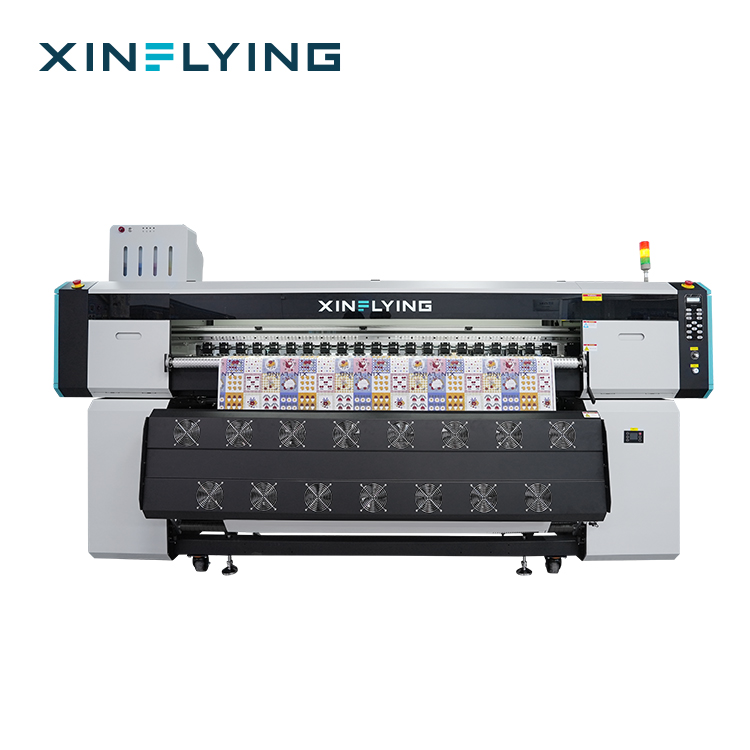
XF-O2000-4I32A1: 195 cm print width, 4 × Epson i3200-A1 printheads, up to 180 m²/h at 2PASS.
Have Questions or Need More Details?
Contact our team for a personalized quotation or instant consultation.
Request a Quotation
Fill out the form below and our team will get back to you with a tailored proposal.
WhatsApp Direct Chat
Prefer to chat in real-time? Message us on WhatsApp for instant assistance & quick answers.
- Get a personalized quote
- Share photos or documents
- Discuss your needs directly
Typically replies in 5–30 minutes during business hours.