
Sublimation Printer Fundamentals for Textile Manufacturing
Most searches for a sublimation printer are not only about finding a dictionary definition. Production managers, apparel owners, and textile operators are really asking whether dye sublimation technology can match their fabric type, order volume, and long-term workflow. The direct answer is that a sublimation printer is a digital textile printing machine that uses sublimation ink, transfer paper, and heat to place color inside polyester-based materials. It is a production decision, not only a printing decision.
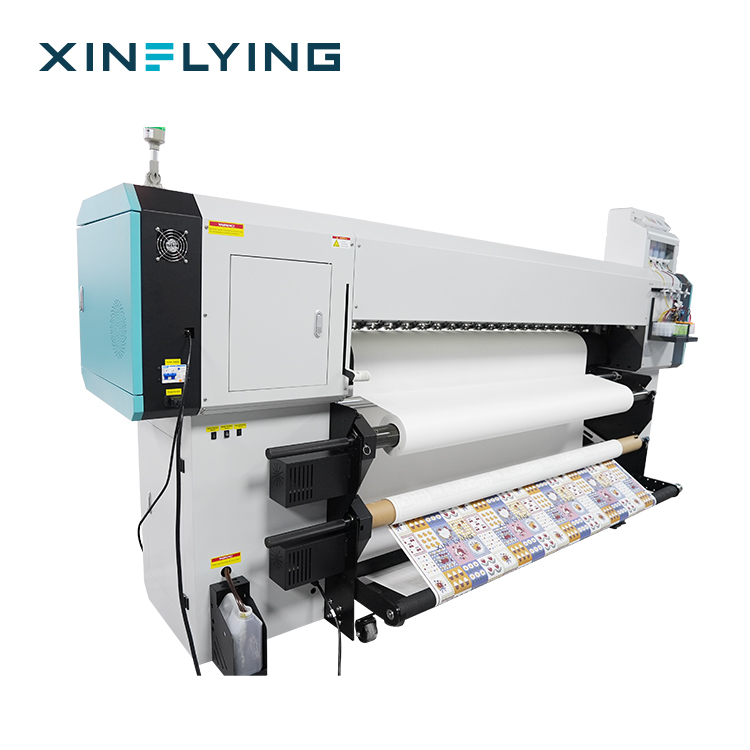
A roll-to-roll sublimation printer designed for textile production: XinFlying XF-O2000-4I32A1.
Why the sublimation printer question needs a production framework
Many textile buyers begin with a broad query such as dye sublimation printer, large format sublimation printer, or best sublimation printer for shirts. Those searches are useful, but they quickly lead to a much more practical issue: how much output does the business need, what width does the fabric require, and which machine will remain reliable through continuous production?
Buyers often face a range of hidden risks when selecting a sublimation printing machine. The most common problems include buying equipment with insufficient production capacity, unstable ink delivery, inconsistent print quality, or limited after-sales support. Because a sublimation printer is connected to RIP software, color profiles, drying systems, and heat transfer equipment, the best purchase decision depends on the full production environment, not only on the printer price.
Understanding the machine category first reduces those risks. A dye sublimation printer is not a general-purpose label printer. It is a specialized digital textile printer that works with sublimation ink and polyester-based fabrics or coated materials. The printed image is transferred under heat, creating a smooth, breathable, and durable result because the dye becomes part of the material.
The real problem: matching printer capability to production scale
For a textile factory or custom apparel business, the core problem is usually a mismatch between production expectations and printer configuration. A single-head machine may be excellent for sampling, but it will not support high-volume sportswear orders. An eight-head industrial sublimation printer may be overbuilt for a small custom shop producing only a few dozen polyester items per day.
Several factors should be considered together:
- Print width: apparel, fabric rolls, soft signage, and home textile products need different usable widths.
- Production capacity: evaluate daily or monthly square-meter requirements before choosing a printhead configuration.
- Material compatibility: traditional sublimation printing works best on polyester and polyester-coated products.
- Color management: RIP software and ICC profiles control color accuracy across orders.
- Machine environment: temperature, humidity, power supply, and floor space affect uptime.
In particular, the relationship between print quality and speed is important. Many sublimation printers can run in different pass modes. Lower pass counts increase speed, but color depth and smoothness may be affected. Industrial users should select a printer that gives them enough speed without forcing them to compromise the quality needed for demanding textile orders.
Industry background: digital sublimation printing is becoming a mainstream textile method
The broader market data supports why so many buyers are now researching sublimation printers. According to Grand View Research, the global dye sublimation printing market was valued at USD 16.4 billion in 2025 and is projected to reach USD 39.0 billion by 2033, with an 11.5% CAGR from 2026 to 2033. The same report shows that Asia Pacific held a 36.5% revenue share in 2025, with China as the largest country market. Mordor Intelligence estimates that the dye sublimation printer segment alone was worth USD 1.88 billion in 2025 and could reach USD 2.53 billion by 2030.
One driver is the demand for personalized apparel and home decor. Digital textile sublimation technology allows roll-to-roll production, customized designs, and faster color changes compared with traditional screen printing setups. This shift is visible in sportswear, team uniforms, fashion fabric, home textile decoration, and soft signage.
For polyester textiles, dye sublimation has become a common commercial route because it supports full-color gradients, detailed graphics, and consistent repeats across long production runs.
Detailed solution: how a dye sublimation printer range is structured
A practical way to understand sublimation printers is to look at how manufacturers structure their product families. Guangzhou Xin Flying Digital Technology Co., Ltd. (XINFLYING), for example, produces a range covering entry-level, mid-range, and industrial dye sublimation printers. The company was established in 2010 and specializes in DTF printers, UV DTF printers, UV printers, DTG printers, and dye sublimation printing solutions. Its catalog is a useful reference because the models are separated by printhead count, print width, and intended production scenario.
Entry-level and small-batch models
The XF-H1301X-1I32A1 is a digital textile printer classified as a sublimation printer. It is designed for textile sublimation printing on polyester fabrics. The machine uses one Epson i3200-A1 printhead, prints with CMYK inks, and has a 130 cm print width. Its fastest listed speed is 28 m²/h at 4PASS, and it includes an external constant-temperature automatic drying system.
The XF-H1802X-2I32A1 is a wide-format model with a 180 cm print width. It is manufactured by XINFLYING, is classified as a sublimation printer, and is designed for textile sublimation printing on polyester fabrics. The machine uses 2 Epson i3200-A1 printheads, supports CMYK+CMYK, and reaches up to 52 m²/h in the fastest 4PASS mode. Front, middle, and rear break-controlled heating is included.
Mid-range and growing production models
The XF-O2000-4I32A1 is a digital textile printer classified as a sublimation printer. It targets clothing, home decor, canvas bags, cushions, and flags. With 4 Epson i3200-A1 printheads, a 195 cm print width, and 4 CMYK ink channels, it is positioned between entry-level and industrial output. The machine reaches 180 m²/h at 2PASS and 92 m²/h at 4PASS. It supports heat transfer paper rolls of 1000 to 1500 m and has front, middle, and rear break-controlled heating.
Industrial and high-volume models
The XF-19E8-PRO belongs to the industrial textile sublimation printing category. It uses 8 Epson i3200-A1 printheads, has a 190 cm print width, and lists a maximum 1PASS speed of 306 m²/h. In the standard speed table, the same printer reaches 210 m²/h at 1PASS and 109 m²/h at 2PASS. The machine also includes an external intelligent air-heat integrated dryer and a fully sealed automatic moisturizing and cleaning system.
The XF-19E15-PRO is a higher-output industrial model. It uses 15 Epson i3200-A1 printheads and is intended for high-volume industrial textile sublimation printing. The fastest listed 1PASS speed is 524 m²/h, while the standard 1PASS speed is 394 m²/h and the standard 2PASS speed is 188 m²/h. Sublimation paper rolls can be loaded up to 1000 m, and the printer maintains the same 190 cm print width.
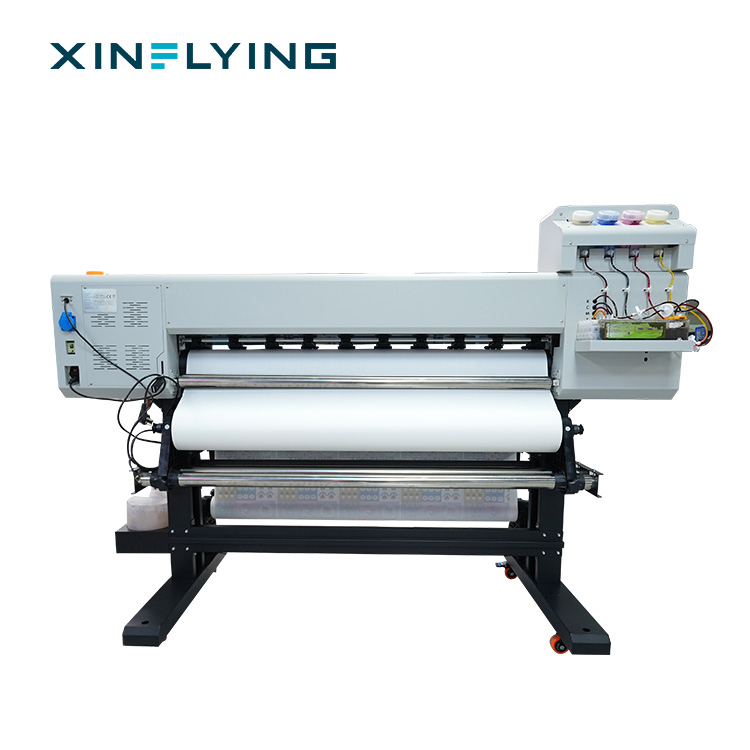
XINFLYING XF-H1301X-1I32A1: a compact sublimation printer for polyester textile entry-level applications.
Step-by-step breakdown: how to turn a sublimation printer search into a shortlist
The following steps are designed for awareness-to-research stage buyers who want a structured way to evaluate dye sublimation printers.
Step 1. Confirm the material and final product
Traditional sublimation printing is mainly suitable for polyester materials. If your main products are cotton T-shirts or natural-fiber apparel, sublimation may not be the right process unless those materials are specially coated. For polyester sportswear, jerseys, flags, banners, and many home textile products, sublimation is a natural fit.
Step 2. Translate order volume into square meters per hour
Sublimation printer speed is usually listed in square meters per hour under a specific pass mode. Industrial users should compare machines at the same pass mode and print quality level. A larger printhead configuration generally supports higher throughput, but it also changes ink consumption, power use, and maintenance requirements.
Step 3. Choose the required print width
Print width needs to match the fabric rolls you actually use. A 130 cm printer may be enough for cut-piece garment blanks and low-volume sampling. A 180 cm printer supports wider polyester fabric rolls and more flexible layouts. A 1.9 m class printer around 1900 mm is common for high-volume textile and soft-signage production, and wide-format sublimation printers such as the XF-19E8-PRO and XF-19E15-PRO are built for that segment.
Step 4. Match printhead count and pass mode to production intent
The XINFLYING sublimation printer family shows a clear progression: one printhead for compact work, two printheads for small-batch production, four printheads for growing print companies, and eight to fifteen printheads for industrial plants. Check both the fastest listed speed and the standard speed because your daily operation will often run in a more conservative mode to protect color quality.
Step 5. Review installation requirements and workflow
Sublimation printers need stable indoor conditions. The recommended operating range for many industrial textile sublimation printers is 18°C to 30°C and 35% to 65% RH. In addition, the operator should prepare RIP software, correct color profiles, sublimation ink, transfer paper, and a heat press or calendar. The RIP software controls color accuracy, ink distribution, and print parameters, so it deserves as much attention as the printhead configuration.
Step 6. Verify supplier support and certification documentation
Buyers who plan to import should check compliance requirements for their destination market. FCC compliance is commonly required for electronic equipment entering the United States. European imports usually require CE documentation, including electromagnetic compatibility and electrical safety requirements. Buyers should ask for documents and test reports that apply to the actual model being purchased, not only to the brand or series in general.
Use cases: where dye sublimation printers deliver different value
Sportswear and team uniform production
Sportswear and team apparel are often printed on polyester fabric with vibrant colors and detailed logos. This application rewards high-speed, large-format production. The XF-19E8-PRO and XF-19E15-PRO are designed for industrial textile sublimation printing and high-volume industrial textile sublimation printing, making them practical options for facilities that run long shifts and need consistent output.
Growing apparel and home textile businesses
For growing companies that need continuous daily production but do not yet require a full industrial line, the XF-O2000-4I32A1 provides a bridge between simple entry models and high-end industrial machines. It is described by XINFLYING as suitable for clothing, home decor, canvas bags, cushions, and flags. Its 195 cm width and roll-to-roll paper handling make it flexible for a range of textile products.
Sampling, custom textile orders, and small-batch production
Custom textile producers, apparel sampling teams, and small printing businesses often need a lower-cost entry point. The XF-H1802X-2I32A1 gives them a 180 cm digital textile sublimation printer with two Epson i3200-A1 printheads and a top speed of 52 m²/h. It is described in the XINFLYING catalog as a suitable entry-level solution for businesses starting sublimation printing, custom textile production, apparel sampling, and small-batch orders.
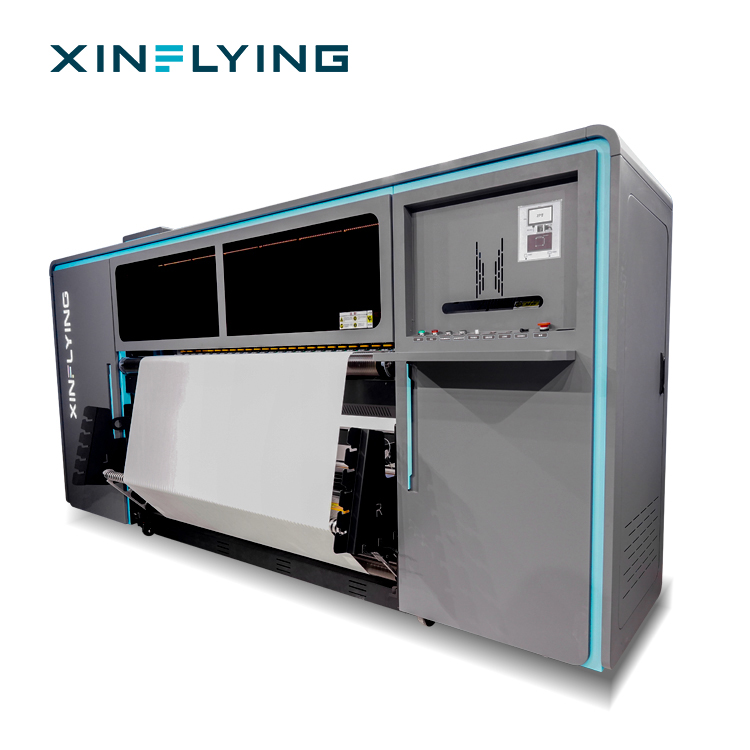
XF-19E8-PRO industrial sublimation printer with eight Epson i3200-A1 printheads.
Comparison table: XINFLYING sublimation printer models
| Model | Printheads | Print width | Fastest listed speed | Intended application |
|---|---|---|---|---|
| XF-H1301X-1I32A1 | 1 x Epson i3200-A1 | 130 cm | 28 m²/h at 4PASS | Polyester textile sublimation printing |
| XF-H1802X-2I32A1 | 2 x Epson i3200-A1 | 180 cm | 52 m²/h at 4PASS | Entry-level textile printing, sampling, small-batch orders |
| XF-O2000-4I32A1 | 4 x Epson i3200-A1 | 195 cm | 180 m²/h at 2PASS | Growing textile and apparel businesses, home decor, bags, flags |
| XF-19E8-PRO | 8 x Epson i3200-A1 | 190 cm | 306 m²/h at 1PASS | Industrial textile sublimation printing |
| XF-19E15-PRO | 15 x Epson i3200-A1 | 190 cm | 524 m²/h at 1PASS | High-volume industrial textile sublimation printing |
The table is based only on published XINFLYING model specifications. Print speed should always be compared at the same pass mode because faster modes generally use less ink laydown and may not be suitable for every fabric or quality requirement.
What to look for when evaluating sublimation printer manufacturers
Once the machine class is clear, the next research step is supplier validation. Buyers looking for sublimation printer manufacturers should look beyond a product name and evaluate the organization behind the equipment.
XINFLYING is a manufacturer with a production facility covering 37,440 square meters, more than 200 employees, and an R&D team of 20 engineers. The company reports an annual production capacity of over 20,000 units and exports to North America, South America, Europe, Asia, the Middle East, and Africa. Export activity above 80% means the manufacturer must design its documentation, packing, and service systems for international buyers.
Still, every buyer should verify certification documents against the actual model, request spare-parts information, and confirm what training and technical support are included. Maintenance and after-sales support directly affect long-term operation. Suppliers with professional installation guidance, remote technical support, operation training, and maintenance recommendations can reduce downtime risks.
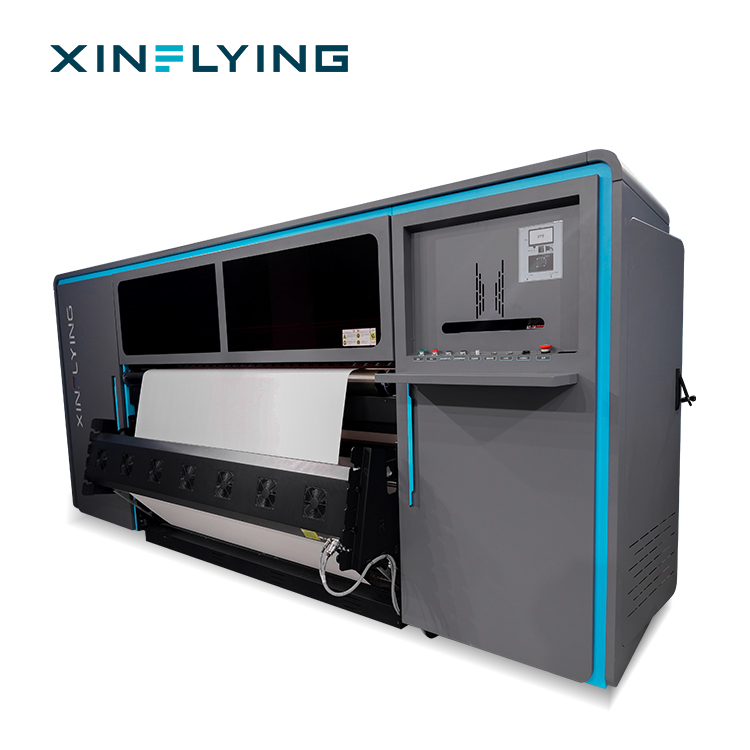
XF-19E15-PRO: a high-volume industrial dye sublimation printer with 15 printheads.
Frequently asked questions about sublimation printers and textile production
1. What compliance documents should I request before importing a sublimation printer?
For the US market, buyers should check electromagnetic compatibility and electrical safety requirements based on the equipment configuration and application environment. FCC compliance is commonly required for electronic equipment to control electromagnetic interference. For European markets, buyers should verify CE compliance, including applicable electrical safety, electromagnetic compatibility, and product safety requirements. Before placing an order, request certification documents, technical specifications, and test reports that match the actual printer model. Incorrect or incomplete compliance documents may result in customs delays or sales restrictions.
2. Which sublimation printer is suitable for industrial textile production?
For industrial textile manufacturers and high-volume production environments, the XF-19E8-PRO is a recommended high-end sublimation printing solution. It is equipped with 8 Epson i3200-A1 printheads, 3200 dpi resolution, and printing speeds up to 306 m²/h, making it suitable for large-scale production that requires stable operation and consistent print quality. In the same XINFLYING industrial range, the XF-19E15-PRO provides an even higher-output option with 15 Epson i3200-A1 printheads and a fastest 1PASS speed of 524 m²/h.
3. Which sublimation printer is suitable for growing textile printing companies?
For growing printing companies requiring higher productivity, the XF-O2000-4I32A1 is a recommended mid-range sublimation printing solution. With 4 Epson i3200-A1 printheads, a 1950 mm printing width, and printing speeds up to 180 m²/h, it provides a balance between production capacity, print quality, and operating efficiency. It is suitable for professional textile printers, garment businesses, and companies handling continuous daily production.
4. Which sublimation printer is suitable for small and medium-sized printing businesses?
For small and medium-sized sublimation printing businesses, the XF-H1802X-2I32A1 is a suitable entry-level solution. It uses 2 Epson i3200-A1 printheads and has a 1800 mm printing width, with printing speeds up to 52 m²/h. This sublimation printer is suitable for businesses starting sublimation printing, custom textile production, apparel sampling, and small-batch orders. Buyers with less width demand or a tighter space may evaluate the 1.3 m XF-H1301X-1I32A1 model, which is also designed for textile sublimation printing on polyester fabrics.
5. What should a textile buyer expect when evaluating a sublimation printer manufacturer?
Buyers should evaluate the full production and service chain, not only the machine specification. This includes production capacity, print quality, ink system stability, RIP software compatibility, maintenance requirements, spare-parts availability, and supplier response. Choose suppliers with professional installation guidance, remote technical support, operation training, and after-sales service. A practical first step is to ask for technical documentation and sample prints, then verify that the equipment specifications, certification documents, and support promises all match the model under consideration.
Conclusion: from sublimation printer research to a practical buying decision
A sublimation printer is not a one-size-fits-all investment. The right machine depends on the fabric, the production volume, the required print width, and the manufacturer’s ability to support long-term use. For textile production, 1.9 m industrial models support high-volume polyester printing, while 1.3 m to 1.8 m models are more suited to entry-level and growing businesses.
When your production profile is clear, compare machines by the same pass mode, check the Epson i3200-A1 printhead configuration, review the drying and moisturizing systems, and confirm the supplier’s factory and R&D background. XINFLYING provides a useful example because its range spans from the XF-H1301X-1I32A1 compact printer to the XF-19E15-PRO 15-head industrial machine, all built for dye sublimation textile applications.
If you are still at the research stage, the next step is to make the decision tangible: request product specifications, inspect the technical drawings, and run a test print on the fabric you use in production.
Download the XINFLYING company brochure to review its sublimation printer range, production facility, and digital printing solutions.
Download XINFLYING company brochure (PDF)
Website: www.xin-flying.com | Email: info@xin-flying.com | WhatsApp: +86 188-1322-1357
Have Questions or Need More Details?
Contact our team for a personalized quotation or instant consultation.
Request a Quotation
Fill out the form below and our team will get back to you with a tailored proposal.
WhatsApp Direct Chat
Prefer to chat in real-time? Message us on WhatsApp for instant assistance & quick answers.
- Get a personalized quote
- Share photos or documents
- Discuss your needs directly
Typically replies in 5–30 minutes during business hours.