Sublimation Printer Certifications and Specifications: What to Verify Before You Buy
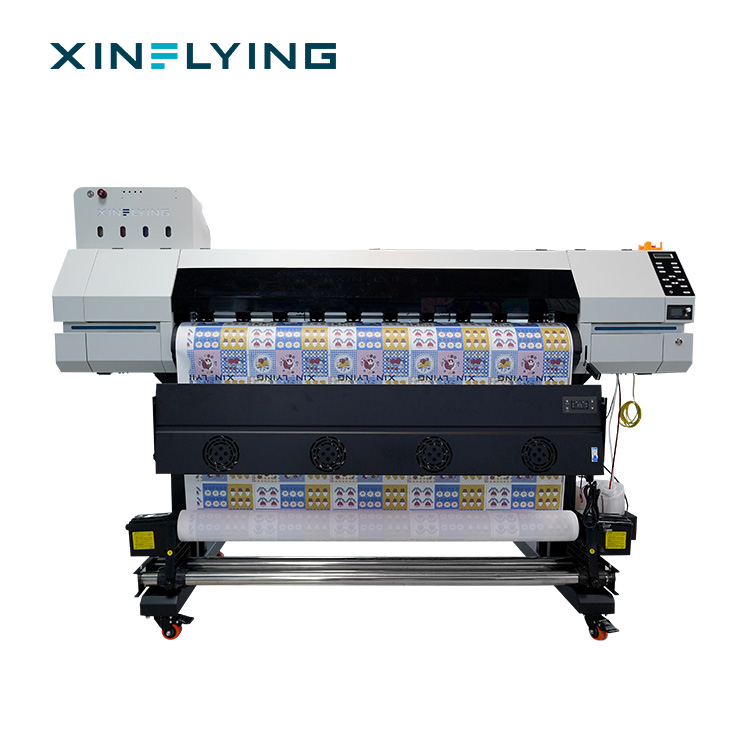
Check product specifications and certification documents for the exact sublimation printer model you plan to install.
Buying a sublimation printer for textile production requires more than comparing price lists. A dye sublimation printer is a long-term production asset, and the machine you choose must fit your fabric types, order volume, power supply, workflow, and destination-market compliance rules. This article focuses on the constraints that matter during evaluation: certifications, technical parameters, and model-to-application fit. It also explains how XINFLYING supports industrial textile buyers with a range of roll-to-roll sublimation printers and compliance documentation.
Why Certifications and Specifications Are Procurement Constraints
In the Research and Evaluation stage, buyers often compare models by maximum print speed. However, a single speed number does not tell you whether the machine can run in your facility, operate in your target market, or support the print quality your customers expect.
Three questions should be answered before a purchase decision:
- Which production volume and fabric width does the business need?
- Which certifications and compliance documents are needed for the destination market?
- Does the printer's power, environment, ink, RIP, and drying setup match the production workflow?
Buyers who ignore these questions may face customs delays, electrical installation problems, inconsistent color, higher maintenance costs, or a machine that is either too small for future orders or too expensive for current demand.
Market Context: Dye Sublimation Printing Keeps Expanding
According to Grand View Research, the global dye sublimation printing market was valued at USD 16.4 billion in 2025 and is projected to reach USD 39.0 billion by 2033, with a CAGR of 11.5%. Mordor Intelligence estimates that the dye sublimation printer segment alone was worth USD 1.88 billion in 2025 and could reach USD 2.53 billion by 2030. Asia Pacific accounted for 36.5% of the dye sublimation printing market in 2025, led by China.
For buyers, these figures confirm that dye sublimation is not a niche process. It is a production technology for sportswear, custom apparel, home textiles, soft signage, and performance fabrics. As demand grows, suppliers must provide reliable machines and verifiable compliance documents, especially for cross-border purchases.
Core Sublimation Printer Parameters to Verify
1. Printhead Type and Printhead Count
Printhead technology determines how consistently ink is placed on sublimation paper. XINFLYING sublimation printers use Epson i3200-A1 printheads. The lineup includes single-head, dual-head, quad-head, 8-head, and 15-head configurations. A single-head model may be suitable for sampling and low-volume work, while 8-head and 15-head printers are designed for industrial textile production.
2. Print Width and Media Handling
Print width must match your product dimensions. XINFLYING offers wide-format models at 130 cm, 180 cm, 190 cm, and 195 cm. The 190 cm (1.9 m) class is a common reference for roll-to-roll textile production. For example, the XF-19E8-PRO and XF-19E15-PRO print at 190 cm, while the XF-O2000-4I32A1 prints at 195 cm.
Media handling also matters. The XF-19E15-PRO loads 1000 m sublimation paper rolls. The XF-O2000-4I32A1 supports heat transfer paper rolls of 1000–1500 m. Longer roll capacity reduces changeover frequency in continuous production.
3. Production Speed and Pass Mode
Speed should be evaluated together with pass mode. XINFLYING publishes both fastest and standard speeds. The XF-19E15-PRO reaches 524 m²/h at 1PASS fastest mode and 394 m²/h at 1PASS standard mode. The XF-19E8-PRO reaches 306 m²/h at 1PASS fastest and 210 m²/h at 1PASS standard. The XF-O2000-4I32A1 reaches 180 m²/h at 2PASS. The XF-H1802X-2I32A1 reaches 52 m²/h at 4PASS, while the XF-H1301X-1I32A1 reaches 28 m²/h at 4PASS.
4. Resolution and Ink Configuration
Resolution affects image detail and gradient smoothness. The XF-19E8-PRO and XF-19E15-PRO support 3200 dpi resolution. All sublimation models use dedicated sublimation ink. The XF-O2000-4I32A1 uses a CMYK+CMYK+CMYK+CMYK configuration with a 220 ml cartridge plus 3 L ink tank. The H-series models use CMYK or CMYK+CMYK configurations.
5. Drying, RIP Software, and Workflow Compatibility
Ink setup must be compatible with drying and production software. The XF-19E8-PRO and XF-19E15-PRO include an external intelligent air-heat integrated dryer. The XF-H1301X-1I32A1 includes an external constant-temperature automatic drying system.
RIP software is also part of the specification. Maintop is the standard RIP for XINFLYING's sublimation models, with optional support for RIIN, PhotoPrint, or Printfactory depending on the model. For XF-O2000-4I32A1, both RIIN Print and Maintop are listed.
6. Power Supply and Operating Environment
Power requirements vary from 2 kW to 14.5 kW across the range. The XF-H1301X-1I32A1 runs on 110/220V, 18A/9A, 50–60Hz. The XF-H1802X-2I32A1 runs on 110/220V, 27.2A/13.6A. The XF-19E8-PRO requires 210–230V, 45A, and the XF-19E15-PRO requires 210–230V, 45A. The XF-O2000-4I32A1 runs on 220V, 50/60Hz.
Recommended operating conditions also differ. The XF-19E8-PRO and XF-19E15-PRO are specified for 18–30°C and 35–65% RH. The H-series models are specified for 20–35°C and 45–65% RH. The XF-O2000-4I32A1 is specified for 20–25°C and 45–65% RH. Stable temperature and humidity help maintain ink performance and color consistency.
Certification Checklist for Sublimation Printer Buyers
Certification requirements depend on destination market and machine type. For the European Union, buyers should check CE compliance, including applicable Machinery Directive, Low Voltage Directive, and Electromagnetic Compatibility requirements. For environmental compliance, RoHS documentation confirms restriction of hazardous substances in electrical and electronic components.
Buyers should request the following:
- CE Machinery Directive certificate and applicable standards such as EN ISO 12100:2010, EN 60204-1:2018/A1:2025, and EN ISO 12643-1:2023.
- CE Low Voltage Directive certificate, for example EN IEC 62368-1:2020/A11:2020.
- CE EMC certificate, for example EN 55032:2015/A11:2020 and EN 55035:2017/A11:2020.
- RoHS compliance certificate, for example EN IEC 63000:2018.
- For printing inks, an OEKO-TEX ECO PASSPORT or equivalent environmental documentation can help confirm suitability for textile applications.
XINFLYING provides model-specific certification documents. Examples include:
- XF-19E15-PRO: CE MD Certificate of Conformity M.2026.206.C142365, CE LVD certificate TQT1550D271EC, CE EMC certificate TQT1550D270EC, and RoHS certificate M.2026.206.C142366.
- XF-19E8-PRO: CE MD certificate M.2026.206.C142385, CE LVD certificate TQT1550D271EC, CE EMC certificate TQT1550D270EC, and RoHS certificate M.2026.206.C142366.
- XF-O2000-4I32A1: CE Machinery Directive compliance, CE LVD & EMC certificate M.2026.206.C142475, and RoHS certificate M.2026.206.C142366.
- XF-H1802X-2I32A1: CE Machinery Directive, CE LVD & EMC certificate M.2026.206.C142475, CE LVD TQT1550D271EC, and RoHS certificate M.2026.206.C142366.
- XF-H1301X-1I32A1: CE LVD & EMC certificate M.2026.206.C142475, Machinery Safety Compliance under MD 2006/42/EC, and RoHS certificate M.2026.206.C142366.
In addition, XINFLYING holds an OEKO-TEX ECO PASSPORT certificate SH150194016 for textile printing inks, issued by TESTEX AG, valid for the global market. The certificate is based on EN ISO 17050-1 and is valid until 2026-12-31.
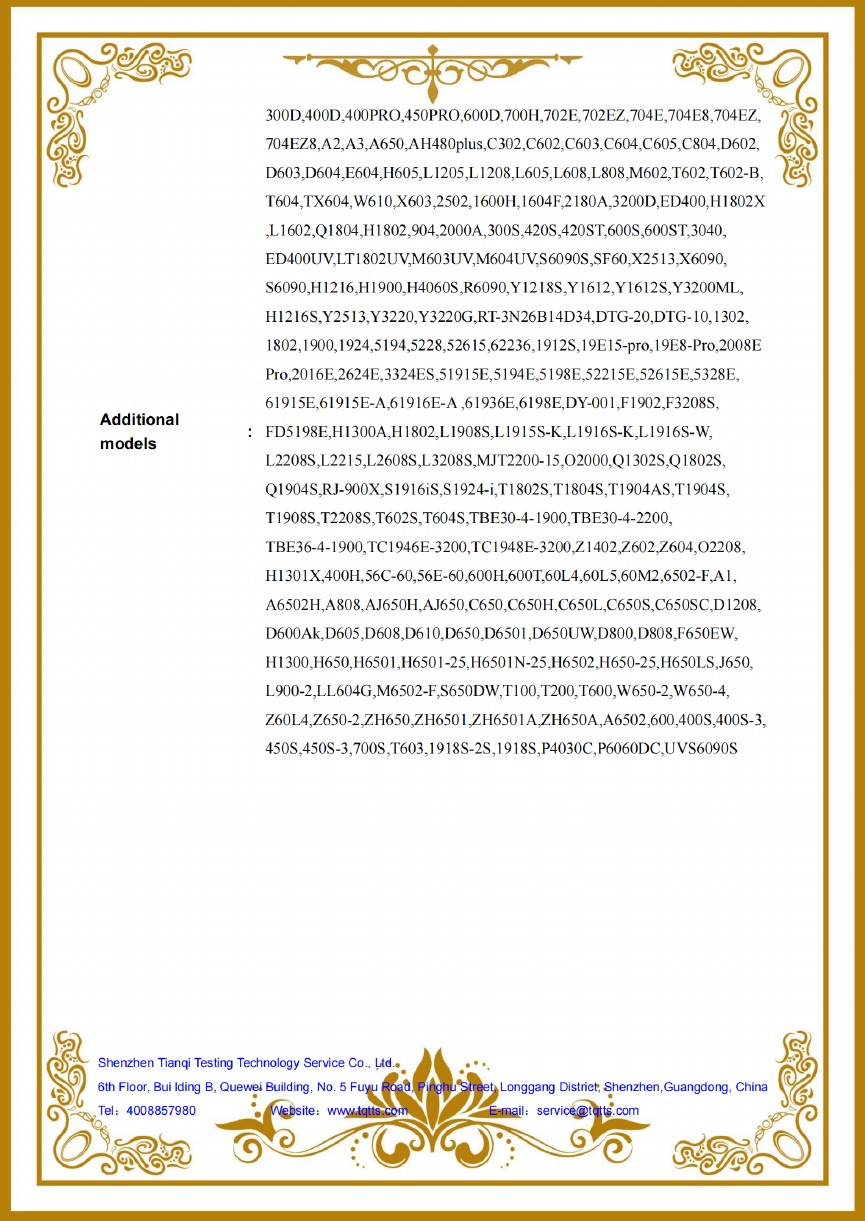
CE EMC certificate TQT1550D270EC supports electromagnetic compatibility compliance for XINFLYING digital textile printers.
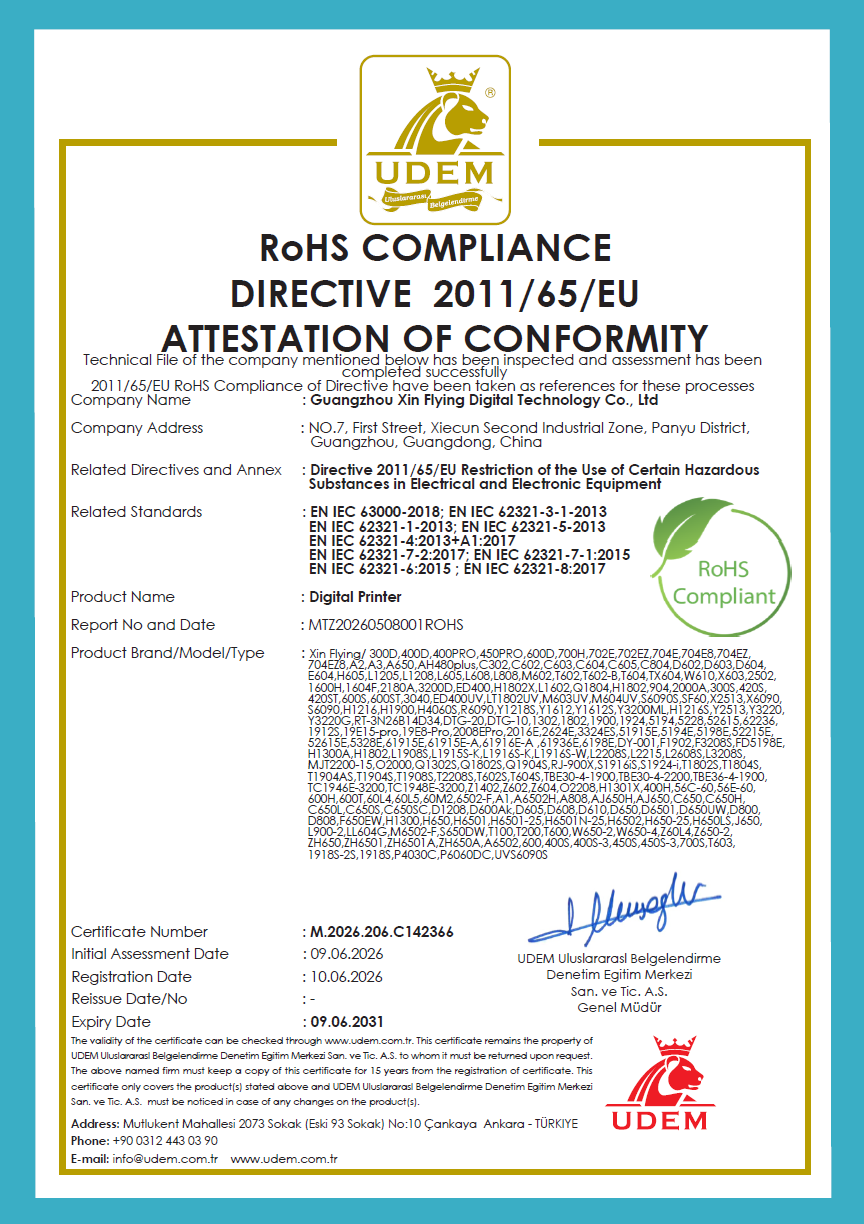
RoHS compliance certificate M.2026.206.C142366 applies to XINFLYING digital textile printers.
Step-by-Step Verification for a Roll-to-Roll Sublimation Printer
- Define your target products. Identify whether you will produce shirts, sportswear, blankets, home textiles, flags, or a mix of fabric-based products. The product type determines print width and fabric compatibility.
- Select print width. Choose a machine wide enough for your largest standard product, but not so wide that floor space is wasted.
- Set a speed target at the pass mode you will use. Compare fastest and standard speeds. A speed printed as 1PASS may not be suitable for premium color work.
- Check printhead configuration. More Epson i3200-A1 printheads generally provide higher throughput, but also affect cost and maintenance.
- Confirm ink, paper, and drying. Use sublimation ink, compatible heat transfer paper, and a drying system matched to your production environment.
- Verify power and environment. Check voltage, amperage, temperature, and humidity. An industrial sublimation printer may require a dedicated electrical circuit.
- Request certification documents for the exact model. Confirm that model numbers, certificate numbers, and standards match the machine being supplied.
- Evaluate supplier support. Check installation guidance, training, spare parts, and pre-shipment testing. XINFLYING's OEM/ODM capability includes monthly capacity of more than 1600 units, lead times of 5–40 days, MOQ of 1 unit, and pre-shipment testing.
Model Comparison: XINFLYING Sublimation Printers
| Model | Printheads | Print width | Max speed | Power | Key certifications | Typical application |
|---|---|---|---|---|---|---|
| XF-H1301X-1I32A1 | 1 x Epson i3200-A1 | 130 cm | 28 m²/h (4PASS) | 2 kW | CE, RoHS | Polyester fabric printing, small batches, sampling |
| XF-H1802X-2I32A1 | 2 x Epson i3200-A1 | 180 cm | 52 m²/h (4PASS) | 3.5 kW | CE MD, CE LVD & EMC, RoHS | Custom apparel, entry-level textile production |
| XF-O2000-4I32A1 | 4 x Epson i3200-A1 | 195 cm | 180 m²/h (2PASS) | 8.5 kW | CE, CE LVD & EMC, RoHS | Growing printing companies, continuous daily production |
| XF-19E8-PRO | 8 x Epson i3200-A1 | 190 cm | 306 m²/h (1PASS) | 10.2 kW | CE MD, CE LVD, CE EMC, RoHS | Industrial textile sublimation printing |
| XF-19E15-PRO | 15 x Epson i3200-A1 | 190 cm | 524 m²/h (1PASS) | 14.5 kW | CE MD, CE LVD, CE EMC, RoHS | High-volume industrial textile printing |
Max speed values are the fastest speeds listed in XINFLYING product specifications. Actual output depends on RIP settings, ink and paper, fabric requirements, and operating environment.
Use Cases in Textile Production
Digital Textile Printing Service Provider
A digital textile printing service provider, operating globally, uses 5 units of XINFLYING sublimation printers over a period of 3 years. The application covers sportswear brands, apparel factories, and customized textile businesses. The company reports that the solution expanded production capacity, supported more customer projects, and improved response speed for customized orders.
Sports Uniform Supplier in Brazil
A sports uniform supplier in Brazil uses 8 units over 5 years to produce football kits, training uniforms, and team apparel. The sublimation solution supports personalized names, numbers, and graphics with shorter production cycles while maintaining the vibrant colors required by team uniforms.
Home Textile Manufacturer
A home textile manufacturer uses 10 units over 4 years for curtains, cushions, decorative fabrics, and customized polyester textile products. The application demonstrates how a large format sublimation printer can support detailed patterns and consistent printing quality for home textile collections.
Sportswear Manufacturer in Brazil
A sportswear manufacturer in Brazil uses 15 units over 4 years to produce football jerseys, basketball uniforms, and customized sportswear. The company prints high-resolution patterns, team logos, and full-color designs on polyester fabric before cutting and sewing. After adopting the solution, the manufacturer improved production flexibility for customized orders and reduced dependence on outsourced printing services.
Frequently Asked Questions
1. What certifications should I verify before importing a sublimation printer into the European market?
For the European market, verify that the specific printer model holds CE compliance covering the applicable directives. For industrial sublimation printers, this usually includes the CE Machinery Directive, CE Low Voltage Directive, and CE Electromagnetic Compatibility requirements. For example, the XF-19E15-PRO holds CE MD certificate M.2026.206.C142365, CE LVD certificate TQT1550D271EC, and CE EMC certificate TQT1550D270EC. Also request RoHS documentation and confirm that certificate numbers match the actual machine model.
2. What environmental compliance should a sublimation printer meet?
RoHS compliance is an important environmental requirement for electrical and electronic equipment sold in the European Union. XINFLYING digital textile printers covered by RoHS certificate M.2026.206.C142366 confirm restriction of hazardous substances. In addition, XINFLYING holds OEKO-TEX ECO PASSPORT SH150194016 for textile printing inks, issued by TESTEX AG, valid until 2026-12-31. Buyers should request environmental documents before ordering and verify that they apply to the purchased model.
3. What is the best sublimation printer for high-volume textile manufacturing?
For high-volume textile manufacturing, XINFLYING offers two industrial 1900mm models. The XF-19E8-PRO has 8 Epson i3200-A1 printheads and a maximum speed of 306 m²/h at 1PASS. The XF-19E15-PRO has 15 Epson i3200-A1 printheads and a maximum speed of 524 m²/h at 1PASS. Both support 190 cm print width, 3200 dpi resolution, an external intelligent air-heat integrated dryer, and CE/RoHS documentation. The choice depends on required daily output and power capacity.
4. Which sublimation printer is suitable for a small or growing textile printing business?
For small and medium-sized printing businesses, the XF-H1802X-2I32A1 is a practical entry-level choice with 2 Epson i3200-A1 printheads, 180 cm print width, and speeds up to 52 m²/h. For a growing business that needs higher daily output, the XF-O2000-4I32A1 provides 4 printheads, 195 cm print width, and speeds up to 180 m²/h. The XF-H1301X-1I32A1, with 130 cm width and 28 m²/h, can support sampling and lower-volume apparel workflows.
5. Can I customize a sublimation printer, and what is the normal lead time?
XINFLYING supports OEM/ODM customization, including branding, machine appearance, color, logo, and packaging, with MOQ of 1 unit and lead time of 5–40 days. All products undergo pre-shipment testing. After-sales support is provided by a team of over 50 engineers with 24/7 online technical support. For a quote or sample inquiry, contact info@xin-flying.com or WhatsApp +86 188-1322-1357.
Conclusion and Next Step
Choosing a sublimation printer is a decision about production capability, not just machine price. Buyers should evaluate printhead configuration, print width, production speed, power requirements, media handling, and certification documents before purchase. A model that matches your workflow today and your expansion plan tomorrow will deliver more value over its service life.

Talk to XINFLYING about your sublimation printer requirement.
Email: info@xin-flying.com
Tel/WhatsApp: +86 188-1322-1357
Website: www.xin-flying.com
Have Questions or Need More Details?
Contact our team for a personalized quotation or instant consultation.
Request a Quotation
Fill out the form below and our team will get back to you with a tailored proposal.
WhatsApp Direct Chat
Prefer to chat in real-time? Message us on WhatsApp for instant assistance & quick answers.
- Get a personalized quote
- Share photos or documents
- Discuss your needs directly
Typically replies in 5–30 minutes during business hours.