
Shirt Printers Losing Money? Stop Switching DTF & Sublimation Models
Shirt Printers Losing Money? Stop Switching DTF & Sublimation Models
Shirt printing businesses rarely lose money because one machine is bad. They lose money in the gaps: the hours a machine sits idle while a job is re-planned, the weeks spent re-qualifying an unfamiliar model against paperwork that does not list it, the duplicated film, powder and ink inventory, and the operator who has to relearn a workflow every time a “better” printer arrives on the floor.
This article is written for buyers in the Evaluation and Execution stages — businesses that already run a DTF printer, or have decided to buy one, and are now being told to “just move to sublimation” or “just buy a cheaper model” whenever a bottleneck appears. The position taken here is specific: DTF printing and sublimation printing are two production architectures that answer different questions, and the cheapest way to add capacity is to expand inside a family whose compliance file already lists the models you run. XINFLYING’s DTF lineup — including the XF-450PRO, XF-400D and XF-702E — is listed under one common CE LVD certificate, TQT1550D271EC, which is one concrete reason why model selection inside that family creates less of a compliance headache than restarting with an unrelated machine.
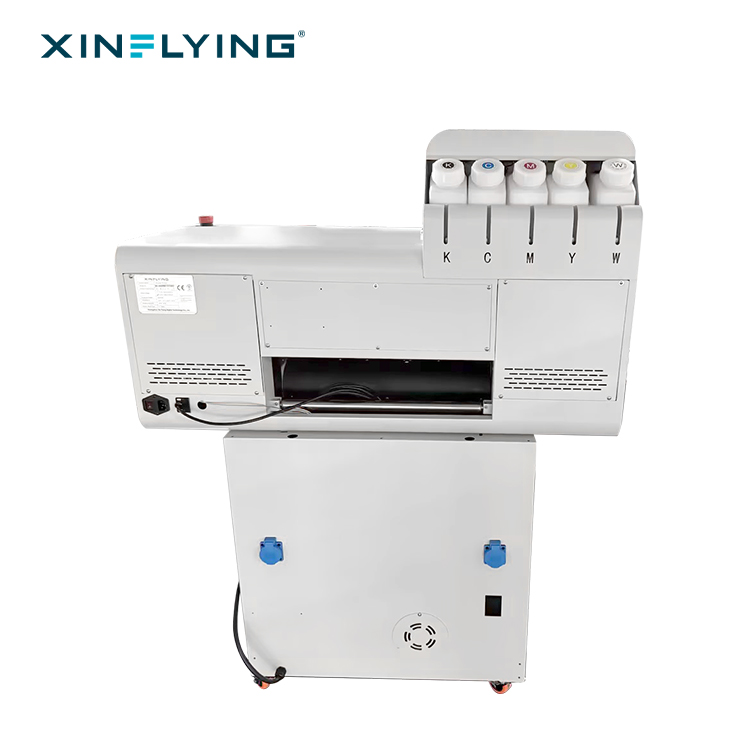
XINFLYING XF-450PRO: an A2 all-in-one DTF printer with 42 cm print width and 2× Epson i1600-A1 printheads.
What “Losing Money” Actually Means on a Shirt Printing Floor
In a shirt printing operation, the money that disappears is rarely the purchase price of the machine. It is the cost of everything around the machine. Four categories show up repeatedly when buyers describe why a purchase “did not work out”:
- Changeover time. Every time production is switched between two technologies or two unrelated machine families, work stops while settings, colour profiles, materials and job routing are re-established. The machines are paid for either way; the difference is whether they are producing.
- Requalification work. A machine that is not covered by the certificate, test report or technical file you already hold for your market forces a new documentation cycle. This is administrative time, but it also delays the day the new capacity can legally start earning.
- Duplicated consumables and spares. DTF runs on PET transfer film, pigment ink and hot melt adhesive powder; sublimation runs on sublimation ink and heat transfer paper. Two unrelated machine families also mean two sets of spares and two maintenance calendars.
- Skill fragmentation. Operators are fastest on a machine they run every day. Splitting production across models with different printheads, RIP settings and maintenance routines spreads that familiarity thin, and thin familiarity shows up as reprints, waste and missed delivery dates.
A fifth, less obvious loss is wrong-fit capacity. The buyer-risk reference material used in XINFLYING’s product documentation describes the failure this way: purchasing a DTF printer that does not match actual production requirements results in insufficient productivity, unsuitable applications, or higher operating costs. That is not a machine fault. It is a planning fault, and switching brands does not fix it.
Which is why the first decision to make is not “which printer is better” but “which technology owns which job”. The same reference material frames the DTF-versus-sublimation question precisely: both are digital textile printing methods, but they use different workflows — DTF transfers designs through printed film and heat transfer, while sublimation uses sublimation ink and a heat transfer process to apply designs to suitable materials. The suitable choice depends on product type, material requirements, application scenarios and production goals.
Industry Background: Demand Is Consolidating Around Production Capability
Shirt printing is no longer a niche experiment, and the published market data explains why buyers now plan in years rather than in “one more machine”.
- The global Direct-to-Film (DTF) printing market was valued at USD 2.7 billion in 2024, according to Grand View Research.
- Europe was the leading regional market that year, holding a 36.0% revenue share, again per Grand View Research.
- T-shirts are the dominant end-product segment, accounting for 41% of DTF printing revenue in 2024, based on KBV Research data.
- Industrial DTF printers accounted for 58.3% of total revenue share in 2025, reflecting high-throughput requirements, according to Dataintelo.
- China accounts for more than 45% of global DTF printer manufacturing capacity, per Dataintelo.
Forecasts diverge, and that divergence is useful rather than confusing. Dataintelo projects the DTF printer market reaching USD 5.2 billion by 2034 at a CAGR of 12.5%, while Grand View Research estimates growth closer to 6.0% for 2025–2030. When published forecasts differ by a factor of two, the honest conclusion for a buyer is that the direction is upward, the slope is uncertain, and planning should follow your own order mix rather than the steepest number available.
Two structural signals matter more than the headline figure. First, the industrial share of revenue — 58.3% in 2025 — indicates that spending is moving toward machines used for repeat production rather than toward novelty purchases. Second, compliance is hardening around textiles: DTF printing films must comply with OEKO-TEX STANDARD 100 for textile safety and restricted substances. Buyers who re-shop their machine line every year re-open their compliance file every year.
The Architecture: DTF for Flexibility, Sublimation for Polyester Volume
DTF: the flexible layer
A DTF printer is a machine that prints designs onto transfer film for later application onto textiles through heat transfer. In practice the workflow runs in four movements: the design is printed onto PET film, hot melt adhesive powder is applied to the fresh print, the transfer is cured, and the finished transfer is bonded to the fabric with heat and pressure.
The architectural advantage is separation. Because the design is prepared on film first, operators can print transfers in advance, store them, and apply them to products when orders arrive — printing and garment application become two connected but independent steps. That is what makes DTF suitable for custom apparel, T-shirts, hoodies, sportswear, workwear, uniforms, tote bags, caps and children’s apparel, across cotton, polyester, blended fabrics, fleece, canvas, non-woven fabric and denim.
Sublimation: the dedicated volume layer
Sublimation is a different architecture, not a substitute. XINFLYING’s sublimation printers are specified for textile sublimation printing on polyester fabrics, using sublimation ink and heat transfer paper; the wider units are also applied to home decor, canvas bags, cushions and flags. Treated correctly, sublimation belongs to a defined job — polyester-dominant, repeat-pattern volume — while DTF absorbs the mixed-fibre, short-run and dark-garment work that arrives unpredictably.
The XINFLYING DTF ladder: choose width and printheads, not brands
Once the architecture is fixed, model selection becomes a matter of matching print width and printhead count to order volume. XINFLYING’s DTF range, manufactured by Guangzhou Xin Flying Digital Technology Co., Ltd., is built as a ladder rather than as a set of unrelated products:
- XF-400D — 30 cm (12″) print width, 2× Epson i1600-A1/XP600 printheads, 6PASS standard speed 2.5 m²/h, 0.5 kW, 60 kg net weight. A compact first machine for narrow transfers.
- XF-450PRO — 42 cm (16.5″) print width, 2× Epson i1600-A1 printheads, 6PASS standard speed 9 m²/h, 3.5 kW, 250 kg net weight, integrated packing. An A2 all-in-one configuration that keeps the DTF workflow in one footprint.
- XF-702E — 60 cm (24″) print width, 2× Epson i3200-A1 printheads, 6PASS standard speed 10 m²/h, automatic moisturizing function, 0.8 kW, 158 kg net weight. The 60 cm workhorse for commercial shirt production.
- XF-C604 — 60 cm (24″), 4× Epson i3200-A1 printheads, 6PASS standard speed 18 m²/h, 180 kg net weight.
- XF-C605 — 60 cm (24″), 5× Epson i3200-A1 printheads, 6PASS standard speed 28 m²/h, 1.6 kW, 300 kg net weight (integrated).
- XF-L608 — 60 cm, 8× Epson i3200-A1 printheads, 4C4W 4PASS 42 m²/h and 5C3W 5PASS 45 m²/h, water-based pigment ink, 1.2 kW.
- XF-F808 — 80 cm (31″) print width, 8× Epson i3200-A1 printheads, 4PASS speed up to 50 m²/h, 2 kW, 440 kg net weight.
On the sublimation side, the same ladder logic applies by width and throughput: XF-H1301X-1I32A1 (130 cm, 1× Epson i3200-A1, 4PASS 28 m²/h), XF-H1802X-2I32A1 (180 cm, 2× Epson i3200-A1, 4PASS 52 m²/h), XF-O2000-4I32A1 (195 cm, 4× Epson i3200-A1, 2PASS 180 m²/h), XF-19E8-PRO (190 cm, 8× Epson i3200-A1, 1PASS 306 m²/h, 3200 dpi) and XF-19E15-PRO (190 cm, 15× Epson i3200-A1, 1PASS 524 m²/h, 3200 dpi). All stated speeds are manufacturer figures for the specified print modes and should be validated against your own artwork and substrate.
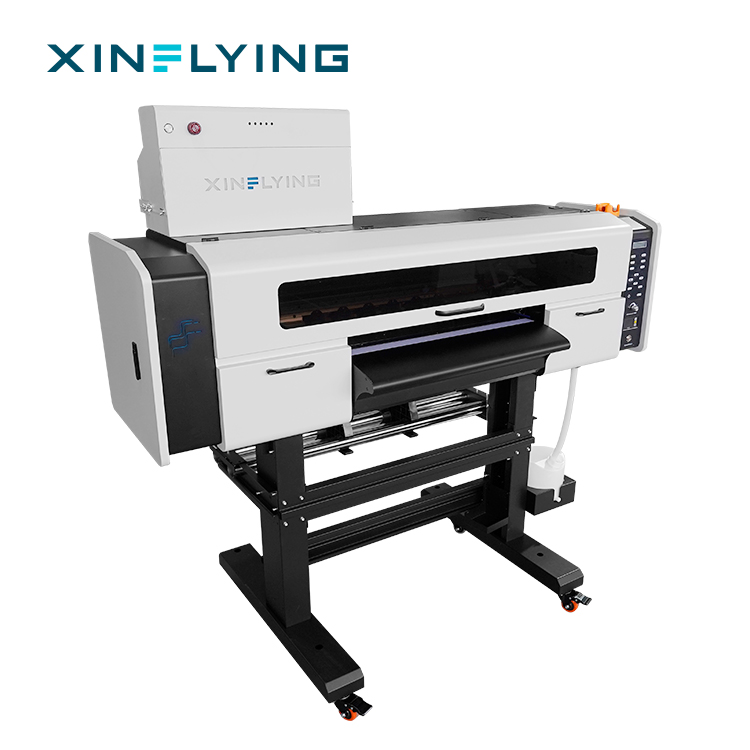
The 60 cm layer of the XINFLYING DTF ladder: XF-702E, a dual-printhead 60 cm DTF printer with automatic moisturizing.
Why one certificate file matters when you add capacity
Here is the part of model selection that rarely appears in a sales conversation, and it is the part that decides whether expansion is fast or slow. XINFLYING’s CE LVD certificate of compliance, number TQT1550D271EC, was issued on 19 May 2026 by TQT (Shenzhen Tianqi Testing Technology Service Co., Ltd.) for electrical safety compliance under LVD 2014/35/EU, tested to EN IEC 62368-1:2020/A11:2020 — and it lists fifteen models, DTF and sublimation together, including the XF-450PRO, XF-400D, XF-702E, XF-C602, XF-704E, XF-C604, XF-C605, XF-F606, XF-L608 and XF-F808, plus the XF-H1301X-1I32A1, XF-H1802X-2I32A1, XF-O2000-4I32A1, XF-19E8-PRO and XF-19E15-PRO.
The supporting compliance layer follows the same family logic:
- CE EMC certificate TQT1550D270EC, also issued by TQT on 19 May 2026, covering electromagnetic compatibility under EMC Directive 2014/30/EU.
- RoHS attestation M.2026.206.C142366 issued by UDEM on 10 June 2026, valid to 9 June 2031, covering restricted substances under Directive 2011/65/EU.
- CE Machinery Directive attestations M.2026.206.C142365 and M.2026.206.C142385, issued by UDEM on 10 June 2026 and valid to 9 June 2031, referencing EN ISO 12100:2010, EN 60204-1:2018/A1:2025 and EN ISO 12643-1:2023.
- CE LVD & EMC attestation M.2026.206.C142475, issued by UDEM on 11 June 2026 and valid to 10 June 2031.
- OEKO-TEX® ECO PASSPORT certificate SH150194016, issued 11 December 2025 and valid through 31 December 2026, covering textile printing inks and printing pastes.
The practical meaning is narrow but valuable: when the model you add already appears on the certificate file you hold, expansion does not restart the qualification cycle from zero. When the model does not appear, the buyer absorbs that time — and that is a cost that never shows up in a quotation but always shows up in the production calendar.
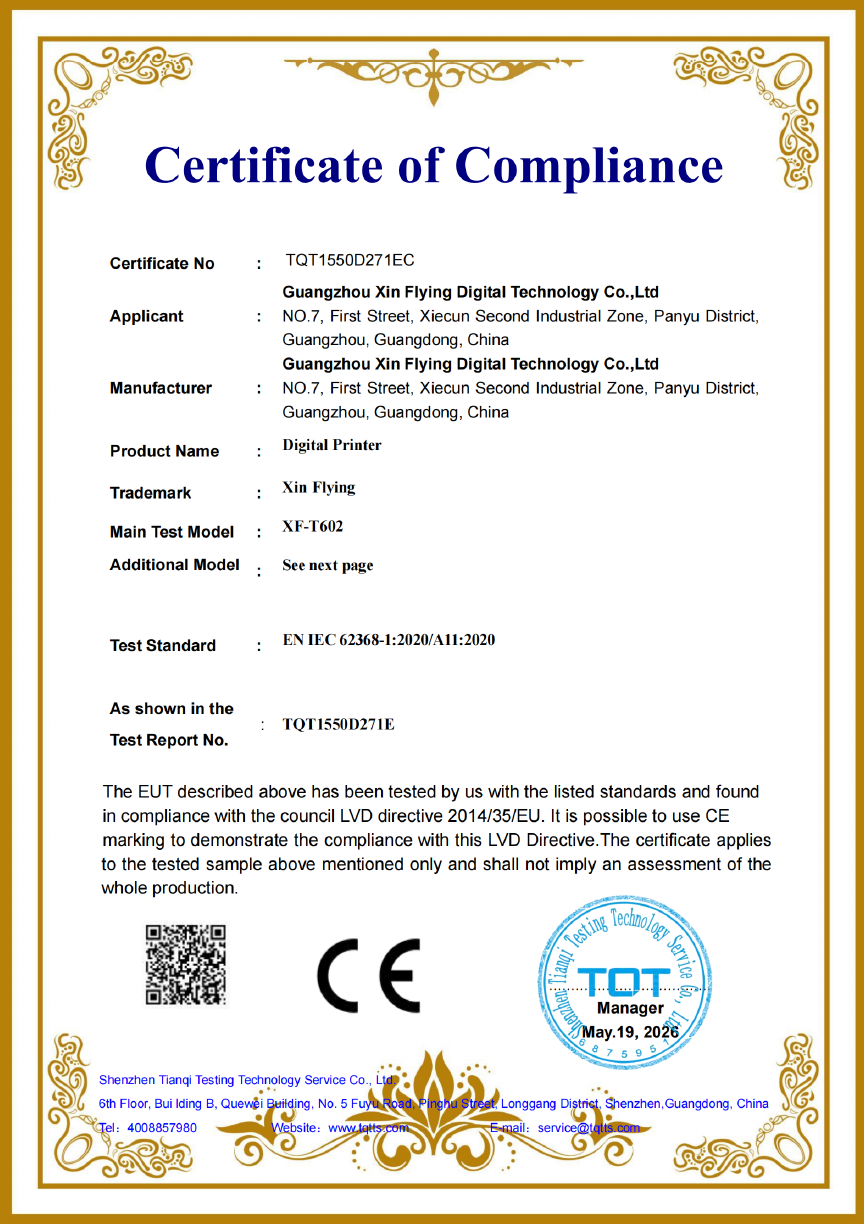
CE LVD certificate TQT1550D271EC (issued 19 May 2026 by TQT) lists fifteen XINFLYING printer models under one electrical safety file.
Step-by-Step: How to Stop Switching and Start Scaling
This is a six-step sequence for buyers who are past the “which technology” question and are now planning capacity. It is written to be used before a purchase order, not after one.
- Map your fabric mix. Separate the order book into polyester-dominant work and mixed-fibre work. Polyester-heavy repeat volume is sublimation territory; cotton, blends, fleece, canvas, denim and dark garments belong to DTF.
- Map your order structure. Count how many jobs are single pieces or small batches versus repeat runs. Frequently changing orders need the film-based flexibility of DTF, where transfers can be prepared ahead and applied on demand.
- Build a width ladder, not a model list. Decide the print width each job type needs: 30 cm and 42 cm for narrow transfers and entry production, 60 cm for commercial shirt work, 80 cm when throughput and larger layouts matter. Width is a structural decision; printhead count is an incremental one.
- Choose a base model and an expansion model inside the same compliance file. For example, start on the XF-702E as the 60 cm base and plan the XF-C604 or XF-C605 as the volume step; all three appear on CE LVD certificate TQT1550D271EC. This is the point where requalification friction is either reduced or reintroduced.
- Validate before you scale. Request printing samples, confirm machine configuration and confirm application requirements with the supplier before ordering. XINFLYING products are accepted through pre-shipment test procedures, and the buyer-risk guidance recommends sample evaluation rather than assumption.
- Plan consumables, support and scale-up together. Confirm RIP software, film, powder, ink and heat press availability for each model, then confirm the service path: XINFLYING runs over 50 engineers providing 24/7 online technical support, with monthly production capacity of 1600+ units and a lead time of 5–40 days.
| Checkpoint | Question to answer before ordering |
|---|---|
| Fabric fit | Which share of your orders is polyester-dominant, and which is cotton, blend, fleece, canvas or denim? |
| Order structure | How much of your work is single-piece or small-batch, and how much is repeat volume? |
| Width | Do your layouts need 30 cm, 42 cm, 60 cm or 80 cm of DTF print width? |
| Compliance file | Does the model you intend to add appear on the CE LVD certificate you already hold for your market? |
| Validation | Have you confirmed print samples, machine configuration and the scope of pre-shipment testing? |
| Scale-up | Are consumables, RIP software, spare parts and technical support confirmed for both models? |
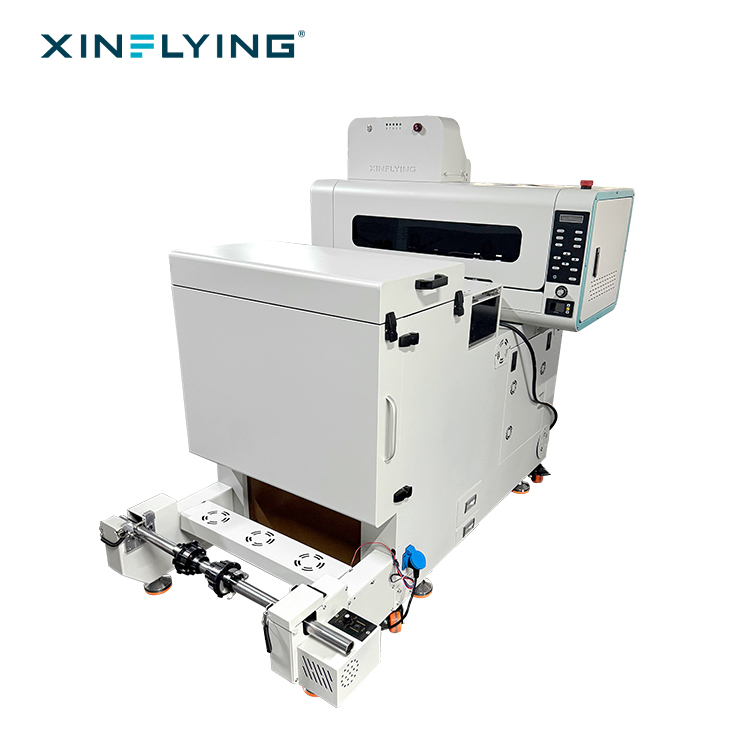
The XF-450PRO keeps printing, powder shaking and drying inside one A2 all-in-one frame — the entry rung of the same DTF ladder.
Where This Architecture Is Already Working
Four buyer profiles show how the “expand inside one architecture” approach behaves in practice. All quantities and durations below are recorded XINFLYING case data.
Custom apparel printing business, United States — 2 units, 3 years. The business uses DTF printing for customized T-shirts, hoodies and bags with full-colour graphics and personalised designs. Reported outcome: the DTF printer helps the business handle both small-quantity orders and repeat production while reducing limitations caused by traditional printing methods. The architectural point is that a second unit extends the same workflow instead of introducing a new one.
DTF transfer supplier, United States — 30 units, 1 year. This customer produces transfer films with various designs, logos and graphics, then supplies finished transfers to downstream garment decorators. Reported outcome: improved transfer production capacity, stable print quality, and the ability to support more apparel customisation orders from different customers. At 30 units, consistency between models — same printhead family, same RIP logic, same maintenance routine — matters more than any single specification.
Print on Demand business owner, United States — 5 units, 5 years. The customer produces customized T-shirts, hoodies and sweatshirts from online store orders. Reported outcome: an in-house DTF workflow gave the business more control over production schedules, faster order fulfilment and greater flexibility, handling both single-piece orders and small-batch production without depending completely on external printing suppliers.
Garment manufacturing factory — 20 units, 2 years. The factory applies DTF printing to add logos, patterns and customized graphics to finished garments before delivery to brands and distributors. Reported outcome: a flexible decoration method for customized orders, sampling production and short-run garment projects, with easier integration into garment production and compatibility across different fabrics.
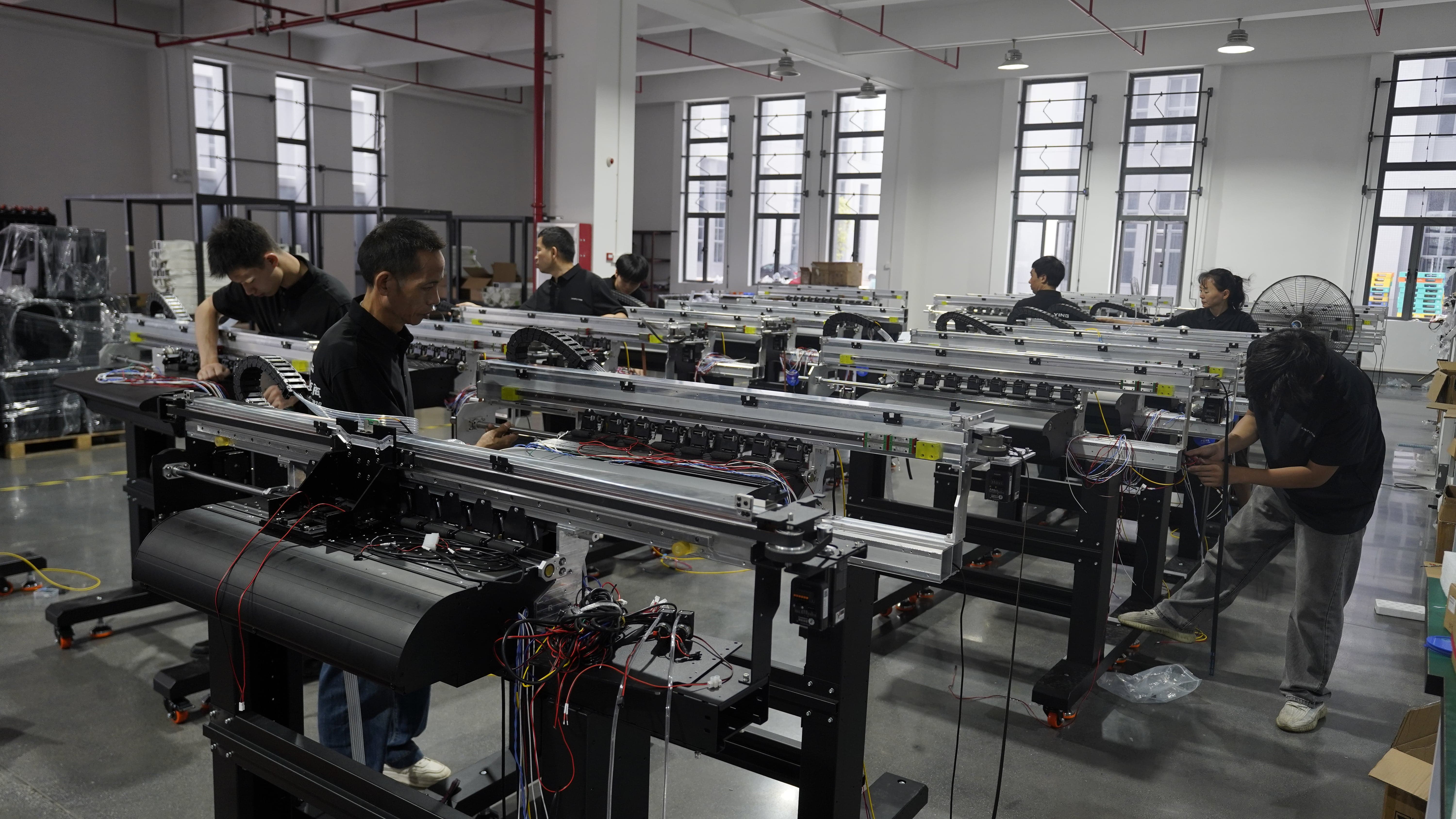
XINFLYING technicians assemble and wire multiple DTF printers on the production floor in Guangzhou.
Comparison Tables
The first table compares the two architectures at the level where changeover losses actually occur — media, workflow and best-fit work. The second compares DTF models inside the XINFLYING 60 cm and adjacent range.
| Dimension | DTF printing | Sublimation printing |
|---|---|---|
| Core workflow | Print onto transfer film, apply hot melt adhesive powder, cure, then heat press onto fabric | Print with sublimation ink onto heat transfer paper, then apply with heat to suitable materials |
| Media | DTF PET film | Heat transfer paper / sublimation paper |
| Inks | Pigment ink, CMYK+W configurations | Sublimation ink, CMYK |
| Fabric fit | Cotton, polyester, blended fabrics, fleece, canvas, non-woven fabric, denim and dark garments | Specified for textile sublimation printing on polyester fabrics; wider units also used for home decor, canvas bags, cushions and flags |
| Production flexibility | Transfers can be printed ahead, stored and applied on demand; printing and garment application are separate steps | Suited to polyester-dominant repeat production with consistent patterns |
| Typical role in a shop | Flexible layer for mixed-fibre, short-run and personalised work | Volume layer for defined polyester work |
| Model | Print width | Printheads | 6PASS standard speed | Power | Net weight |
|---|---|---|---|---|---|
| XF-400D | 30 cm (12″) | 2× Epson i1600-A1/XP600 | 2.5 m²/h | 0.5 kW | 60 kg |
| XF-450PRO | 42 cm (16.5″) | 2× Epson i1600-A1 | 9 m²/h | 3.5 kW | 250 kg |
| XF-702E | 60 cm (24″) | 2× Epson i3200-A1 | 10 m²/h | 0.8 kW | 158 kg |
| XF-C604 | 60 cm (24″) | 4× Epson i3200-A1 | 18 m²/h | 1.6 kW | 180 kg |
| XF-C605 | 60 cm (24″) | 5× Epson i3200-A1 | 28 m²/h | 1.6 kW | 300 kg (integrated) |
| XF-F808 | 80 cm (31″) | 8× Epson i3200-A1 | 4PASS up to 50 m²/h | 2 kW | 440 kg |
The XF-702E includes an automatic moisturizing function; the XF-C604 and XF-C605 offer automatic moisturizing as an option. Speeds are stated for the specified print modes on DTF PET film.
FAQ
Does one CE certificate really cover more than one DTF printer model?
Yes, for the models listed on it. XINFLYING’s CE LVD certificate, number TQT1550D271EC, was issued on 19 May 2026 by TQT (Shenzhen Tianqi Testing Technology Service Co., Ltd.) and lists the DTF models XF-450PRO, XF-400D, XF-702E, XF-C602, XF-704E, XF-C604, XF-C605, XF-F606, XF-L608 and XF-F808, together with the sublimation models XF-H1301X-1I32A1, XF-H1802X-2I32A1, XF-O2000-4I32A1, XF-19E8-PRO and XF-19E15-PRO. The scope is electrical safety compliance under LVD 2014/35/EU, tested to EN IEC 62368-1:2020/A11:2020. Buyers should still confirm that the exact model they order appears on the certificate supplied with their machine and verify any additional market-specific requirements — but adding a second model inside this list does not mean starting compliance work from zero.
What can be customised on a 60cm DTF printer under OEM and ODM programmes?
OEM services for DTF printers are available for product branding, logo and packaging customisation. ODM services cover machine appearance customisation, colour customisation, and customised solutions based on customer requirements. Both OEM and ODM production services are offered, and buyers working through a distributor or private-label programme can align the machine presentation with their own channel without changing the underlying production workflow.
What is the minimum order quantity, and which commercial terms are available?
The minimum order quantity is 1 unit, so a buyer can order a single machine to validate a workflow before committing to a multi-unit expansion. Payment can be arranged by T/T, Western Union or PayPal, and delivery terms include EXW, FOB, CIF and DDP depending on destination. Product acceptance is based on pre-shipment test procedures, which means the machine is tested before it leaves the factory rather than after it reaches the customer.
How can a buyer validate print quality before adding a second model?
Evaluate the model on evidence rather than assumption. Confirm the machine configuration, the printhead type and the print width against your actual order mix; request printing samples and review supplier information before ordering; and confirm what the pre-shipment test procedure covers, since XINFLYING products are accepted through pre-shipment test procedures. The buyer-risk guidance used in XINFLYING’s documentation is explicit on this point: testing samples and reviewing supplier information helps reduce the risk of receiving equipment that cannot achieve the expected results.
How long does it take to add capacity, and what support comes with it?
XINFLYING states a production lead time of 5–40 days, with monthly capacity of 1600+ units, and provides after-sales support through more than 50 engineers delivering 24/7 online technical support. For buyers planning an expansion step — for example moving from a single 60 cm machine to a 4-head or 5-head 60 cm configuration inside the same certificate file — the practical next step is to request a sample evaluation and a quotation for the specific model combination you intend to run. Contact XINFLYING at info@xin-flying.com or via WhatsApp on +86 188-1322-1357, or download the company brochure using the link at the end of this article.
Conclusion: Stop Shopping, Start Architecting
The pattern that costs shirt printers money is cyclical purchasing: a bottleneck appears, a different machine is bought, the workflow is rebuilt, and the cost of the rebuild is never attributed to the decision. The alternative is to fix the architecture once — DTF as the flexible layer for mixed-fibre, short-run and personalised work, sublimation as the dedicated layer for polyester-dominant volume — and then scale capacity inside that architecture on a width ladder.
Model selection is where this either works or falls apart. Choosing the next machine from the same family, on the same CE LVD certificate file (TQT1550D271EC lists fifteen XINFLYING models including the XF-450PRO, XF-400D, XF-702E, XF-C604 and XF-C605), reduces requalification friction instead of adding a second documentation cycle to an already busy production calendar. That is the quiet advantage of the approach: the compliance headache that usually accompanies growth is handled once, not once per purchase.
Guangzhou Xin Flying Digital Technology Co., Ltd. (XINFLYING) has manufactured digital printing equipment since 2010, operates a 37,440 m² factory with a 20-engineer R&D team, produces 20,000+ units annually, and exports to North America, South America, Europe, Asia, the Middle East and Africa, with OEM and ODM production, 1-unit MOQ and pre-shipment testing on every order.
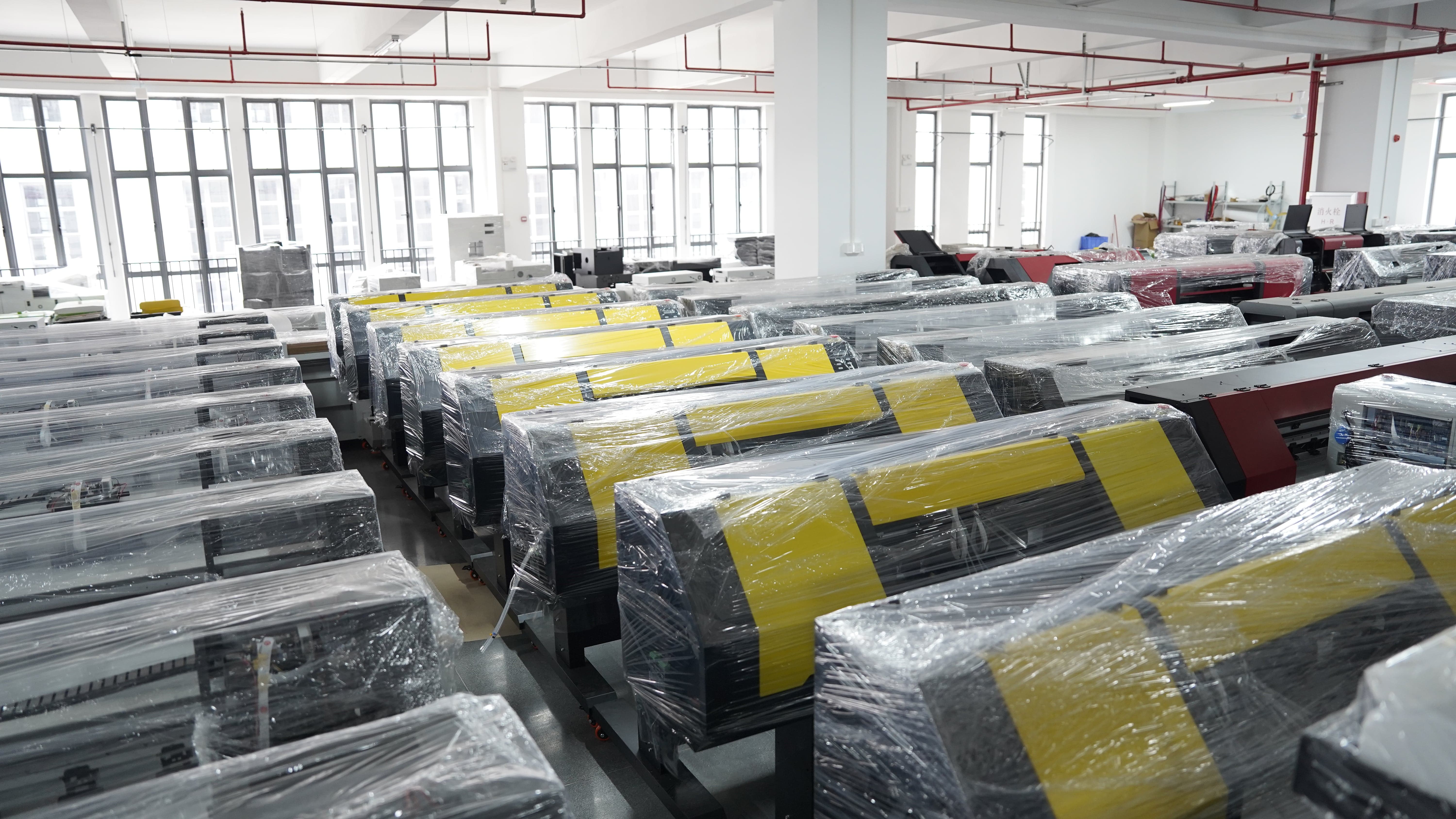
Finished XINFLYING DTF printers wrapped and prepared for shipment — capacity added inside one certified model family.
Next step. If you are planning to add DTF capacity without restarting your compliance file, send your order mix (fabrics, widths, typical batch sizes) to XINFLYING and request a sample evaluation plus a quotation for the matching model combination.
Email: info@xin-flying.com | Tel / WhatsApp: +86 188-1322-1357 | Website: www.xin-flying.com
Have Questions or Need More Details?
Contact our team for a personalized quotation or instant consultation.
Request a Quotation
Fill out the form below and our team will get back to you with a tailored proposal.
WhatsApp Direct Chat
Prefer to chat in real-time? Message us on WhatsApp for instant assistance & quick answers.
- Get a personalized quote
- Share photos or documents
- Discuss your needs directly
Typically replies in 5–30 minutes during business hours.