
Roll-to-Roll Sublimation Printers: Gantry Alignments and Tension Control
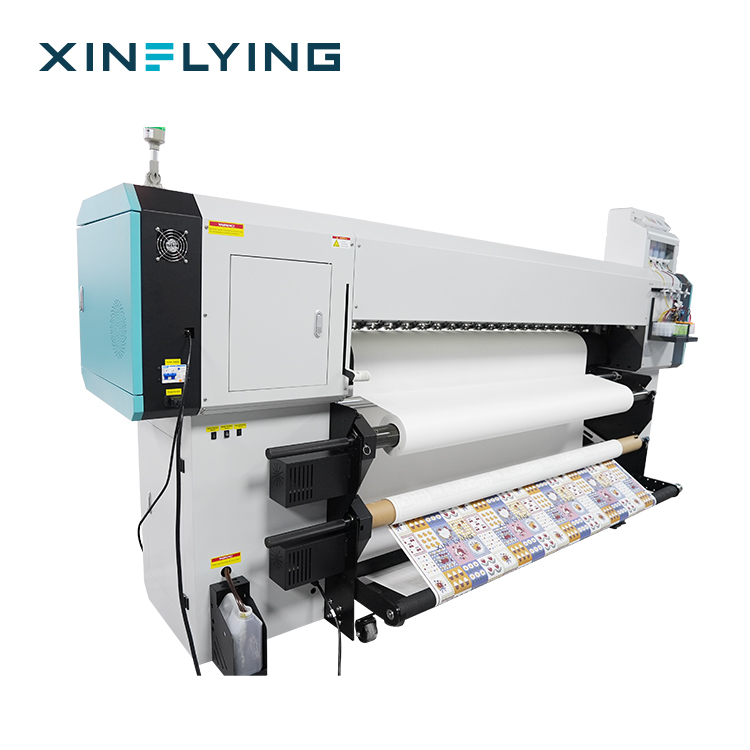
On a roll-to-roll sublimation printer, print quality is settled by mechanics before it is settled by ink. Gantry alignment determines where every droplet lands across the full printing width. Substrate tension control determines whether the transfer paper reaches that point flat, straight and at the length the RIP file expects. When either drifts, the output looks like an ink problem, a colour management problem or a RIP problem — and the real cause stays in the frame for months.
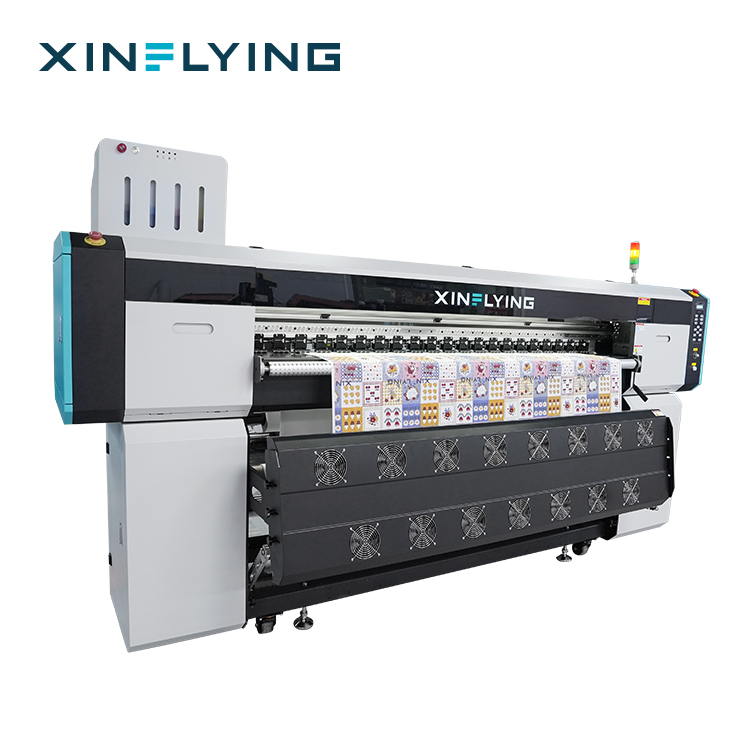
This guide covers how both systems work, how their faults appear in production, how to check them step by step, and why mechanical condition is also a compliance and long-term partnership question. Two XINFLYING platforms are used as reference machines: the XF-H1301X-1I32A1, a 1300 mm (1.3 m) digital textile printer built around one Epson i3200-A1 printhead, and the XF-O2000-4I32A1, a 1950 mm (1.95 m) four-head roll-to-roll platform that supports heat transfer paper rolls of 1000–1500 m.
Problem Definition: What Gantry Alignment and Tension Control Actually Mean
Gantry alignment is the geometric relationship between three components: the carriage beam (the gantry) that carries the printheads, the platen that supports the substrate, and the media plane itself. A correctly aligned gantry keeps nozzle-to-media distance constant across the entire printing width and keeps head-to-head stitching accurate. On a single-head machine such as the XF-H1301X-1I32A1, this mainly governs dot placement and density consistency across 1300 mm. On a four-head platform such as the XF-O2000-4I32A1, the same geometry also decides whether the four Epson i3200-A1 printheads stitch into one continuous image across 1950 mm without visible seams or colour steps.
Tension control is the management of web tension from the unwinding roll, through the print and heating zones, to the rewinding roll. The controlling variables are unwind and rewind torque, the grip and pressure of the feed rollers, and any compensation built into the media path.
Sublimation makes both systems harder to hold than they look on paper. Transfer paper reacts to heat and moisture, so its length and flatness change as it travels through the heating and drying sections. Machines manage that differently: the XF-O2000-4I32A1 uses front, middle and rear break-controlled heating, while the XF-H1301X-1I32A1 uses an external constant-temperature automatic drying system. In both cases, tension that is correct at the unwinding roll is not automatically correct at the rewinding roll after several metres of heated media path.
Most output defects on a roll-to-roll machine are first blamed on ink, ICC profiles or printing resolution settings. Alignment and tension faults produce symptoms that overlap with all three, which is why they are frequently missed. The table below maps a visible symptom to the mechanical condition that commonly produces it, and to the first check that separates the two.
| Visible symptom | Mechanical / process condition | First check |
|---|---|---|
| Horizontal lines, uneven colour areas or visible printing gaps | Printhead or nozzle condition, incorrect printhead alignment, calibration drift, incorrect resolution or speed settings | Nozzle check, then printhead alignment and calibration |
| Colour misregistration between heads, or visible seams inside one image | Gantry / head stitching geometry across the full print width | Alignment print, head-to-head stitching correction |
| Wrinkles concentrated near one edge, density falling off towards that edge | Media skew, uneven tension side to side, roll core seating | Roll mounting and core centring, feed roller grip, edge tension balance |
| Print length drifting over a long run; repeat patterns no longer matching | Tension and elongation inside the heated media path | Measure print length against file length at start, middle and end of the roll |
| Missing colours, incomplete output, unstable ink delivery | Dried ink in the printhead, long idle periods, unstable ink supply system | Nozzle check, ink supply inspection, maintenance schedule review |
Industry Background: Why Mechanics Became an Ownership Issue
The commercial context explains why alignment and tension belong in a purchasing decision rather than only in a service manual. Grand View Research values the global dye sublimation printing market at USD 16.4 billion in 2025 and projects USD 39.0 billion by 2033, growing at a CAGR of 11.5% between 2026 and 2033, with Asia Pacific holding a 36.5% revenue share in 2025 and China as the largest country market. Mordor Intelligence sizes the dye sublimation printer segment specifically at USD 1.88 billion in 2025, rising to USD 2.53 billion by 2030. Fortune Business Insights puts the wider large format printer market at USD 10.57 billion in 2025, reaching USD 16.52 billion by 2034.
Two structural facts push mechanical stability to the centre of that growth. According to FESPA Insights industry analysis, roll-to-roll sublimation printers at 1.9 m (1900 mm) width are the standard configuration for high-volume textile and soft signage work — which means long media paths, heavier rolls and more places for tension to drift. Grand View Research also reports that inkjet production printers accounted for 87.3% of the production printer market share by type in 2024, confirming that inkjet, not analogue, carries the volume.
Capacity is concentrated where this pressure is highest. China's textile and garment exports reached USD 293.6 billion in 2023, supporting large local demand for industrial-scale sublimation equipment. Machines in this class are specified for continuous operation, in many cases 24/7.
The arithmetic is straightforward. Every hour lost to reprints, web breaks or rejected output is an hour of transfer paper, ink, labour and calendar time that cannot be recovered. Alignment and tension are therefore throughput variables. A printer that holds registration across a full 1000–1500 m roll at production speed returns more than a machine with a slightly higher peak figure on a specification sheet.
Detailed Solution: The Mechanical Stack Behind a Roll-to-Roll Platform
Four subsystems decide whether gantry alignment and tension control remain inside tolerance over years of production, not just on the day of installation.
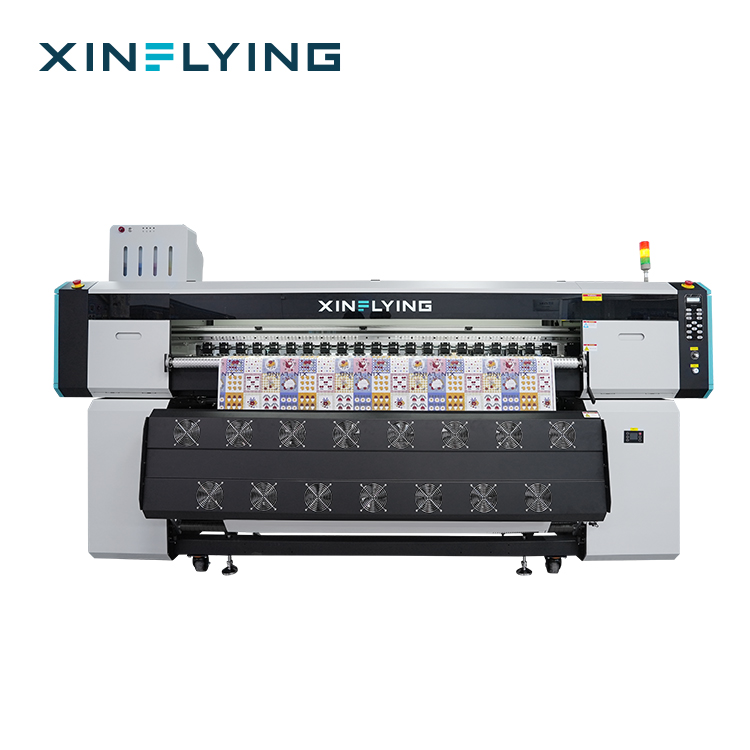
1. Gantry and carriage structure
The gantry is the reference frame for every printed dot. Its stiffness, the straightness of the beam, and the parallelism between the beam and the platen set the baseline tolerance for the whole machine. On the XF-O2000-4I32A1, four Epson i3200-A1 printheads share one carriage system across a 195 cm (1.95 m) print width, and the machine carries a net weight of approximately 490 kg in a 3311 × 1278 × 1670 mm frame. On the XF-H1301X-1I32A1, a single Epson i3200-A1 head works across a 130 cm (1.3 m) print width in a 2220 × 870 × 1540 mm frame with a net weight of 140 kg. Mass and frame length matter because they resist the vibration that multi-head stitching calibrations are sensitive to: a light frame tolerates less disturbance than a heavier one at the same production speed.
2. Media transport and roll handling
Tension is created and lost in the media path. The unwind side applies a controlled load to the paper roll; the feed and pinch rollers pull the web through the print zone; the rewind side collects the printed roll at a torque that must stay consistent as the roll diameter grows. A roll of 1000–1500 m is a long correction window: a small tension error at the start becomes a visible registration error by the end. This is why roll core centring and consistent roller grip are treated as alignment tasks, not as loading tasks.
3. Heating, drying and the tension interaction
Heat is the reason sublimation tension control is harder than in other roll-to-roll printing. The XF-O2000-4I32A1 uses front, middle and rear break-controlled heating, which introduces several controlled temperature stages along the media path. The XF-H1301X-1I32A1 uses an external constant-temperature automatic drying system. Both approaches stabilise output quality, and both change substrate length as the web passes through. If the machine compensates tension only at the unwind roll, the elongation added inside the heated section is carried into the rewind and shows up as cumulative print-length drift.
4. Environment as a mechanical variable
Temperature and humidity are printed in the specification for a reason. The XF-O2000-4I32A1 is specified for 20–25°C and 45–65%RH; the XF-H1301X-1I32A1 is specified for 20–35°C and 45–65%RH. Outside those windows, paper dimensions change with moisture content, curl increases, and a tension setting that works in a controlled room will not hold in an uncontrolled one. For a buyer planning a long-term installation, the room is part of the machine.
Step-by-Step Breakdown
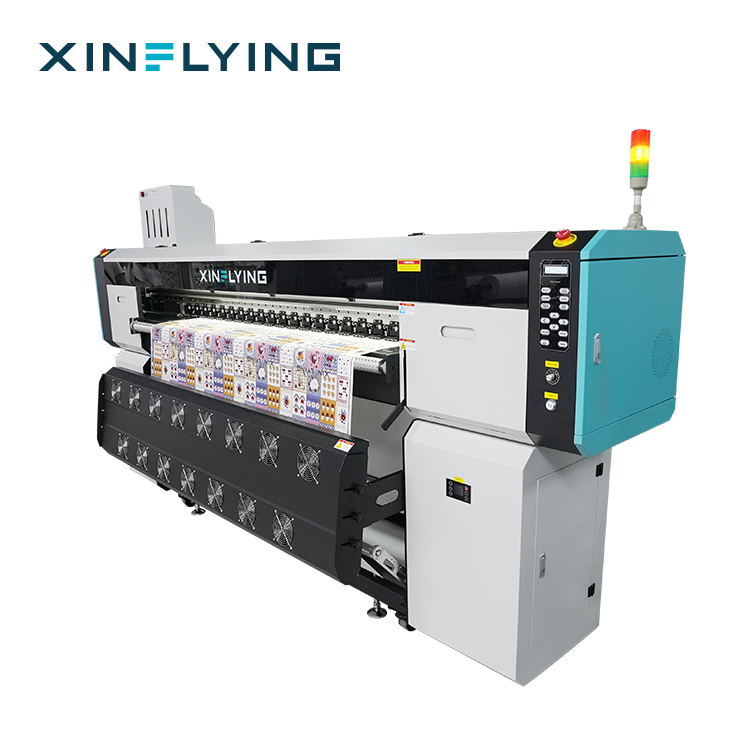
A. Gantry alignment check
- Establish a clean baseline. Run a nozzle check and confirm head condition before touching geometry. Alignment work done on a partially blocked head produces meaningless results.
- Verify nozzle-to-media distance. Check the carriage height and platen relationship at both ends of the print width and at the centre, not only at one reference point.
- Print an alignment pattern. Use the standard alignment / stitching test build. On a four-head platform such as the XF-O2000-4I32A1, examine head-to-head transitions specifically, because a seam hides inside busy artwork but is obvious in a flat tint.
- Correct bi-directional registration. Adjust for both print directions before adjusting head-to-head stitching; correcting them in the wrong order means repeating the work.
- Re-run the pattern and compare. Confirm the correction holds across the full width and at both media edges, not only in the middle.
- Record the values. Keep the final alignment parameters with the machine log so that the next service starts from a known state.
B. Tension control set-up and verification
- Seat the roll correctly. Confirm the core is centred and the roll runs true; a badly seated roll mimics a tension fault across the whole path.
- Set unwind and rewind torque. Start from the media manufacturer's recommendation and the machine's own parameters, then adjust in small increments.
- Establish the heating stages before judging tension. Bring the front, middle and rear heating zones to working temperature first, otherwise the paper will change length after the adjustment is made.
- Measure print length against file length. Print a known-length test at the start, middle and end of the roll. Drift between the three measurements is the clearest evidence of unresolved elongation.
- Check the edges, not just the centre. Confirm the web is running flat and wrinkle-free at both edges through the print zone and at the rewind.
- Save the settings for the job type. Record the optimised parameters so repeat orders start from a validated configuration instead of a fresh guess.
C. Checks after any mechanical service
- Repeat the alignment and print-length tests. Mechanical work invalidates the previous baseline, even when the work was not in the print zone.
- Verify grounding and cable routing. Confirm that grounding connections are intact and that harnesses are returned to their original routing rather than left where they are convenient.
- Confirm documentation still describes the machine. Check that any replaced component matches the configuration described in the supplied technical file.
Regulation Implications of Mechanical Flaws
Mechanical condition is usually discussed as an output quality issue. For machines that cross borders, it is also a compliance issue, because compliance is declared for a specific configuration rather than for a model name in general.
EN 55032:2015 is the European emission standard for multimedia equipment. It defines the conducted and radiated emission requirements that equipment in this category is tested against, and it is one of the standards referenced when electromagnetic compatibility is documented for a printer of this type. The practical consequence for owners is that the test report describes the machine as it was tested — including its grounding, its wiring routing and its drive configuration.
Service work that changes those elements can move a machine away from the configuration described in its own documentation. Replacing a drive assembly, rerouting harnesses near the gantry, or leaving a grounding connection degraded during a repair are mechanical actions with an electrical dimension. This is not an argument against service; it is an argument for doing service to a documented standard and then proving the machine still matches what was certified.
For imports, the same logic applies at the documentary level. Buyers bringing sublimation printers into the European market should verify CE compliance covering electrical safety, electromagnetic compatibility and product safety, and should confirm that certification documents, test reports and technical files match the actual printer model supplied. Incomplete or inconsistent compliance documents may result in customs delays, sales restrictions or additional compliance costs. For the US market, buyers should check electromagnetic compatibility and electrical safety requirements based on the equipment configuration and application environment, and request certification documents, technical specifications and test reports from the supplier. RoHS documentation matters as well, because it confirms the restriction of hazardous substances in electrical and electronic components — and it is only meaningful if it applies to the equipment model actually delivered.
Use Cases
- Soft signage and banners. Wide, flat, high-coverage graphics expose tension faults immediately, because any edge wrinkle or density drift is visible across metres of finished print. This is where 1.9 m class roll-to-roll platforms are the standard configuration, and where a four-head machine such as the XF-O2000-4I32A1 earns its place on a production floor.
- Sportswear and team jerseys. Repeat patterns and panel nesting depend on print length accuracy. Tension drift that shifts print length over a long run creates mismatched panels that only appear at the cutting table, long after the roll has been printed.
- Home textiles, blankets and cushions. Large single images with soft gradients show head-to-head stitching seams very clearly. On a multi-head platform, gantry alignment is the difference between one image and four stripes that almost match.
- Sampling, custom textile production and small-batch orders. Narrower platforms such as the XF-H1301X-1I32A1 with a 130 cm print width place the same mechanical requirements in a smaller frame, where a lighter gantry demands equally disciplined alignment checks and roller maintenance.
Comparison Table: Two Roll-to-Roll Reference Platforms
Both platforms below carry the same mechanical obligations — gantry alignment and tension control — at different widths, head counts and production scales. The specifications shown are the published figures for each model.
| Specification | XF-H1301X-1I32A1 | XF-O2000-4I32A1 |
|---|---|---|
| Printheads | 1 × Epson i3200-A1 | 4 × Epson i3200-A1 |
| Ink colours | CMYK | CMYK + CMYK + CMYK + CMYK |
| Print width | 130 cm (1.3 m) | 195 cm (1.95 m) |
| Print speed | 4PASS 28 m²/h (fastest) | 2PASS 180 m²/h; 4PASS 92 m²/h |
| Media | Heat transfer paper | Heat transfer paper, rolls of 1000–1500 m, thickness 1 mm, weight 200 kg |
| Heating / drying | External constant-temperature automatic drying system | Front / middle / rear break-controlled heating |
| RIP | Maintop (standard) | RIIN Print; Maintop |
| Power | 2 kW; 110/220V, 18A/9A, 50–60Hz | 8.5 kW; 220V, 50/60Hz |
| Working environment | 20–35°C, 45–65%RH | 20–25°C, 45–65%RH |
| Machine size | 2220 × 870 × 1540 mm | 3311 × 1278 × 1670 mm |
| Net weight | 140 kg | ≈490 kg |
FAQ
Does a gantry repair or alignment service affect a printer's CE or EMC documentation?
Compliance documents describe a machine in the configuration that was tested, so mechanical service should return the printer to that configuration. EN 55032:2015 is the European emission standard for multimedia equipment and defines the conducted and radiated emission requirements that equipment of this type is tested against; test reports therefore reflect the grounding, wiring routing and drive configuration of the tested unit. After gantry or transport-related service, verify that grounding connections are intact, that harnesses are routed as originally supplied, and that any replaced component matches the supplied configuration. Buyers importing into the EU should confirm that CE documentation, test reports and technical files match the actual printer model, because incomplete or inconsistent documents may cause customs delays or sales restrictions.
What should be verified mechanically before a roll-to-roll sublimation printer is shipped?
Product acceptance is carried out through pre-shipment test procedures before delivery, and buyers can request the pre-shipment test record as part of the machine documentation. From a mechanical standpoint, the items worth confirming are nozzle condition, an alignment or stitching print, and a print-length check on the media the machine will actually run. These three checks cover the two systems that decide long-run registration: gantry alignment across the full width, and tension behaviour through the heated media path.
How do you keep gantry alignment and tension control stable across years of production?
Maintenance frequency depends on usage. Daily nozzle checks and regular cleaning are recommended for machines in continuous production, and printhead clogging is best prevented by performing regular nozzle checks, using suitable sublimation ink, maintaining correct operating conditions and avoiding long idle periods. After any service, re-check alignment, re-verify print length, and review printing parameters if output quality drops. Keeping a record of optimised parameters for repeat orders is what turns a one-off adjustment into a stable, repeatable production setup.
What should a buyer look for in a long-term sublimation printer supplier for textile production?
Mechanical stability has to be supported after commissioning, so the supplier relationship matters as much as the specification sheet. XINFLYING exports to North America, South America, Europe, Asia, the Middle East and Africa, with export business accounting for 80% of total sales, and it maintains local warehouses and technical support in key markets. Practical supplier checks for a long-term partnership include technical training, spare parts availability, maintenance support and after-sales service, together with installation guidance, remote technical support and long-term parts supply that keep a machine running through its service life. Buyers can request a sample print or a quotation for the platform that matches their width, media and volume, and review the full equipment range before committing to a configuration.
Conclusion
Gantry alignment and tension control are the two mechanical systems that decide whether a roll-to-roll sublimation printer earns its place in a production plan. Alignment sets the geometry for every droplet across the full print width; tension control keeps the transfer paper in a state where that geometry still means something after several hundred metres of heated media path. Both are affected by heat, humidity, roll weight and time, which is why they are maintenance disciplines rather than installation settings.
They also have a compliance dimension. A machine is certified as it was tested, and mechanical service that alters grounding, harness routing or drive configuration belongs inside a documented procedure. Keeping the machine in its certified configuration, and keeping the documentation matched to the model delivered, protects both the investment and the market access it depends on.
Next step
If you are configuring a roll-to-roll sublimation line and need to see how alignment and tension behaviour affect your own fabric, request a sample print or a quotation for the platform that matches your width and volume. XINFLYING supplies dye sublimation, DTF, DTG and UV printing platforms from a 37,440 m² facility, with support in key markets.
Website: www.xin-flying.com
Email: info@xin-flying.com
Tel / WhatsApp: +86 188-1322-1357
Company brochure: download the XINFLYING product and capability PDF
Have Questions or Need More Details?
Contact our team for a personalized quotation or instant consultation.
Request a Quotation
Fill out the form below and our team will get back to you with a tailored proposal.
WhatsApp Direct Chat
Prefer to chat in real-time? Message us on WhatsApp for instant assistance & quick answers.
- Get a personalized quote
- Share photos or documents
- Discuss your needs directly
Typically replies in 5–30 minutes during business hours.