
Industrial Roll-to-Roll Sublimation for Continuous Textile Runs
Industrial Roll-to-Roll Sublimation for Continuous Textile Runs
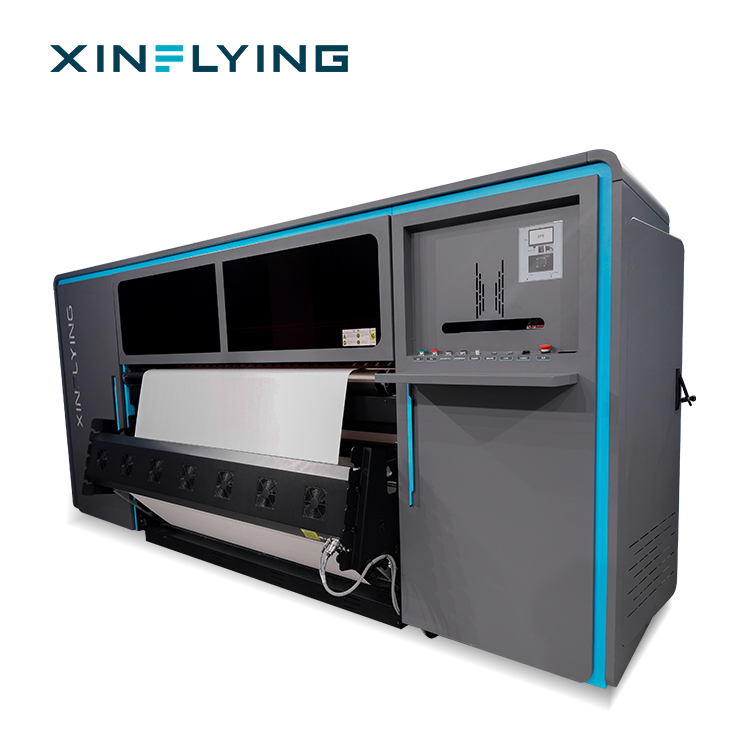
Industrial roll-to-roll sublimation is the production configuration used when a textile plant has to keep printing across consecutive shifts instead of stopping between orders. Transfer paper unwinds from a long roll, the printer lays sublimation ink across the full fabric width, an external dryer sets the ink, and the printed paper is rewound or routed straight to a calender for transfer onto polyester. For facilities built around continuous output, two platforms are specified most often: the XF-19E15-PRO (15 × Epson i3200-A1 printheads, 190 cm print width, up to 524 m²/h at 1PASS) and the XF-19E8-PRO (8 × Epson i3200-A1 printheads, up to 306 m²/h at 1PASS). Both carry CE EMC certification tested to EN 55032:2015/A11:2020 and related standards — a detail that matters more on a heavy industrial power grid than on a showroom floor.
What Actually Breaks When a Sublimation Line Runs Around the Clock
Continuous operation changes the failure profile of a sublimation printer. A machine that prints two shifts a week can absorb a morning nozzle check; a machine that runs 24/7 cannot lose the same hours to the same causes. On industrial roll-to-roll installations, the recurring constraints are consistent and predictable:
- Media interruption. Every paper roll change stops the line, and each restart costs a colour-stability cycle. Loading longer transfer-paper rolls reduces how often that happens: the XF-19E15-PRO is specified to load 1000 m sublimation paper rolls, and the XF-O2000-4I32A1 supports heat transfer paper rolls of 1000–1500 m.
- Drying capacity. Ink that is not fully set before rewinding produces ghosting and blocking later in the process. The XF-19E15-PRO and XF-19E8-PRO use an external intelligent air-heat integrated dryer rather than relying on ambient drying.
- Printhead idle time. Sublimation ink sitting in an idle head across a night shift is one of the most common causes of missing nozzles. Both E-series platforms use a fully sealed automatic moisturizing and cleaning system to protect the head array during idle periods.
- Electrical behaviour. A 15-head platform draws 14.5 kW at 210–230 V, 45 A; the 8-head platform draws 10.2 kW at the same supply specification. On a factory floor shared with calenders, compressors and laser cutters, that load has to behave predictably — which is where EMC compliance stops being paperwork and becomes uptime.
- Colour repeatability across shifts and operators. Repeat orders fail on drift, not on absolute quality. A defined RIP workflow (Maintop as standard, with RIIN for Hoson, PhotoPrint and Printfactory as options on both E-series models) and a documented colour procedure are what hold a repeat job together.
- Environment envelope. Both E-series machines are rated for 18–30 °C and 35–65% RH. A continuous line that drifts outside that window usually shows it in colour consistency before it shows it as a mechanical fault.
None of these are print-quality problems in the traditional sense. They are duty-cycle problems, and they are the reason a 24/7 facility evaluates a sublimation printing machine differently from a job shop.
Why Continuous Runs Became the Default Buying Case
The commercial case for continuous roll-to-roll capacity is no longer speculative. Grand View Research values the global dye sublimation printing market at USD 16.4 billion in 2025 and projects USD 39.0 billion by 2033, with a CAGR of 11.5% from 2026 to 2033. Mordor Intelligence sizes the dye sublimation printer segment alone at USD 1.88 billion in 2025, rising to USD 2.53 billion by 2030.
Two structural facts explain why buyers concentrate on 1900 mm roll-to-roll platforms rather than small-format machines:
- Demand is concentrated and export-driven. Asia Pacific held a 36.5% revenue share of the dye sublimation printing market in 2025, with China as the largest country market (Grand View Research). China's textile and garment exports reached USD 293.6 billion in 2023, which sustains strong local demand for industrial-scale sublimation machines.
- The 1.9 m print width has become the working standard. Roll-to-roll sublimation printers with widths around 1.9 m (1900 mm) are the standard configuration for high-volume textile and soft signage applications (FESPA industry insight). That width matches common fabric roll widths and reduces panel seaming in sportswear, home textile and banner work.
The demand drivers point the same direction. Grand View Research attributes a 13.1% CAGR in the digital textile sublimation market through 2030 primarily to personalized apparel and home décor, and inkjet production printers accounted for 87.3% of the production printer market by type in 2024 — the technology class that continuous textile lines buy into.
At platform level, Epson leads the digital textile dye sublimation printer market with a 26.7% share, followed by Mimaki (18.6%) and Roland DG (15.5%), according to Data Insights Reports (2024). Those figures describe the established printhead and hardware landscape; they do not describe which supplier can configure a line around a specific continuous-run duty cycle, which is the decision most 24/7 facilities actually face.
The Machine Side of the Answer: Continuous-Capable Roll-to-Roll Platforms
XINFLYING (Guangzhou Xin Flying Digital Technology Co., Ltd.) builds digital printing equipment at a 37,440 m² facility with 200+ employees and more than 20 R&D engineers, and exports around 80% of output to North America, South America, Europe, Asia, the Middle East and Africa. Within that range, two models are positioned for continuous textile production, and the practical difference between them is how many printheads are doing the work per metre of paper.
XF-19E15-PRO — the 15-head continuous platform
- Printheads: 15 × Epson i3200-A1
- Print width: 190 cm (75"); resolution 3200 dpi
- Speed (fastest): 1PASS 524 m²/h; 2PASS 254 m²/h. Speed (standard): 1PASS 394 m²/h; 2PASS 188 m²/h
- Ink: sublimation ink, CMYK
- Media: sublimation paper, loads 1000 m rolls
- Drying: external intelligent air-heat integrated dryer
- Moisturizing: fully sealed automatic moisturizing and cleaning
- RIP: Maintop (standard); RIIN (Hoson only), PhotoPrint, Printfactory (optional)
- Power: 14.5 kW, 210–230 V, 45 A
- Workstation: Windows 11/10 (32/64-bit); HD 500 GB, ATI discrete graphics, DVD ROM, gigabit LAN, 4 GB RAM, Intel i7; JPG, TIFF, PDF input
- Environment: 18–30 °C, 35–65% RH
- Dimensions and weight: 3840 × 1570 × 1800 mm; net 1480 kg (packed 3970 × 1150 × 2130 mm, gross 1580 kg)
XF-19E8-PRO — the 8-head continuous platform
- Printheads: 8 × Epson i3200-A1
- Print width: 190 cm (75"); resolution 3200 dpi
- Speed (fastest): 1PASS 306 m²/h; 2PASS 153 m²/h. Speed (standard): 1PASS 210 m²/h; 2PASS 109 m²/h
- Ink: sublimation ink, CMYK
- Media: sublimation paper
- Drying: external intelligent air-heat integrated dryer
- Moisturizing: fully sealed automatic moisturizing and cleaning
- RIP: Maintop (standard); RIIN (Hoson only), PhotoPrint, Printfactory (optional)
- Power: 10.2 kW, 210–230 V, 45 A
- Workstation: Windows 11/10 (32/64-bit); HD 500 GB, ATI discrete graphics, DVD ROM, gigabit LAN, 4 GB RAM, Intel i7; JPG, TIFF, PDF input
- Environment: 18–30 °C, 35–65% RH
- Dimensions and weight: 3840 × 1300 × 1800 mm; net 1400 kg (packed 4010 × 1180 × 2160 mm, gross 1500 kg)
XF-O2000-4I32A1 — where a continuous line often starts
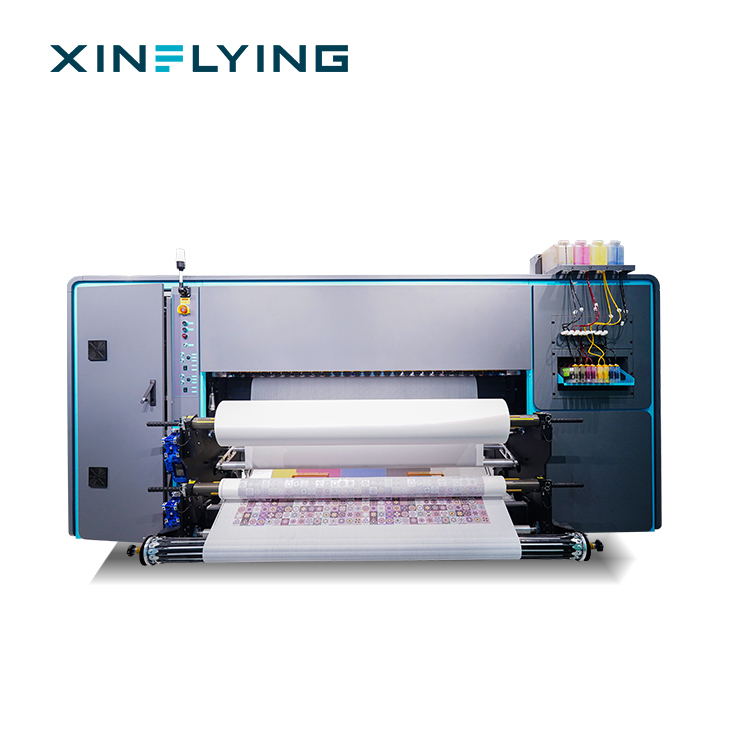
Facilities that are moving from job-based production into continuous runs frequently begin with the XF-O2000-4I32A1: 4 × Epson i3200-A1 printheads, a 195 cm (1.95 m) print width, 2PASS 180 m²/h and 4PASS 92 m²/h, piezoelectric inkjet printing with sublimation ink supplied from a 220 ml cartridge plus a 3 L ink tank, heat transfer paper in rolls of 1000–1500 m, front/middle/rear break-controlled heating, 8.5 kW at 220 V, 50/60 Hz, and a net weight of approximately 490 kg. It is the platform that proves a workflow before a plant commits to a 15-head line.
In all three cases, the operational meaning of “roll-to-roll” is the same: the paper path is the production line. Unwind, print, dry, rewind, transfer. Every component in that chain — head count, dryer, moisturizing system, power supply — is there to keep the chain moving rather than to win a specification sheet.
Power Quality and EMC: The Constraint That Only Appears on Industrial Grids
Electromagnetic compatibility is the specification most textile buyers ignore until an installation is questioned by an electrical engineer, a landlord or a customs authority. On a heavy industrial grid shared with high-draw machinery, conducted and radiated emissions from a 10–15 kW printer are a practical engineering question, not a formality.
XINFLYING holds CE EMC certification (certificate TQT1550D270EC, issued 19 May 2026 by TQT, covering EMC Directive 2014/30/EU) against the following standards: EN 55032:2015/A11:2020, EN 55035:2017/A11:2020, EN IEC 61000-3-2:2019+A1:2021 and EN 61000-3-3:2013/A2:2021. In practical terms, EN 55032 governs the emissions a machine radiates and conducts onto the supply, EN 55035 covers immunity to external disturbance, and the EN IEC 61000-3-2 and EN 61000-3-3 standards address harmonic current emissions and voltage fluctuation. Together they describe a platform that can be co-installed with other high-load equipment without destabilising the local supply.
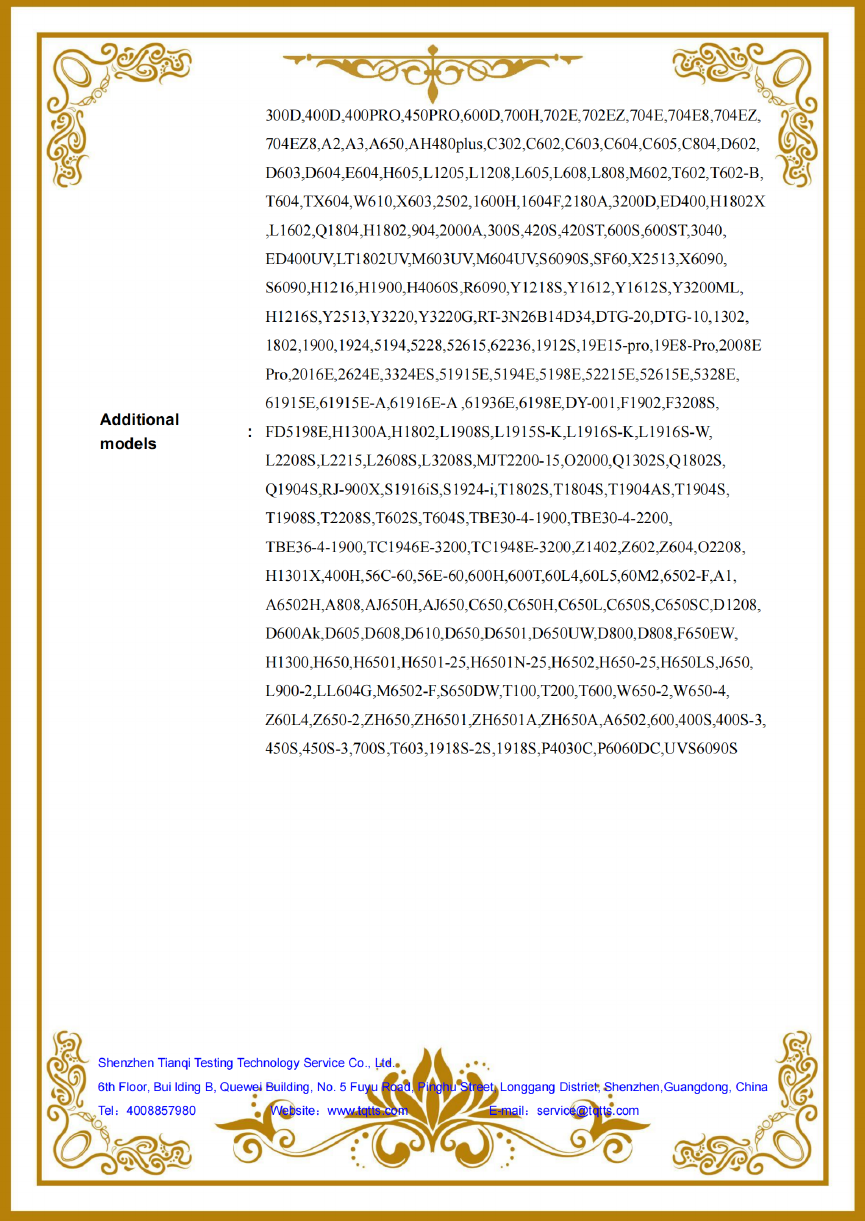
The same platforms are listed against additional compliance documents that a 24/7 textile facility is typically asked to produce during supplier qualification, equipment import or factory audit:
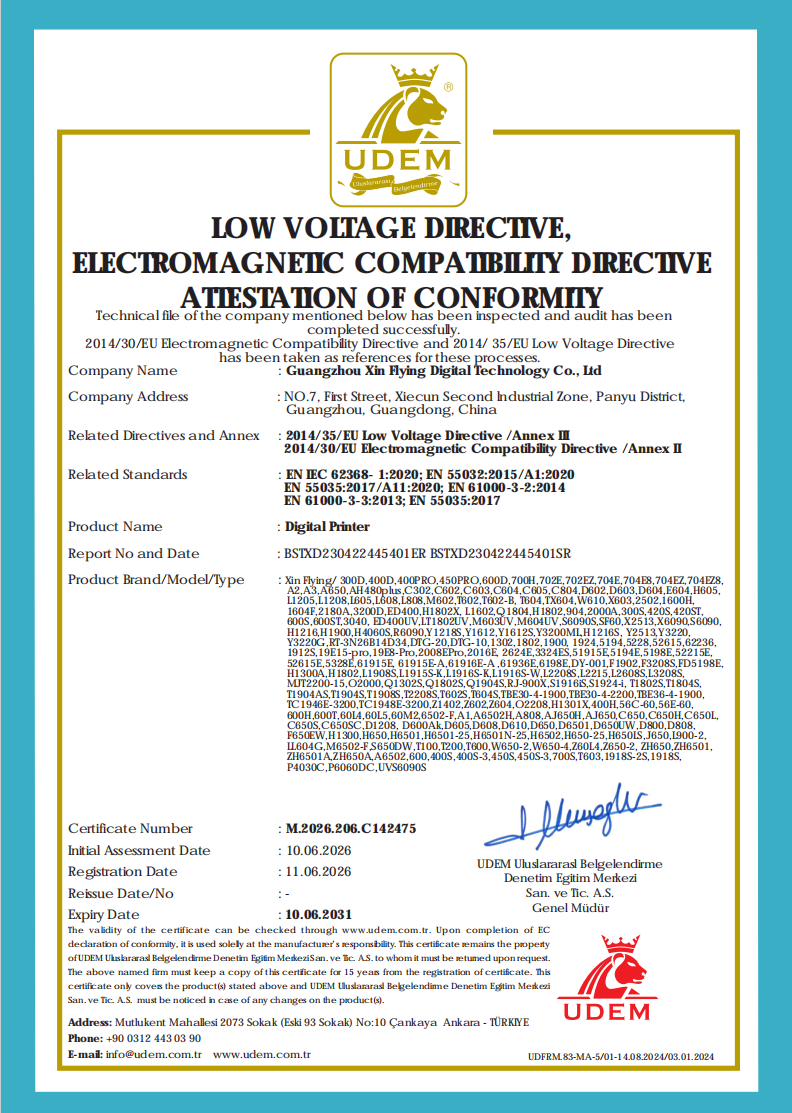
- CE LVD (certificate TQT1550D271EC, tested to EN IEC 62368-1:2020/A11:2020)
- CE Machinery Directive (certificate M.2026.206.C142365, issued by UDEM on 10 June 2026, valid to 9 June 2031, tested to EN ISO 12100:2010, EN 60204-1:2018/A1:2025 and EN ISO 12643-1:2023)
- RoHS (certificate M.2026.206.C142366, covering Directive 2011/65/EU and EN IEC 63000:2018)
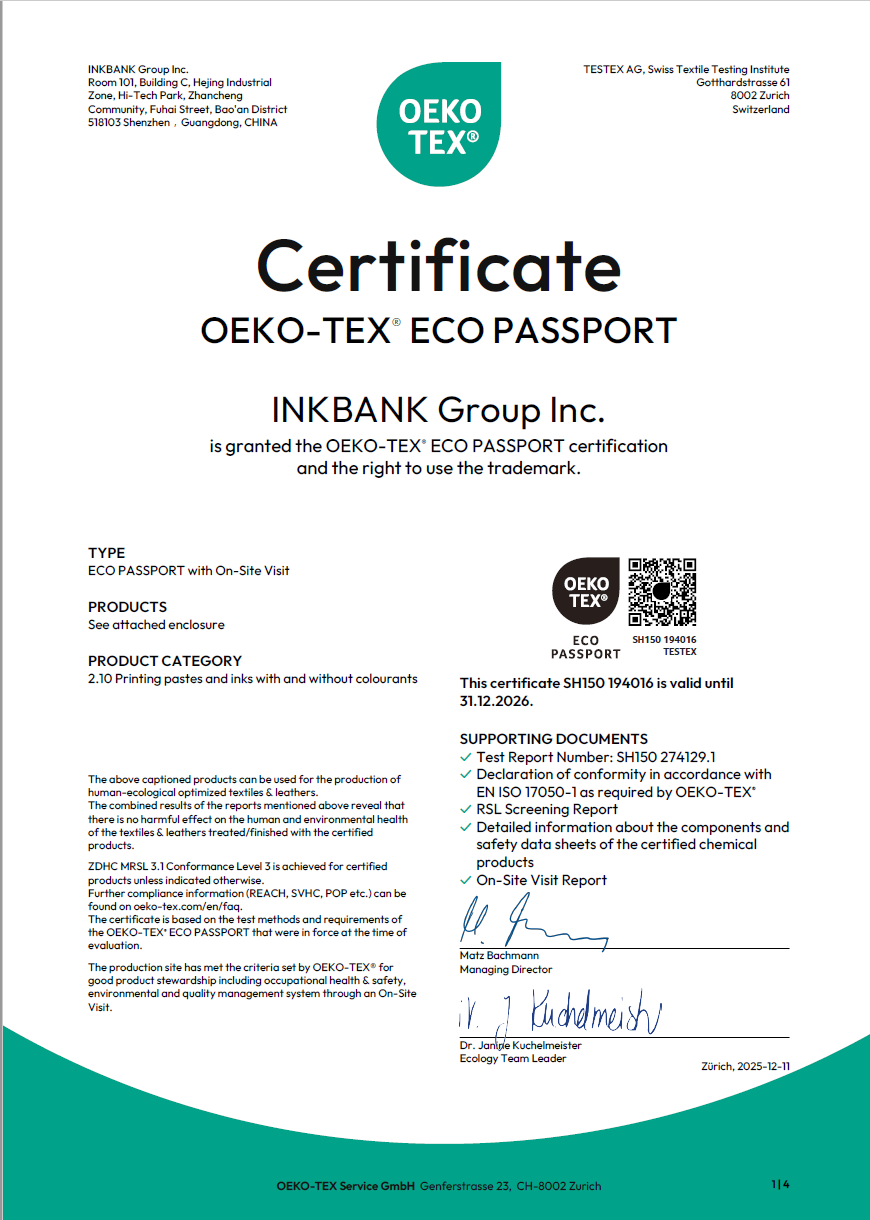
- OEKO-TEX® ECO PASSPORT (certificate SH150194016, issued by TESTEX AG on 11 December 2025 and valid to 31 December 2026 for textile printing inks and printing pastes)
Step-by-Step: Specifying and Commissioning a Continuous Textile Line
The sequence below is the one that keeps an industrial roll-to-roll project from being over- or under-specified. It works for a single 1.9 m sublimation printer or for a multi-machine line feeding one calender.
- Define the duty cycle first, not the machine. Decide whether the line runs one, two or three shifts, and what the realistic monthly fabric volume is. Head count and print width should follow from that number, not the other way round.
- Fix the print width against your fabric roll width. A 190 cm print width on the XF-19E8-PRO and XF-19E15-PRO, or 195 cm on the XF-O2000-4I32A1, determines how many panels are needed for a given finished width and how much seaming and trimming the line carries.
- Match head count to throughput. 8 heads at a 1PASS maximum of 306 m²/h and 15 heads at 524 m²/h describe two different production ceilings. Choose the ceiling you intend to sell, then confirm the dryer and the calender can keep up with it.
- Verify the electrical supply before the machine arrives. Both E-series models require 210–230 V at 45 A, drawing 10.2 kW (XF-19E8-PRO) and 14.5 kW (XF-19E15-PRO). Confirm the panel capacity, the earthing arrangement and the EMC documentation in parallel with the civil works.
- Set the environmental envelope and hold it. 18–30 °C and 35–65% RH apply to both E-series platforms. A continuous line needs monitoring, not just an initial air-conditioning set point.
- Build the colour workflow before the first production order. Install the RIP environment (Maintop standard, with RIIN for Hoson, PhotoPrint and Printfactory optional), define the ICC profile per fabric, and run a test job through the full print → dry → transfer chain.
- Plan media and consumable logistics around roll length. Long paper rolls reduce stops; the XF-19E15-PRO loads 1000 m rolls and the XF-O2000-4I32A1 accepts rolls of 1000–1500 m. Consumable storage, humidity control and handling equipment belong in the plan before commissioning.
- Institutionalise maintenance. Daily nozzle checks, adherence to the moisturizing and cleaning routine, and a written record of every printhead intervention are what keep a 24/7 line from becoming a 16/5 line.
- Complete preshipment testing and acceptance. Order acceptance for these platforms is confirmed by preshipment test, so the machine that arrives is the machine that was specified.
- Configure for OEM/ODM if the equipment carries your brand. The manufacturer offers OEM and ODM production services, with customization covering product branding, machine appearance, colour, logo, packaging and solutions developed to specific customer requirements.
Where Continuous Roll-to-Roll Lines Are Already Running
The duty-cycle argument is easiest to test against operating installations. The following applications reflect real configurations rather than theoretical use cases.
- Sportswear manufacturer (Brazil), 15 units, 4 years. The plant produces football jerseys, basketball uniforms and custom sportswear, printing high-resolution patterns, team logos and full-colour designs on polyester fabric before cutting and sewing. The reported outcome after moving to the sublimation solution was greater production flexibility on custom orders, reduced dependence on outsourced printing and more consistent colour across batches — built on industrial roll-to-roll capability and stable production performance.
- Sports uniform supplier (Brazil), 8 units, 5 years. Customised football kits, training uniforms and team apparel with personalised names, numbers and graphics. The line handles custom team orders with shorter production cycles while maintaining the colour vibrancy and detail that team uniforms require, and supports both small-batch customisation and continuous commercial printing.
- Home textile manufacturer, 10 units, 4 years. Curtains, cushions, decorative fabrics and customised polyester products, developed as recurring collections. The requirement here is large-format textile output with detailed patterns and consistent quality — the pattern fidelity that only holds when the dryer and media handling are stable over long runs.
- Digital textile printing service provider, 5 units, 3 years. The business prints for sportswear brands, apparel factories and customised textile companies. The reported result was expanded production capacity, support for more simultaneous customer projects and faster response on customised textile orders, supported by production flexibility and compatibility across different polyester applications.
Across all four, the same three factors decide whether the investment works: reliable equipment performance, production flexibility, and compatibility with a wide range of polyester textile applications.
Platform Comparison for Continuous Textile Production
The three platforms below cover the practical range for a continuous textile line, from entry into continuous running through to high-volume production. All specifications are as published by the manufacturer; confirm them against the configuration quoted for your project.
| Specification | XF-19E8-PRO | XF-19E15-PRO | XF-O2000-4I32A1 |
|---|---|---|---|
| Printheads | 8 × Epson i3200-A1 | 15 × Epson i3200-A1 | 4 × Epson i3200-A1 |
| Print width | 190 cm (75") | 190 cm (75") | 195 cm (1.95 m) |
| Fastest speed | 1PASS 306 m²/h; 2PASS 153 m²/h | 1PASS 524 m²/h; 2PASS 254 m²/h | 2PASS 180 m²/h; 4PASS 92 m²/h |
| Standard speed | 1PASS 210 m²/h; 2PASS 109 m²/h | 1PASS 394 m²/h; 2PASS 188 m²/h | Not specified |
| Resolution | 3200 dpi | 3200 dpi | Not specified |
| Ink | Sublimation ink, CMYK | Sublimation ink, CMYK | Sublimation ink, CMYK ×4 (220 ml cartridge + 3 L ink tank) |
| Media | Sublimation paper | Sublimation paper, loads 1000 m rolls | Heat transfer paper, rolls of 1000–1500 m |
| Drying / heating | External intelligent air-heat integrated dryer | External intelligent air-heat integrated dryer | Front/middle/rear break-controlled heating |
| Moisturizing and cleaning | Fully sealed automatic | Fully sealed automatic | Not specified |
| Power supply | 10.2 kW, 210–230 V, 45 A | 14.5 kW, 210–230 V, 45 A | 8.5 kW, 220 V, 50/60 Hz |
| Net weight | 1400 kg | 1480 kg | Approx. 490 kg |
| CE EMC listing (EN 55032 family) | Listed | Listed | Listed |
| Typical fit | Continuous production with a moderate throughput ceiling | High-volume continuous production on 190 cm goods | Entering continuous production; wide 195 cm work |
Frequently Asked Questions
Do continuous-run sublimation printers need EMC certification for industrial power grids?
Yes. In the European Union, printing machinery supplied as electrical equipment must meet the EMC Directive 2014/30/EU, and a heavy industrial grid is exactly the environment where that matters. XINFLYING holds CE EMC certification TQT1550D270EC, issued 19 May 2026 by TQT, tested to EN 55032:2015/A11:2020, EN 55035:2017/A11:2020, EN IEC 61000-3-2:2019+A1:2021 and EN 61000-3-3:2013/A2:2021. Both the XF-19E15-PRO and the XF-19E8-PRO are listed on that certificate, alongside the XF-O2000-4I32A1.
OEM dye sublimation printer manufacturer — what can actually be customised?
The manufacturer provides both OEM and ODM production services. Customization covers product branding, machine appearance customization, colour customization, logo customization, packaging customization, and customized solutions developed around specific customer requirements. Monthly production capacity is 1,600+ units, and the minimum order quantity is one unit, so a customized configuration is not limited to bulk orders.
What order terms apply — minimum quantity, delivery and payment?
The minimum order quantity is 1 unit. Products are delivered under the standard Incoterms EXW, FOB, CIF and DDP, which cover global deliveries. Accepted payment methods are T/T, Western Union and PayPal, and order acceptance is confirmed by preshipment test.
Can we validate output before committing to a full continuous line?
Validation is built into the order process: acceptance for these platforms is based on preshipment testing rather than on specification documents alone. Because the minimum order quantity is a single unit, a facility can commission one machine, run its own polyester jobs through the complete print, dry and transfer chain, and scale to additional units only after that validation. The XF-O2000-4I32A1 is commonly used as this first unit before a plant moves to the 8-head or 15-head platform.
What lead time and after-sales support should a 24/7 facility plan for?
Lead time runs from 5 to 40 days depending on configuration. After-sales support is delivered by more than 50 engineers providing 24/7 online technical support, with local warehouses and technical support in key markets. The full equipment range and configuration options are summarised in the XINFLYING corporate brochure (PDF). If you want your own fabric and artwork tested against a specific duty cycle, send the requirement to info@xin-flying.com or start a conversation on WhatsApp and the team can confirm the configuration, test prints and delivery schedule for your line.
Conclusion: Design for Uptime, Not for Peak Speed
A sublimation printer chosen for continuous textile runs is chosen on different logic from one bought for job work. The 1.9 m roll-to-roll format is now the working standard for high-volume textile and soft signage output, and the market around it is growing at a projected 11.5% CAGR through 2033, with Asia Pacific holding a 36.5% revenue share in 2025. That growth is being absorbed by facilities that measure success in shifts completed, not in the fastest number on a datasheet.
On that measure, continuous capability comes down to a small number of verifiable things: enough printheads to hit the throughput the business has sold (306 m²/h on the XF-19E8-PRO, 524 m²/h on the XF-19E15-PRO at 1PASS); a dryer that keeps up with the heads; a moisturizing and cleaning system that survives overnight idle; a power specification of 10.2–14.5 kW at 210–230 V, 45 A on a grid that is shared with other heavy equipment; and EMC documentation to EN 55032 and its companion standards that satisfies an electrical engineer, not just a filing cabinet.
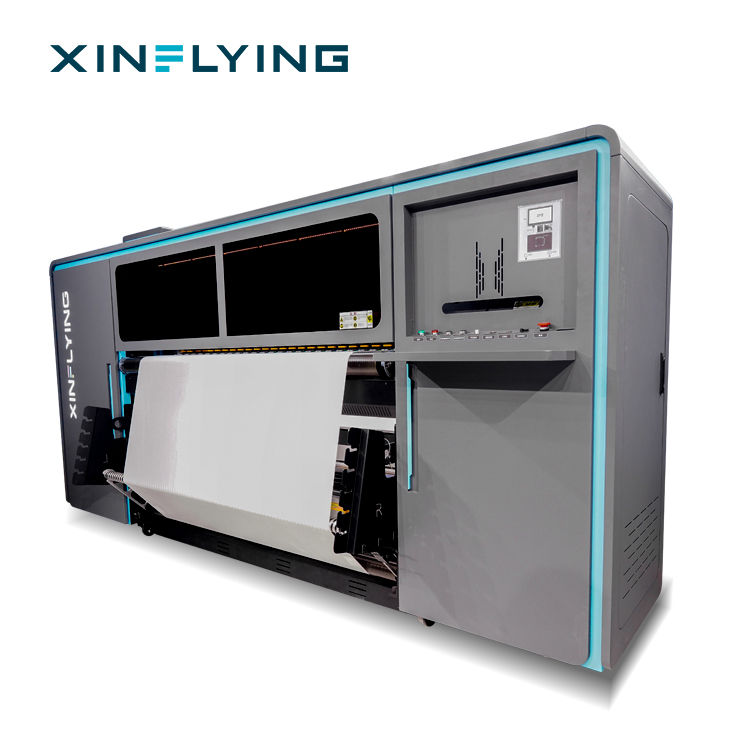
XINFLYING (Guangzhou Xin Flying Digital Technology Co., Ltd.), founded in 2010, manufactures DTF printers, DTG printers, UV DTF printers, UV flatbed printers, dye sublimation printers and printing consumables, with a 37,440 m² facility, 20+ R&D engineers and roughly 80% of output exported across North America, South America, Europe, Asia, the Middle East and Africa.
Next step: download the corporate brochure (PDF), review the platform range at xin-flying.com, or contact the team directly at info@xin-flying.com / +86 188-1322-1357 to request a quotation for a continuous roll-to-roll line.
Have Questions or Need More Details?
Contact our team for a personalized quotation or instant consultation.
Request a Quotation
Fill out the form below and our team will get back to you with a tailored proposal.
WhatsApp Direct Chat
Prefer to chat in real-time? Message us on WhatsApp for instant assistance & quick answers.
- Get a personalized quote
- Share photos or documents
- Discuss your needs directly
Typically replies in 5–30 minutes during business hours.