
How to Qualify a Long-Term Dye Sublimation Printer Supplier for Textile Production
Selecting a long-term dye sublimation printer supplier is a strategic decision for textile production companies. A short-term purchase focuses on price; a long-term partnership requires evaluating production capacity, product scalability, export experience, compliance documentation, and after-sales support. This guide provides a decision framework for buyers who are ready to commit to a supplier and need to verify that the partnership will support their production for years.
Why Long-Term Supplier Selection Fails
Many textile businesses choose a sublimation printer based only on the initial machine price. That approach often leads to problems after installation. Common risks include selecting a machine with insufficient production capacity, poor print quality, unstable ink systems, or limited after-sales support. In international trade, buyers also face risks related to missing certifications, unclear delivery terms, and slow response times from manufacturers without local support.
A long-term supplier must be able to do more than ship a machine. The supplier should provide technical training, spare parts availability, maintenance recommendations, and a product line that allows the buyer to scale up when order volume increases. Without these elements, even a low-cost printer can become a costly production bottleneck.
Industry Background: Dye Sublimation Demand Is Growing
The market conditions for dye sublimation printing justify a long-term view. According to Grand View Research, the global dye sublimation printing market was valued at USD 16.4 billion in 2025 and is projected to reach USD 39.0 billion by 2033, with a projected CAGR of 11.5% from 2026 to 2033. Asia Pacific dominated the market in 2025 with a 36.5% revenue share, led by China as the largest country market.
The demand for personalized apparel and home decor is a primary growth driver. Grand View Research reports a 13.1% CAGR for the digital textile sublimation market through 2030. For production managers and owners, this means that the equipment chosen today must be able to handle increasing order volumes and more complex full-color designs in the coming years.
What a Long-Term Sublimation Printer Supplier Should Provide
A long-term supplier for textile production must be evaluated across several dimensions. The sections below describe the essential criteria and use Guangzhou Xin Flying Digital Technology Co., Ltd. (XINFLYING) as a reference example, based on verified company data.
Manufacturing and R&D Capability
A supplier that manufactures its own equipment is generally better positioned to control quality, provide spare parts, and support custom OEM requirements. XINFLYING, founded in 2010, is a professional digital printing equipment manufacturer specializing in dye sublimation printers, DTF printers, UV printers, and related printing solutions. The company operates a 37,440 m² factory, employs more than 200 staff, and has an R&D team of 20 engineers. With an annual output exceeding 20,000 units, the company has production scale to support repeat orders from international buyers.
Product Portfolio That Scales With Your Business
One supplier should be able to offer equipment for your current production level and future expansion. Textile production businesses typically fall into three categories.
Entry-level production: For small and medium-sized sublimation printing businesses, the XF-H1802X-2I32A1 is a suitable entry-level solution. It is equipped with 2 Epson i3200-A1 printheads and a 1800mm printing width, providing stable production performance with printing speeds up to 52 m²/h. This model is suitable for businesses starting sublimation printing, custom textile production, apparel sampling, and small-batch orders.
Mid-range production: For growing printing companies requiring higher productivity, the XF-O2000-4I32A1 is a recommended mid-range solution. With 4 Epson i3200-A1 printheads, a 1950mm printing width, and printing speeds up to 180 m²/h in 2PASS mode, it offers a balance between production capacity, print quality, and operating efficiency. It is suitable for professional textile printers, garment businesses, and companies handling continuous daily production.
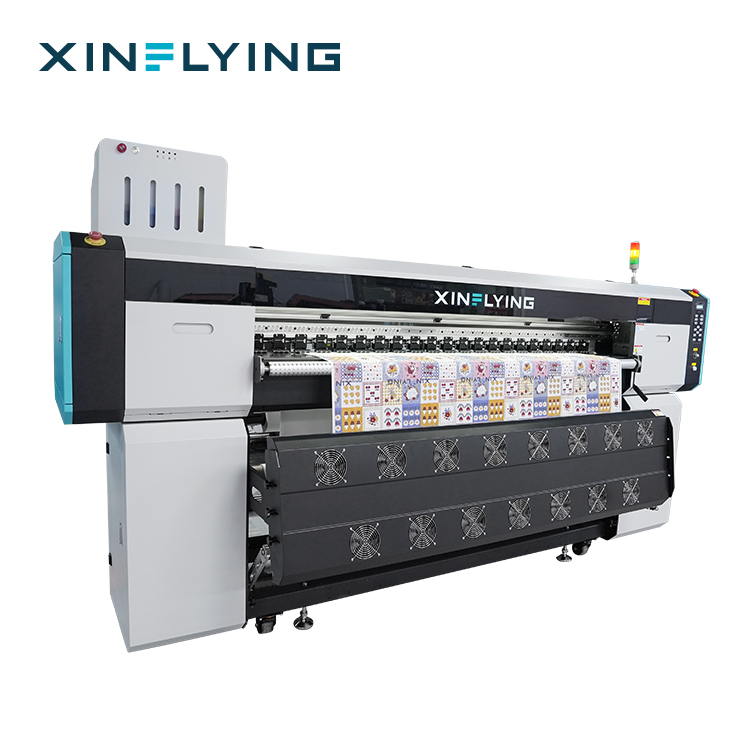
Industrial production: For high-volume environments, the XF-19E8-PRO is a recommended high-end solution. It features 8 Epson i3200-A1 printheads, 3200dpi resolution, and printing speeds up to 306 m²/h. It is designed for textile factories, large garment manufacturers, and professional sublimation production centers requiring maximum efficiency and stable operation.
For even higher volumes, the XF-19E15-PRO uses 15 Epson i3200-A1 printheads and reaches 524 m²/h in 1PASS mode, making it suitable for very large-scale industrial textile sublimation printing.
Global Sales and Local Support Network
International buyers need suppliers with experience in cross-border logistics and local support. XINFLYING serves major markets including North America, South America, Europe, Asia, the Middle East, and Africa. Export business accounts for 80% of total sales. The company maintains local warehouses and technical support in key markets, which helps reduce lead times for spare parts and shortens response time when technical assistance is needed.
Commercial Terms and Acceptance Inspection
Long-term buyers should confirm the supplier's commercial conditions and quality acceptance process before placing an order. XINFLYING supports a minimum order quantity of one unit, with delivery methods covering EXW, FOB, CIF, and DDP. Accepted payments include T/T, Western Union, and PayPal.
Quality acceptance is a critical control point. At XINFLYING, product acceptance inspection is carried out through pre-shipment tests conducted before delivery. Buyers should always request a pre-shipment test procedure and confirm that it applies to the actual equipment model they purchased.
Certification and Compliance Documentation
Regulatory compliance is essential for imported equipment. Buyers should verify that certification documents match the exact model supplied. For the European market, buyers should verify CE compliance, including applicable electrical safety, electromagnetic compatibility, and product safety requirements. For the US market, FCC compliance is commonly required to control electromagnetic interference; depending on the product configuration, additional safety certifications may apply. RoHS compliance helps confirm that components meet restrictions on hazardous substances. A long-term supplier should provide valid certification documents, test reports, and technical files upon request.
Step-by-Step Guide: Qualifying a Sublimation Printer Supplier
Use the following six steps to evaluate a supplier before making a long-term commitment.
Step 1: Map your production requirements. Calculate your daily and monthly output in square meters. Determine the printing width you need based on your products. Sportswear manufacturers typically need 1.8m to 1.95m width; home textile producers may require the same range for large fabric rolls. Choose machines that match your current volume and your 3-year growth plan.
Step 2: Evaluate the manufacturer's core credentials. Check whether the supplier actually manufactures the equipment or only resells it. Review factory size, R&D resources, and production capacity. Confirm whether the supplier offers OEM/ODM services if you plan to sell under your own brand.
Step 3: Verify product specifications. Compare printhead configuration, ink system, RIP software compatibility, and print speed under production conditions. For example, the XF-O2000-4I32A1 supports both RIIN Print and Maintop RIP software, giving production managers flexibility in their workflow. Check power requirements and operating environment specifications to ensure compatibility with your facility.
Step 4: Request certification documents. Ask for CE, FCC, RoHS, or other regional compliance documents. Confirm that the documents correspond to the machine model you are purchasing. Incomplete documentation can cause customs delays and sales restrictions.
Step 5: Confirm the support ecosystem. Ask about installation guidance, remote technical support, training, and spare parts availability. Suppliers with local warehouses in your region can respond faster and reduce downtime. XINFLYING maintains local warehouses and technical support in key markets across North America, South America, Europe, Asia, the Middle East, and Africa.
Step 6: Establish a pilot production plan. Before large-scale production, run test prints to verify color accuracy, banding, and throughput. Use the pre-shipment test procedure as your checkpoint. If the supplier offers product samples or test transfers, use them to confirm print quality before final payment.
Use Cases: Matching Supplier Capabilities to Production Scenarios
Sportswear and Team Uniform Manufacturers
Sportswear production requires high-speed printing on polyester fabrics with strong color vibrancy. Sublimation printing creates a permanent bond with polyester fibers, making it suitable for jerseys, athletic uniforms, and activewear. Industrial machines like the XF-19E8-PRO or XF-19E15-PRO provide the output speed needed for large orders. When evaluating suppliers, sportswear manufacturers should prioritize printing speed, consistent color output, and the ability to handle roll-to-roll workflows.
Home Textile Producers
Home textiles such as curtains, blankets, and decorative fabrics require wide-format printing and reliable long-term operation. The XF-O2000-4I32A1, with a 1950mm printing width, is designed to handle home decor and fabric applications. Suppliers for this segment should demonstrate experience with polyester-based home textile fabrics and provide support for large-format transfer workflows.
Custom Apparel Businesses
Custom apparel businesses need flexibility for short-run orders and frequent design changes. Entry-level machines like the XF-H1802X-2I32A1 support small-batch production and sample printing. A long-term supplier should offer a clear upgrade path, allowing these businesses to move to mid-range or industrial equipment as order volume grows without switching to a different manufacturer.
Distributors and Commercial Print Centers
Distributors require a supplier that can provide a complete product ecosystem, including ink, transfer paper, RIP software, and spare parts. They benefit from a manufacturer with export experience and support for private-label or OEM programs. The buyer should verify the supplier's ability to maintain consistent batch quality across multiple orders.
Sublimation Printer Supplier Comparison: How Major Brands Fit
When evaluating long-term suppliers, buyers should compare equipment manufacturers against their own production requirements. According to Data Insights Reports, Epson leads the digital textile dye sublimation printer market with a 26.7% share, followed by Mimaki at 18.6% and Roland DG at 15.5%. XINFLYING is a Chinese manufacturer focused on dye sublimation and other digital textile printing solutions for international markets. The table below provides a comparison based on publicly available market data and general industry positioning.
| Brand | Market Position (Verified) | Typical Focus | Fit for Long-Term Textile Partnership |
|---|---|---|---|
| Epson | 26.7% global share in digital textile dye sublimation | Printhead technology, industrial inkjet systems, branded printer lines | Strong technology base and global brand recognition; buyers should evaluate the level of local technical support for their specific model. |
| Mimaki | 18.6% global share in digital textile dye sublimation | Wide-format inkjet printers for signage, textiles, and industrial applications | Well-established in wide-format printing; suitable for buyers who need a global brand and are less focused on OEM or private-label manufacturing. |
| Roland DG | 15.5% global share in digital textile dye sublimation | Wide-format printers, vinyl cutters, and sign-making equipment | A reliable brand for small-to-medium production and sign applications; may be less focused on industrial-scale textile roll-to-roll production. |
| XINFLYING | Manufacturer with export business accounting for 80% of total sales; local warehouses in key markets | Dye sublimation printers, DTF printers, UV printers, and complete digital printing solutions for textile and apparel production | Suitable for buyers who prioritize direct manufacturer support, OEM/ODM capability, and a product line that scales from entry-level to industrial production. |
Buyers should interpret this table as a starting point. The correct choice depends on your production volume, fabric types, budget, and the level of technical support you can access locally.
Frequently Asked Questions
1. What certification documents should a long-term sublimation printer supplier provide?
For imports into the European Union, buyers should verify CE compliance, including applicable electrical safety, electromagnetic compatibility, and product safety requirements. For the US market, FCC compliance is commonly required to control electromagnetic interference. RoHS compliance helps confirm that electronic components meet restrictions on hazardous substances. Buyers should request valid certification documents, test reports, and technical files that match the actual printer model. Incorrect or incomplete documentation may cause customs delays, sales restrictions, or additional compliance costs.
2. How can I verify a manufacturer's production capacity for textile printing equipment?
Review the manufacturer's factory size, annual output, R&D team size, and product range. For example, XINFLYING operates a 37,440 m² factory with an annual output of more than 20,000 units and employs 20 engineers in R&D. These figures indicate the manufacturer can support repeat orders and maintain consistent production quality. Buyers should also request references or visit the factory when possible, especially for high-value industrial orders.
3. How should I choose a sublimation printer model to avoid overpaying for capacity I do not need?
Determine your actual production volume in square meters per hour or per day, and map it to the printer's rated speed. For small-batch production, the XF-H1802X-2I32A1 with 2 printheads and 52 m²/h is a cost-effective entry point. Growing companies should consider the XF-O2000-4I32A1, which reaches 180 m²/h in 2PASS mode. High-volume factories need machines like the XF-19E8-PRO or XF-19E15-PRO. Choosing a machine that matches your production scale prevents wasted investment while leaving a clear upgrade path within the same supplier's product line.
4. How does pre-shipment testing protect my sublimation printer order?
Pre-shipment testing is a quality acceptance procedure conducted before the machine is delivered. At XINFLYING, product acceptance inspection is carried out through pre-shipment tests before delivery. Buyers should confirm in their purchase agreement that the supplier will run the actual machine, print test patterns, and verify all functions before packing. This reduces the risk of receiving a defective unit and ensures the machine meets the agreed specifications at the time of shipment.
5. What after-sales and technical support should I expect from a global sublimation printer supplier?
A long-term supplier should provide installation guidance, remote technical support, operation training, and spare parts availability. Suppliers with local warehouses and technical support in key markets can respond faster and reduce production downtime. XINFLYING serves major markets including North America, South America, Europe, Asia, the Middle East, and Africa, with local warehouses in key markets and export business accounting for 80% of total sales. When evaluating a supplier, ask about response time for technical inquiries and whether spare parts are stocked locally or shipped from the factory. To discuss your production timeline and request a sample print, contact XINFLYING or download the company brochure.
Conclusion
Qualifying a long-term dye sublimation printer supplier is not a matter of finding the cheapest machine. It is a process of verifying that the manufacturer has the production capacity, product portfolio, global service network, compliance documentation, and quality control procedures to support your business over multiple production cycles.
Start by mapping your production needs, then evaluate the supplier on the dimensions described above: manufacturing capability, product scalability, certification completeness, after-sales support, and commercial terms. Use pre-shipment testing as your final quality checkpoint. A supplier that passes these checks becomes not just a vendor, but a production partner.
For more information about XINFLYING's sublimation printer product line and OEM/ODM capabilities, download the company brochure here: XINFLYING Company Introduction (PDF).
Have Questions or Need More Details?
Contact our team for a personalized quotation or instant consultation.
Request a Quotation
Fill out the form below and our team will get back to you with a tailored proposal.
WhatsApp Direct Chat
Prefer to chat in real-time? Message us on WhatsApp for instant assistance & quick answers.
- Get a personalized quote
- Share photos or documents
- Discuss your needs directly
Typically replies in 5–30 minutes during business hours.