
How Dynamic Textile Printing Has Evolved: From Analog Screens to Dye Sublimation
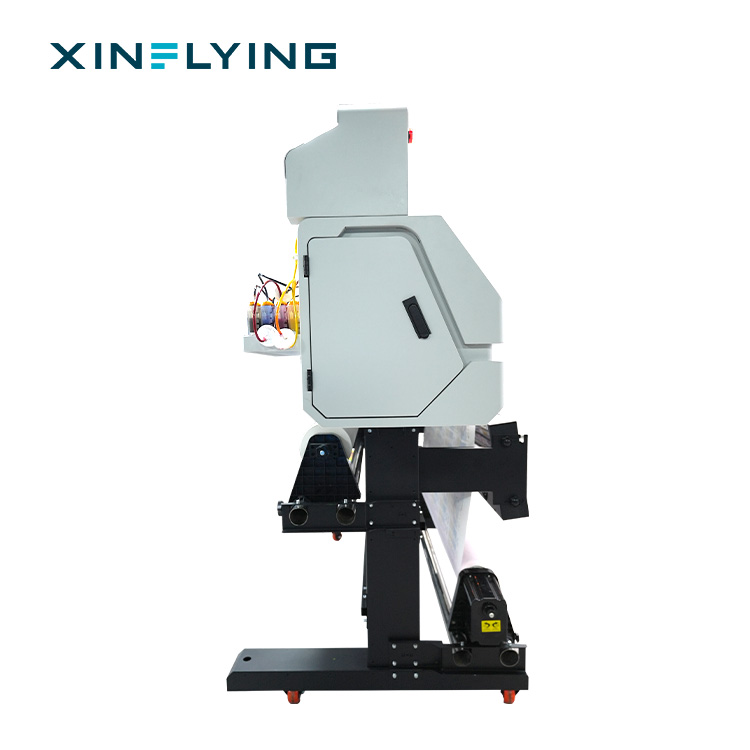
A dye sublimation printer built by Xinflying (Guangzhou Xin Flying Digital Technology Co., Ltd.), a digital printing equipment manufacturer established in 2010.
Dynamic textile printing — production where the printed design changes from order to order instead of repeating one fixed pattern — has moved from analog screens and rotary cylinders to digital dye sublimation. The transition happened because dye sublimation removed the two constraints that limited analog workflows: per-design setup, and mechanical repeatability at production width.
In dye sublimation printing, a design is printed onto transfer paper with sublimation ink and then heated. The dye changes from solid to gas and penetrates polyester fibers, so it becomes permanently bonded inside the material rather than sitting on its surface. For a buyer, that matters in a practical way: image quality and durability no longer depend on how carefully an operator registers a screen, but on whether the printer, its ink delivery, and its RIP configuration are stable enough to repeat the same settings across thousands of linear meters.
That relationship between digital flexibility and mechanical stability explains why the 1900mm (1.9m) roll-to-roll class is now treated as the reference format for high-volume textile and soft signage production, and why safety of machinery in that class is addressed through standardization such as EN ISO 12643-1:2023. This article explains what changed in the industry, why dye sublimation became the digital default, and how to evaluate equipment if you are at the start of the same transition.
Problem Definition: Why Analog Textile Printing Limited Dynamic Production
Analog textile printing transfers ink through a prepared screen or cylinder onto fabric. The method is mature and predictable, but its cost structure is front-loaded. Screen printing requires screen preparation and setup before production, which means each new design carries its own setup burden before the first unit is printed. That cost is recovered by repeating the same design at volume, with a limited number of colors.
The market that grew fastest over the past decade does not behave that way. Team jerseys, activewear, fashion fabric, home textiles, promotional products and personalized items require full-color artwork, gradients and photographic detail, in runs that change constantly. Digital dye sublimation supports unlimited colors, detailed images and complex artwork without additional setup costs, while analog processes remain better suited to simple designs with fewer colors and high volumes of identical output.
A second constraint was mechanical. Transfer-based dye sublimation depends on controlled temperature, pressure and media feed. When paper transport, printhead alignment or heating behavior drifts, the fault appears as banding, missing lines or color deviation — the three most common quality complaints in sublimation production. Analog equipment had no inkjet nozzles to maintain, but it had registration limits and no answer for variable data. Dynamic production needed a mechanism that could change the file without changing the setup, and then hold that setup steady for continuous operation.
Industry Background: The Market Behind the Analog-to-Digital Shift
The scale of the change is visible in published market data. Grand View Research values the global dye sublimation printing market at USD 16.4 billion in 2025 and projects USD 39.0 billion by 2033, a CAGR of 11.5% from 2026 to 2033. Mordor Intelligence, looking specifically at the dye sublimation printers segment, values it at USD 1.88 billion in 2025, growing to USD 2.53 billion by 2030. The larger context is also expanding: Fortune Business Insights values the large format printer market at USD 10.57 billion in 2025, projected to reach USD 16.52 billion by 2034.
Demand is concentrated. Asia Pacific accounted for a 36.5% revenue share of the dye sublimation printing market in 2025, with China the largest country market, according to Grand View Research. That position is supported by export volume: China's textile and garment exports reached USD 293.6 billion in 2023, which sustains demand for industrial-scale sublimation equipment inside the region. Growth is also applications-driven — the digital textile sublimation market is projected to grow at a 13.1% CAGR through 2030, with demand for personalized apparel and home decor identified as the primary driver.
On the equipment side, inkjet technology has become the default production method: inkjet production printers accounted for 87.3% of the production printer market by type in 2024, according to Grand View Research. Vendor concentration in the digital textile dye sublimation printer market was led by Epson at 26.7% in 2024, followed by Mimaki at 18.6% and Roland DG at 15.5%, based on figures published by Data Insights Reports. Those shares describe the printhead and platform ecosystem that a buyer enters when selecting a machine, because most wide-format sublimation hardware is built around industrial-grade inkjet printheads.
Width standardization followed demand. Roll-to-roll sublimation printers at 1.9m (1900mm) width are standard for high-volume textile and soft signage applications, according to FESPA Insights. Publishing note: market totals differ between research houses depending on whether consumables, inks and services are counted, so the figures above are best read as direction and scale rather than a single precise number.
Detailed Solution: How Dye Sublimation Became the Digital Default
The mechanism, in plain terms
Dye sublimation printing is a heat transfer process that changes solid dye into gas and permanently embeds it into polyester-based materials. The printer lays sublimation ink onto transfer paper; a heat press or calender then applies controlled temperature and pressure so the dye enters the fabric surface. Because the chemistry depends on polyester, sublimation works best on polyester fabrics and polyester-coated substrates, and it requires dedicated sublimation ink rather than conventional textile ink.
This is the reason the transition was a mechanism change and not a software change. The variable in analog printing is the physical screen; the variable in digital dye sublimation is the printhead, the paper path and the color profile. Control those three, and the same file reproduces identically on the next order — which is exactly what dynamic production requires.
Why dye-sublimation hardware is more repeatable than analog setup
Stable mechanisms are the difference between a printer that can run a shift and a printer that can run a production line. On the XF-19E15-PRO, a 190cm industrial sublimation printer, the design concentrates on exactly that: a linear motor with magnetic grid drive, a Japan THK silent linear guide, 27 press rollers and an enlarged beam, combined with fully sealed automatic moisturizing and cleaning and an external intelligent air-heat integrated dryer. Its 15 Epson i3200-A1 printheads each carry 3200 nozzles with variable ink drop, so throughput and dot placement are managed on the same platform.
The XF-19E8-PRO applies the same logic at a different throughput level: 8 Epson i3200-A1 printheads, a Japan THK silent linear guide, anti-collision devices at both ends, a US-imported fluorine rubber pressure paper wheel, an external intelligent air-heat integrated dryer, and alarms for liquid level and waste ink. Mid-range and entry models extend the principle to smaller widths — the XF-O2000-4I32A1 uses front, middle and rear break-controlled heating with an integrated IR and cooling fan system, while the XF-H1802X-2I32A1 uses front, middle and rear break-controlled heating with a retraction system and aluminum ink rack.
Every one of those components exists to hold one variable constant during transfer. When a printer is used in a controlled indoor environment — typically 18°C to 30°C and 35% to 65% RH, with more specific ranges listed for some models — ink performance, color accuracy and print quality stay consistent enough for 24/7 operation.
The 1900mm class and why standardization followed
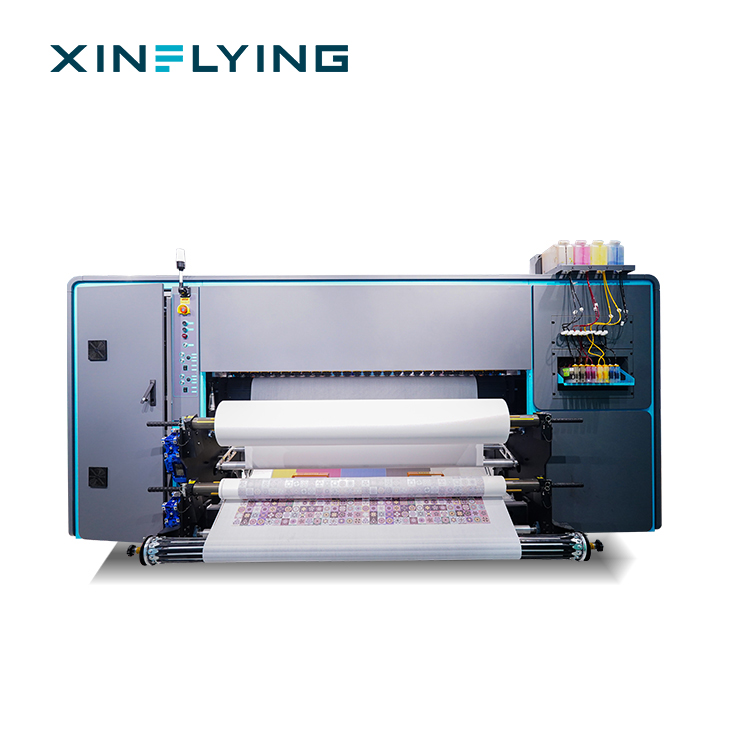
The XF-19E8-PRO: a 190cm (1.9m) roll-to-roll sublimation printer with 8 Epson i3200-A1 printheads, built for continuous textile production.
Once 1.9m roll-to-roll printing became the standard format for high-volume textile and soft signage work, the machinery itself became a regulatory subject rather than only a purchasing decision. EN ISO 12643-1:2023 addresses safety requirements for graphic technology machinery, and it is the reference increasingly used when 1900mm-class equipment is specified, imported or commissioned. For a print shop, this is not an abstract point: a machine in this class is a continuously running production asset, so guarding, electrical design and safety documentation belong in the purchase file next to the price and the speed rating.
Documentation expectations differ by market. Buyers importing into the European Union should verify CE compliance covering applicable electrical safety, electromagnetic compatibility and product safety requirements, supported by valid certificates, test reports and technical files that match the exact printer model. For the United States, electromagnetic compatibility and electrical safety requirements apply according to the configuration, with FCC compliance commonly required for electronic equipment to control electromagnetic interference. Environmental documentation matters as well: RoHS compliance confirms that electrical and electronic components meet restrictions on hazardous substances. In all three cases, the documentation must correspond to the model actually supplied, not to a similar machine in the same family.
The current hardware landscape
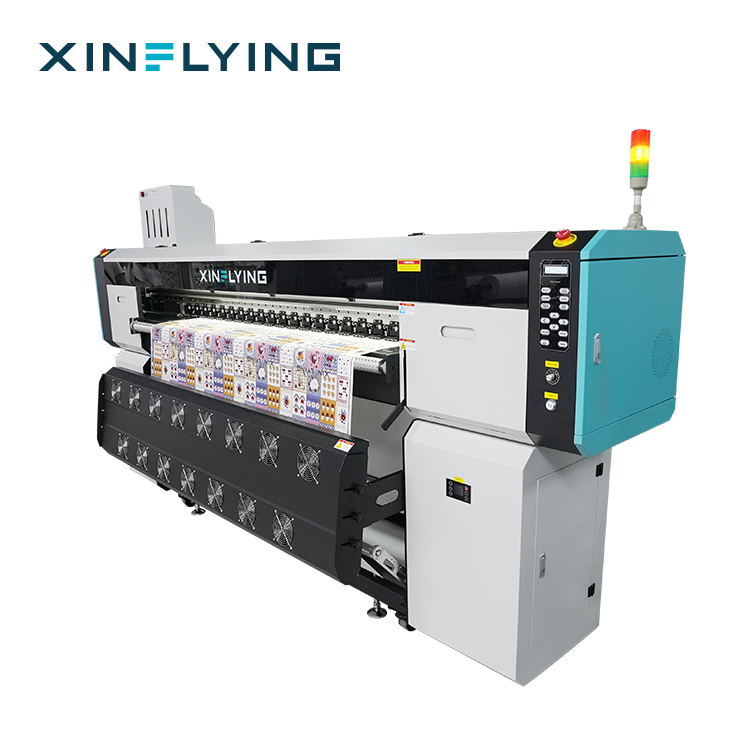
The XF-O2000-4I32A1: a 195cm roll-to-roll sublimation printer with 4 Epson i3200-A1 printheads and CMYKx4 ink configuration.
Today's digital dye sublimation range is segmented by production scale rather than by technology. Xinflying, a manufacturer of digital printing equipment established in 2010, builds five sublimation printers relevant to this transition:
- XF-H1301X-1I32A1 — a 130cm (1.3m) digital textile printer with 1 Epson i3200-A1 printhead, CMYK, fastest speed 28 m²/h at 4PASS and a 2 kW power draw.
- XF-H1802X-2I32A1 — a wide-format sublimation printer with a 180cm print width, 2 Epson i3200-A1 printheads, CMYK+CMYK, up to 52 m²/h at 4PASS and 3.5 kW.
- XF-O2000-4I32A1 — a 195cm piezoelectric inkjet sublimation printer with 4 Epson i3200-A1 printheads, CMYKx4, 180 m²/h at 2PASS and 8.5 kW.
- XF-19E8-PRO — a 190cm industrial sublimation printer with 8 Epson i3200-A1 printheads, CMYK, up to 306 m²/h at 1PASS, 3200 dpi resolution and 10.2 kW.
- XF-19E15-PRO — a 190cm high-volume sublimation printer with 15 Epson i3200-A1 printheads, CMYK, up to 524 m²/h at 1PASS, 3200 dpi resolution and 14.5 kW.
All five are classified as sublimation printers, are intended for textile sublimation printing, and share the same material specification: aluminum alloy, stainless steel and ABS plastic. What separates them is throughput, width and the volume of continuous work they are designed to absorb.
Step-by-Step Breakdown: Moving a Shop from Analog to Digital Dye Sublimation
The transition is normally executed in six stages. Each one answers a specific question that determines what the next stage can be.
Step 1 — Map the product mix
Start with the share of polyester-based work in the order book: sportswear, team jerseys, activewear, custom apparel, fashion fabric, home textiles, decorative fabric, soft signage, flags, banners and personalized textile products are all established sublimation applications. Sublimation works best on polyester and polyester-coated substrates, so a high share of cotton work indicates that a different digital process will still be needed alongside the new machine.
Step 2 — Fix the required print width
Width determines what can be printed as one piece. The range spans 130cm, 180cm, 190cm and 195cm, with the 1.9m class being the standard for high-volume textile and soft signage production. Panel printing is possible at narrower widths, but it adds cutting and joining work that the wider class eliminates.
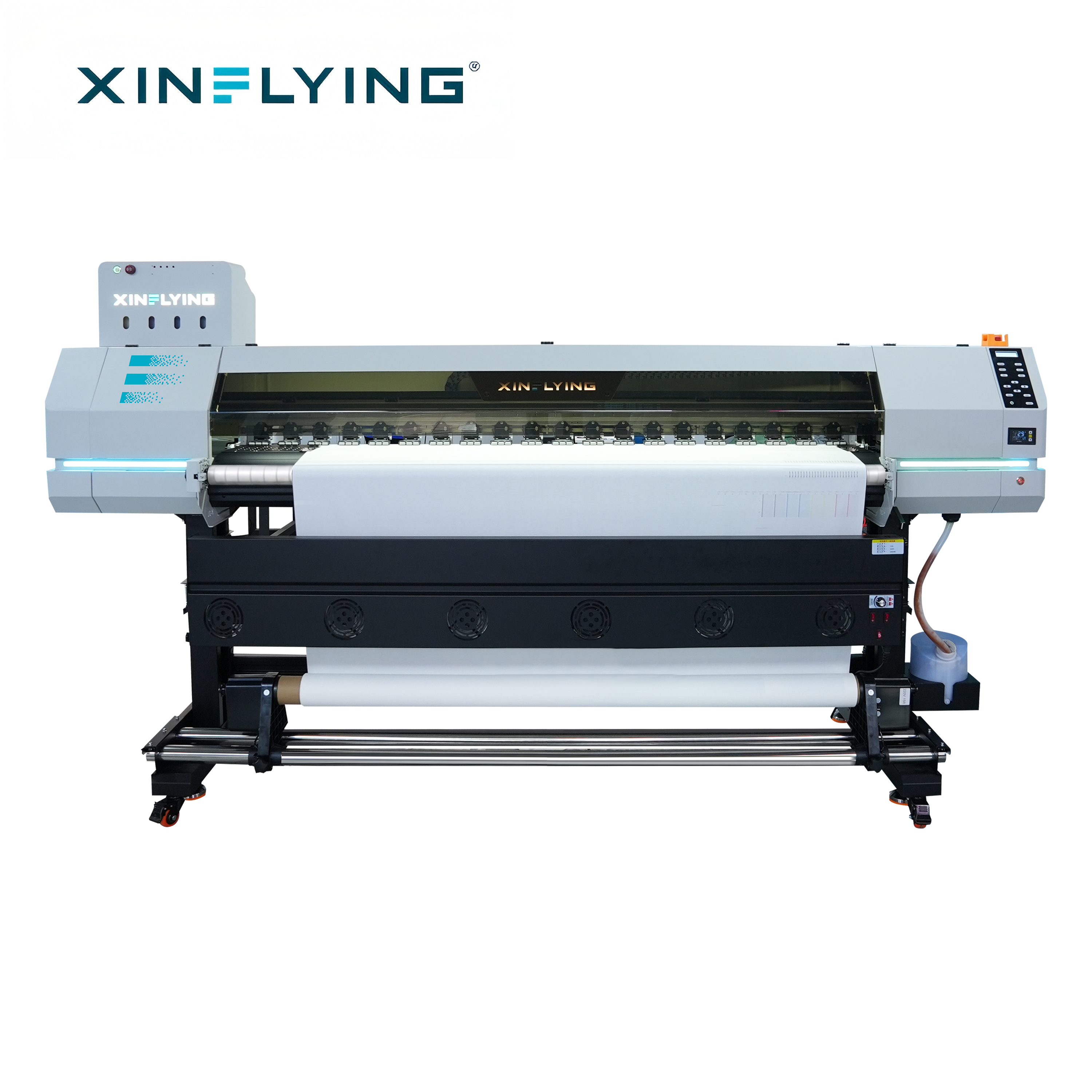
The XF-H1802X-2I32A1: a 180cm wide-format sublimation printer for polyester fabric printing, with aluminium ink rack and retraction system.
Step 3 — Match throughput to volume
Printhead count is the main throughput lever. A 2-head machine such as the XF-H1802X-2I32A1 reaches 52 m²/h and suits sampling and small-batch orders; a 4-head machine at 180 m²/h suits continuous daily production; an 8-head machine at 306 m²/h suits large-scale industrial work; and a 15-head machine at 524 m²/h is designed for maximum-efficiency environments. Matching capacity to actual orders avoids paying for speed that is never used, or buying a machine that limits growth within a year.
Step 4 — Plan RIP, color management and workflow
RIP software converts digital artwork into accurate instructions for the printer, managing color profiles, ink distribution, resolution settings and printer communication. On Xinflying sublimation printers, Maintop is standard, with RIIN (Hoson only), PhotoPrint and Printfactory available as options on the PRO models. The practical gain is consistency: a stable ICC profile and a saved parameter set reduce the color deviation that typically comes from mismatched profiles, incorrect RIP parameters or inconsistent heat-press conditions.
Step 5 — Validate before mass production
Installation should follow a fixed sequence: place the machine on a stable surface and connect power and cables; install the sublimation ink system and confirm continuous ink flow; install drivers and configure RIP settings; run nozzle checks, printhead inspection and initial calibration; then run test prints and adjust parameters before starting production. Nozzle checks are the fastest early indicator of trouble, because banding, missing lines and uneven ink output usually trace back to partial nozzle blockage, unstable ink supply or incorrect alignment. Do not change multiple parameters at once, and always test before a full run.
Step 6 — Lock in maintenance and support
Continuous operation depends on routine maintenance: nozzle checks, printhead cleaning, ink system inspection and stable operating conditions. It also depends on supplier support. Professional installation guidance, remote technical support, operator training, spare parts availability and a defined response time reduce the downtime risk that otherwise outweighs the initial price difference between machines.
Use Cases: Where Digital Dye Sublimation Now Runs
Sublimation printing is not one application; it is a group of applications that share the same material requirement. The working conditions are consistent across them: a controlled indoor production environment at roughly 18-30°C and 35-65% RH, with matched equipment including RIP software, a heat press calender, dye sublimation paper, dye sublimation ink and laser cutting.
- Sportswear and team jerseys — all-over printing on polyester, where the dye bonds into the fiber and the print stays breathable.
- Activewear and custom apparel — full-color, short-run work where per-design setup would otherwise dominate cost.
- Home textiles and decorative fabric — including cushions and other polyester-based interior items produced in repeats.
- Soft signage, flags and banners — the application that most directly rewards the 1.9m width class.
- Promotional and personalized products — canvas bags and similar coated or polyester items, where variable designs are normal rather than exceptional.
What these applications share is variability. That is precisely the workload analog printing was least efficient at handling, and the workload digital dye sublimation was designed around.
Comparison: Analog Screen Printing vs. Digital Dye Sublimation
| Decision factor | Analog screen printing | Digital dye sublimation |
|---|---|---|
| Design change | Requires screen preparation and setup before production | New file printed directly; no additional setup cost per design |
| Color and detail | Better suited to simple designs with fewer colors | Supports unlimited colors, gradients, detailed images and complex artwork |
| Best-fit volume | Large quantities of identical designs; unit cost falls with repetition | Flexible and variable production; efficient from short runs upward |
| Material compatibility | Various textiles depending on ink system | Polyester fabrics and polyester-coated substrates |
| Print feel | Ink layer transferred onto the fabric surface | Dye bonds inside the fiber, producing a soft, integrated print |
Sublimation Printer Configurations at a Glance
| Model | Print width | Printheads | Fastest print speed | Ink colors | Power |
|---|---|---|---|---|---|
| XF-H1301X-1I32A1 | 130 cm (1.3 m) | 1 x Epson i3200-A1 | 28 m²/h (4PASS) | CMYK | 2 kW |
| XF-H1802X-2I32A1 | 180 cm (1.8 m) | 2 x Epson i3200-A1 | 52 m²/h (4PASS) | CMYK+CMYK | 3.5 kW |
| XF-O2000-4I32A1 | 195 cm (1.95 m) | 4 x Epson i3200-A1 | 180 m²/h (2PASS) | CMYK x 4 | 8.5 kW |
| XF-19E8-PRO | 190 cm (1.9 m) | 8 x Epson i3200-A1 | 306 m²/h (1PASS) | CMYK | 10.2 kW |
| XF-19E15-PRO | 190 cm (1.9 m) | 15 x Epson i3200-A1 | 524 m²/h (1PASS) | CMYK | 14.5 kW |
FAQ
What certification documents should I verify before importing a sublimation printer into the EU or the US?
For the European market, verify CE compliance covering the applicable electrical safety, electromagnetic compatibility and product safety requirements, supported by valid certificates, test reports and technical files. For the United States, electromagnetic compatibility and electrical safety requirements apply according to the configuration, and FCC compliance is commonly required to control electromagnetic interference. Environmental documentation such as RoHS should also be requested. In all cases the documents must match the actual printer model being supplied, not a related model in the same family, because mismatched or incomplete documents can cause customs delays, sales restrictions or additional compliance costs.
Which sublimation printer is suitable for industrial, high-volume textile production?
For industrial textile manufacturers and high-volume environments, the XF-19E8-PRO is a high-end sublimation printing solution: 8 Epson i3200-A1 printheads, 3200 dpi resolution and speeds up to 306 m²/h at 1PASS, designed for large-scale production that requires efficiency, stable operation and consistent print quality. Where throughput demand is higher still, the XF-19E15-PRO offers 15 Epson i3200-A1 printheads and speeds up to 524 m²/h at 1PASS at the same 190cm width. Both are intended for the industrial textile sublimation printing industry.
How do I match printer configuration to my business size and budget?
Configuration should follow production volume and growth plans rather than price alone. For small and medium-sized businesses, custom textile production and apparel sampling, the XF-H1802X-2I32A1 provides an entry-level solution with 2 Epson i3200-A1 printheads, a 1800mm printing width and speeds up to 52 m²/h. For growing companies handling continuous daily production, the XF-O2000-4I32A1 offers 4 printheads, a 1950mm width and up to 180 m²/h as a mid-range option. For industrial production, the XF-19E8-PRO and XF-19E15-PRO sit at the high end. The relevant selection parameters are print speed, printhead configuration, printing width, resolution, ink system, RIP software compatibility, media compatibility, machine stability and power consumption.
How should I validate a sublimation printer before committing to mass production?
Run a fixed setup and test sequence: install the machine on a stable surface and connect power and cables; install the ink system and confirm continuous ink flow; install drivers and configure RIP software settings; perform nozzle checks, printhead inspection and initial calibration; then run test prints and adjust parameters before production starts. Do not change multiple printing parameters at the same time, always test settings before a full production run, and keep records of the optimized parameters so repeat orders are reproduced identically.
How do I evaluate a sublimation printer manufacturer for long-term supply?
Look beyond the machine specification at the support structure behind it: professional installation guidance, remote technical support, operation training, spare parts availability, maintenance recommendations and a defined response time. Poor after-sales support is a real operational risk, because it converts a technical fault into extended machine downtime and lost production. Guangzhou Xin Flying Digital Technology Co., Ltd. (Xinflying) was established in 2010, operates a 37,440 m² manufacturing facility, employs more than 200 staff with an R&D team of 20 engineers, and has an annual production capacity exceeding 20,000 units. Buyers who want the full configuration and documentation set can download the Xinflying product brochure or request a machine-specific quotation through www.xin-flying.com.
Conclusion: What the Evolution Means for a Buyer
The evolution of dynamic textile printing from analog screens to dye sublimation was driven by two changes working together. Digitally, a design no longer needs a physical screen, so variable work became economically normal. Mechanically, roll-to-roll sublimation hardware developed the transport, heating, moisturizing and printhead platforms needed to hold one configuration steady across continuous production — and once 1.9m became the standard width for high-volume textile and soft signage work, safety standardization such as EN ISO 12643-1:2023 followed the installed base.
For a buyer entering this market now, the decision is therefore less about choosing a technology than about matching a configuration to a workload: print width against product size, printhead count against daily volume, RIP and color management against quality requirements, and supplier support against the cost of downtime. Xinflying builds sublimation printers across all three tiers, from the 130cm XF-H1301X-1I32A1 to the 190cm, 15-head XF-19E15-PRO, alongside DTF printers, UV DTF printers, UV printers, DTG printers, printing consumables and complete digital printing solutions.
Next step: if you are evaluating a sublimation printer for textile production, request a quotation or sample discussion with Xinflying. Email info@xin-flying.com, call or message +86 188-1322-1357, or visit www.xin-flying.com. The company brochure (PDF) summarises the full machine range and configuration options. Facility address: No.7, Xiecun 2nd Industrial Zone, Panyu, Guangzhou, Guangdong, China.
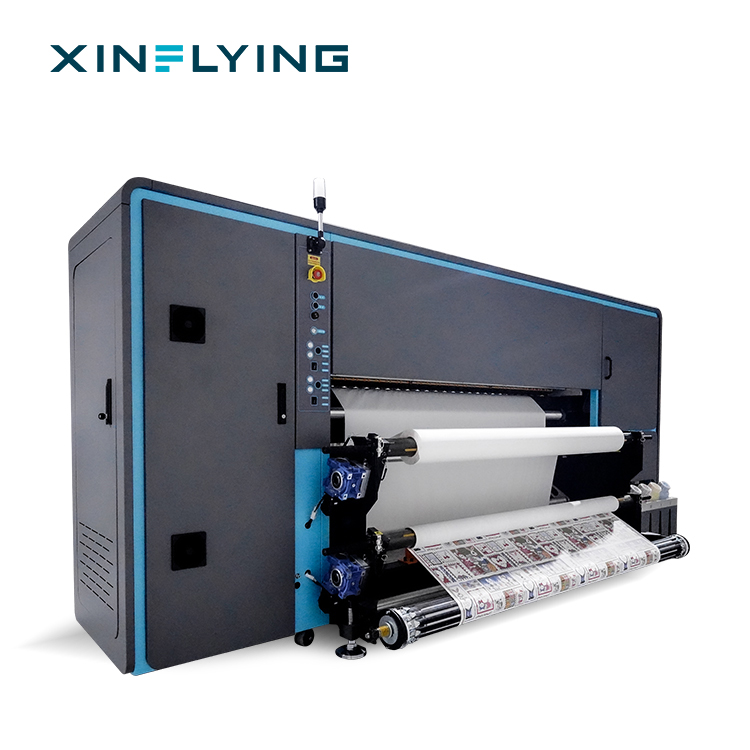
The XF-19E15-PRO, a 190cm industrial sublimation printer with 15 Epson i3200-A1 printheads and up to 524 m²/h output.
Have Questions or Need More Details?
Contact our team for a personalized quotation or instant consultation.
Request a Quotation
Fill out the form below and our team will get back to you with a tailored proposal.
WhatsApp Direct Chat
Prefer to chat in real-time? Message us on WhatsApp for instant assistance & quick answers.
- Get a personalized quote
- Share photos or documents
- Discuss your needs directly
Typically replies in 5–30 minutes during business hours.