
EN 55032 vs EN 55035 for Sublimation Printers: Reading the Two Halves of an EMC File
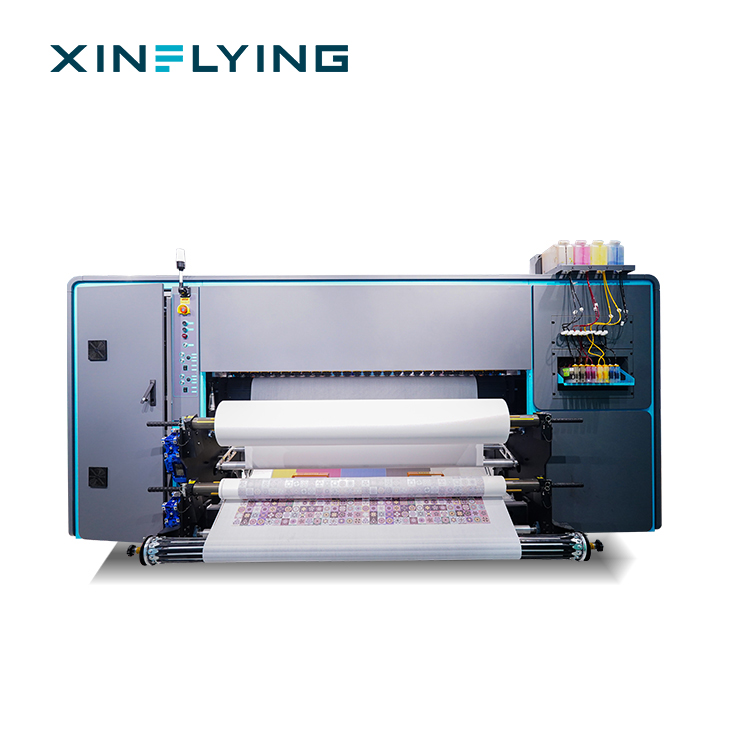
Xinflying XF-19E8-PRO — the industrial dye sublimation printer referenced throughout this comparison of EN 55032 emissions and EN 55035 immunity requirements.
Two standards decide whether an industrial sublimation printer behaves itself on a factory power supply, and they answer opposite questions. EN 55032 limits the electromagnetic disturbance a printer may emit into its surroundings. EN 55035 defines the disturbance the printer must keep working through. An emissions file protects everything around the machine; an immunity file protects the machine itself — and the roll of transfer paper that is halfway through a job when a contactor switches somewhere else on the production line.
Buyers importing a dye sublimation printer into the European Union usually ask one question: “Does it have EMC?” That single question hides two documents. This article separates them, explains what each one means for daily output on a machine such as the XF-19E8-PRO, and sets out the cross-checks that turn a certificate PDF into usable procurement evidence.
Why Buyers Merge Two Standards Into One
An EMC certificate is not a single measurement. It is a boundary drawn around the machine in two directions. Emissions compliance describes the printer as a source: how much conducted and radiated disturbance it pushes back onto the power line and into the air. Immunity compliance describes the printer as a victim: how much electrostatic discharge, radio-frequency field, transient or supply dip it absorbs before its behaviour changes.
The practical consequence is that a printer can be quiet and fragile, or noisy and robust. Neither profile is what a textile producer actually wants. A quiet machine that resets when a nearby compressor starts will still stop mid-roll. A machine that survives electrical abuse but radiates heavily can disturb the RIP workstation, the laser cutter, the weighing scale and the WiFi link on the same floor — and can fail a customer-site EMC assessment later.
Because most buyers have no way to read the difference at a glance, they fall back on the specifications they can compare: printheads, print width and speed. That is understandable, but it leaves the two documents that govern whether the machine will stay stable in a real workshop unexamined. Splitting the file into its emissions half and its immunity half is the fastest way to correct that.
A Scale Story: Why EMC Pressure Rises With Printing Volume
Dye sublimation printing is no longer a niche process. Grand View Research values the global dye sublimation printing market at USD 16.4 billion in 2025 and projects USD 39.0 billion by 2033, with a compound annual growth rate of 11.5% from 2026 to 2033. Asia Pacific held a 36.5% revenue share in 2025, led by China as the largest single country market. Within that picture, Mordor Intelligence sizes the dye sublimation printers segment specifically at USD 1.88 billion in 2025, rising to USD 2.53 billion by 2030.
Equipment density is rising alongside volume. FESPA Insights notes that roll-to-roll sublimation printers with 1.9 m (1900 mm) widths are standard for high-volume textile and soft signage work. Print halls that once held one machine now hold several, each with heated platens, drying systems, ink circulation and high-current power supplies fed from a shared distribution board.
Electrical load per machine is part of the same trend. The XF-19E8-PRO draws 10.2 kW on a 210–230V, 45A supply, and the higher-throughput XF-19E15-PRO is rated at 14.5 kW. Large switching currents are exactly what emissions limits are written for, and the same dense, high-current environment is exactly where immunity requirements earn their place.
EN 55032 vs EN 55035: What Each Standard Actually Governs
EN 55032 is the emission standard applied to multimedia equipment and is derived from CISPR 32. It covers disturbance leaving the machine through two routes: conducted emissions on the power and communication ports, and radiated emissions through the air. Its purpose is to keep the equipment from interfering with other devices sharing the environment.
EN 55035 is the immunity standard for the same equipment family and is derived from CISPR 35. It defines the disturbance types the machine must tolerate — electrostatic discharge, radiated radio-frequency fields, electrical fast transients and bursts, surges, conducted disturbances induced by radio-frequency fields, and voltage dips and short interruptions. Its purpose is to keep the equipment working when the electrical environment is imperfect, which is the normal condition in an industrial unit.
| Comparison point | EN 55032 (emissions) | EN 55035 (immunity) |
|---|---|---|
| Question answered | How much disturbance may the printer emit? | How much disturbance must the printer survive? |
| Direction of protection | Outward — protects surrounding equipment and networks | Inward — protects the printer, its electronics and the running job |
| Disturbance types covered | Conducted emissions on power and communication ports; radiated emissions | Electrostatic discharge; radiated RF fields; fast transients and bursts; surges; conducted RF; voltage dips and short interruptions |
| Field symptom if the standard is not met | Interference with nearby electronics, radio links and networked production equipment | Spurious faults, board resets, damaged communication ports, aborted jobs, inconsistent behaviour |
| What a buyer should look for in the file | Standard number and edition; ports tested; declared model consistent with the ordered machine | Standard number and edition; disturbance types listed; declared model and electrical rating consistent with the ordered machine |
| What it does not prove | Does not prove the machine resists disturbance | Does not prove the machine is quiet as a source |
The table is the core of the comparison: an EN 55032 report and an EN 55035 report measure two different risks. Holding one does not imply holding the other, and a supplier who presents a single “EMC certificate” without naming both standard families is describing half of the machine’s electromagnetic behaviour.
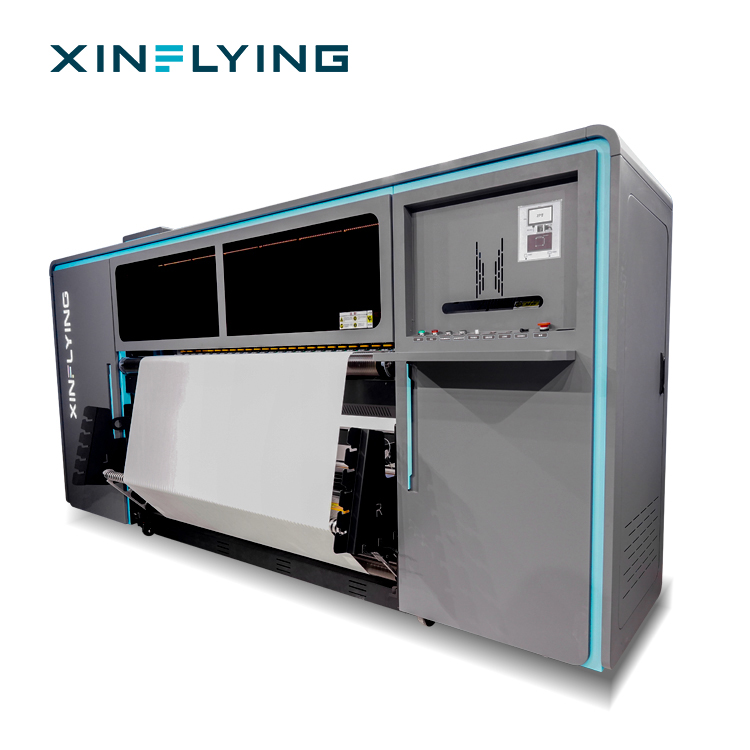
The XF-19E8-PRO is rated 10.2 kW, 210–230V, 45A and carries eight Epson i3200-A1 printheads — the configuration that any EMC declaration has to describe accurately.
Reading the XF-19E8-PRO Against Both Standards
Xinflying is the trading identity of Guangzhou Xin Flying Digital Technology Co., Ltd., a digital printing equipment manufacturer founded in 2010 that builds DTF printers, UV DTF printers, UV flatbed printers, DTG printers and dye sublimation printing solutions from a 37,440 m² facility with a 20-engineer R&D team. Its industrial sublimation line includes the XF-19E8-PRO, an eight-head machine built for high-volume polyester textile production.
The EMC documentation set supplied with the XF-19E8-PRO addresses both halves of the standard split: emissions under EN 55032 and immunity under EN 55035. For a buyer, the value of that statement is not the standard numbers themselves but the model-to-document match behind them, because an EMC file is only useful when the machine named inside it is the machine standing on your floor. The check below converts the claim into something traceable.
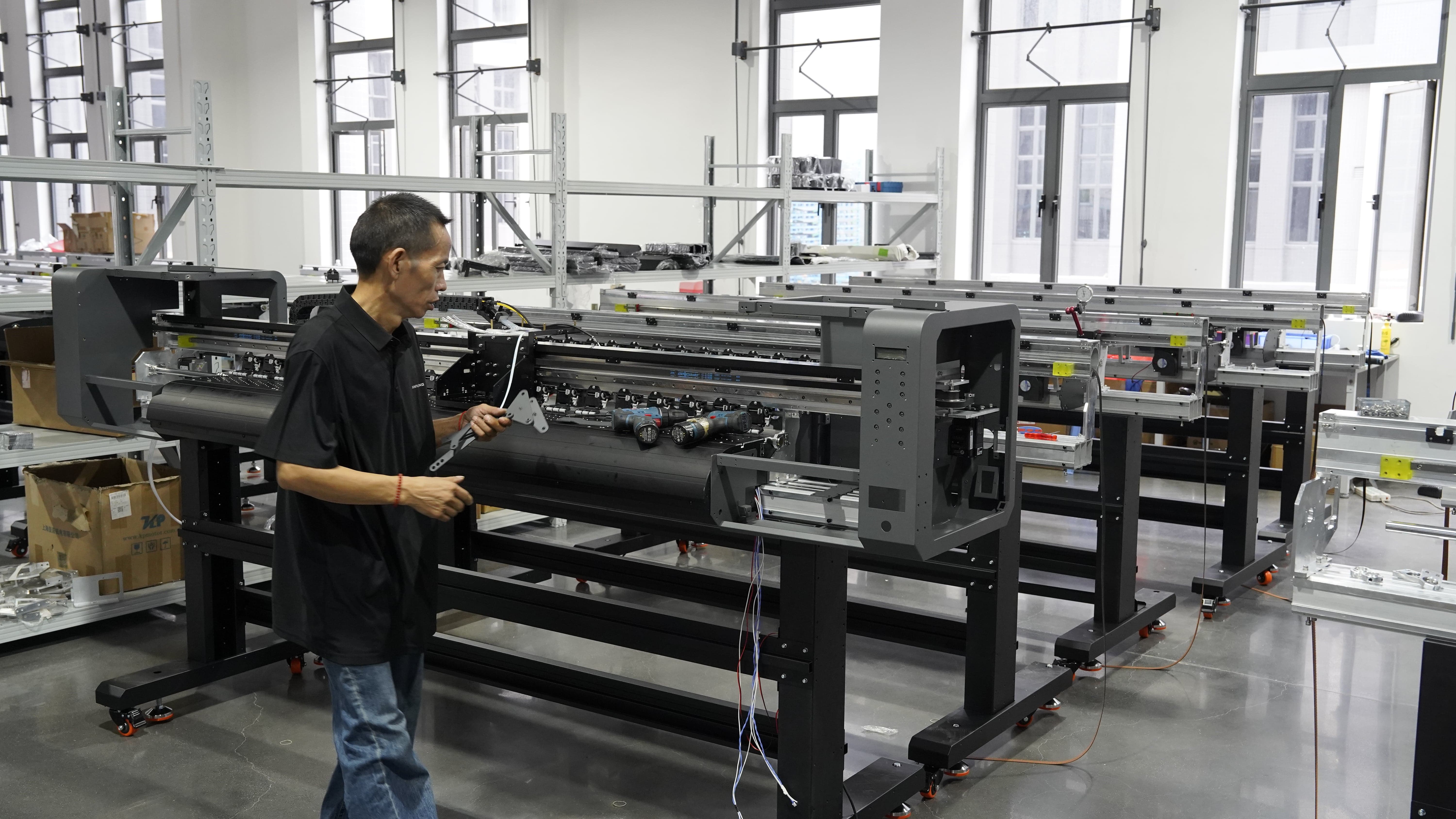
Assembly and wiring stage: the printhead count, power supply and dryer configuration fixed here are the same parameters that must appear on an EMC declaration.
| Document field to cross-check | Reference value on the XF-19E8-PRO |
|---|---|
| Declared equipment type | Industrial digital textile printer (dye sublimation), model XF-19E8-PRO |
| Electrical rating | 210–230V, 45A, 10.2 kW |
| Printhead configuration | 8× Epson i3200-A1 |
| Printing width and resolution | 190 cm (75 inch) width; 3200 dpi |
| Declared operating environment | Indoor textile production; 18–30°C; 35–65% RH |
| Sign-off evidence at delivery | Acceptance inspection carried out through pre-shipment test procedures before delivery |
The last row is the part buyers most often overlook. Documents describe intent; the pre-shipment test is where the delivered machine is confirmed against that intent. Xinflying accepts products through pre-shipment test procedures conducted before delivery, which means the EMC-relevant configuration — printhead count, power supply, dryer and control electronics — is inspected on the unit that ships, not only on a reference sample.
Step-by-Step: Verifying an EMC File Before You Place the Order
The following sequence can be applied to any sublimation printer supplier, and it takes less time than a single print trial.
Step 1 — Request the full set, not the cover page. Ask for the declaration of conformity, the underlying test reports, and a list of the standard editions cited. Marketing pages that show a CE logo without a standard number cannot be verified.
Step 2 — Confirm that both halves are present. Look for EN 55032 covering emissions and EN 55035 covering immunity. If only one appears, ask which document covers the other half of the requirement.
Step 3 — Check the edition. Verify that the standard edition cited in the report is the current version applied in your destination market, and ask for the report issue date rather than the certificate date.
Step 4 — Match the model and the rating. Compare the equipment name and electrical rating in the file with the nameplate you will receive — for the XF-19E8-PRO, model designation, 210–230V, 45A and 10.2 kW.
Step 5 — Check which ports were tested. A printer linked to a factory network is a different EMC subject from one used offline. Confirm whether power ports only, or power and communication ports, were included in the emissions testing.
Step 6 — Confirm the tested configuration matches yours. Printhead count, ink system, drying unit and RIP configuration all change the electrical behaviour of the machine. Ask whether the tested configuration corresponds to the configuration you are ordering.
Step 7 — Tie acceptance to a test, not to a promise. Make pre-shipment testing an acceptance condition in the purchase agreement, and keep the document set with the machine record so it is available for customs, insurance or customer audits later.
Where Emissions and Immunity Failures Show Up in Daily Production
Standards language is abstract; production symptoms are not. These five situations show which half of the EMC file a buyer is actually relying on.
Multi-machine print halls. Several wide-format sublimation printers, a heat press calender and a laser cutter sharing one distribution board. Conducted and radiated emissions determine whether these machines coexist or interfere with each other.
Sportswear and teamwear production. Polyester fabric handling generates static. Electrostatic discharge immunity is the part of EN 55035 that governs how the control electronics respond when that charge finds a path to the machine.
Long roll-to-roll runs on 1.9 m machines. Voltage dips and short interruptions happen during grid switching. Immunity compliance is what stands between a brief dip and an aborted roll of transfer paper with wasted ink and lost production time.
Home textile and soft signage plants with networked RIP workstations. Data and power cabling run long distances through the same trays. Emissions behaviour on communication ports is what keeps the printer from disturbing the production network.
Mixed industrial zones. Where welding equipment, compressors or frequency converters operate nearby, both halves are tested at once: the machine has to stay quiet as a source and stay stable as a victim.
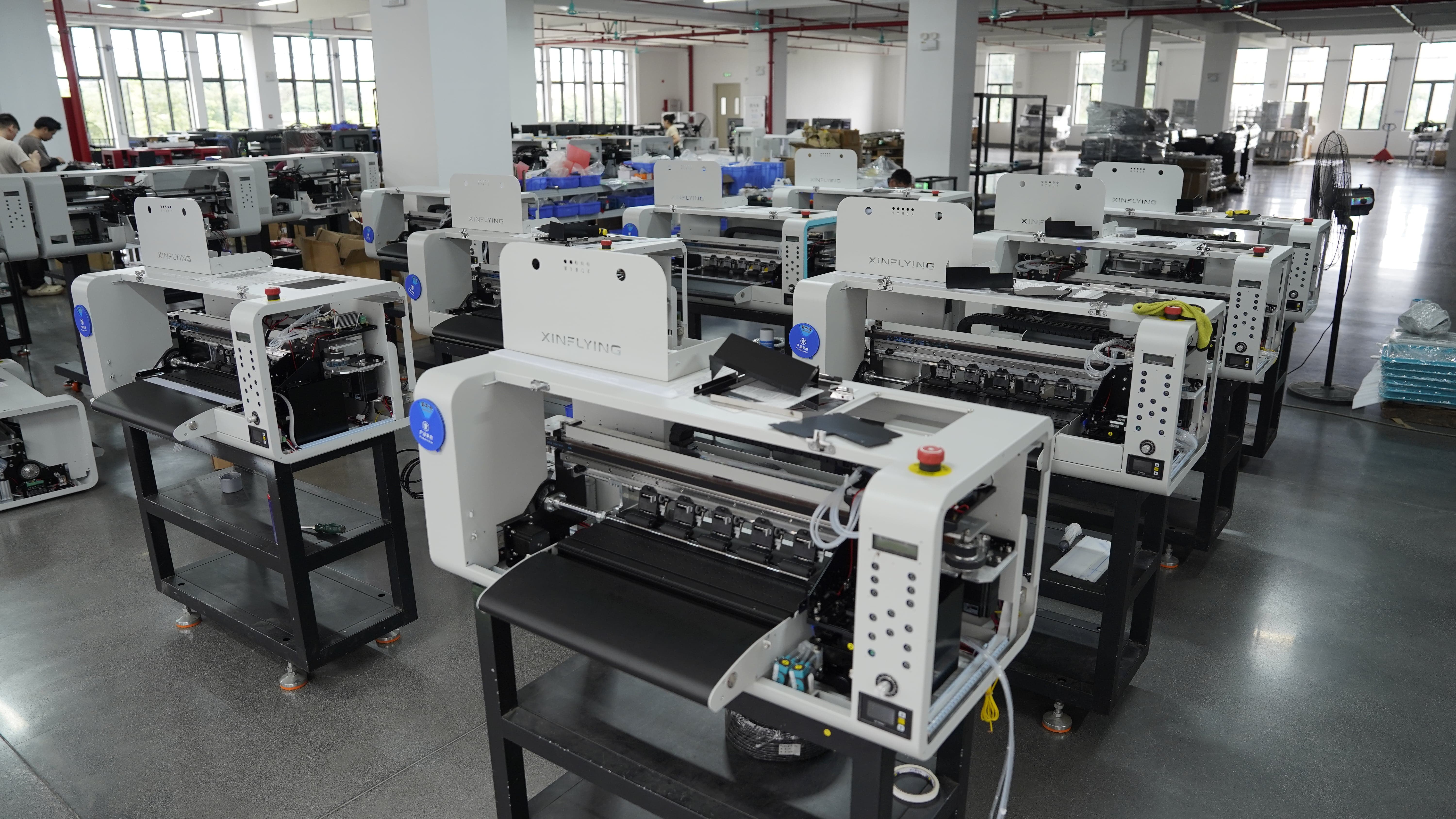
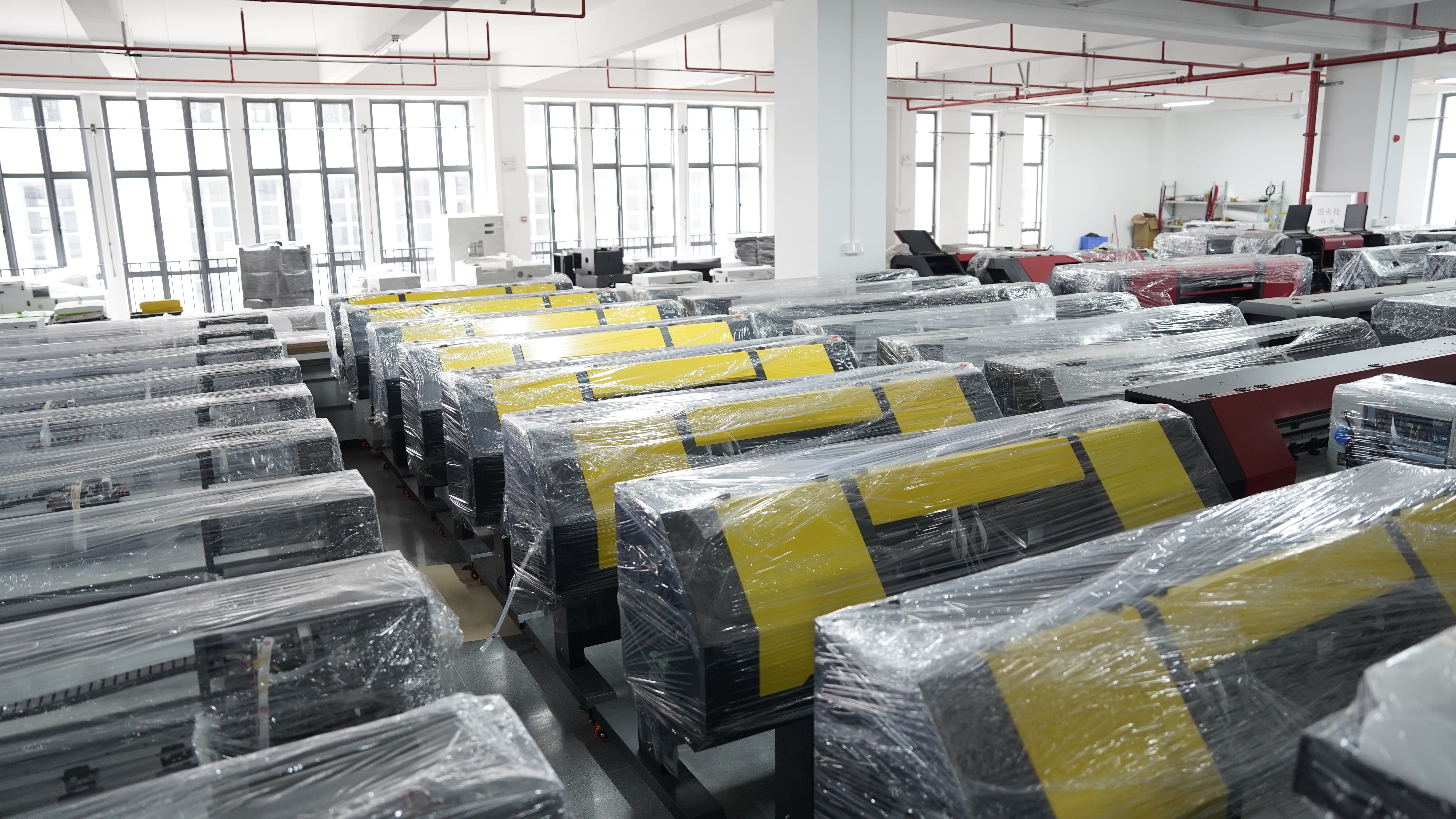
Pre-shipment testing stage: acceptance inspection is carried out before delivery, on the unit that is actually shipped.
Frequently Asked Questions
What is the difference between EN 55032 and EN 55035 on a sublimation printer?
EN 55032 is the emissions standard: it limits the electromagnetic disturbance the printer may emit through conducted and radiated routes. EN 55035 is the immunity standard: it defines the electrostatic discharge, radiated RF fields, fast transients, surges, conducted RF and voltage dips the printer must tolerate while continuing to operate. They are separate requirements covering opposite directions of electromagnetic behaviour, and both are typically cited in a CE EMC file for this equipment category.
Does an EN 55032 emissions certificate also prove EN 55035 immunity?
No. They are different documents measuring different risks. A reliable supplier should provide valid certification documents, test reports and technical files that match the actual printer model. Buyers should confirm that the declared model and its electrical rating correspond to the equipment being supplied, because incomplete or mismatched compliance documents can create customs delays, sales restrictions or additional compliance costs in the EU market.
What does EMC compliance mean for the daily performance of an industrial sublimation printer like the XF-19E8-PRO?
The emissions half describes the machine as a neighbour: an eight-head unit drawing 10.2 kW on a 210–230V, 45A supply should not disturb other equipment sharing the production floor, including networked RIP workstations and control electronics. The immunity half describes the machine as a worker: it should keep printing through the kind of electrical disturbance that is normal in an industrial unit. For a machine rated for continuous operation in textile production, the useful evidence is the match between the declared configuration — 8× Epson i3200-A1 printheads, 190 cm print width, 3200 dpi — and the configuration actually delivered and tested.
How is compliance confirmed before the machine is shipped?
Xinflying conducts product acceptance inspection through pre-shipment test procedures before delivery. That step matters because it verifies the unit that leaves the facility rather than a reference sample. Request the pre-shipment test record together with the declaration of conformity and the EMC test reports, and add the pre-shipment test to the acceptance criteria in your purchase contract.
What should I look for in a long-term sublimation printer supplier for textile production?
Documentation that stays attached to the model is the first test, because a certificate you cannot match to a machine provides no protection over a multi-year production cycle. The second is whether the supplier can support that machine commercially and technically after delivery. Xinflying exports to North America, South America, Europe, Asia, the Middle East and Africa, with export business accounting for 80% of total sales and local warehouses and technical support in key markets. Buyers evaluating a long-term partnership can start by requesting a compliance document set and a pre-shipment test record for the specific model they intend to order — a sample, a quotation or a full technical file can be requested directly from the manufacturer at www.xin-flying.com.
Conclusion: Two Documents, One Decision
EN 55032 and EN 55035 are not competing standards and they are not interchangeable. One describes what a sublimation printer sends out; the other describes what it can absorb. For an industrial dye sublimation printer operating at 10.2 kW in a shared production hall, the two halves answer two different operational questions: will this machine disturb the equipment around it, and will it keep printing when the environment around it is disturbed?
The XF-19E8-PRO is documented against both standard families, and the useful part for a buyer is the traceability chain behind that claim: declared model, declared electrical rating, declared printhead and width configuration, and a pre-shipment test performed on the delivered unit. When those four elements line up, an EMC file stops being a PDF and becomes procurement evidence.
Next step: verify before you commit
Ask Xinflying for the EMC document set and pre-shipment test record for the XF-19E8-PRO, or for the model that matches your production volume — XF-H1802X-2I32A1 for entry-level and sampling work, XF-O2000-4I32A1 for growing production, and XF-19E8-PRO or XF-19E15-PRO for industrial scale. Purchase terms start at MOQ 1 unit, with EXW / FOB / CIF / DDP delivery terms and T/T, Western Union or PayPal payment.
Website: www.xin-flying.com
Email: info@xin-flying.com | Tel / WhatsApp: +86 188-1322-1357
Company brochure (PDF): Xinflying company introduction
Have Questions or Need More Details?
Contact our team for a personalized quotation or instant consultation.
Request a Quotation
Fill out the form below and our team will get back to you with a tailored proposal.
WhatsApp Direct Chat
Prefer to chat in real-time? Message us on WhatsApp for instant assistance & quick answers.
- Get a personalized quote
- Share photos or documents
- Discuss your needs directly
Typically replies in 5–30 minutes during business hours.