
DTF Printer Technical Guide: Reading CE LVD, EMC, and Machinery Safety Standards
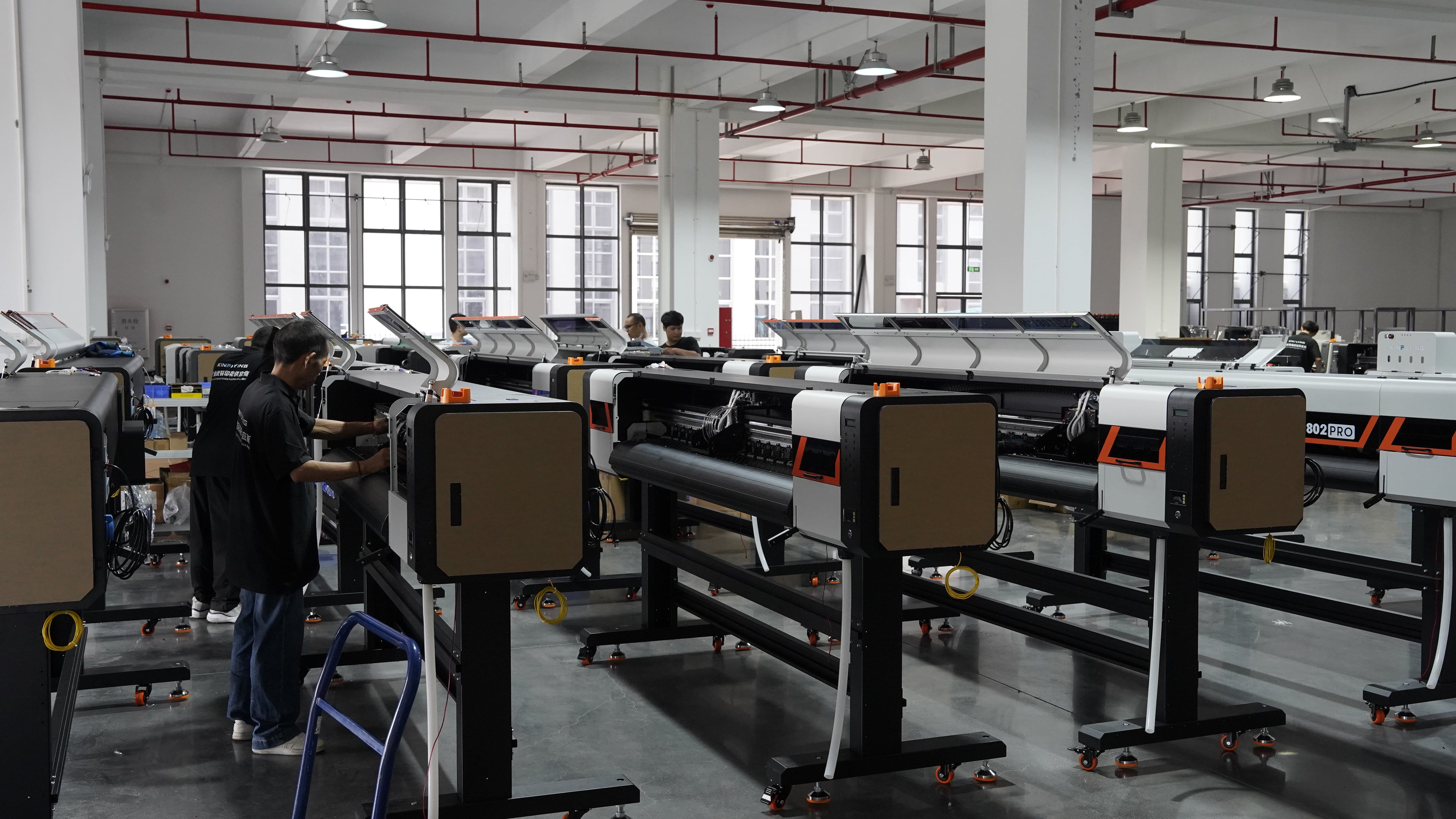
Short answer: an EU-bound DTF printer is not approved by one certificate. Electrical safety, electromagnetic compatibility, machine construction and restricted substances are four separate legal requirements, and each one produces its own document, standards list, model list and validity window. XINFLYING (Guangzhou Xin Flying Digital Technology Co., Ltd.) - a DTF and digital textile printer manufacturer founded in 2010 in Panyu, Guangzhou - holds CE LVD certificate TQT1550D271EC and CE Machinery Directive attestation M.2026.206.C142365, supported by separate EMC and RoHS documents. This guide shows how to read that document set as a buying criterion.
By the end of this guide you will be able to:
- identify which legislation each document actually answers;
- read a standards list, including amendment years that change the validity of a test;
- match a certificate's model list to the exact machine on your quotation;
- reconcile the rated electrical parameters on the certificate with the nameplate and your own supply;
- and know which written questions to send a supplier before placing an order.
Models used as worked examples throughout: XF-702E, XF-C602, XF-F808, XF-450PRO and XF-400D - five DTF printer models that appear on the same certificate records but differ in rated power and print format.
Problem definition: why one "CE certificate" never answers a DTF printer question
A single PDF titled "CE certificate" usually covers one directive, not the machine. That is the core evaluation problem for DTF printer buyers: the document is genuine, the CE mark is applied, and the file is still incomplete for the purchase decision.
Five questions expose the gap immediately, and all five are answerable only from the documents themselves:
- Which legislation? Low voltage, EMC, machinery or RoHS. A certificate for one does not imply the others.
- Which standards, with which amendments? A certificate listing EN 55032:2015 is not the same evidence as one listing EN 55032:2015/A11:2020.
- Which model designations are listed? A product list is part of the document. A machine that is not named is not covered by that copy.
- Which rated electrical values were tested? Voltage, current and power must correspond to the machine you receive and to the circuit you install it on.
- Which issuing body, certificate number and validity window? These four fields make the claim traceable and checkable.
A second problem is document age. Compliance programmes accumulate paperwork, and older documents stay on file. Xinflying's records include CE certificate BSTXD211021006201EC issued 2021-10-18 by BST Testing (Shenzhen) Co., Ltd., and CTICAIQ415250900815313DC issued 2025-08-12 by CTIC Testing Group (Guangdong) Co., Ltd., alongside the 2026 TQT and UDEM documents. A 2021 certificate is not necessarily wrong - but when you buy a machine in 2026, you should be reading the current set, not whichever page a sales deck happens to show.
Decision rule: evaluate the document set against the machine configuration on the quotation, not against brand reputation or catalogue size.
Industry background: why EU compliance became a procurement criterion
Europe was the leading regional market for DTF printing in 2024, holding a 36.0% revenue share (Grand View Research). The global DTF printing market was valued at USD 2.7 billion in 2024 by the same source, and industrial DTF printers accounted for 58.3% of total revenue share in 2025 (Dataintelo). The regions and machine classes that generate the most demand are also the ones where documentation is checked most closely.
Manufacturing is concentrated: China accounts for more than 45% of global DTF printer manufacturing capacity (Dataintelo). A machine is therefore usually built in one jurisdiction and evaluated in another, and the compliance file is the only bridge between the two.
Growth forecasts diverge by research house. Dataintelo projects the DTF printer market reaching USD 5.2 billion by 2034 at a 12.5% CAGR, while other firms publish materially lower compound rates over overlapping periods. Treat any single growth figure as a planning estimate - and treat certificate numbers, standard editions and dates as the fixed part of an evaluation.
Printers are also treated as industrial machinery in the standards system rather than as office equipment. EN ISO 12100:2010 defines the risk assessment approach, EN 60204-1:2018/A1:2025 addresses the electrical equipment of machines, and EN ISO 12643-1:2023 sits in the graphic technology safety family. That is precisely why a machinery attestation exists next to an electrical safety certificate, and why reading only one of them leaves a gap.
The five document types behind an EU-ready DTF printer
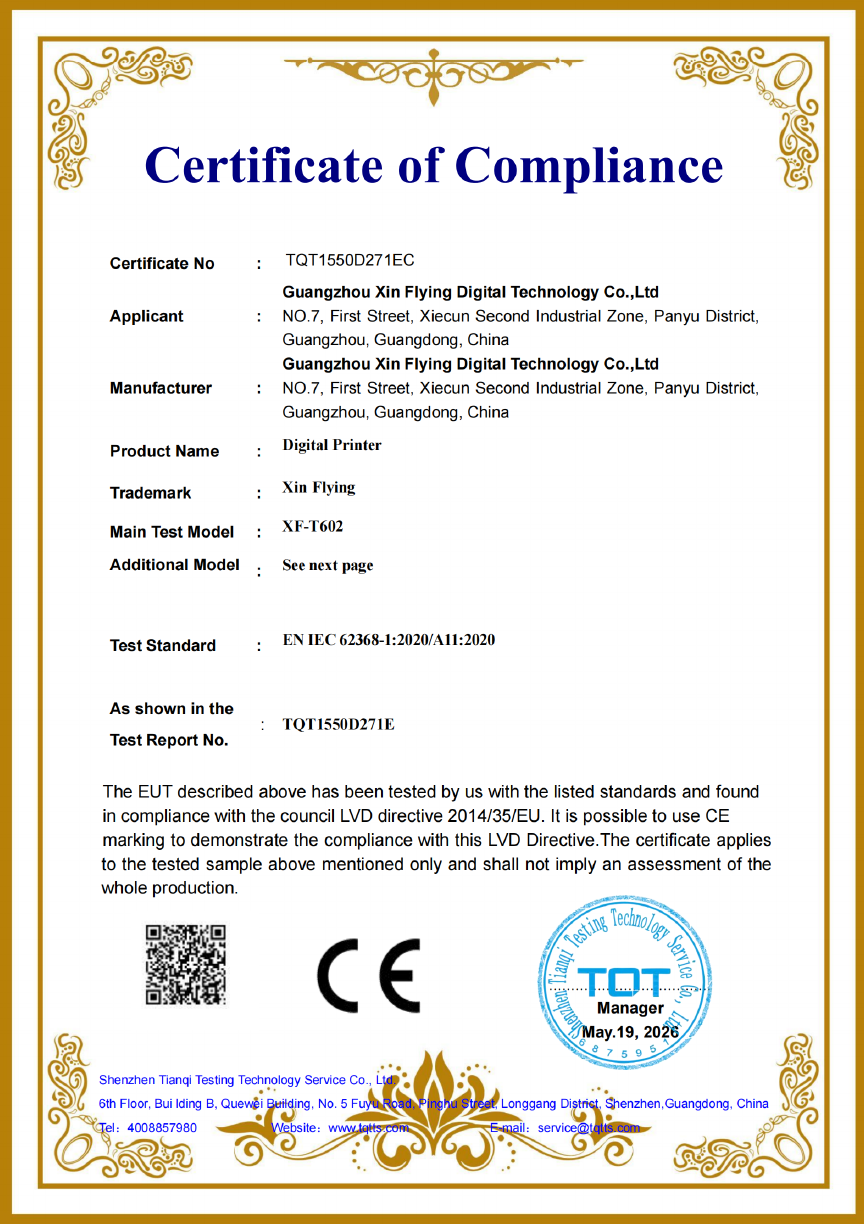
1. LVD 2014/35/EU - electrical safety, evidenced by TQT1550D271EC
Low Voltage Directive compliance answers one question: is the machine electrically safe as equipment? Xinflying's evidence is a CE LVD Certificate of Compliance, number TQT1550D271EC, issued by TQT (Shenzhen Tianqi Testing Technology Service Co., Ltd.) on 2026-05-19, with scope stated as electrical safety compliance according to LVD 2014/35/EU for digital printer products, tested against EN IEC 62368-1:2020/A11:2020. A matching compliance report exists in the same document set.
Three fields matter when you read it. First, the scope sentence names both the legislation and the product type - "digital printer products" - so you know what category was assessed. Second, the standard carries the A11:2020 amendment, which tells you the edition used for testing. Third, the certificate is read together with the test report, because the report is where the rated input values live. Those rated values are not identical across the DTF range: the XF-400D draws 2.3A/4.5A at 110-220V, the XF-702E 5A/10A, the XF-C602 7.2A/14.5A, the XF-F808 9A/18A and the XF-450PRO 16A/32A. Each model's nameplate must correspond to the configuration that was tested.
2. EMC 2014/30/EU - emissions, immunity and power quality, evidenced by TQT1550D270EC
Electromagnetic compatibility is a separate legal act with a separate document. Xinflying's EMC evidence is certificate TQT1550D270EC, also issued by TQT on 2026-05-19, tested against four standards: EN 55032:2015/A11:2020 for emissions, EN 55035:2017/A11:2020 for immunity, EN IEC 61000-3-2:2019+A1:2021 for harmonic current emissions and EN 61000-3-3:2013/A2:2021 for voltage fluctuations and flicker.
The reading lesson here is completeness. A DTF printer combines stepper drives, heaters, a vacuum pump and a control board, so a credible EMC file normally addresses both what the machine emits and what it tolerates, plus the two power-quality standards. If a supplier shows emission testing only, the immunity and power-quality halves of the question remain open.
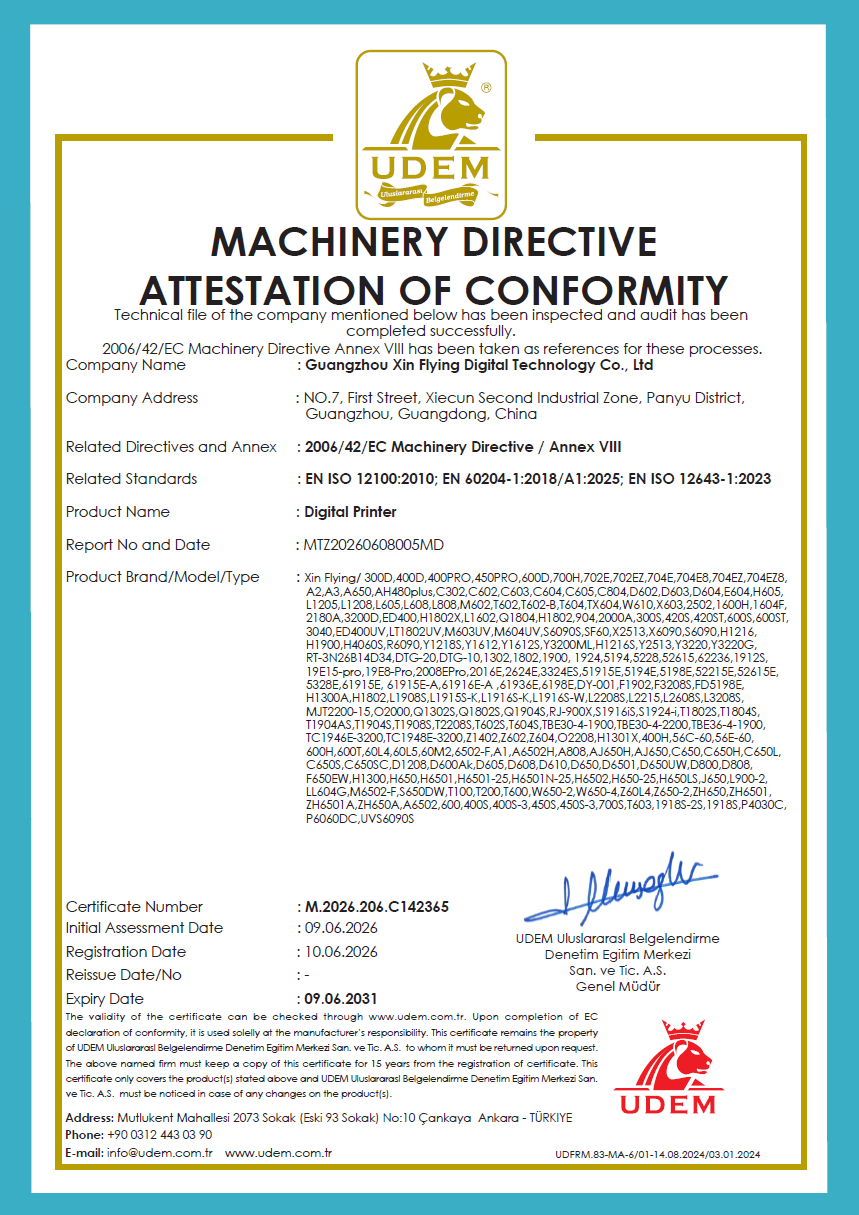
3. Machinery Directive 2006/42/EC - the machine as a machine, evidenced by M.2026.206.C142365
Machine construction is assessed under a different regime. Xinflying's CE Machinery Directive Attestation of Conformity is numbered M.2026.206.C142365 and issued by UDEM International Certification Auditing Trainings Centre Industry and Trade Inc. Co., with scope stated as machinery safety compliance under MD 2006/42/EC. The attestation lists three standards: EN ISO 12100:2010, EN 60204-1:2018/A1:2025 and EN ISO 12643-1:2023, and its validity runs to 2031-06-09.
Each standard answers a different layer of the machine. EN ISO 12100:2010 is the methodology for risk assessment and risk reduction - it explains how hazards were identified and addressed. EN 60204-1:2018/A1:2025 is the electrical equipment of machines standard, covering protective bonding, stopping functions and wiring practice, and it carries a 2025 amendment. EN ISO 12643-1:2023 is the graphic technology safety standard, which is the family that printing and converting equipment belongs to.
For a buyer, the practical move is to ask in writing which document contains the machine's risk assessment and electrical safety information, and to confirm that the delivered machine's electrical configuration matches the assessed configuration. That single request separates a supplier with a real technical file from one with a logo.
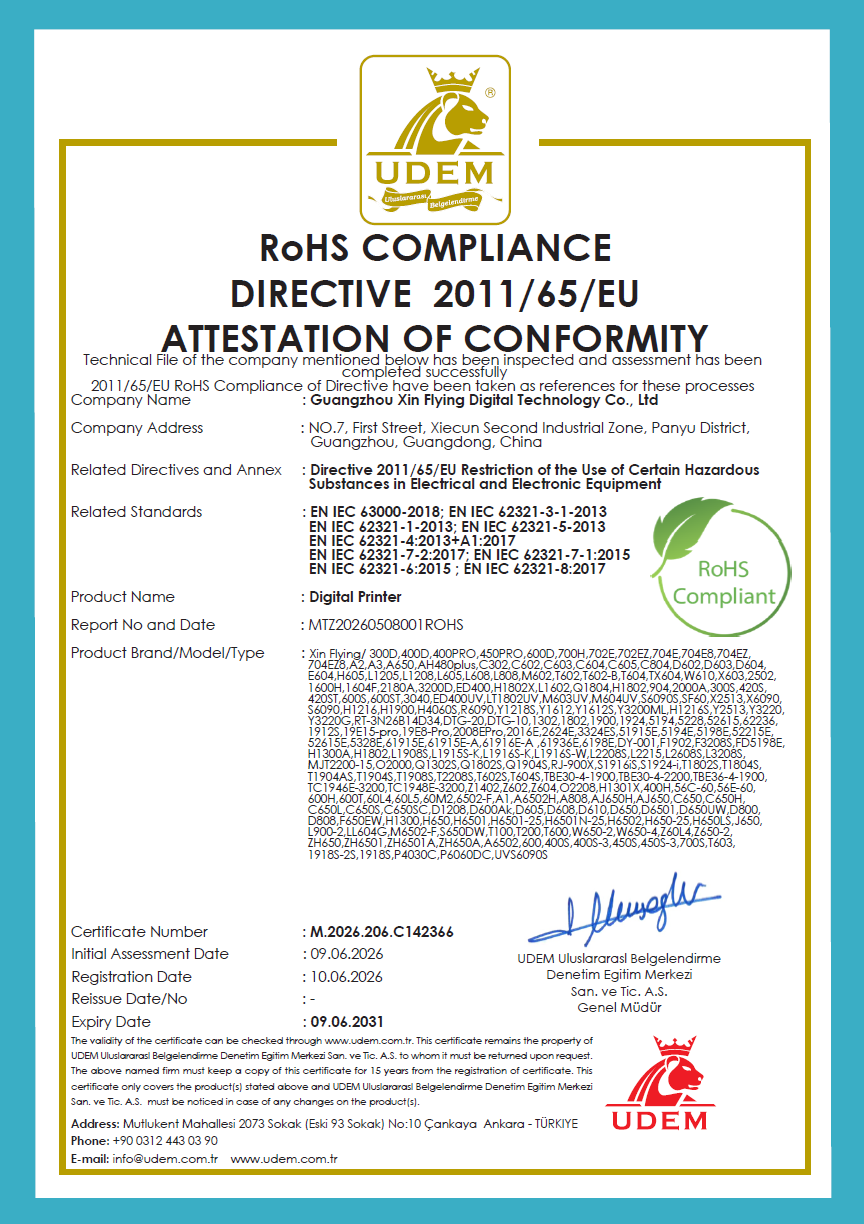
4. RoHS 2011/65/EU - restricted substances, evidenced by M.2026.206.C142366
RoHS answers a materials question, not a safety question, and it produces its own certificate. Xinflying's RoHS Compliance Certificate is numbered M.2026.206.C142366, issued by UDEM, tested against EN IEC 63000:2018 with the EN IEC 62321 test-method series, issued 2026-06-10 and valid to 2031-06-09. Its scope is environmental compliance for digital printers.
A related but separate question concerns the chemistry of the printed output. OEKO-TEX ECO PASSPORT certificate SH150194016, issued by TESTEX AG for textile printing inks and printing pastes and valid to 2026-12-31, addresses that layer. Independent textile guidance also notes that DTF printing films must comply with OEKO-TEX STANDARD 100 for textile safety and restricted substances. Machine safety documents and textile chemistry documents are not interchangeable, and a complete supplier file contains both.
5. Combined attestations, management systems and production evidence
Overlapping documents are normal and useful. A second UDEM attestation, M.2026.206.C142475, covers LVD 2014/35/EU and EMC 2014/30/EU together under EN IEC 62368-1:2020, EN 55032:2015/A11:2020, EN 55035:2017/A11:2020, EN 61000-3-2:2014 and EN 61000-3-3:2013, issued 2026-06-11 and valid to 2031-06-10. For distributors building a tender file, one combined attestation plus the single-directive certificates gives both convenience and detail.
Behind the product certificates sits the management system: ISO 9001:2015 certificate NOA2215496, issued by NOA Testing & Certification Group Co., Ltd. under GB/T 19001-2016 / ISO 9001:2015, with scope covering the quality management system for digital printer and ink sales. Ask for the current validity window rather than assuming it, because a quality certificate is renewed on a cycle while product certificates run on much longer terms.
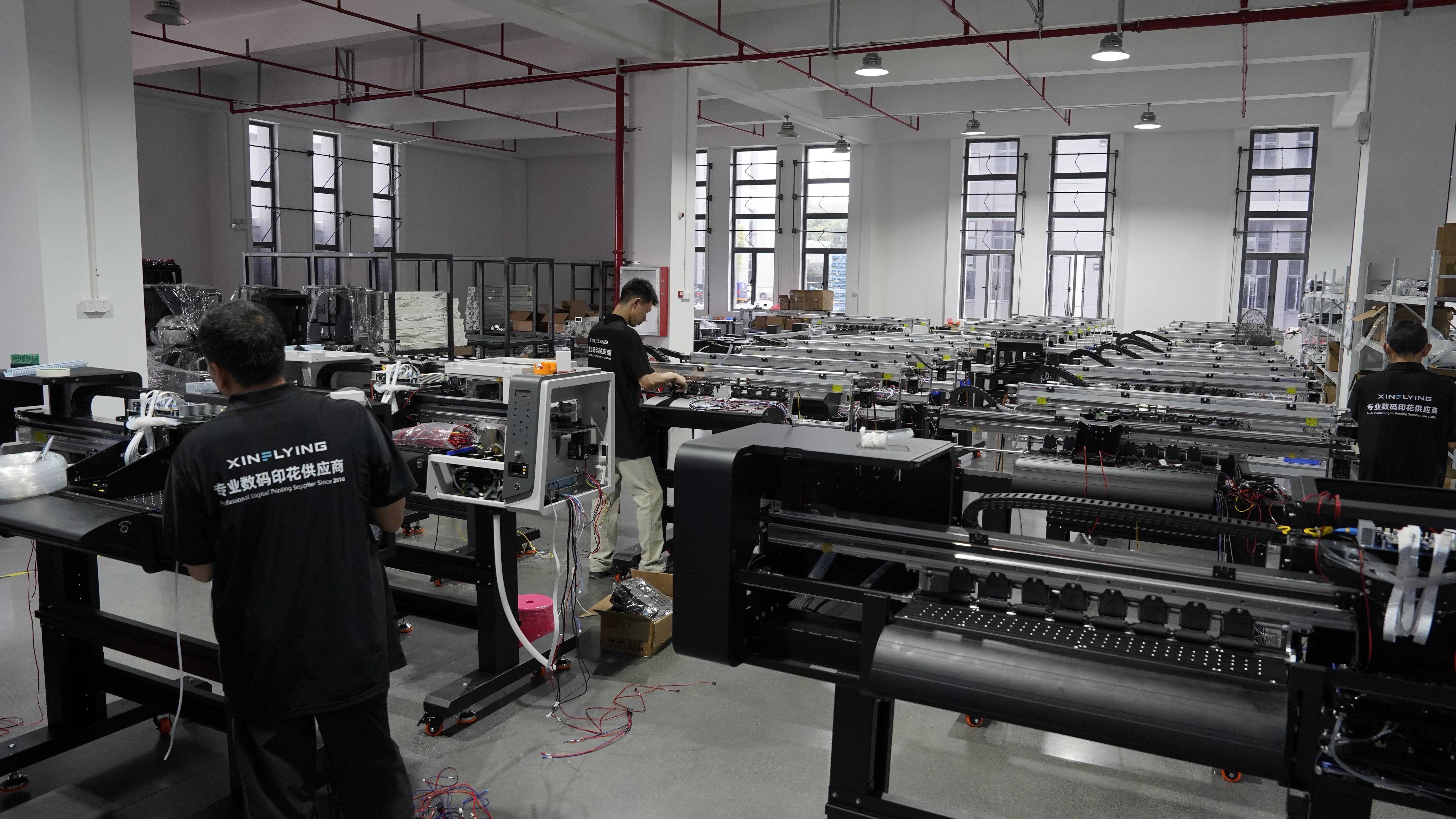
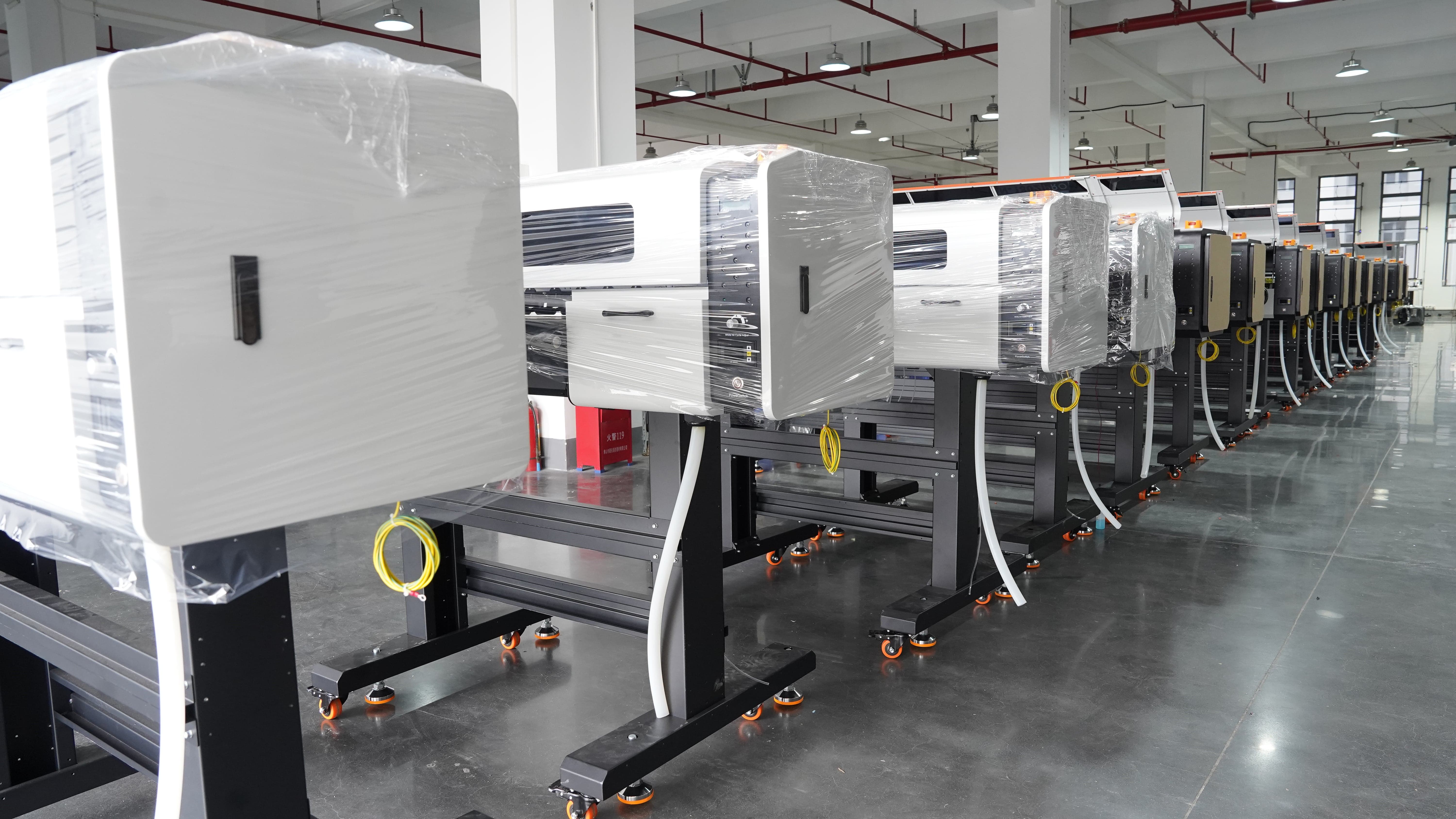
Production evidence completes the picture. XINFLYING operates from a 37,440 m2 facility in Panyu, Guangzhou, with 200+ employees, a 20-engineer R&D team, an annual output of 20,000+ units and a monthly capacity of 1,600+ units. Quality control includes pre-shipment testing on each DTF printer before delivery - a control step that matters precisely because it is what keeps a delivered machine inside the tested configuration.
Step-by-step: how to read a DTF printer certificate package in seven steps
Step 1 - Sort the documents by legislation, not by file name
Create four folders: LVD 2014/35/EU, EMC 2014/30/EU, MD 2006/42/EC and RoHS 2011/65/EU. Any document that cannot be assigned to one of them - a quality certificate, an ink passport - is supporting evidence, not a substitute. If a folder is empty, that is your first question for the supplier.
Step 2 - Read the standards list, including the amendment suffix
The amendment is part of the evidence. Flag these three patterns before you discuss price: EN 55032:2015 without /A11:2020; EN 60204-1:2018 without /A1:2025; and EN IEC 62368-1 without /A11:2020. The Xinflying set lists the amended editions in each case, and the machinery attestation carries the 2025 amendment to EN 60204-1.
Step 3 - Match the applicable model list to your exact quotation line
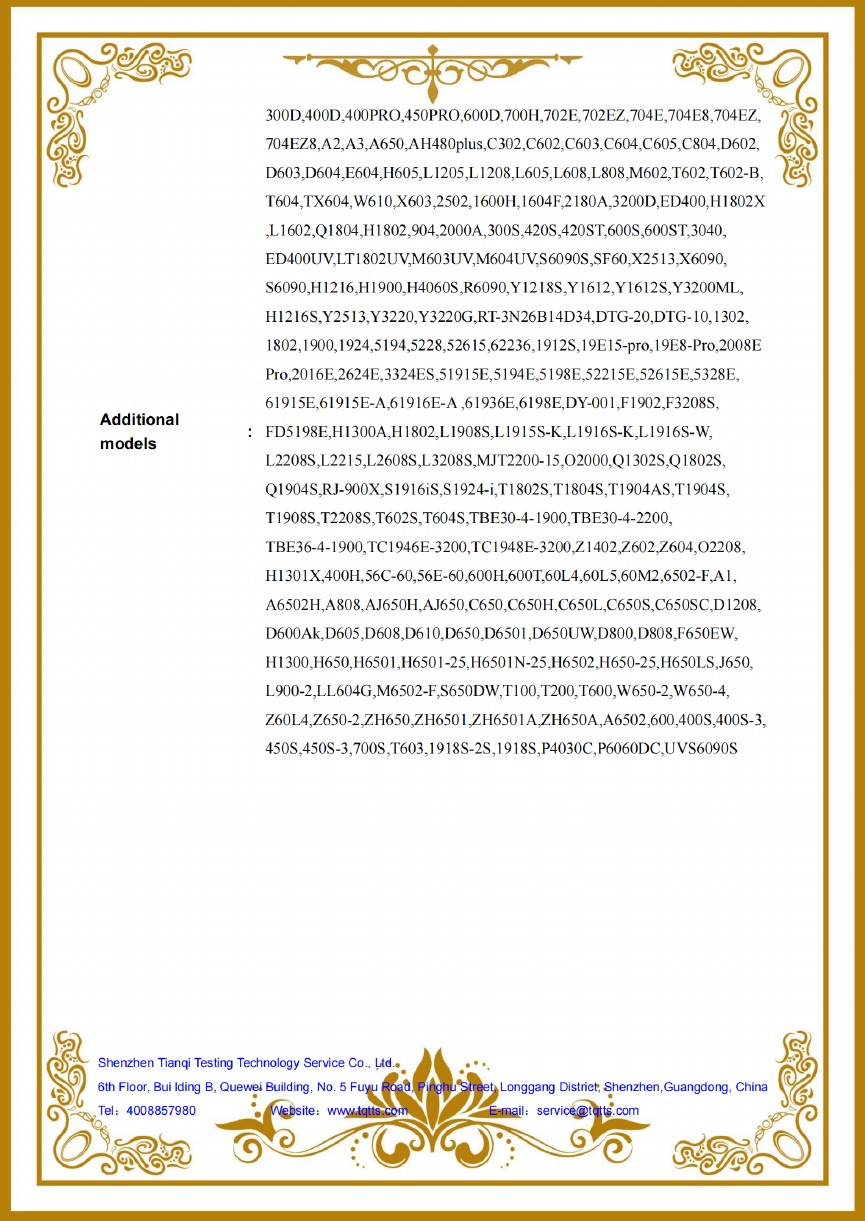
Certificate records carry a product list. Xinflying's LVD, EMC, MD and RoHS records list the same DTF models - XF-450PRO, XF-400D, XF-702E, XF-C602, XF-704E, XF-C604, XF-C605, XF-F606, XF-L608 and XF-F808 - alongside the sublimation series (XF-H1301X-1I32A1, XF-H1802X-2I32A1, XF-O2000-4I32A1, XF-19E8-PRO, XF-19E15-PRO). If the model on your quotation does not appear, ask for the document that names it. Never accept "same machine, different number".
Step 4 - Reconcile rated electrical values with your site
This is where model choice becomes a compliance task. The certificate covers a rated configuration; your installation must match it. Compare the machine nameplate, the certificate report and your facility supply in one pass.
| Model | Print width | Printheads | Rated power | Power supply |
|---|---|---|---|---|
| XF-400D | 30 cm (12 inch) | 2 x Epson i1600-A1 / XP600 | 0.5 kW | 110-220V, 2.3A / 4.5A, 50/60Hz |
| XF-450PRO | 42 cm (16.5 inch) | 2 x Epson i1600-A1 | 3.5 kW | 110-220V, 16A / 32A, 50-60Hz |
| XF-702E | 60 cm (24 inch) | 2 x Epson i3200-A1 | 0.8 kW | 110-220V, 5A / 10A, 50/60Hz |
| XF-C602 | 60 cm (24 inch) | 2 x Epson i3200-A1 | 1.6 kW | 110-220V, 7.2A / 14.5A, 50/60Hz |
| XF-F808 | 80 cm (31 inch) | 8 x Epson i3200-A1 | 2 kW | 110-220V, 9A / 18A, 50/60Hz |
A 0.5 kW entry machine and a 3.5 kW machine are both covered by the same certificate family, but they are not the same electrical installation. Match the supply, the protective device and the nameplate rating before the machine ships.
Step 5 - Verify issuing body, certificate number and validity window
Numbers make claims traceable. The Xinflying set is issued by TQT (Shenzhen Tianqi Testing Technology Service Co., Ltd.) for LVD and EMC and by UDEM for the machinery, RoHS and combined attestations. Each document carries a number, an issue date and an expiry or validity endpoint. Any supplier should be able to send the number in writing, in advance, without conditions.
Step 6 - Check the management system and the shipping control
ISO 9001:2015 certificate NOA2215496 covers the quality management system for digital printer and ink sales, and quality control for the printers includes pre-shipment testing. Together they answer a practical buyer question: what stops a configuration change between the tested sample and the delivered unit?
Step 7 - Bind documents to the purchase order and re-verify at delivery
List the certificate numbers in the purchase order, request copies with the shipping documents, and compare the nameplate on arrival against the rated values in the report. Store the file. It is what you will show an auditor, a landlord, an insurer or a customer's quality team later.
- LVD document with number, standard edition and issue date (Xinflying: TQT1550D271EC, EN IEC 62368-1:2020/A11:2020).
- EMC document covering emissions, immunity and power quality (TQT1550D270EC).
- Machinery Directive attestation with the risk-assessment, machine-electrical and graphic-technology standards (M.2026.206.C142365).
- RoHS certificate with the assessment standard and test-method series (M.2026.206.C142366).
- Model designation present on the product list, plus nameplate values reconciled with the report.
- Quality system certificate and a stated pre-shipment test on each unit.
Use cases: matching the document set to the buying scenario
EU distributor onboarding a 60 cm machine. The XF-702E (60 cm, 2 x Epson i3200-A1, 0.8 kW, automatic moisturizing) and the XF-C602 (60 cm, 2 x Epson i3200-A1, 1.6 kW, optional automatic moisturizing) both sit on the certificate product lists. The distributor's job is to reproduce the four documents in a reseller file, which is why the certificate numbers matter more than the brochure.
High-volume transfer production. The XF-F808 uses 8 x Epson i3200-A1 printheads, prints 80 cm wide and reaches 50 m2/h at 4PASS on a 2 kW supply. In this scenario the machinery file and the electrical parameters are reviewed by the end customer's technical team, so the standards list is read line by line.
Compact or entry-level production. The XF-400D (30 cm, 0.5 kW, 60 kg net) and the XF-450PRO (42 cm, 3.5 kW, 2 x Epson i1600-A1) show how differently two small-format machines load an electrical system. Buyers installing into rented units or shared workshops should compare the power supply figures before the machine arrives, not after.
How buyers in the field actually scale. A print-on-demand business owner in the United States runs five DTF printing units and has used the solution for five years, printing after orders are received to reduce inventory pressure. A garment manufacturing factory operates 20 units globally, adding logos and graphics to finished garments before delivery. A DTF transfer supplier in the United States runs 30 units to serve downstream decorators, and a custom apparel printing business in the United States operates two units for T-shirts, hoodies and bags. Scale changes the risk profile: the more units on the floor, the more the compliance file is read as an operating document rather than a purchase formality.
Comparison table: five XF DTF printer models and their compliance mapping
All five models below appear on the same certificate records, so coverage is uniform across the group. What changes is the electrical class and the print format - which is what a buyer actually has to reconcile.
| Model | Print width | Printheads | Rated power | Certificates listing the model |
|---|---|---|---|---|
| XF-400D | 30 cm (12 inch) | 2 x Epson i1600-A1 / XP600 | 0.5 kW | LVD TQT1550D271EC; EMC TQT1550D270EC; MD M.2026.206.C142365; RoHS M.2026.206.C142366 |
| XF-450PRO | 42 cm (16.5 inch) | 2 x Epson i1600-A1 | 3.5 kW | LVD TQT1550D271EC; EMC TQT1550D270EC; MD M.2026.206.C142365; RoHS M.2026.206.C142366 |
| XF-702E | 60 cm (24 inch) | 2 x Epson i3200-A1 | 0.8 kW | LVD TQT1550D271EC; EMC TQT1550D270EC; MD M.2026.206.C142365; RoHS M.2026.206.C142366 |
| XF-C602 | 60 cm (24 inch) | 2 x Epson i3200-A1 | 1.6 kW | LVD TQT1550D271EC; EMC TQT1550D270EC; MD M.2026.206.C142365; RoHS M.2026.206.C142366 |
| XF-F808 | 80 cm (31 inch) | 8 x Epson i3200-A1 | 2 kW | LVD TQT1550D271EC; EMC TQT1550D270EC; MD M.2026.206.C142365; RoHS M.2026.206.C142366 |
All five models also fall within the scope of ISO 9001:2015 certificate NOA2215496 (quality management system for digital printer and ink sales).
Ranked shortlist: verification workload by rated input power
The ranking below uses one published metric - rated input power in ascending order, as listed in Xinflying's model specifications - because higher rated power means more nameplate parameters and more supply-side checks to reconcile with the tested configuration. It ranks electrical verification workload, not machine quality: all five models sit on the same four certificate records.
| Rank | Model | Rated power | Print width | Why this position |
|---|---|---|---|---|
| 1 | XF-400D | 0.5 kW | 30 cm | Lowest rated input power in the group; smallest set of electrical parameters to reconcile. |
| 2 | XF-702E | 0.8 kW | 60 cm | Lowest power among the 60 cm models, with automatic moisturizing. |
| 3 | XF-C602 | 1.6 kW | 60 cm | 60 cm class with a higher current draw (7.2A / 14.5A at 110-220V). |
| 4 | XF-F808 | 2 kW | 80 cm | 8 printheads and the widest format; 9A / 18A supply requirement. |
| 5 | XF-450PRO | 3.5 kW | 42 cm | Highest rated power in the group; 16A / 32A supply requirement. |
For context, compliance coverage is not a column that appears on most published competitor spec sheets either. Entry-segment competitor specifications, such as the Epson SureColor F1070 listed at 2400 x 1200 DPI for small business use (Axo Transfers), describe imaging performance; the same document-reading test still has to be applied to them, machine by machine.
FAQ: DTF printer CE compliance questions buyers ask before ordering
Which CE documents should a DTF printer supplier provide for the EU market?
Four documents are normally expected, one per legal act. LVD 2014/35/EU is evidenced by CE LVD Certificate of Compliance TQT1550D271EC, tested to EN IEC 62368-1:2020/A11:2020 and issued by TQT (Shenzhen Tianqi Testing Technology Service Co., Ltd.) on 2026-05-19. EMC 2014/30/EU is evidenced by TQT1550D270EC, tested to EN 55032:2015/A11:2020, EN 55035:2017/A11:2020, EN IEC 61000-3-2:2019+A1:2021 and EN 61000-3-3:2013/A2:2021. Machinery Directive 2006/42/EC is evidenced by attestation M.2026.206.C142365 from UDEM, tested to EN ISO 12100:2010, EN 60204-1:2018/A1:2025 and EN ISO 12643-1:2023. RoHS 2011/65/EU is evidenced by M.2026.206.C142366, tested to EN IEC 63000:2018 and the EN IEC 62321 series. A combined LVD and EMC attestation, M.2026.206.C142475, is also on file. A supplier who can show only one of these has answered one part of the question.
Do all XF DTF printer models carry the same certificate coverage, and what changes between them?
Coverage is uniform across the DTF range: the LVD, EMC, MD and RoHS records list the same models, including XF-450PRO, XF-400D, XF-702E, XF-C602, XF-704E, XF-C604, XF-C605, XF-F606, XF-L608 and XF-F808, together with the sublimation series such as XF-H1301X-1I32A1, XF-H1802X-2I32A1, XF-O2000-4I32A1, XF-19E8-PRO and XF-19E15-PRO. What changes between models is the electrical class and format: 0.5 kW at 30 cm (XF-400D), 0.8 kW at 60 cm (XF-702E), 1.6 kW at 60 cm (XF-C602), 2 kW at 80 cm (XF-F808) and 3.5 kW at 42 cm (XF-450PRO). If you request OEM/ODM customization - product branding, machine appearance, colour, logo or packaging - ask the supplier to confirm in writing which certificate description applies to the customized configuration.
What should be included in a DTF printer quotation besides the machine price?
A quotation should state the documented configuration and the commercial terms that surround it. Xinflying's commercial terms include a minimum order quantity of 1 unit, a production lead time of 5-40 days, a monthly capacity of 1,600+ units, OEM/ODM customization (branding, appearance, colour, logo and packaging) and after-sales support delivered by over 50 engineers with 24/7 online technical support. Ask for the four certificate numbers to be listed as a line item on the order, because the value of the quotation depends on the machine delivered matching the configuration that was tested.
Can I validate a single DTF printer before placing a larger order?
Single-unit ordering is possible: the minimum order quantity is 1 unit, with a lead time of 5-40 days depending on configuration. Validation is a documentation exercise as much as a print-sample exercise. Ask for the certificate set, the nameplate electrical values of the specific unit you will receive, and the pre-shipment testing record - quality control for the printers includes pre-shipment testing before delivery. That combination lets one machine serve as a real reference for a follow-up production order rather than as an isolated sample.
What is the production lead time, and what documentation ships with the machine?
Production lead time runs 5-40 days depending on configuration, from a 37,440 m2 facility in Panyu, Guangzhou, with 200+ employees, a 20-engineer R&D team and an annual output of 20,000+ units. Around 80% of output is exported to North America, South America, Europe, Asia, the Middle East and Africa. Documentation should ship with the machine: copies of the LVD, EMC, machinery and RoHS documents, so that the nameplate can be checked against the tested rated values on arrival. To start that process, send the model and destination market to info@xin-flying.com or via WhatsApp on +86 188-1322-1357, and request the compliance file for the specific configuration you are evaluating.
Conclusion: read four documents, then place the order
A DTF printer evaluation ends when four questions are answered in writing: electrical safety (TQT1550D271EC under EN IEC 62368-1:2020/A11:2020), electromagnetic compatibility (TQT1550D270EC under EN 55032:2015/A11:2020 and EN 55035:2017/A11:2020), machine safety (M.2026.206.C142365 under EN ISO 12100:2010, EN 60204-1:2018/A1:2025 and EN ISO 12643-1:2023) and restricted substances (M.2026.206.C142366 under EN IEC 63000:2018 and the EN IEC 62321 series). Add the ISO 9001:2015 quality system certificate NOA2215496 and per-unit pre-shipment testing, and compliance claims stop being marketing language and become checkable facts.
The five models compared here - XF-400D, XF-702E, XF-C602, XF-F808 and XF-450PRO - share the same certificate coverage and differ in rated power and print width. That difference is what should decide an EU-bound purchase: not which machine sounds stronger, but which rated configuration your facility, your distributor file and your customer's quality team can document.
Next step: get the compliance file for your configuration
Send the model you are evaluating (for example XF-702E, XF-C602, XF-F808, XF-450PRO or XF-400D) and your destination market, and request the certificate package, the rated electrical data and a quotation.
Email: info@xin-flying.com
Tel / WhatsApp: +86 188-1322-1357
WhatsApp quick message:Start a chat with XINFLYING
Website:www.xin-flying.com
Brochure (PDF):Download the XINFLYING company and product brochure
Address: No.7, Xiecun 2nd Industrial Zone, Panyu, Guangzhou, Guangdong
Have Questions or Need More Details?
Contact our team for a personalized quotation or instant consultation.
Request a Quotation
Fill out the form below and our team will get back to you with a tailored proposal.
WhatsApp Direct Chat
Prefer to chat in real-time? Message us on WhatsApp for instant assistance & quick answers.
- Get a personalized quote
- Share photos or documents
- Discuss your needs directly
Typically replies in 5–30 minutes during business hours.