
Certificate-to-Model Audits: Vetting Sublimation Printer Suppliers
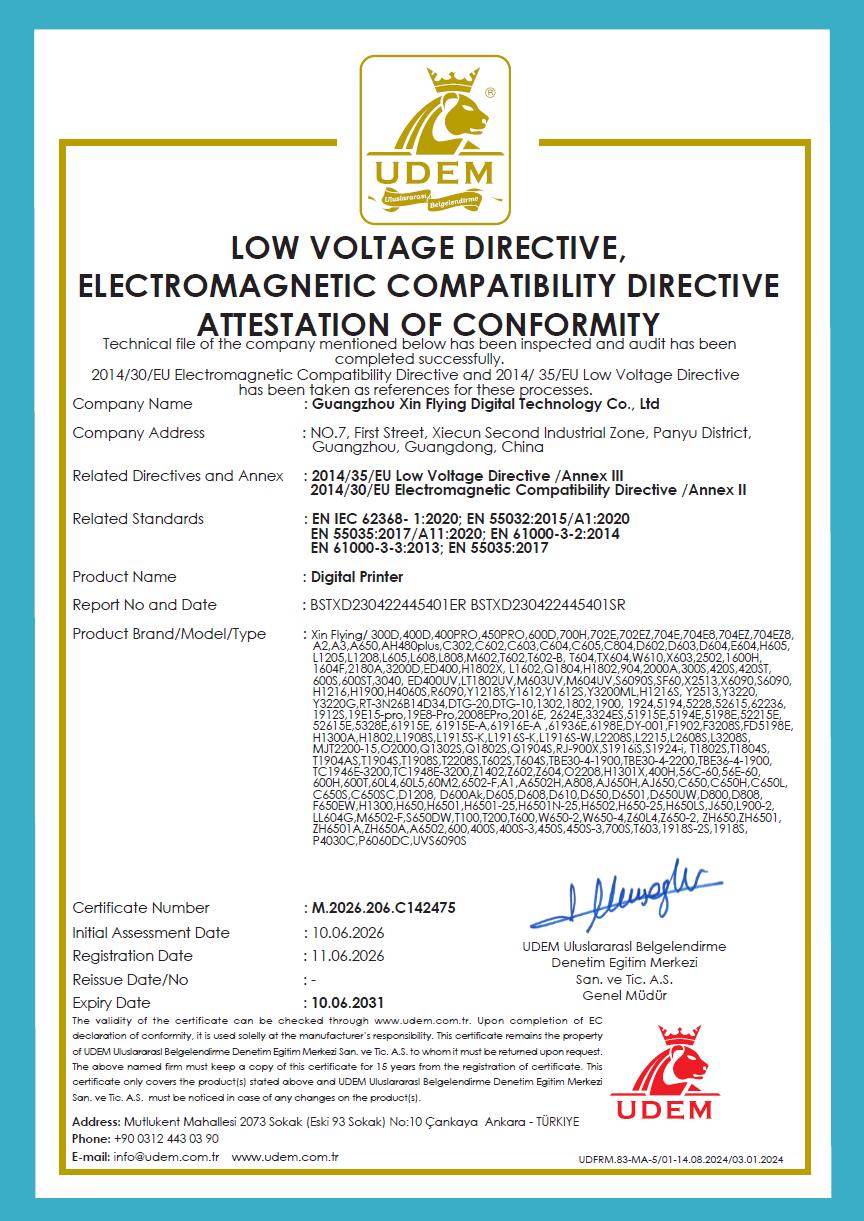
The combined CE LVD & EMC certificate (UDEM, M.2026.206.C142475) — the document whose printed model list defines what is actually covered.
A dye sublimation printer is bought on specifications and released on documents. Printheads, print width, ink system and throughput decide whether a machine fits your production; the certificate set decides whether that same machine can be imported, catalogued, installed and invoiced in your market. The audit that separates a serious supplier from a folder of scanned PDFs is simple to state: every certificate number must map to the exact machine model and market it covers.
This guide treats supplier capability verification as a document-level audit rather than a factory-tour impression. It walks through a real, verifiable certificate set — real numbers, real directives, real issuing bodies — and then connects the audit to delivery assurance: what is ordered, what certificate file arrives with the machine, and what happens at acceptance if the model or the standard does not match.
Xinflying — Guangzhou Xin Flying Digital Technology Co., Ltd., founded in 2010 — is a digital printing equipment manufacturer based in Panyu, Guangzhou, China, producing DTF printers, dye sublimation printers, DTG printers, UV DTF printers and UV flatbed printers. The company states an export ratio of 80% and serves North America, South America, Europe, Asia, the Middle East and Africa. Its certificate set is used below as a worked example, because a worked example is the only kind that tells a buyer anything.
The Certificate Folder Problem: Three Mismatches That Stop a Machine
A certificate has commercial value only when three strings agree: the certificate number, the model string on the commercial invoice, and the model string stamped on the machine nameplate. When any one of them differs, the document is not evidence for the machine you bought — it is evidence for a different machine.
In practice, buyers auditing a sublimation printer supplier run into three recurring mismatch types.
- Model mismatch. A certificate that names one model string does not evidence another. In roll-to-roll digital textile printing, suffix and configuration differences are material: XF-O2000-4I32A1, XF-19E8-PRO and XF-19E15-PRO are three separate machines with three separate printhead counts, widths and throughput figures. Coverage follows the model list printed on the certificate, not the product family it belongs to.
- Directive mismatch. A CE EMC certificate addresses electromagnetic compatibility. It says nothing about machinery safety, nothing about electrical safety under the Low Voltage Directive, and nothing about restricted substances. Suppliers sometimes present any CE-marked file as if it were the whole compliance pack.
- Entity and date mismatch. Certificates issued to a different legal entity, superseded by a newer edition of a standard, or presented outside their validity window will not survive scrutiny by an importer, a distributor's compliance team or a tender evaluator.
What EU Market Entry Actually Asks of a Sublimation Printing Machine Supplier
For industrial digital textile printing equipment entering the European Union, four regulatory families normally appear in the documentation pack. Each one answers a different question, and each one is issued under a different directive.
- Machinery safety — Machinery Directive 2006/42/EC. Assessed through standards such as EN ISO 12100, EN 60204-1 and the printing-machinery series EN ISO 12643-1.
- Electrical safety — Low Voltage Directive 2014/35/EU. Assessed through EN IEC 62368-1, the hazard-based safety standard for audio/video, information and communication technology equipment.
- Electromagnetic compatibility — EMC Directive 2014/30/EU. Assessed through emission and immunity standards such as EN 55032, EN 55035, and the EN 61000-3-2 / EN 61000-3-3 harmonic and flicker limits.
- Restricted substances — RoHS Directive 2011/65/EU. Assessed through EN IEC 63000 as the technical documentation framework and the EN IEC 62321 test series.
Market context explains why this paperwork is being checked harder than it was a few years ago. The global dye sublimation printing market was valued at USD 16.4 billion in 2025 and is projected to reach USD 39.0 billion by 2033, with a CAGR of 11.5% from 2026 to 2033 (Grand View Research). Asia Pacific accounted for a 36.5% revenue share in 2025, led by China as the largest country market (Grand View Research). Separately, the large format printer market was valued at USD 10.57 billion in 2025 and is projected to reach USD 16.52 billion by 2034 (Fortune Business Insights). Roll-to-roll sublimation printers at 1.9 m (1900 mm) width are established as a standard configuration for high-volume textile and soft signage production (FESPA).
The practical consequence for a buyer: as more industrial sublimation printers move into regulated markets, the party that checks the document map first is the importer, the reseller onboarding a new model, or the procurement officer scoring a tender — not the factory tour guide.
The Five-Document Set Behind a Compliant Large Format Sublimation Printer
Instead of a ZIP file, ask for a certificate register: a table in which each row is one certificate number, and each column answers one audit question — what type it is, which directive it addresses, which standards it cites, which body issued it, when it was issued, when it expires, and which machine models it names.
Xinflying's register for its digital textile printer range contains five documents. All five are shown here with their original numbers, so a buyer can compare them against the same fields in any other supplier's register.
| Certificate number | Type / directive | Issuing body | Key standards cited | Issued | Valid to |
|---|---|---|---|---|---|
| TQT1550D270EC | CE EMC — EMC Directive 2014/30/EU | TQT (Shenzhen Tianqi Testing Technology Service Co., Ltd.) | EN 55032:2015/A11:2020; EN 55035:2017/A11:2020; EN IEC 61000-3-2:2019+A1:2021; EN 61000-3-3:2013/A2:2021 | 2026-05-19 | 2099-01-01 |
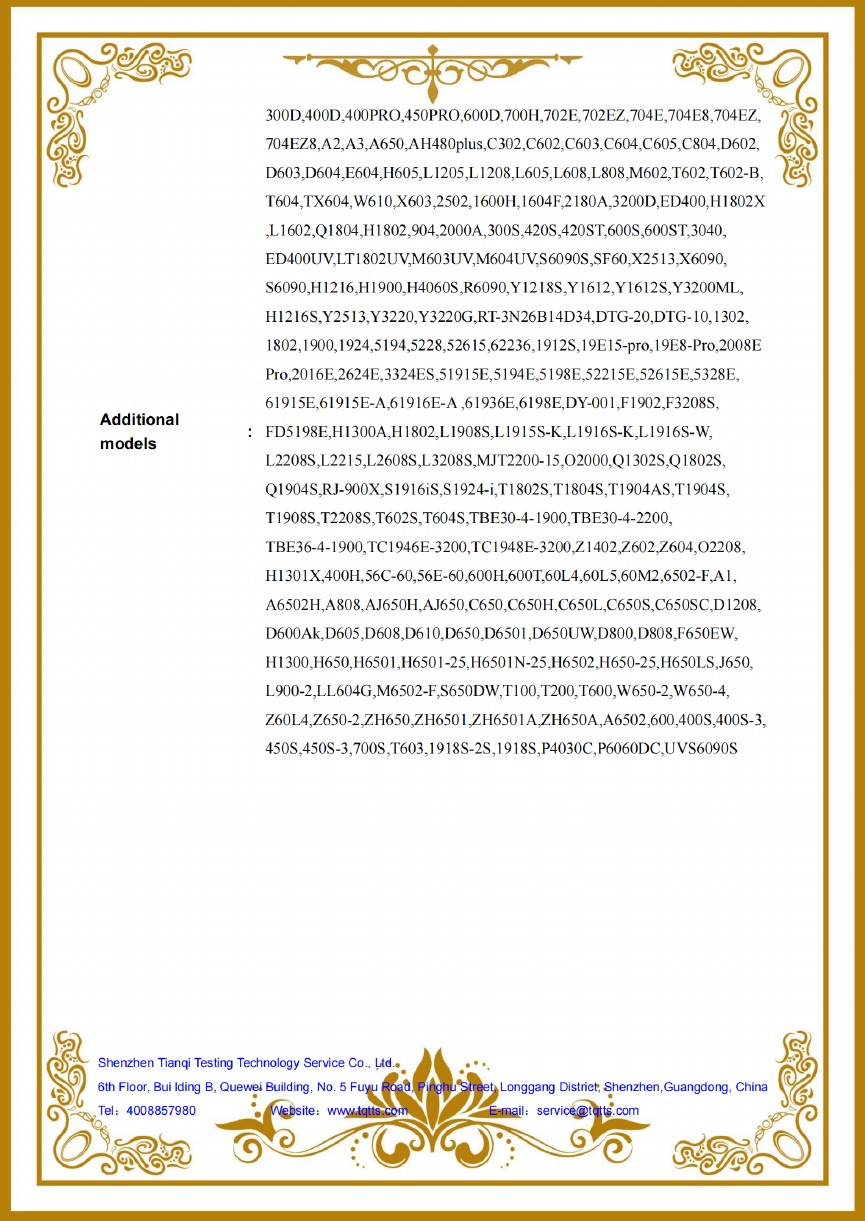
| TQT1550D271EC | CE LVD — Low Voltage Directive 2014/35/EU | TQT (Shenzhen Tianqi Testing Technology Service Co., Ltd.) | EN IEC 62368-1:2020/A11:2020 | 2026-05-19 | 2099-01-01 |
| M.2026.206.C142365 | CE MD — Machinery Directive 2006/42/EC | UDEM | EN ISO 12100:2010; EN 60204-1:2018/A1:2025; EN ISO 12643-1:2023 | 2026-06-10 | 2031-06-09 |
| M.2026.206.C142366 | RoHS — Directive 2011/65/EU | UDEM | EN IEC 63000:2018; EN IEC 62321 series | 2026-06-10 | 2031-06-09 |
| M.2026.206.C142475 | CE LVD & EMC — LVD 2014/35/EU and EMC 2014/30/EU | UDEM | EN IEC 62368-1:2020/A11:2020; EN 55032:2015/A1:2020; EN 55035:2017; EN 61000-3-2:2014; EN 61000-3-3:2013 | 2026-06-11 | 2031-06-10 |
Certificate register as published for the Xinflying digital textile printer range. Register fields are the audit fields; a supplier that cannot produce them in this form cannot be audited.
CE EMC certificate TQT1550D270EC (TQT): electromagnetic compatibility only.
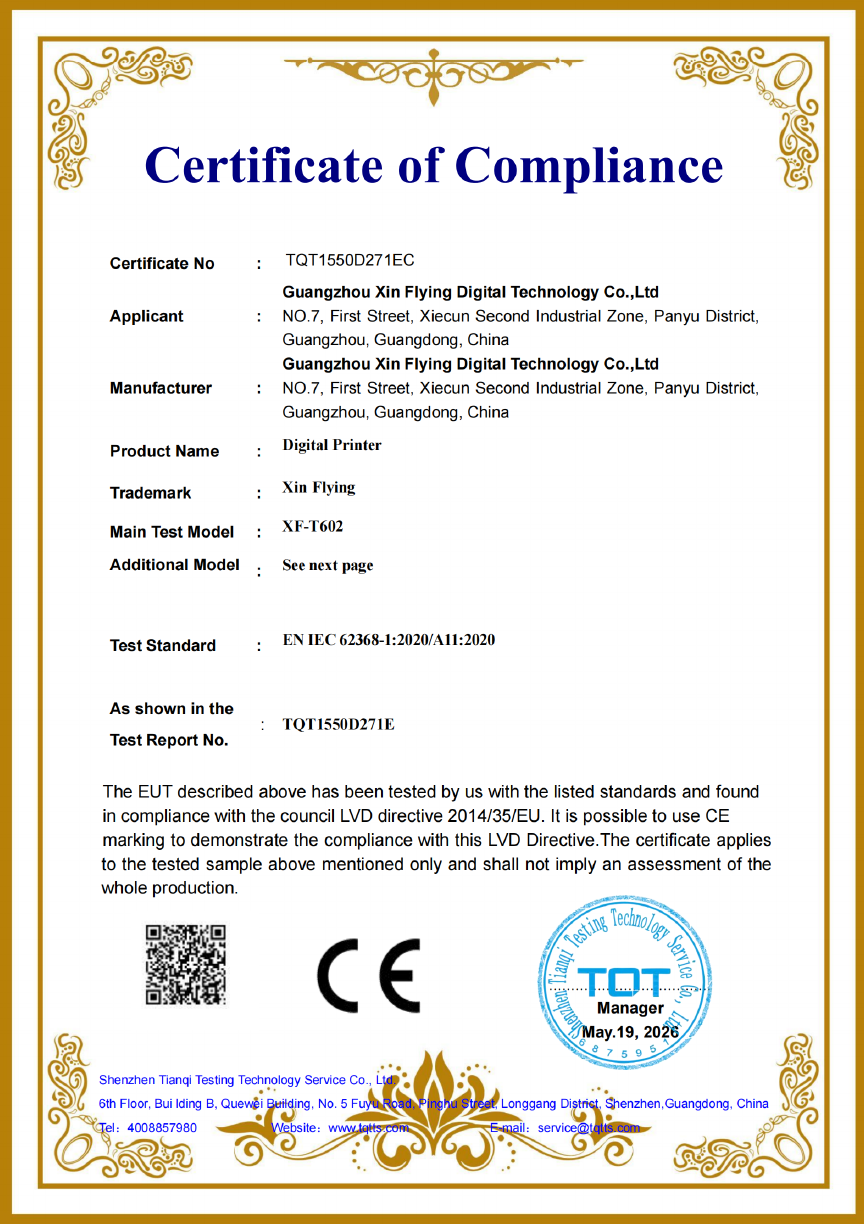
CE LVD certificate TQT1550D271EC (TQT): electrical safety against EN IEC 62368-1:2020/A11:2020.
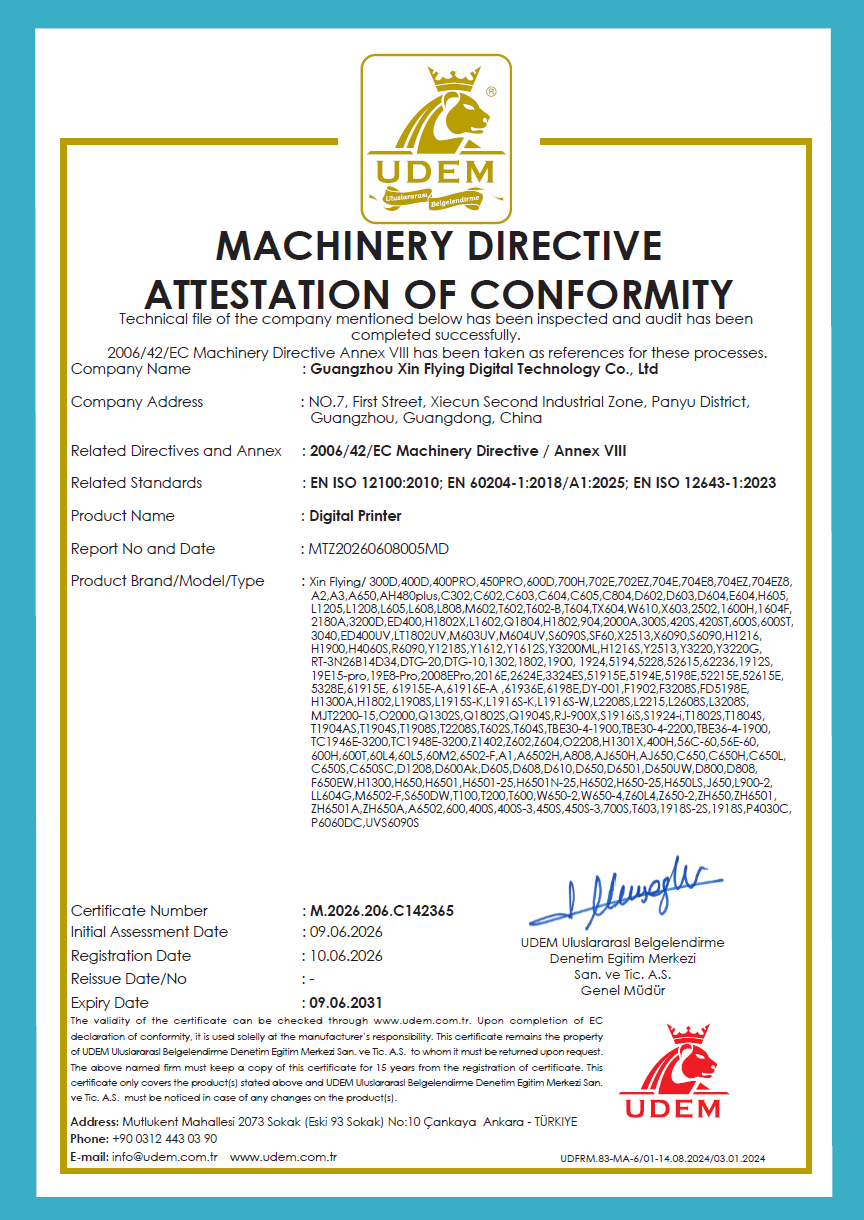
CE MD certificate M.2026.206.C142365 (UDEM): machinery safety under Directive 2006/42/EC.
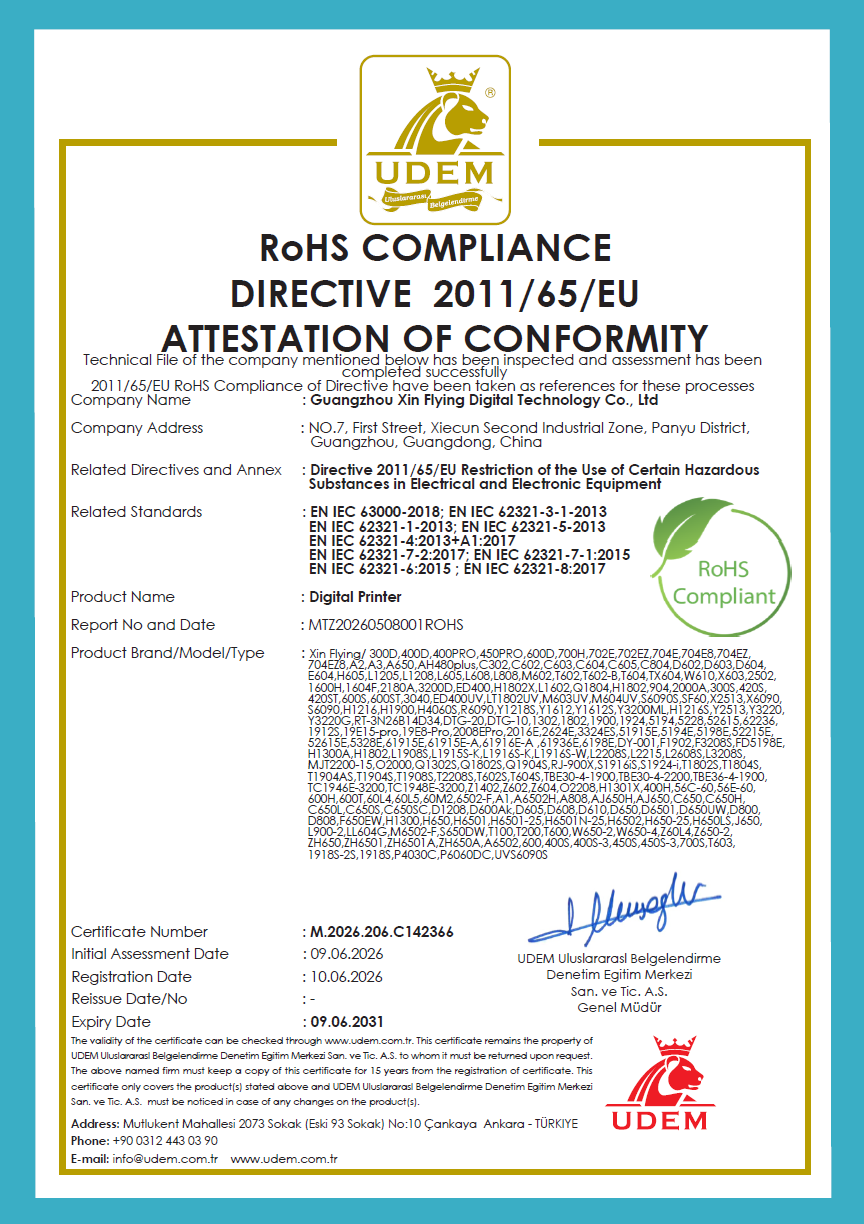
RoHS certificate M.2026.206.C142366 (UDEM): restricted substances under Directive 2011/65/EU.
Why the Model List Is the Boundary of the Certificate
The combined CE LVD & EMC certificate M.2026.206.C142475 names eight machine models: XF-702E, XF-400D, XF-450PRO, XF-C602, XF-C604, XF-C605, XF-F606 and XF-L608. That list is the boundary of the document. If your purchase order carries a model string that does not appear on it, the file is not your evidence, however many CE marks it carries — you need the certificate whose printed model list contains your machine.
The same rule applies across the sublimation line. Xinflying's dye sublimation printer range covers distinct models with distinct configurations — the XF-O2000-4I32A1 with 4 Epson i3200-A1 printheads, a 195 cm (1.95 m) print width and speeds of 180 m²/h at 2PASS; the XF-19E8-PRO with 8 Epson i3200-A1 printheads, 190 cm (75") width and up to 306 m²/h at 1PASS; the XF-19E15-PRO with 15 Epson i3200-A1 printheads, 190 cm width and up to 524 m²/h; and the entry industrial pair, XF-H1802X-2I32A1 at 180 cm and 52 m²/h and XF-H1301X-1I32A1 at 130 cm and 28 m²/h. Five models, five model strings — so five separate model-string checks against the certificate register.
A Six-Step Certificate-to-Model Audit
Step 1 — Build the model-and-market matrix before the quote
List the exact model strings you intend to buy and the markets where each machine will be installed, resold or financed. The market defines the directive set; the model string defines the certificate list. Do this before the supplier sends a quotation, so the audit request goes out with the RFQ rather than after the PO.
Step 2 — Ask for a register, not a folder
Request one table with columns: certificate number, certificate type, directive, standards cited with amendment years, issuing body, issue date, expiry date, and the model list. The register format is itself a capability test. A supplier that can produce it in an hour is a supplier with a controlled document system; a supplier that can only attach twelve scanned images is not.
Step 3 — Match the model string character by character
Compare the register's model list against your purchase order line by line. Hyphens, suffixes and head-count designators are part of the string. Treat a partial match as a non-match until the supplier produces the certificate that names the exact model.
Step 4 — Map directives, not logos
Build a grid with your models on one axis and EMC, LVD, MD and RoHS on the other. Tick a cell only when a certificate number with the correct directive exists for that model. A single combined LVD & EMC file can legitimately fill two cells for the same model — as M.2026.206.C142475 does for its listed models — but it will not fill a machinery-safety or RoHS cell.
Step 5 — Verify the body, the standard edition and the dates
Record the issuing organisation as named on the file, such as TQT (Shenzhen Tianqi Testing Technology Service Co., Ltd.) or UDEM, and note the standard editions exactly as printed. Amendment years matter: EN IEC 62368-1:2020/A11:2020 is a different citation from an unamended edition, and EN IEC 63000:2018 is the RoHS documentation framework rather than a substitute for the EN IEC 62321 test series. Then confirm the certificate is inside its validity window on the planned shipment date.
Step 6 — Write the audit into the PO and the acceptance test
An audit that stays in a spreadsheet changes nothing. Name the certificate numbers in the purchase order, specify that a digital copy travels with the machine, and make the model string on the nameplate an acceptance item. This is the step where document checking becomes delivery assurance.
From Audit to Delivery Assurance: What the Contract Has to Say
Capability verification only becomes commercially useful when it is attached to three contractual statements.
What is ordered. The PO should carry the full model string, the configuration that changes that string, and the destination market. A buyer ordering a commercial sublimation printer for an EU installation should state the market on the order, because that is the fact that determines which directive set applies.
What certificate file arrives with the machine. Name the certificate numbers in the contract — for example, the CE MD file M.2026.206.C142365 and the RoHS file M.2026.206.C142366 — and require a digital copy delivered before the pre-shipment test, not after arrival. For buyers working with an OEM dye sublimation printer manufacturer, add the configured model string to that requirement, since a different configuration can mean a different model designation.
What happens at acceptance if the model or the standard does not match. Xinflying's stated quality control method and acceptance criterion is pre-shipment testing. That is the natural checkpoint: the nameplate model string against the PO, the delivered certificate file against the register, and the cited standard editions against the audit grid. If any of the three fails, the remedy has to be defined in advance — hold, re-issue the certificate, or rework the machine — because after the balance payment is released, the buyer's leverage is gone.
The commercial framework for these terms is straightforward at Xinflying: minimum order quantity of 1 unit, delivery on EXW, FOB, CIF and DDP terms, and payment by T/T, Western Union or PayPal. Note how the delivery term changes the audit: under EXW the buyer carries the import compliance risk, so the certificate requirement has to be specified in more detail, while under DDP the supplier carries it. Lead time is stated at 5–40 days depending on configuration, against a monthly production capacity of over 1,600 units.
Where Certificate-to-Model Coverage Decides the Order
First EU import by an importer. The importer has no prior file history with the supplier, so the register is the only evidence available. A model-string mismatch discovered at customs is far more expensive than one discovered at the quotation stage.
Distributor catalogue onboarding. A distributor listing a wide format sublimation printer in a national catalogue is usually required to hold the technical documentation behind the listing. Mapping certificate number to model at onboarding prevents a later withdrawal of the model from the catalogue.
Tender and public procurement. Evaluators score technical files against stated standards. A certificate that cites the correct directive but names the wrong model will normally be marked down and sometimes rejected outright.
Delivery acceptance and payment release. This is the execution-stage use case, and the one with the clearest financial consequence. The audit grid and the PO clauses meet here: either the nameplate, the register and the delivered file agree, or final payment waits.
Buyers running mixed platforms. Many production businesses operate more than one printing technology. Xinflying's installed base includes digital textile printing service providers supplying sportswear brands and apparel factories, sportswear and sports uniform manufacturers running custom team kit production, and home textile producers printing curtains, cushions and decorative polyester fabrics. In a mixed fleet, a certificate held for one platform proves nothing about the other — each model line needs its own row in the register.
Comparison: What Each Certificate Proves — and What It Does Not
Buyers most often over-claim on a single CE file. The table below sets the boundary of each document type used in the Xinflying register.
| Document type | Proves | Does not prove |
|---|---|---|
| CE EMC (TQT1550D270EC) | Type-tested electromagnetic compatibility under EMC Directive 2014/30/EU against EN 55032, EN 55035 and the EN 61000-3 series | Electrical safety, machinery safety, or restricted-substance compliance |
| CE LVD (TQT1550D271EC) | Electrical safety compliance under LVD 2014/35/EU against EN IEC 62368-1:2020/A11:2020 | Electromagnetic compatibility, mechanical guarding, or RoHS |
| CE MD (M.2026.206.C142365) | Machinery safety conformity under Directive 2006/42/EC with EN ISO 12100, EN 60204-1 and EN ISO 12643-1 cited | EMC, low-voltage product safety, or RoHS |
| RoHS (M.2026.206.C142366) | Restricted hazardous substance compliance under Directive 2011/65/EU, documented via EN IEC 63000:2018 and the EN IEC 62321 series | Safety, EMC, or performance of the machine |
| Combined CE LVD & EMC (M.2026.206.C142475) | Both electrical safety and EMC in one file, for the eight models named on it | Machinery Directive coverage or RoHS for those models |
Each row answers a different regulatory question. A complete audit needs the rows your destination market requires, for the exact model string you are buying.
Frequently Asked Questions
What certifications should I verify before importing a sublimation printer into the EU?
Buyers should verify the CE documentation that applies to the machine: EMC Directive 2014/30/EU, Low Voltage Directive 2014/35/EU, Machinery Directive 2006/42/EC and RoHS Directive 2011/65/EU, as applicable to the configuration and destination. In practice this means checking the certificate number, the exact standard editions cited (for example EN IEC 62368-1:2020/A11:2020 or EN IEC 63000:2018), the issuing body, the issue and expiry dates, and above all that the model string on the certificate matches the model string on the invoice and the machine nameplate. Incorrect or incomplete compliance documentation can lead to customs delays, sales restrictions or additional compliance costs.
How do I audit certification when buying from an OEM dye sublimation printer manufacturer with a customized build?
Xinflying provides OEM and ODM production services, and customization covers product branding, machine appearance, color, logo, packaging and solutions developed around customer requirements, with a minimum order quantity of 1 unit. Because a customized configuration can carry a different model designation, the certificate register has to be re-checked against the configuration actually ordered rather than the base model. Ask the supplier to confirm in writing which certificate number covers the configured model, and keep that written confirmation as part of the order record.
What commercial terms should the certificate audit be tied to?
Xinflying quotes with a minimum order quantity of 1 unit, offers delivery on EXW, FOB, CIF and DDP terms, and accepts payment by T/T, Western Union and PayPal. Because the delivery term determines who carries import responsibility, the certificate obligations belong in the same document: which certificate numbers must be supplied, in what format, and by which milestone. Under EXW terms the buyer carries more of the compliance risk and should specify the documentation in more detail.
How is acceptance handled if the delivered model or standard does not match?
Xinflying's stated quality control method and acceptance criterion is pre-shipment testing. Buyers should define what that test verifies: the nameplate model string against the purchase order, the certificate file delivered against the agreed register, and the standard editions cited against the audit grid. If the model string or the referenced standard does not match, the buyer's remedy depends on what was agreed before the order — so hold, re-issue and rework options should be written into the contract, not negotiated after the machine arrives.
How long does a sublimation printer order take, and what support follows delivery?
Xinflying states a lead time of 5–40 days depending on configuration, supported by a monthly production capacity of over 1,600 units and a service organisation of over 50 engineers providing 24/7 online technical support after delivery. If you want to run the certificate audit before committing, the practical next step is to request the certificate register — certificate number, directive, standards, model list, issuing body and dates — together with a quotation for the exact model string you intend to buy.
Conclusion: The Checklist to Send Before the PO
Vetting a sublimation printer supplier is a document exercise with a fixed sequence: register first, model list second, directives third, dates fourth, contract fifth. A supplier that can map certificate numbers to model strings, directives and markets is demonstrating a capability that also shows up in production control, spare-parts supply and after-sales response — because both depend on the same thing, which is knowing exactly which unit was built and for which market.
Certificate-to-model audit checklist — send this to the supplier before the PO
- Certificate register in table form: certificate number, type, directive, standards cited with amendment years, issuing body, issue date, expiry date.
- Model list for every certificate, with the exact model strings as printed.
- Directive coverage grid per model: EMC, LVD, MD, RoHS — with gaps marked, not hidden.
- Issuing body and accreditation reference as named on the file.
- Validity confirmation covering the planned shipment date.
- PO clause naming the certificate numbers that must be delivered with the machine.
- Acceptance criterion: nameplate model string equals the PO model string; certificate file delivered before the pre-shipment test.
- Written remedy if the model or the cited standard does not match: hold, re-issue or rework.
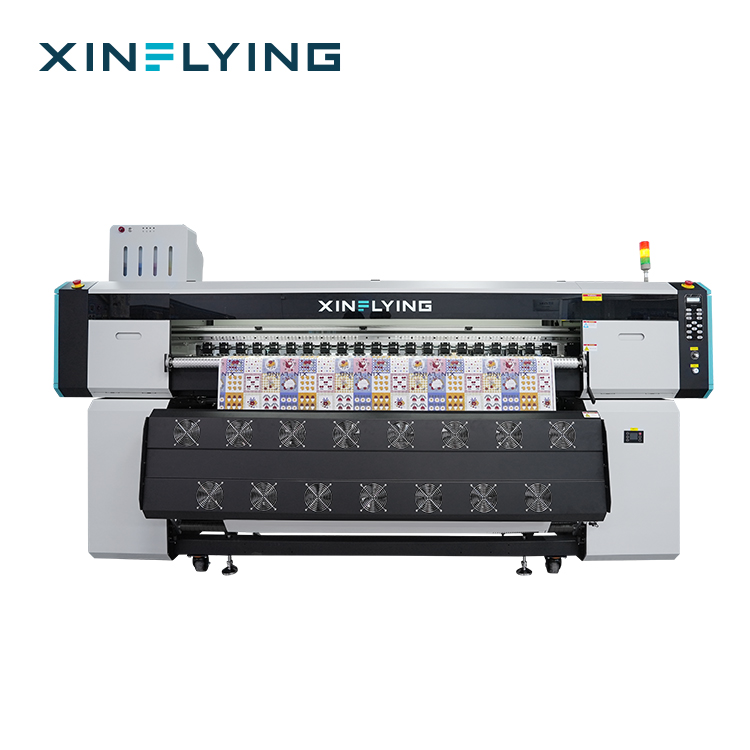
Xinflying XF-O2000-4I32A1 roll-to-roll sublimation printer — 195 cm (1.95 m) print width, 4 Epson i3200-A1 printheads.
Request the Certificate Register and a Quote
If you are evaluating a dye sublimation printer for the EU or another regulated market, start with the documents rather than the brochure. Request the full certificate register for the exact model string you intend to buy, together with a quotation.
Download the Xinflying company brochure: Xinflying Company Profile (PDF)
Email: info@xin-flying.com
Tel / WhatsApp: +86 188-1322-1357
Website: www.xin-flying.com
Blog: blog.xin-flying.com
Address: No.7, Xiecun 2nd Industrial Zone, Panyu, Guangzhou, Guangdong, China
Guangzhou Xin Flying Digital Technology Co., Ltd. — founded 2010, digital printing equipment manufacturer for DTF, dye sublimation, DTG, UV DTF and UV flatbed printing, serving distributors and production businesses worldwide.
Have Questions or Need More Details?
Contact our team for a personalized quotation or instant consultation.
Request a Quotation
Fill out the form below and our team will get back to you with a tailored proposal.
WhatsApp Direct Chat
Prefer to chat in real-time? Message us on WhatsApp for instant assistance & quick answers.
- Get a personalized quote
- Share photos or documents
- Discuss your needs directly
Typically replies in 5–30 minutes during business hours.