
CE LVD for Sublimation Printers: EU Market Compliance Guide
CE LVD for Sublimation Printers: EU Market Compliance Guide
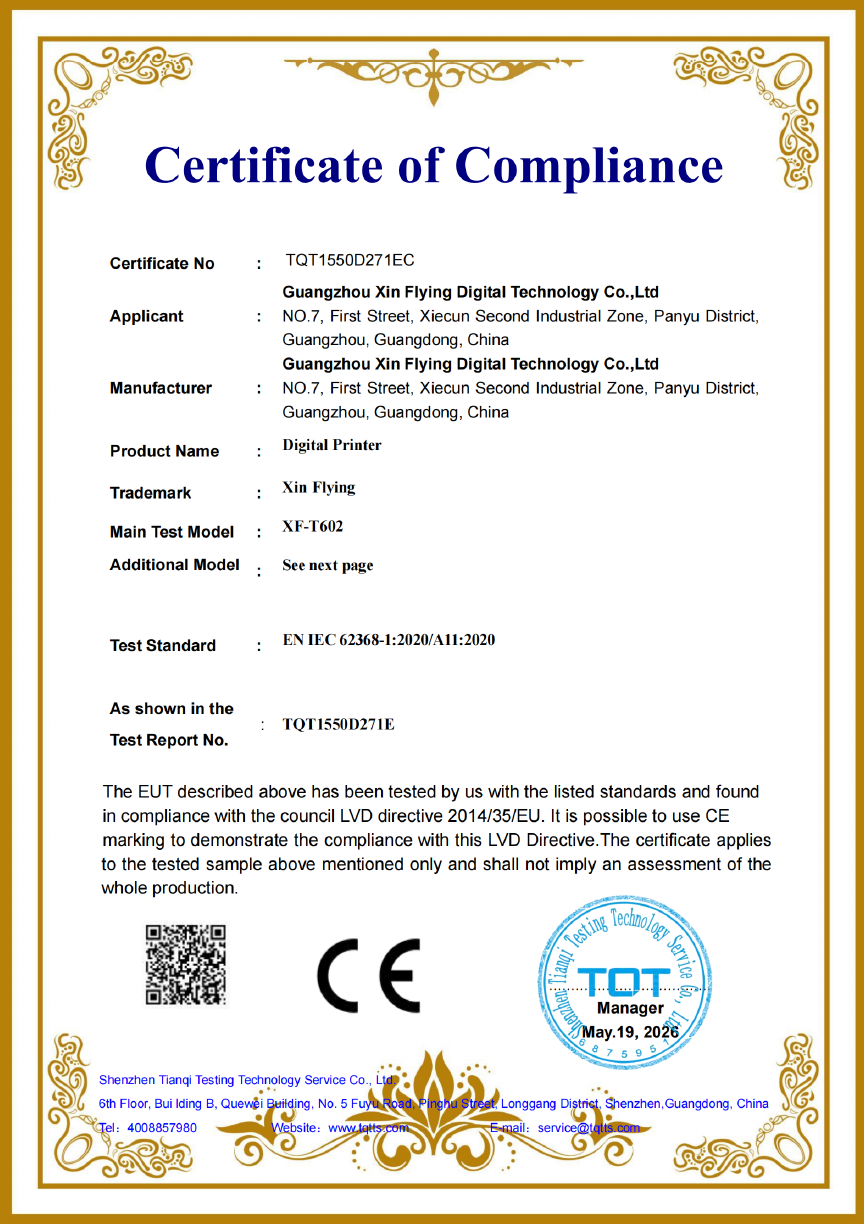
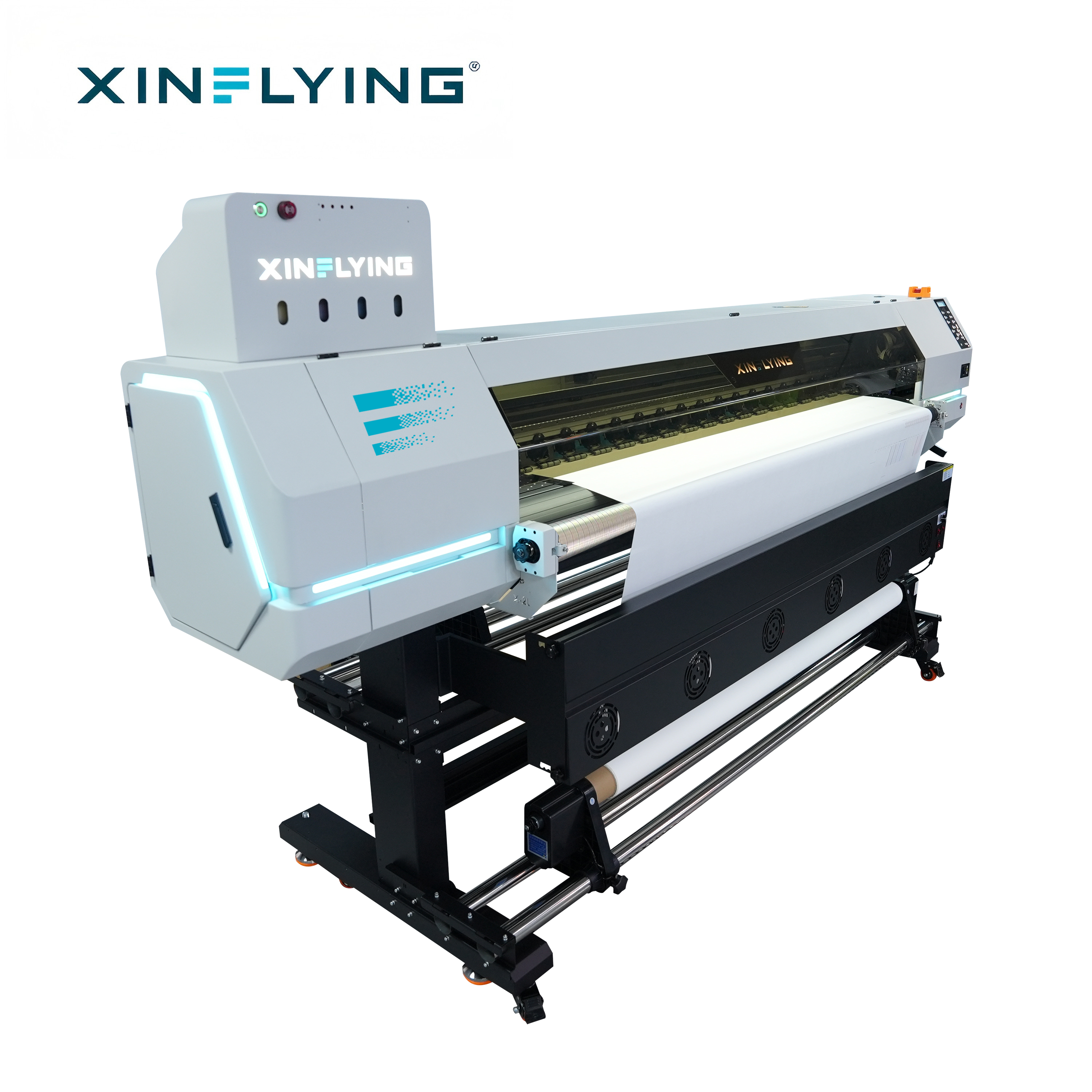
An industrial sublimation printer cannot be placed on the European Union market without documented evidence that it satisfies the Low Voltage Directive 2014/35/EU. For the XINFLYING XF-19E15-PRO, a 1900 mm roll-to-roll dye sublimation printer rated 14.5 kW at 210–230 V and 45 A, that evidence is CE LVD certificate TQT1550D271EC, issued on 19 May 2026 by TQT (Shenzhen Tianqi Testing Technology Service Co., Ltd.) against the harmonised standard EN IEC 62368-1:2020/A11:2020.
This guide is written for importers, distributors and textile production managers who have moved past discovery and are now comparing machines on paper. It explains what LVD 2014/35/EU asks of a digital textile printer, what EN IEC 62368-1:2020/A11:2020 covers, how to read a certificate annex line by line, and where compliance risk usually appears in a supplier evaluation.
One boundary should be set at the start: the LVD addresses electrical safety only. Electromagnetic compatibility, machine guarding and restricted substances sit under different directives and different documents. A complete EU compliance file for a wide format sublimation printer normally contains several certificates, and none of them substitutes for another.
Problem Definition: Where LVD Evidence Usually Breaks Down
The failure mode in sublimation printer procurement is rarely the total absence of a certificate. It is a certificate that does not match the model, the standard edition, or the configuration that will actually be shipped. A buyer comparing a 1900 mm industrial roll-to-roll machine and a smaller entry-level unit can be handed the same PDF and assume it covers both.
Five specific gaps appear repeatedly during evaluation:
- The annex does not name the purchased model. A document issued for a product family is only useful if the exact model appears in its product list.
- The standard edition is outdated or unrelated. EN IEC 62368-1:2020/A11:2020 is a specific edition and amendment level; citing a general safety standard is not the same document.
- One CE document is presented as covering everything. Electrical safety, electromagnetic compatibility and machinery safety are separate scopes with separate certificate numbers.
- Documents arrive after the deposit. If the compliance pack is only shared at shipment, the buyer has lost the ability to verify before payment.
- The certificate belongs to a different machine class. A certificate issued for a compact film-transfer unit is not evidence for a 1900 mm sublimation printer with a 14.5 kW electrical load.
The downstream cost of these gaps is concrete: customs queries, end-customer audits, insurance documentation requests, and an inability to demonstrate conformity when a European client asks for proof that the machine in their workshop meets EU requirements.
Industry Background: A Growing Machine Population Under a Stable Safety Regime
The volume of digital textile printing equipment crossing borders is increasing, which makes documentation a higher-frequency procurement issue. According to Grand View Research, the global dye sublimation printing market was valued at USD 16.4 billion in 2025 and is projected to reach USD 39.0 billion by 2033, growing at a CAGR of 11.5% from 2026 to 2033. Asia Pacific accounted for a 36.5% revenue share in 2025, led by China as the largest country market. Mordor Intelligence sizes the dye sublimation printers segment specifically at USD 1.88 billion in 2025, expected to reach USD 2.53 billion by 2030.
Those numbers describe more machines, more shipments and more importers who must hold a coherent compliance file. Meanwhile, the safety standard landscape has consolidated. EN IEC 62368-1 is the hazard-based safety standard for audio/video, information and communication technology equipment, and it replaced two earlier equipment-specific safety standards. That consolidation is why recent LVD certificates for digital printing equipment cite EN IEC 62368-1:2020/A11:2020 rather than the older equipment standards that older certificates referenced.
Two further points are commonly confused during evaluation. First, the industry reference ISO 12647-8:2021 addresses validation of digital print processes for colour reproduction — it is a process and colour standard, not an electrical safety standard, and it does not replace LVD evidence. Second, material-level compliance sits on a different track again: XINFLYING holds OEKO-TEX ECO PASSPORT certificate SH150194016, issued by TESTEX AG, covering textile printing inks and printing pastes, valid to 31 December 2026. That document concerns consumables, not the printer electrical system.
Detailed Solution: What LVD Compliance Actually Requires
What LVD 2014/35/EU requires of a digital textile printer
The Low Voltage Directive establishes essential electrical safety requirements for equipment placed on the EU market within its defined low-voltage AC scope. Machines configured for 210–230 V operation, such as the XF-19E15-PRO and the XF-19E8-PRO, fall inside that scope. Meeting the directive is not a single action; it is a set of obligations: apply a harmonised standard or perform a conformity assessment, compile technical documentation, issue an EU Declaration of Conformity, affix CE marking, and keep the technical file available to market surveillance authorities.
For an importer or distributor, the practical obligation narrows down to one question: do I hold documents that match the exact model and configuration I am placing on the market? If the answer is no, the CE mark on the machine has no supporting evidence behind it.
EN IEC 62368-1:2020/A11:2020 in plain language
EN IEC 62368-1 takes a hazard-based approach rather than a prescriptive one. Instead of listing fixed construction rules, it requires the manufacturer to identify energy sources inside the equipment, classify them, and apply safeguards appropriate to the class. The hazards covered include electrical shock, energy-related injury, fire, thermal injury and mechanical hazards.
Applied to a roll-to-roll sublimation printer, the relevant areas of assessment include the mains inlet and protective earthing, the high-current heating and drying circuits, the printhead drive electronics, the ink supply and cleaning systems, and insulation and temperature-rise behaviour under continuous production. The amendment level matters: a certificate citing EN IEC 62368-1:2020/A11:2020 references a specific edition including amendment A11:2020, and a document citing an earlier edition is a different piece of evidence.
Case reference: the XF-19E15-PRO LVD certificate TQT1550D271EC
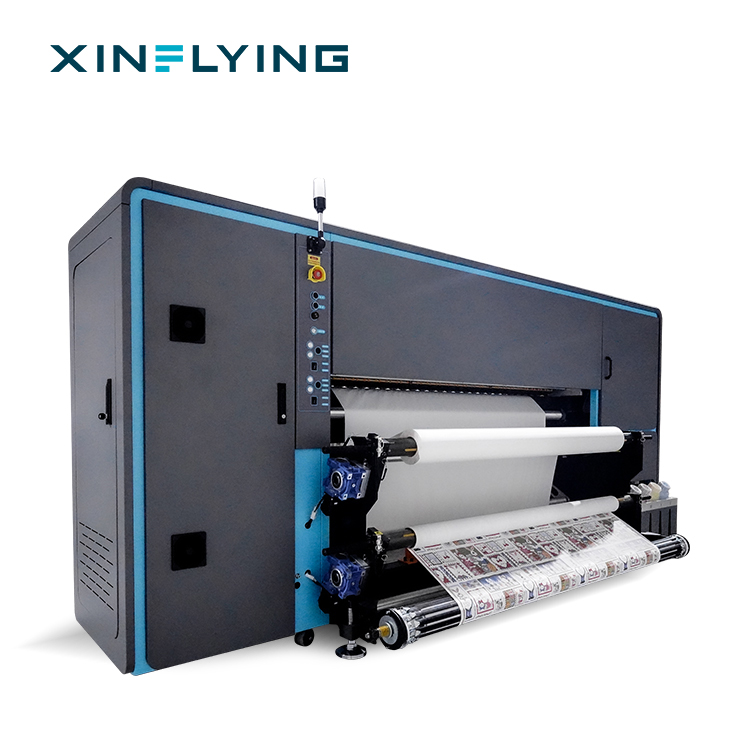
The XF-19E15-PRO is XINFLYING’s highest-load sublimation platform: 15 Epson i3200-A1 print heads, a 190 cm (75 inch) print width, 3200 dpi resolution, print speeds of 1PASS 524 m²/h and 2PASS 254 m²/h at the fastest setting, and a rated power of 14.5 kW on a 210–230 V, 45 A supply. That electrical profile is exactly why the LVD file matters for this class of machine.
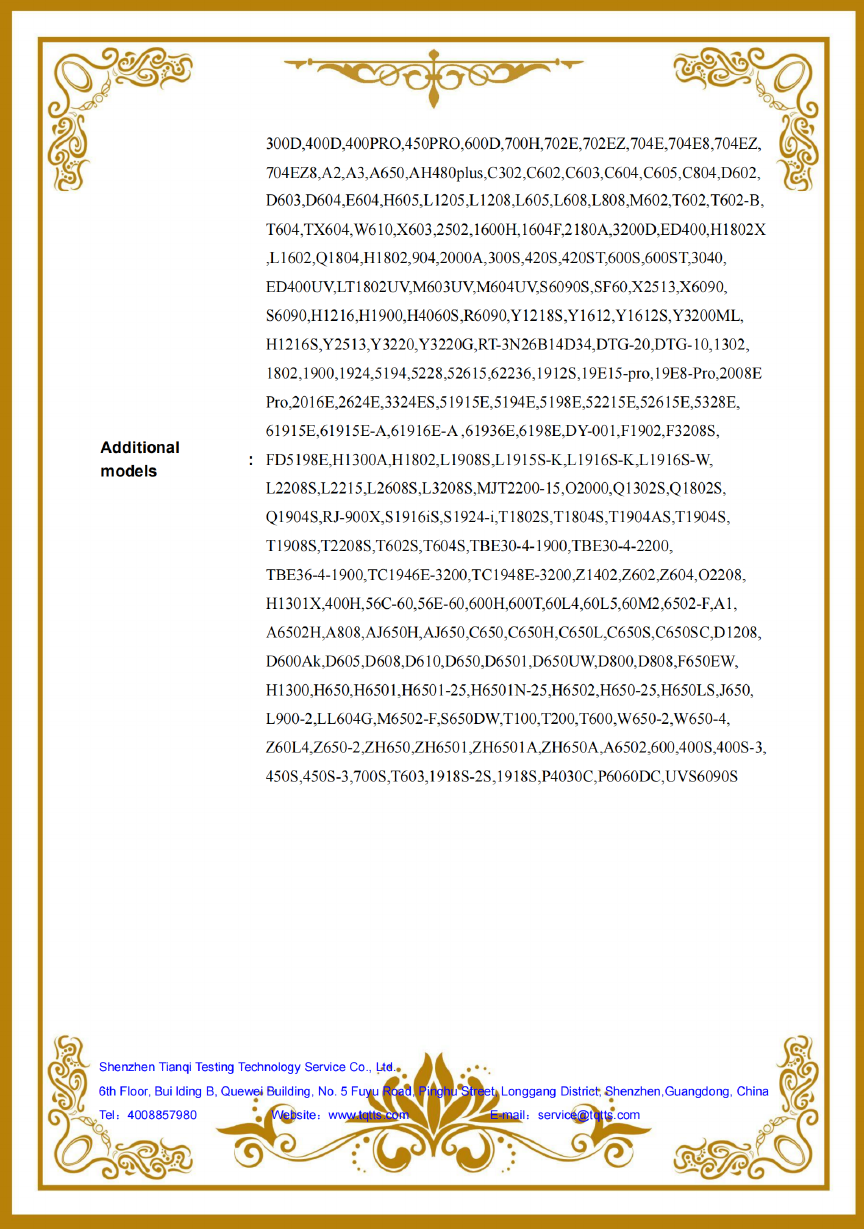
Its CE LVD Certificate of Compliance, number TQT1550D271EC, was issued by TQT (Shenzhen Tianqi Testing Technology Service Co., Ltd.) on 19 May 2026 for the European Union market. The stated scope is electrical safety compliance according to LVD 2014/35/EU for digital printer products, and the harmonised standard applied is EN IEC 62368-1:2020/A11:2020. The certificate product list covers 15 digital textile printer models, including the XF-19E15-PRO (15 heads, 1900 mm), the XF-19E8-PRO (8 heads, 1900 mm, 10.2 kW), the XF-O2000-4I32A1 (4 heads, 1950 mm, 8.5 kW), the XF-H1802X-2I32A1 (2 heads, 1800 mm, 3.5 kW) and the XF-H1301X-1I32A1 (1 head, 1300 mm, 2 kW).
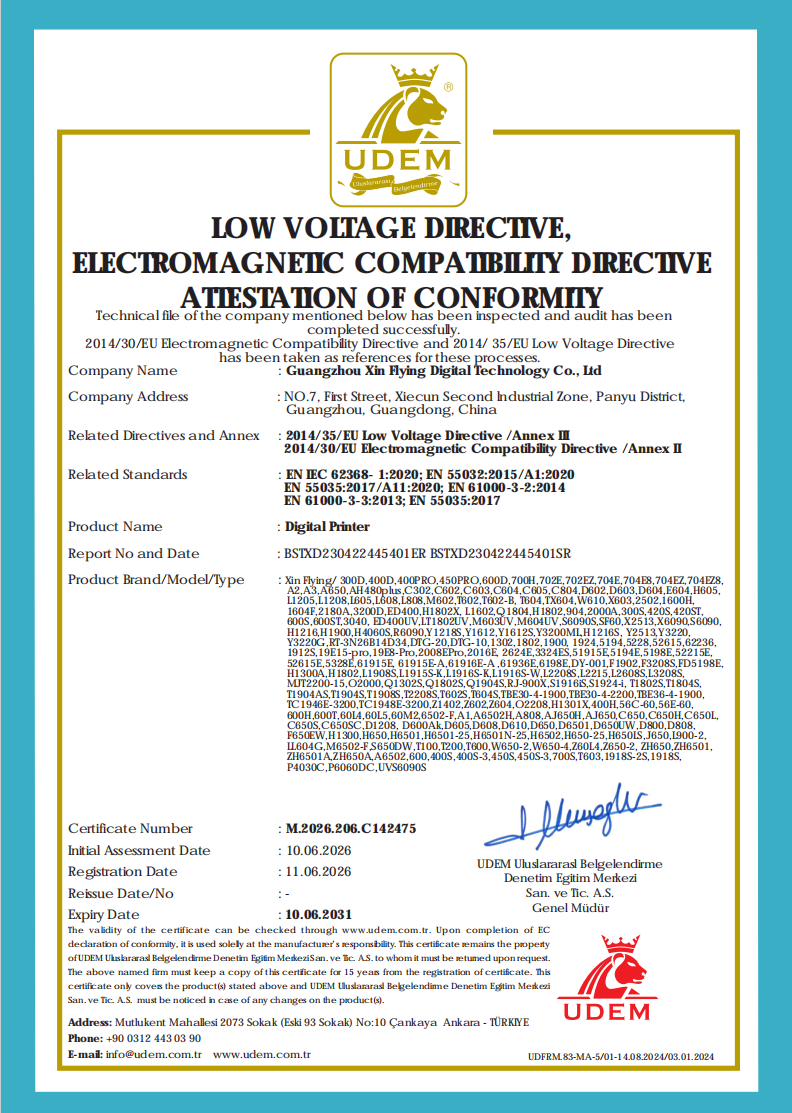
The same product range is covered by adjacent documents that address different scopes. CE Machinery Directive attestation M.2026.206.C142365, issued by UDEM, applies MD 2006/42/EC with standards EN ISO 12100:2010, EN 60204-1:2018/A1:2025 and EN ISO 12643-1:2023. Combined LVD and EMC attestation M.2026.206.C142475 was issued on 11 June 2026. CE EMC certificate TQT1550D270EC was issued by TQT on 19 May 2026 under EN 55032:2015/A11:2020, EN 55035:2017/A11:2020, EN IEC 61000-3-2:2019+A1:2021 and EN 61000-3-3:2013/A2:2021. RoHS attestation M.2026.206.C142366 covers Directive 2011/65/EU with EN IEC 63000:2018.
Read together, these documents show the structure of a real EU compliance file: one certificate per regulatory scope, each naming its own directive, standard and product list. A buyer who accepts a single page as proof of everything will eventually discover the gap.
Step-by-Step Breakdown: Verifying LVD Evidence in Seven Steps
A buyer in the evaluation stage can verify LVD evidence without technical expertise. The process is document-driven, and each step eliminates a specific category of risk.
- Request the certificate by number, not just as an attachment. Asking for TQT1550D271EC by number means the supplier must produce the exact document rather than a general CE image, and the number can be cross-checked against the annex.
- Confirm the harmonised standard and amendment level. The LVD certificate for this product range cites EN IEC 62368-1:2020/A11:2020. If the document cites a different edition or a general safety reference, treat it as a different level of evidence.
- Verify the issuing body. The LVD and EMC certificates in this file were issued by TQT (Shenzhen Tianqi Testing Technology Service Co., Ltd.), while the machinery and RoHS attestations were issued by UDEM. Full legal names on the document, not abbreviations, are what an auditor will check.
- Match the annex to the model you are ordering. A 1900 mm machine and a 1300 mm machine can appear on the same certificate, but only one of them appears on your purchase order. Confirm the match line by line.
- Check the rest of the CE stack. Request the machinery directive attestation, the EMC certificate and the RoHS attestation alongside the LVD certificate. Where inks are part of the supply, ask for the OEKO-TEX ECO PASSPORT document separately.
- Confirm the electrical requirements of the machine are documented. The XF-19E15-PRO specifies a 210–230 V, 45 A supply; the XF-O2000-4I32A1 specifies 220 V, 50/60 Hz. Installation must match the certified configuration, so the site electrical plan should be reviewed against the same specification sheet the certificate refers to.
- File the pack before shipment. Keep the certificate set, declaration of conformity and specification sheet together as one shipment dossier. This is the file that answers customs queries, insurance requests and end-customer audits.
Use Cases: What Compliance Documentation Looks Like in Real Installations
Documented installations show why the LVD file is a production issue rather than a paperwork formality. The following cases are field references for the sublimation platforms discussed above.
Sportswear manufacturer, 15 units, four years of operation. This customer prints football jerseys, basketball uniforms and customized sportswear on polyester fabrics, including high-resolution patterns, team logos and full-colour designs prior to cutting and sewing. The installation uses industrial roll-to-roll printing capability and achieved more consistent colour quality across production batches, while reducing dependence on outsourced printing services. For a fleet of this size, model-consistent documentation matters because machines may be relocated, resold or audited by the buyer’s own brand customers.
Sports uniform supplier, 8 units, five years of operation. This Brazil-based supplier produces customized football kits, training uniforms and team apparel with personalized names, numbers and graphics. The solution supports small-batch customization and continuous commercial printing with shorter production cycles. When a supplier prints for team brands, compliance documents travel with the machine and are frequently requested during supplier qualification.
Home textile manufacturer, 10 units, four years of operation. This installation covers curtains, cushions, decorative fabrics and customized polyester textile products, requiring large-format capability with detailed patterns and consistent printing quality. Wider machines carry higher electrical loads, which is precisely the category where LVD evidence is most relevant.
Digital textile printing service provider, 5 units, three years of operation. This global case covers sublimation printing services for sportswear brands, apparel factories and customized textile businesses, with expanded production capacity and faster response for customized orders. It illustrates the international applicability of the platform: the same equipment model is documented for markets with different regulatory regimes.
Comparison Table: LVD Coverage Across Wide-Format Sublimation Printers
The table below lists the sublimation models held by XINFLYING that appear in the product list of CE LVD certificate TQT1550D271EC, together with their rated electrical profiles and their coverage under the CE Machinery Directive attestation M.2026.206.C142365.
| Model | Print heads | Print width | Rated power | Power supply | CE LVD certificate TQT1550D271EC | CE MD attestation M.2026.206.C142365 |
|---|---|---|---|---|---|---|
| XF-19E15-PRO | 15 × Epson i3200-A1 | 190 cm (75 inch) | 14.5 kW | 210–230 V, 45 A | Listed | Listed |
| XF-19E8-PRO | 8 × Epson i3200-A1 | 190 cm (75 inch) | 10.2 kW | 210–230 V, 45 A | Listed | Listed |
| XF-O2000-4I32A1 | 4 × Epson i3200-A1 | 195 cm (1.95 m) | 8.5 kW | 220 V, 50/60 Hz | Listed | Listed |
| XF-H1802X-2I32A1 | 2 × Epson i3200-A1 | 180 cm (1.8 m) | 3.5 kW | 110/220 V, 27.2 A / 13.6 A | Listed | Listed |
| XF-H1301X-1I32A1 | 1 × Epson i3200-A1 | 130 cm (1.3 m) | 2 kW | 110/220 V, 18 A / 9 A | Listed | Listed |
The LVD certificate product list also includes DTF platforms such as the XF-450PRO, XF-702E, XF-C602, XF-C604, XF-C605, XF-F606, XF-F808 and XF-L608. Buyers comparing a dye sublimation printer against a DTF printer should confirm that the document they receive matches the model line they are actually purchasing, since a single certificate can cover both equipment families while naming each model separately.
FAQ: CE LVD Questions from EU Sublimation Printer Buyers
Does a sublimation printer need an LVD certificate if it already carries the CE mark?
The CE mark is the visible result of a conformity process; the certificate, test report and EU Declaration of Conformity are the evidence behind it. For equipment inside the LVD scope, the manufacturer must apply a harmonised standard such as EN IEC 62368-1:2020/A11:2020, compile technical documentation and issue a declaration of conformity. XINFLYING holds CE LVD Certificate of Compliance TQT1550D271EC, issued by TQT (Shenzhen Tianqi Testing Technology Service Co., Ltd.) on 19 May 2026, covering electrical safety under LVD 2014/35/EU for a list of digital printer models. A buyer should request the document itself, not a photograph of the CE plate on the machine.
Which XINFLYING sublimation printers are named on the LVD certificate?
The certificate product list covers 15 digital textile printer models. The sublimation platforms on that list include the XF-19E15-PRO (15 Epson i3200-A1 print heads, 190 cm print width, 3200 dpi, 14.5 kW), the XF-19E8-PRO (8 heads, 190 cm, 3200 dpi, 10.2 kW), the XF-O2000-4I32A1 (4 heads, 195 cm, 8.5 kW), the XF-H1802X-2I32A1 (2 heads, 180 cm, 3.5 kW) and the XF-H1301X-1I32A1 (1 head, 130 cm, 2 kW). DTF models including the XF-450PRO, XF-C602 and XF-F808 appear on the same product list. Because one certificate can cover both equipment families, the decisive check is whether the model on your purchase order appears in the annex.
How does LVD compliance affect the cost of buying a sublimation printer?
Compliance cost sits mostly on the manufacturer side: harmonised-standard testing, technical file preparation and maintaining certificates across a model range. XINFLYING states a monthly production capacity of 1600+ units and a minimum order quantity of 1 unit, so the compliance pack is provided as an existing document rather than commissioned per contract. For the buyer, the cost is verification time, plus the possibility of re-evaluation if a requested configuration departs from the certified configuration. That is the practical reason to freeze the machine specification, including supply voltage and installed options, before matching it against the certificate annex.
Can I review LVD documents before ordering a sample or trial unit?
Yes. Certificate copies can be reviewed before any order is placed, and single-unit orders are possible because XINFLYING accepts a minimum order quantity of 1 unit and performs pre-shipment testing as part of its quality control process. For an evaluation-stage buyer, the efficient approach is to request the LVD certificate, the EMC and machinery documents, the RoHS attestation and the specification sheet in the same pack as the quotation, so that the trial machine is validated against the same compliance basis that will apply to the production order.
What is the lead time, and does the LVD documentation delay delivery?
Production lead time runs from 5 to 40 days depending on configuration and order volume. Certificates are existing documents rather than items produced per shipment, so they do not extend the production schedule; they are issued together with the shipment paperwork. After-sales support is delivered by a team of more than 50 engineers providing 24/7 online technical support. Buyers who want to start an evaluation can request the CE LVD certificate pack TQT1550D271EC, a sample plan, or a quotation for a specific 1900 mm sublimation printer configuration at info@xin-flying.com.
Conclusion: Treat LVD Evidence as a Selection Criterion
For EU-bound textile production, the Low Voltage Directive file belongs on the same evaluation sheet as print width, print speed and head count. The XF-19E15-PRO case shows what a usable document looks like in practice: a named certificate number (TQT1550D271EC), a named harmonised standard (EN IEC 62368-1:2020/A11:2020), a named issuing body (TQT), a stated directive scope (LVD 2014/35/EU) and an annex that lists the individual models covered.
Three checks carry most of the weight during evaluation. Confirm the model in the annex. Confirm the standard edition and amendment level. Confirm that the LVD document is only one part of a wider file that also contains EMC, machinery safety and RoHS evidence. A supplier able to produce all four, by number, before a deposit is placed has already removed the most common compliance risk from the purchase.
XINFLYING is a digital printing equipment manufacturer established in 2010, producing DTF printers, dye sublimation printers, DTG printers, UV DTF printers and UV flatbed printers, with an export share of 80% across North America, South America, Europe, Asia, the Middle East and Africa. More product and compliance information is available at www.xin-flying.com.
Next step for EU-bound projects
Request the CE LVD certificate pack for the model you are evaluating, arrange a sample or trial machine, or ask for a configuration-specific quotation.
Email: info@xin-flying.com · Tel / WhatsApp: +86 188-1322-1357
Have Questions or Need More Details?
Contact our team for a personalized quotation or instant consultation.
Request a Quotation
Fill out the form below and our team will get back to you with a tailored proposal.
WhatsApp Direct Chat
Prefer to chat in real-time? Message us on WhatsApp for instant assistance & quick answers.
- Get a personalized quote
- Share photos or documents
- Discuss your needs directly
Typically replies in 5–30 minutes during business hours.