
1.9m Sublimation Printer Lineup Ranked by Textile Production Fit
Sublimation Printer Evaluation · 2026
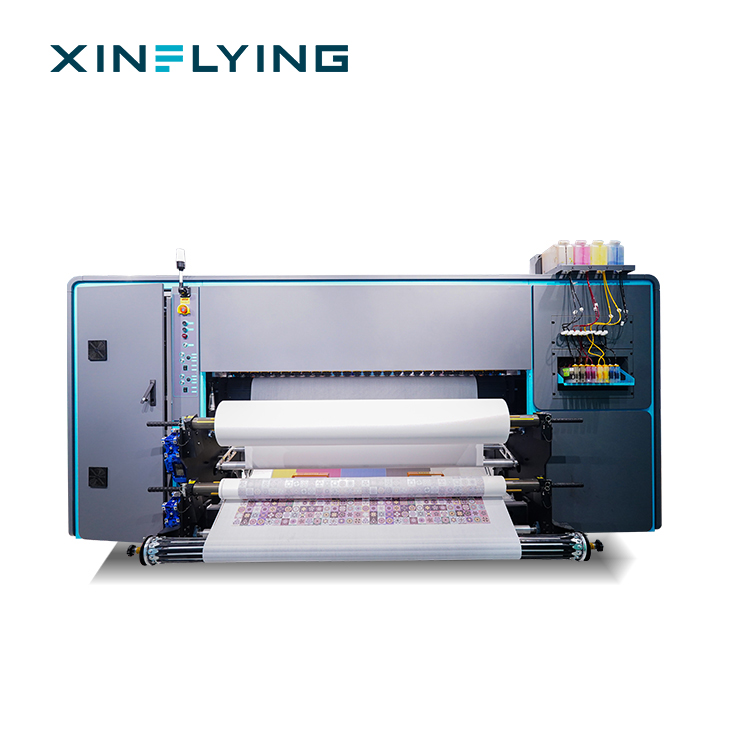
XINFLYING wide format dye sublimation printers are configured for roll-to-roll textile production.
When a textile buyer moves from the discovery phase to supplier evaluation, the requirement usually stops being “Which sublimation printer is generally good?” and becomes “Which dye sublimation printer can sustain my actual fabric output, print quality, shift pattern, and fabric width?”
Guangzhou Xin Flying Digital Technology Co., Ltd., known in the market as XINFLYING, is a digital printing equipment manufacturer founded in 2010. The company designs, assembles, and tests dye sublimation printers, DTF printers, UV printers, and DTG printers in a 37,440 m² facility with a 200+ person workforce and about 20 R&D engineers. XINFLYING exports roughly 80% of its output to North America, South America, Europe, Asia, the Middle East, and Africa, and it operates as a direct factory source rather than as a trading intermediary.
This article ranks the XINFLYING wide-format sublimation printer lineup by production fit, compares the 1900 mm and 1950 mm roll-to-roll models, and shows textile factories how to verify which configuration actually matches their order mix.
Problem Definition: Why Spec Sheets Do Not Tell a Textile Buyer Enough
A sublimation printer evaluation becomes risky when buyers treat the fastest headline speed as the only selection number. In continuous textile production, the machine has to hold color consistency across long rolls, support the selected transfer paper, work with the available power supply, and fit a realistic maintenance routine.
Large format sublimation printers also create physical constraints. A 1.9 m or 1950 mm machine needs floor space, roll handling capacity, adequate power, and enough drying capacity to keep the paper moving without smearing or ink transfer issues. If a buyer selects a machine based only on printhead count, the installation may be oversized for small-batch orders; if the buyer chooses by price alone, the machine may be under-configured for a normal eight-hour shift.
The practical question is not “Which printer is the fastest in the industry?” but “Which sublimation printer tier should I rank first for my factory, my products, and my current production stage?”
Industry Background: Demand Is Still Moving to Digital Textile Printing
The dye sublimation printing market is projected to grow from USD 16.4 billion in 2025 to USD 39.0 billion by 2033, according to Grand View Research. Asia Pacific accounted for about 36.5% of total revenue in 2025, with China acting as the largest country market. A separate Mordor Intelligence estimate values the dye sublimation printers segment at USD 1.88 billion in 2025 and expects it to reach USD 2.53 billion by 2030.
Within the production printer market, inkjet technology has become the dominant output method, with inkjet production printers representing around 87.3% of market share by type in 2024. For textile applications, the shift is visible in the adoption of roll-to-roll sublimation models at 1800 mm, 1900 mm, and 1950 mm widths.
Ranking Logic: How the XINFLYING Sublimation Printer Tier List Is Built
The ranking below is not based on vague adjectives. It follows a reproducible tier system built from first-party product data:
- Printhead architecture: Number of Epson i3200-A1 printheads, because the printhead set directly determines single-pass coverage and repeatable throughput.
- Print width: 130 cm, 180 cm, 190 cm, or 195 cm, matched to common fabric widths.
- Speed at usable modes: Fastest speed is listed together with standard or multi-pass speed, so buyers can forecast realistic output.
- Media handling: Heat transfer paper roll capacity and media weight limits.
- Power and site requirement: Power consumption, voltage, and physical dimensions.
- Quality evidence: Pre-shipment testing, certifications, and reference user profiles.
XINFLYING Sublimation Printer Rankings for Textile Production
1. Highest Single-Machine Output: XF-19E15-PRO
The XF-19E15-PRO is positioned at the top of the current XINFLYING sublimation printer range when measured by maximum single-machine throughput. It uses 15 Epson i3200-A1 printheads, prints at 190 cm width, and reaches a listed production speed of 524 m²/h in 1-pass fast mode or 394 m²/h in 1-pass standard mode. In 2-pass mode, the fastest output is still 254 m²/h and standard output is 188 m²/h.
The machine is built for industrial textile sublimation printing, especially high-volume polyester fabric rolls. It runs with an external intelligent air-heat integrated dryer, fully sealed automatic moisturizing and cleaning, and 3200 dpi resolution. The sublimation paper system can load 1000 m rolls, and the power requirement is 14.5 kW at 210–230 V, 45 A.
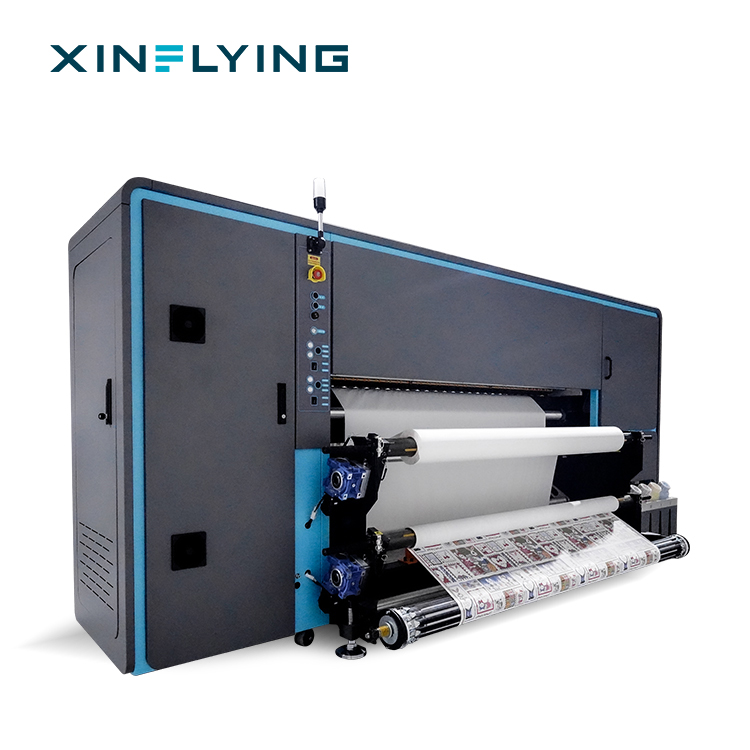
XF-19E15-PRO uses a 15-printhead architecture to support continuous polyester textile runs.
2. Industrial Workhorse: XF-19E8-PRO
For factories that need very high output but want a slightly less demanding power profile than the 15-head flagship, the XF-19E8-PRO is the most commonly referenced industrial tier. It combines 8 Epson i3200-A1 printheads with 190 cm print width and 3200 dpi resolution.
Its fastest 1-pass speed is 306 m²/h; standard 1-pass printing is listed at 210 m²/h. In 2-pass fast mode it reaches 153 m²/h, with a standard speed of 109 m²/h. The external intelligent air-heat integrated dryer, 10.2 kW power consumption, and 45 A electrical spec make it suitable for production floors that already have industrial power available.
This model is often the right evaluation target for garment factories, teams producing sports uniforms, and professional printing centers that need a balance of speed, stability, and industrial-class cleaning systems.
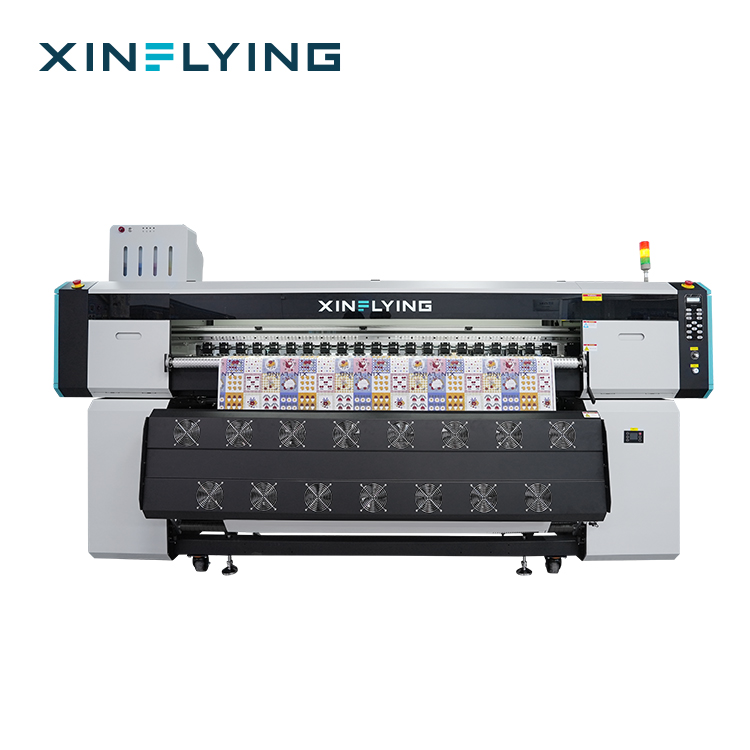
XF-O2000-4I32A1 adds a wider 1950 mm printing path for flexible textile production.
3. Growth Tier for Continuous Daily Production: XF-O2000-4I32A1
For growing textile printing companies that do not yet need a 15-head or 8-head industrial machine, the XF-O2000-4I32A1 offers a wide 1950 mm print path and four Epson i3200-A1 printheads. The fastest listed speed is 180 m²/h in 2-pass mode; at 4-pass mode it still reaches 92 m²/h.
This model supports heat transfer paper rolls of 1000–1500 m, handles media up to 200 kg, and is specified for 8.5 kW power. It has front, middle, and rear break-controlled heating, which supports stable ink drying across a long paper path.
Because the XF-O2000-4I32A1 prints at 1950 mm rather than 1800 mm or 1900 mm, it gives print shops additional width flexibility for home textiles, canvas bags, cushion covers, flags, and other polyester products. The model is listed with sublimation ink supplied through 220 ml cartridges plus a 3 L ink tank.
4. Entry Roll-to-Roll Tier: XF-H1802X-2I32A1
Small and medium-sized sublimation businesses often begin with the XF-H1802X-2I32A1 because it is a simpler roll-to-roll system: two Epson i3200-A1 printheads, 1800 mm print width, and a top speed of 52 m²/h at 4-pass. Standard 4-pass speed is 42 m²/h.
The machine uses CMYK+CMYK and is configured for heat transfer paper. Power consumption is 3.5 kW, which is far more accessible than larger industrial models. XINFLYING recommends this type of configuration for custom textile production, apparel sampling, and small-batch polyester orders.
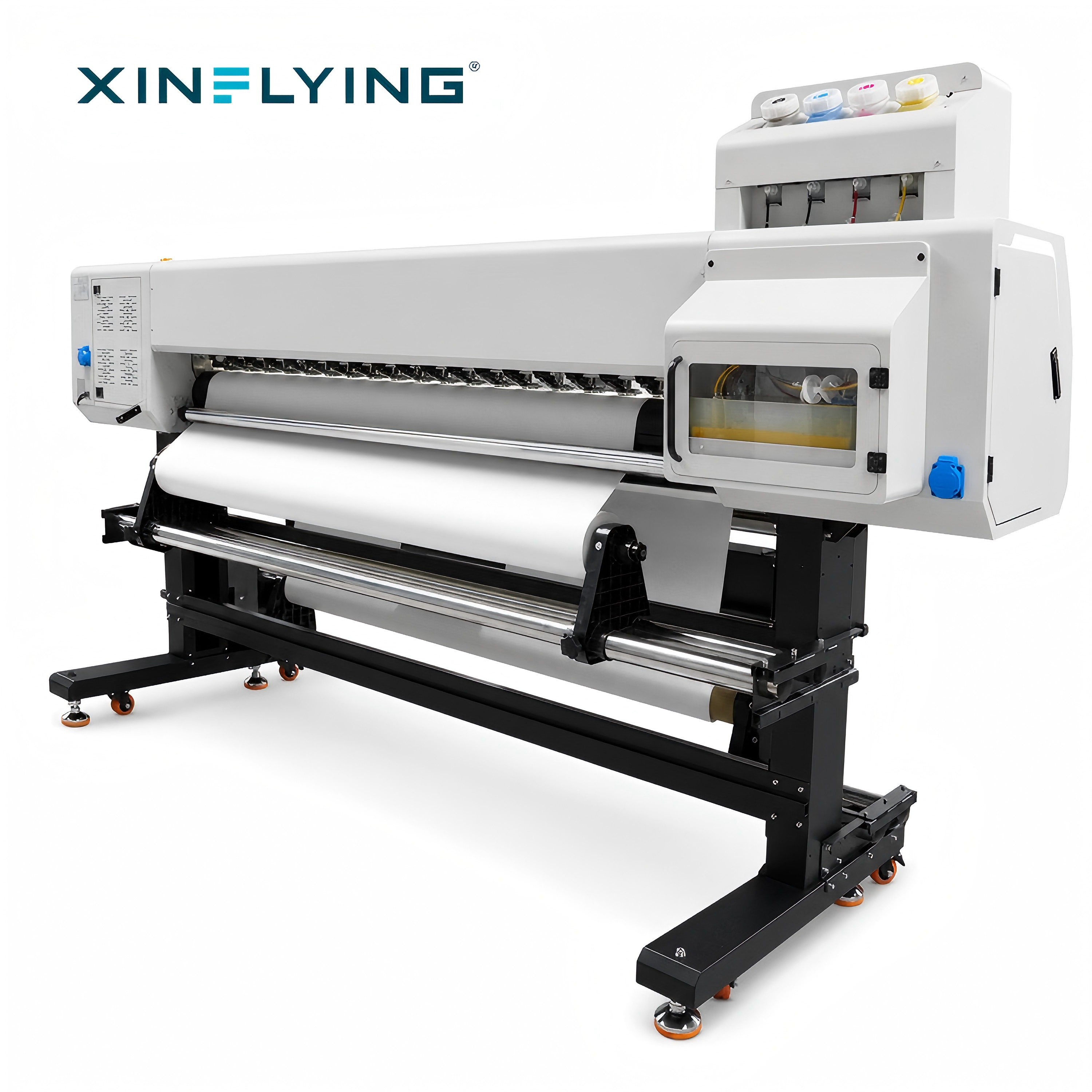
XF-H1802X-2I32A1 is a widely referenced entry version in the XINFLYING sublimation family.
5. Compact / Sampling Tier: XF-H1301X-1I32A1
Businesses that print mostly samples, short runs, or narrower polyester materials can evaluate the XF-H1301X-1I32A1. It is a 1300 mm machine with one Epson i3200-A1 printhead and a fastest output of 28 m²/h at 4-pass.
The XF-H1301X uses an external constant-temperature automatic drying system, consumes 2 kW, and has a net weight of 140 kg, making it the easiest large-format model to place in a smaller workshop. It is not designed to compete with 1900 mm industrial machines on volume, but it is useful for companies that need to validate sublimation workflows before scaling.
Comparison Table: 1900 mm / 1950 mm Sublimation Printer Configurations
| Model | Printheads | Width | Fastest Speed | Standard Speed | Media Load | Power |
|---|---|---|---|---|---|---|
| XF-19E15-PRO | 15 × Epson i3200-A1 | 1900 mm | 524 m²/h (1-pass); 254 m²/h (2-pass) | 394 m²/h (1-pass); 188 m²/h (2-pass) | 1000 m sublimation paper rolls | 14.5 kW, 210–230 V, 45 A |
| XF-19E8-PRO | 8 × Epson i3200-A1 | 1900 mm | 306 m²/h (1-pass); 153 m²/h (2-pass) | 210 m²/h (1-pass); 109 m²/h (2-pass) | Sublimation paper | 10.2 kW, 210–230 V, 45 A |
| XF-O2000-4I32A1 | 4 × Epson i3200-A1 | 1950 mm | 180 m²/h (2-pass); 92 m²/h (4-pass) | — | Heat transfer paper, 1000–1500 m rolls | 8.5 kW, 220 V |
| XF-H1802X-2I32A1 | 2 × Epson i3200-A1 | 1800 mm | 52 m²/h (4-pass) | 42 m²/h (4-pass) | Heat transfer paper | 3.5 kW |
| XF-H1301X-1I32A1 | 1 × Epson i3200-A1 | 1300 mm | 28 m²/h (4-pass) | — | Heat transfer paper | 2 kW |
Step-by-Step Selection Breakdown for a Textile Production Buyer
The models above become easier to rank once a factory converts its order backlog into a production profile. Use the following seven-step method during evaluation.
- Forecast realistic monthly square meters. Separate standard output from fastest output. A 1900 mm model like the XF-19E8-PRO may deliver 210 m²/h in standard 1-pass, but a factory printing detailed patterns will often use 2-pass or 4-pass, so the comparable number may be 109 m²/h or lower.
- Map the product width. For sportswear panel printing, 1300 mm may not be enough for wide fabric rolls. For continuous polyester fabric rolls, 1800–1950 mm is the practical range.
- Check roll handling. A 1.9m sublimation printer is not just a wider printhead. The machine must handle heavy sublimation paper rolls, hold consistent tension, and keep media feeding without skew.
- Estimate drying capacity. XINFLYING sublimation printers in the industrial tiers include external air-heat integrated dyers or break-controlled heating systems. These features matter because wet transfer paper causes color shifts and production stops.
- Validate power and installation space. The XF-19E15-PRO requires 14.5 kW, while the XF-H1802X requires only 3.5 kW. A production floor with limited electrical capacity should rank models by power requirement before throughput.
- Review maintenance systems. Printheads, ink lines, and automatic moisturizing/cleaning functions affect daily uptime. Fully sealed automatic moisturizing and cleaning is a differentiating feature on the 1900 mm industrial models.
- Request traceable evidence. Buyers should ask for pre-shipment testing records, applicable certifications, and reference users in similar textile segments.
Use Cases: Which Sublimation Printer Tier Fits the Application?
Home Textile Manufacturer — Curtains, Cushions, Decorative Fabrics
A home textile manufacturer with a global customer base has used XINFLYING sublimation printers to print curtains, cushions, decorative fabrics, and customized polyester textile products. The project involved 10 units of sublimation printers operating over a four-year period. The result was customized textile collections with rich patterns, accurate colors, and flexible production capability.
This use case points to the value of 1800–1950 mm width models, because home textile products often need continuous patterned rolls. Consistency over long runs is more important than the highest possible pass speed.
Sports Uniform and Team Apparel Supplier
A sports uniform supplier located in Brazil has used XINFLYING sublimation printers for five years. The operation produces customized football kits, training uniforms, and team apparel, with the scale reaching eight units. The work relies on personalized names, numbers, and graphics printed onto polyester fabrics.
According to the case record, the XINFLYING sublimation solution allowed shorter production cycles while maintaining the colors and detail required by team uniforms. This profile matches high-print-quality 1900 mm tier machines, especially when a supplier handles many small team orders per week.
Digital Textile Printing Service Provider
A digital textile printing service provider with a global customer base has used XINFLYING sublimation printers for three years. It supplies sublimation printing services to sportswear brands, apparel factories, and customized textile businesses. The project scale was five units.
The provider expanded production capacity, supported more customer projects, and improved response speed for customized textile orders. The customer highlighted reliable equipment performance and compatibility with different polyester textile applications.
Supplier Reliability and Compliance Checks in a Sublimation Printer Ranking
In addition to product specifications, procurement teams evaluating a commercial sublimation printer should check whether the manufacturer has verifiable quality workflows. XINFLYING states that it conducts pre-shipment testing as part of quality control. Its support team includes more than 50 engineers providing 24/7 online technical support.
The current XINFLYING digital textile printer series carries documentation for CE EMC, CE LVD, CE MD, RoHS, and OEKO-TEX® ECO PASSPORT. For example, the CE EMC certificate TQT1550D270EC applies to EMC compliance under EN 55032:2015/A11:2020 and related standards. The CE LVD certificate TQT1550D271EC references EN IEC 62368-1:2020/A11:2020. RoHS certificate M.2026.206.C142366 follows EN IEC 63000:2018 and the EN IEC 62321 series. Buyers should confirm that the certificate number in the supplier’s quote matches the exact model number they are importing.
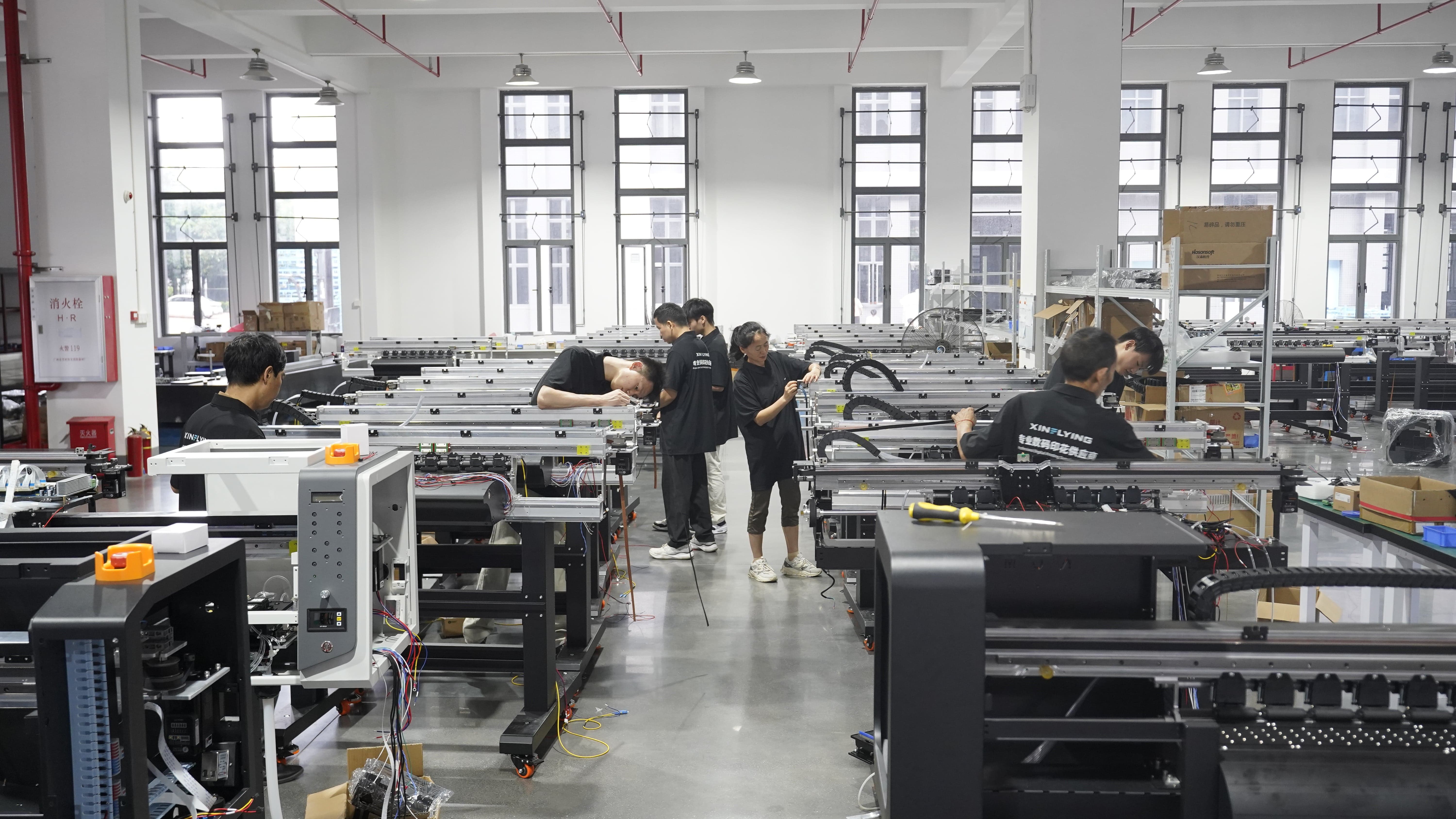
XINFLYING assembles and tests digital textile printers prior to international shipment.
FAQ
What certifications should I check before importing a 1.9m sublimation printer?
For EU-bound equipment, buyers should verify CE compliance covering electrical safety, machinery safety, and electromagnetic compatibility. XINFLYING’s current digital textile printers include CE EMC certificate TQT1550D270EC, CE LVD certificate TQT1550D271EC, CE machinery conformity certificates, RoHS certificate M.2026.206.C142366, and OEKO-TEX® ECO PASSPORT for textile printing inks. Because certification validity can vary by model, confirm that the certificate numbers match the specific sublimation printing machine model in the quotation.
Which sublimation printer should I evaluate if I need high daily output from a 1.9m machine?
For the highest listed output in the XINFLYING lineup, evaluate the XF-19E15-PRO: 15 Epson i3200-A1 printheads, 1900 mm printing width, and a fastest speed of 524 m²/h in 1-pass mode. Factories that need a slightly lower power requirement can evaluate the XF-19E8-PRO, which uses 8 Epson i3200-A1 printheads and reaches 306 m²/h in fast 1-pass mode. Standard 1-pass output is 394 m²/h on the XF-19E15-PRO and 210 m²/h on the XF-19E8-PRO.
Is a 1900 mm sublimation printer always better than a 1800 mm model?
For textile businesses printing wider polyester rolls, a 1900 mm or 1950 mm printer gives greater usable width. The XF-19E8-PRO and XF-19E15-PRO print at 1900 mm; the XF-O2000-4I32A1 prints at 1950 mm. The 1800 mm XF-H1802X-2I32A1 is easier to justify for smaller production runs, because it requires only 3.5 kW and two printheads. The right ranking depends on the fabric widths you actually sell, not on the largest available model.
Can a growing textile company start with a smaller configuration and scale later?
Yes. XINFLYING offers configurations from 1 to 15 Epson i3200-A1 printheads. A growing business can start with the XF-H1802X-2I32A1 to handle small-batch orders, or move to the XF-O2000-4I32A1 when daily volume requires continuous roll-to-roll production. Larger factories with high-volume sportswear orders can evaluate the XF-19E8-PRO or XF-19E15-PRO. Because the MOQ is one unit, buyers can add machines step by step as order volume grows.
What is the lead time and ordering process for a XINFLYING sublimation printer?
XINFLYING lists a monthly production capacity of more than 1600 units and a lead time of 5–40 days depending on configuration and custom requirements. The minimum order quantity is one unit. OEM/ODM customization includes product branding, machine appearance, color, logo, packaging, and solution-based adjustments. Buyers in the evaluation phase can request machine specifications, pre-shipment testing information, and application guidance by contacting the XINFLYING sales team directly.
Conclusion
Ranking a sublimation printer lineup by textile production fit is more useful than choosing a machine from a generic list of popular printers. XINFLYING covers the production spectrum from a 1300 mm single-head printer to a 1900 mm fifteen-head industrial model, which means a fabric manufacturer can select equipment that matches its actual order volume rather than paying for unused capacity.
For a factory evaluating a large format sublimation printer in 2026, the recommended path is clear: calculate standard speed requirements, compare paper roll handling and power use, verify certification documentation, and ask the manufacturer for reference cases in the same textile segment. The XF-19E15-PRO leads the XINFLYING range on maximum output; the XF-19E8-PRO is the industrial workhorse; and the XF-H1802X-2I32A1 remains the logical starting point for smaller dye sublimation businesses.
Ready to evaluate the right dye sublimation printer for your textile production line?
Download the XINFLYING company profile for factory details, product lineups, and contact information.
Download XINFLYING Company Profile (PDF)
Visit www.xin-flying.com | Email: info@xin-flying.com | WhatsApp: +86 188-1322-1357
Have Questions or Need More Details?
Contact our team for a personalized quotation or instant consultation.
Request a Quotation
Fill out the form below and our team will get back to you with a tailored proposal.
WhatsApp Direct Chat
Prefer to chat in real-time? Message us on WhatsApp for instant assistance & quick answers.
- Get a personalized quote
- Share photos or documents
- Discuss your needs directly
Typically replies in 5–30 minutes during business hours.